.jpg)
An uncertain origin
¶What do we know about how the fire began?
The 1871 inquiry placed the fire's start near the O'Leary barn, close to DeKoven Street, shortly before 9:30 p.m. on Sunday, 8 October. The place is in the record. The cause is not: the board could not choose between a wind-blown chimney spark and human agency.
The cow-and-lantern story is no finding of the inquiry. In October 1997, the City Council exonerated Catherine O'Leary and her cow, naming no other culprit. The exact day remains unresolved.
The inquiry leaves us with a place and an open question about cause.
Three days of fire
¶How did the fire spread through the city?
Chicago entered autumn after months with little rain. The National Weather Service reports 3.55 inches of precipitation from 7 July to 8 October, with none recorded from 29 September through 8 October. The city station was evacuated and its observations were lost; nearby readings and later analysis fill the gap.
Timeline hours remain approximate: accounts differ by tens of minutes. Wind-blown embers started new fires, spreading the blaze without one dramatic leap across the river.
-
Sunday, 8 October · about 9–9:30 p.m.
The fire begins at or near the O'Leary barn on DeKoven Street. The inquiry does not determine the cause.
-
Sunday night into Monday
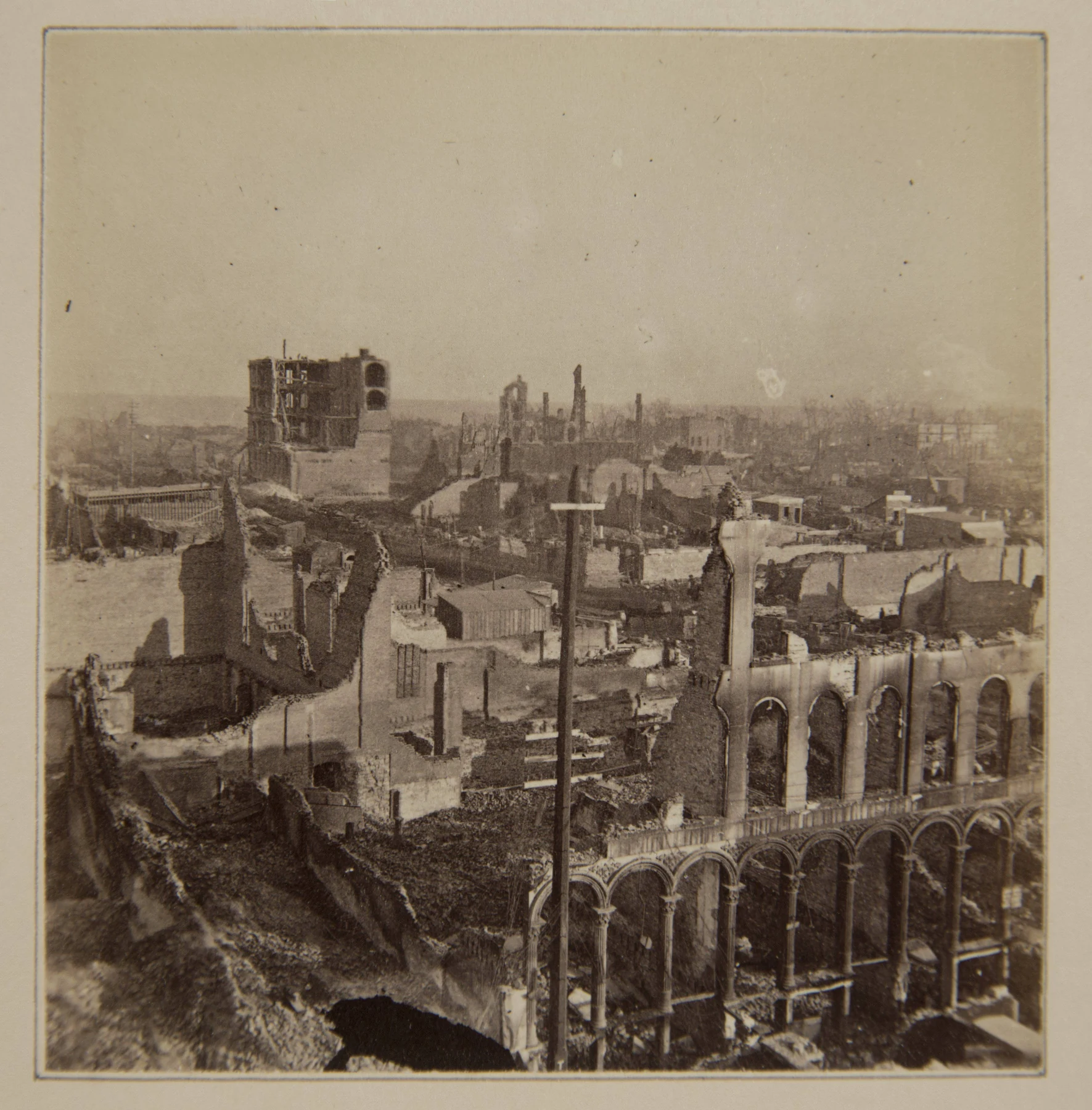
The fire reaches central districts; the courthouse burns in the early morning hours.
-
Monday, 9 October
The fire crosses the South Branch at multiple points and reaches the North Division. Wind-blown embers start new fires.
-
Monday night – Tuesday morning, 10 October
Rain late Monday helps suppression; the fire subsides by Tuesday morning, roughly 36 hours after it began.
Dated view: 1871
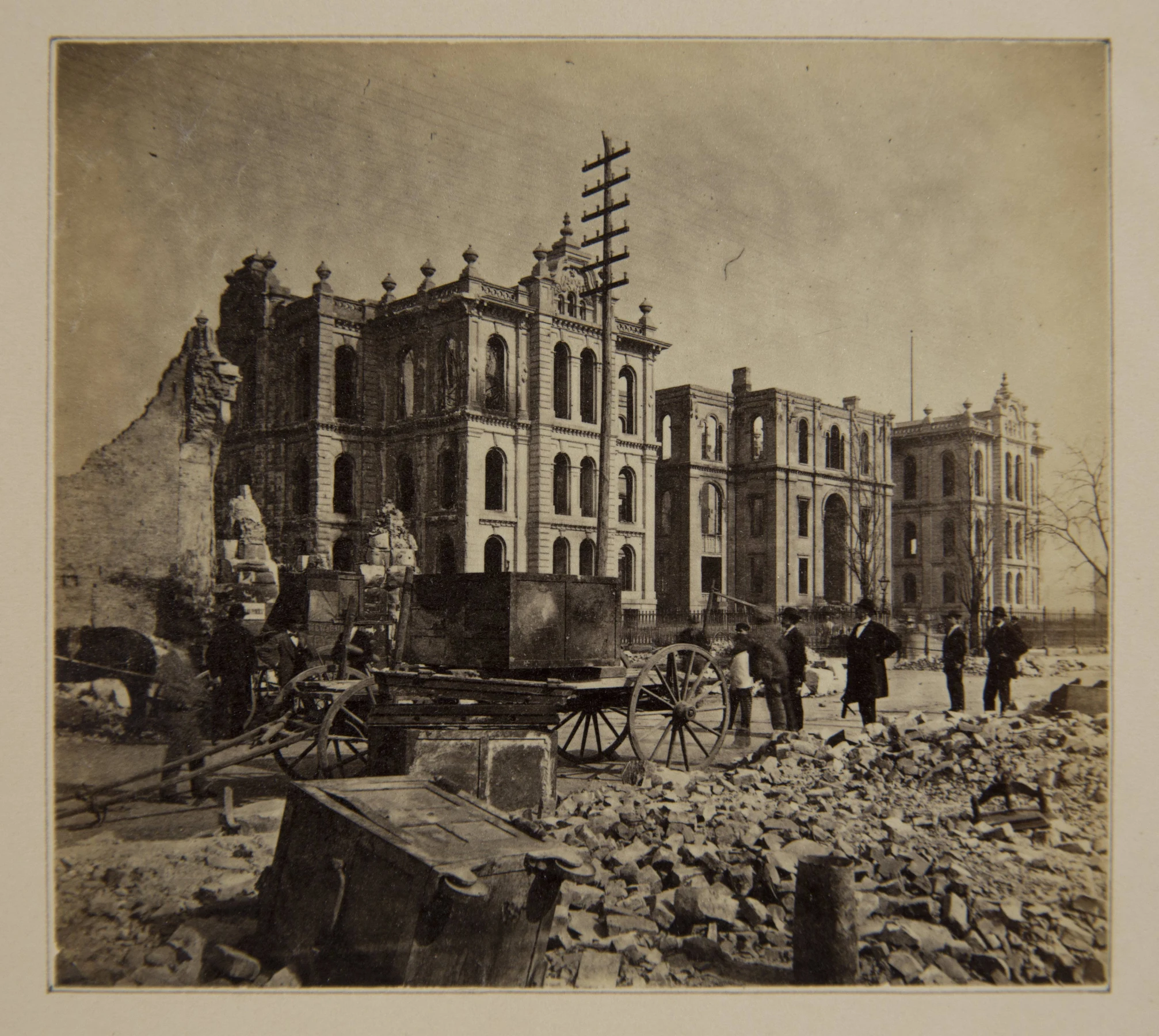
Archival image: Clark, C. R. (Charles R.), Chicago Fire of 1871, Court House (NBY 1501).jpg; 1871. Public domain. Archive record: Newberry: Chicago courthouse photograph record.
.jpg)
Rain late Monday helped suppression; the National Weather Service places the fire's subsidence by Tuesday morning. What can a tally settle when the death count cannot?
Loss and relief
¶How large were the losses?
Three counts sit side by side: about 200 deaths in the commissioners' estimate, 117 bodies recovered by the coroner at the time, and 250–300 in later accounts. There is no reliable final death count.
Other losses also come as nearby, but not identical, estimates: about 17,000–18,000 buildings, roughly 2,100–2,150 acres burned and about 100,000 people left homeless. The reconstructed boundary and totals vary by source.
The Chicago Relief and Aid Society predated the fire. The mayor tasked it with organizing aid. The society distributed food, fuel, clothing and other goods. A count of families helped remains separate from a count of people.
Dated view: 1871
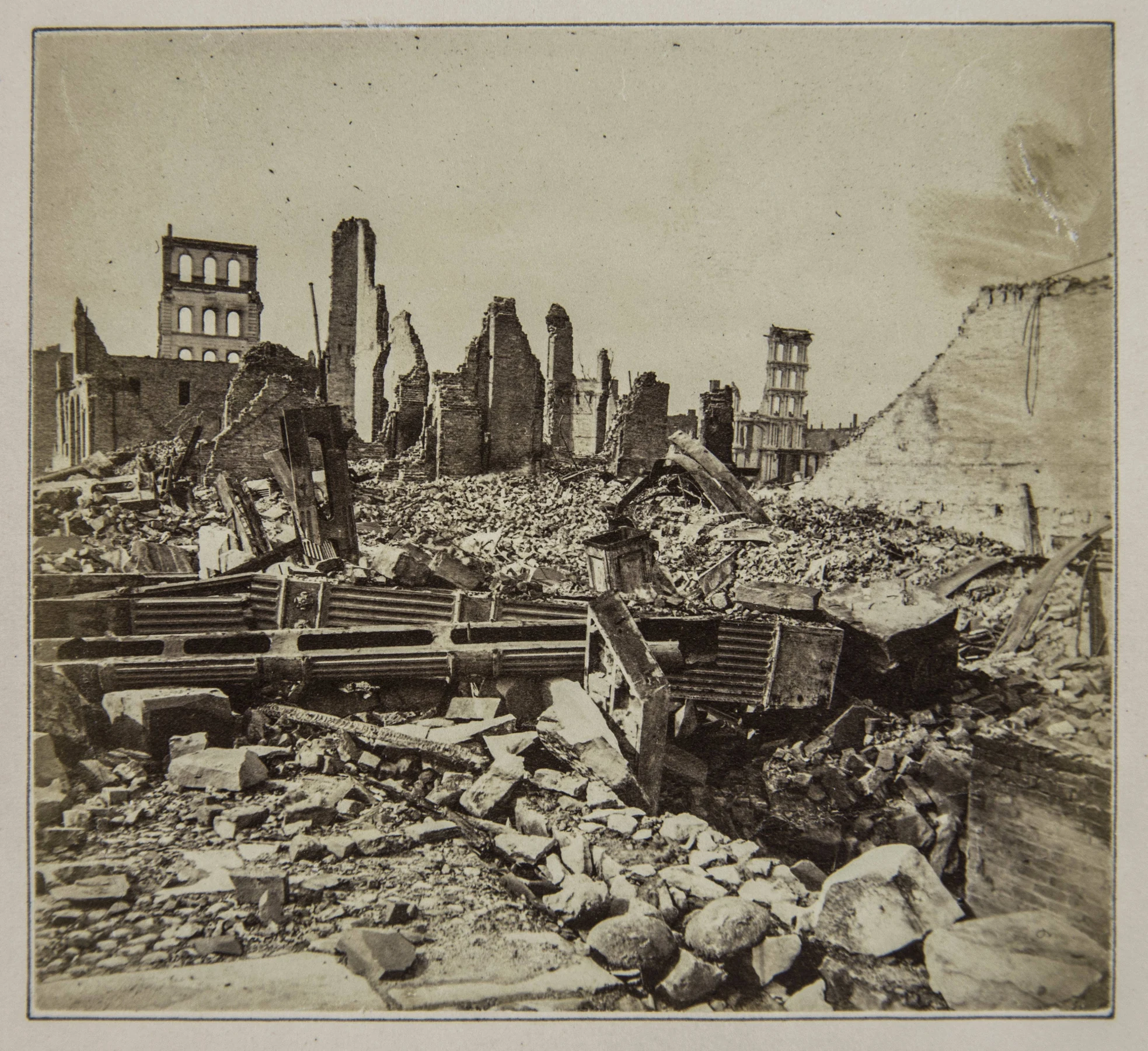
Archival image: Clark, C. R. (Charles R.), Chicago Fire of 1871, Ruins of Palmer House (NBY 1447).jpg; 1871. Public domain. Archive record: Chicago History Museum: Palmer House.
.jpg)
The figures sketch the scale of loss; their gaps tell us what the records cannot settle.
Rules and streets
¶How did the city's rules change?
In February 1872, the city required incombustible materials within a defined central district. The rules' line on a map is not the fire's outline: the district did not cover all of Chicago, and the rule did not make every building fireproof.
The street grid stayed the city's framework, though some routes changed and land was filled along the lakefront. Historic maps support that broad continuity; they do not give a precise modern line for the burned area's perimeter.
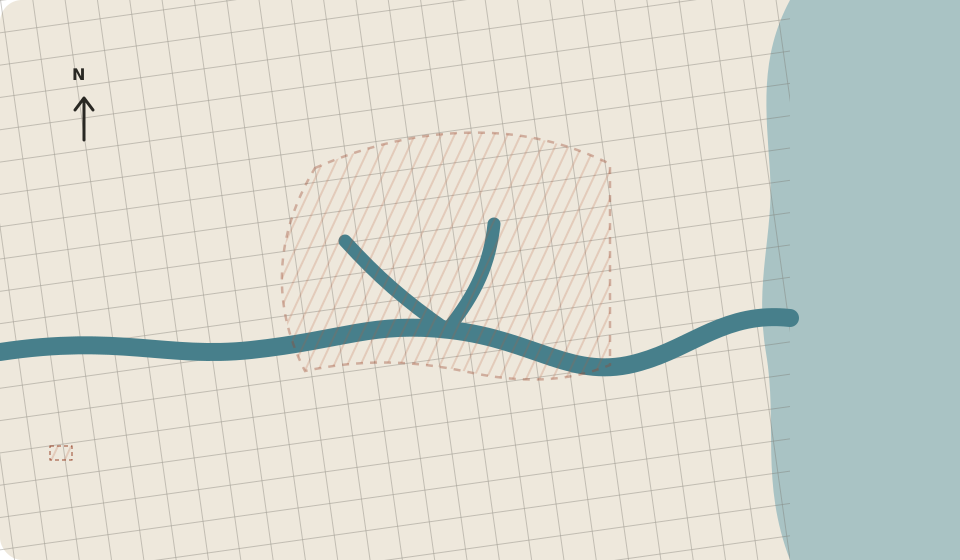
The diagram shows the grid, river and shore together. Its hatched area is illustrative, not a measured boundary. What rises on those streets next?
A taller city
¶Who built the city's new skyline?
Potter Palmer rebuilt his hotel on State Street at Quincy after losing the first building, opened in September 1870. The new Palmer House opened on 8 November 1873; that address clears up the frequent Michigan Avenue confusion.
The Home Insurance Building rose in 1884–85. Its metal frame is why it is often called the first skyscraper, though definitions differ. The fire does not explain the height alone; materials, investment and regulation worked together.
Across three censuses, the city's population rose from 298,977 in 1870 to 503,185 in 1880, then 1,099,850 in 1890. The last figure includes the effect of the 1889 annexation; the jump does not measure post-fire growth alone.
Population in the federal census
The 1890 count includes the effect of the 1889 annexation; the jump does not measure post-fire city growth alone.
The city's rise was more than a taller skyline. What did Chicago choose to show in 1893?
The 1893 exposition
¶What could the city show in 1893?
The World's Columbian Exposition opened in Jackson Park in 1893, twenty-two years after the fire. Over 179 open days, contemporary records add up to 27,529,400 admissions, including passes and repeat entries; about 21.48 million were paid. The total does not count unique people.
The Court of Honor and Ferris wheel put the city's civic ambition on display. Many exposition buildings were temporary. The fair became a symbol of recovery, not evidence that every rebuilding project had ended.
That same night in Wisconsin, the Peshtigo fire killed far more people than Chicago's. Its toll remains uncertain: records were destroyed, and estimates differ.
Dated view: 1893
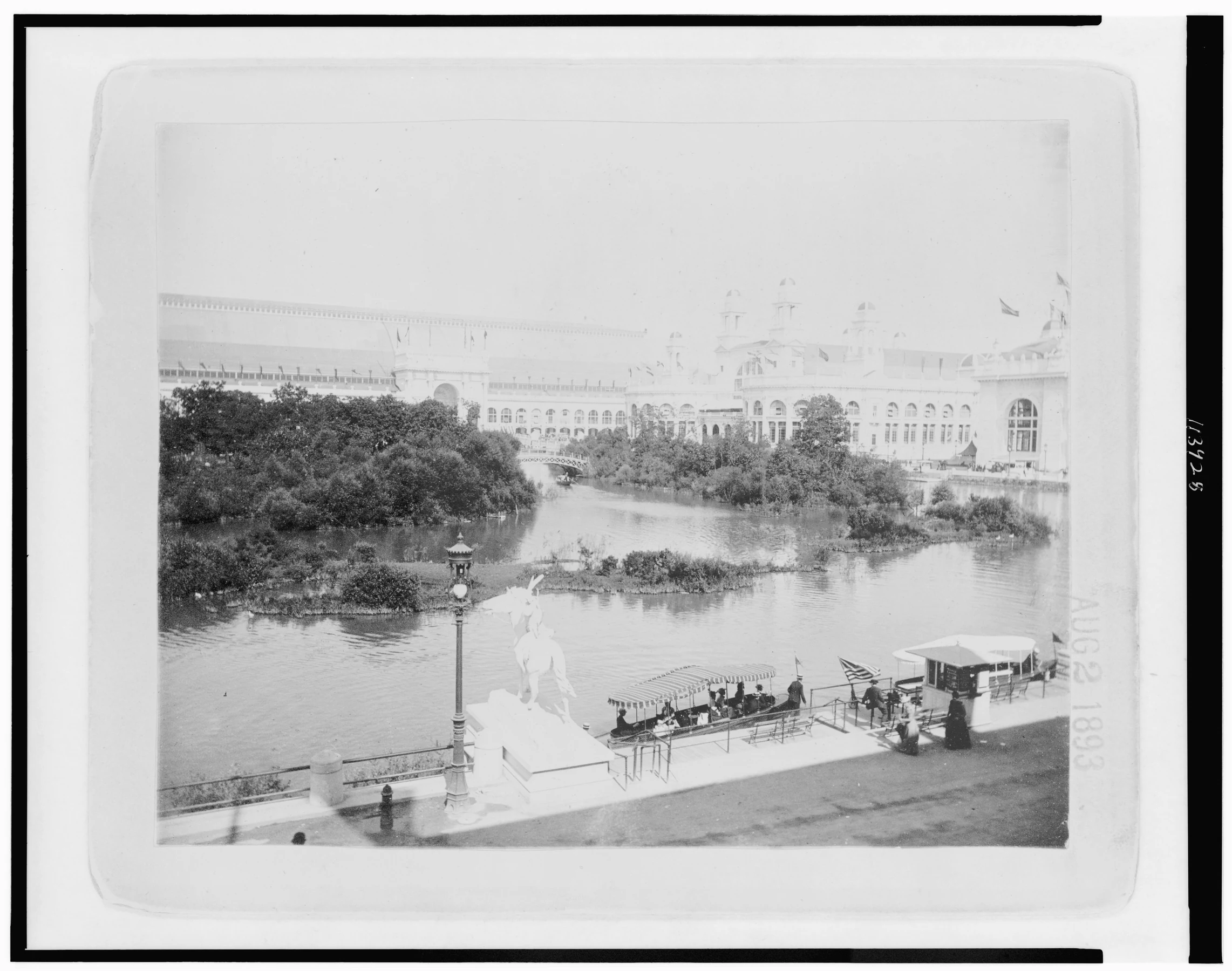
Archival image: Miscellaneous Items in High Demand, PPOC, Library of Congress, Lagoon looking east from Transportation Building LCCN95506984.jpg; 1893. Public domain. Archive record: Library of Congress: World's Columbian Exposition album.

Dated view: 1893
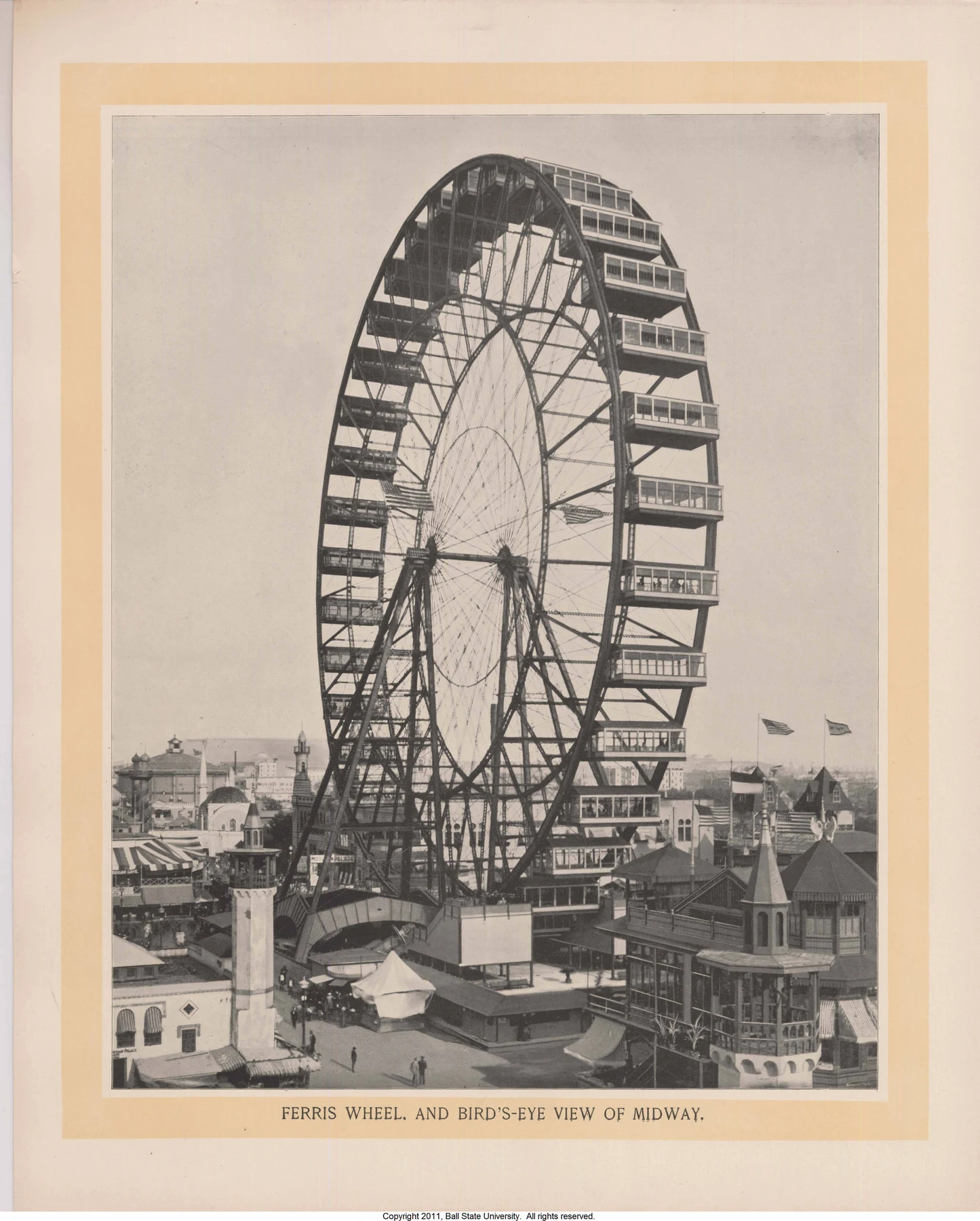
Archival image: William Henry Jackson, Ferris Wheel, and Bird's-Eye View of Midway, William Henry Jackson, 1893.jpg; 1893. Public domain. Archive record: Library of Congress: the 1893 Ferris Wheel.

The exposition left Chicago an image of recovery. What still falls outside the frame?