Iosif Ivanovici · from score to record · 63 labels
Waves of the Danube on 63 records: Ivanovici’s name stayed on the waltz and fell off most ‘Anniversary Song’ labels
The waltz a Romanian army bandmaster wrote in 1880 was printed in Bucharest, Paris, Leipzig, Warsaw and Philadelphia, and sold on records under titles in at least ten languages. On labels of the waltz his name appears on 39 of the 46 issues. When the tune became “Anniversary Song” in 1946, eight of the 13 labels kept only Jolson and Chaplin, or no name at all. Drop the needle and see.
What 63 issues of 78 rpm records photographed by the Internet Archive and the US Library of Congress actually print, read one by one. The sample is small and depends on what has been digitised.
Composer on the label
Drag the arm or tap the disc to drop the needle: the edge is the start, the label is the end. Arrow keys move the needle by 5 seconds, Space plays and pauses, Page Up and Page Down change the disc.
What the label says
39 of 46, then 5 of 13
The Internet Archive keeps label photographs for tens of thousands of 78 rpm records, and the US Library of Congress has put part of its Victor and Columbia holdings online. Searching for the waltz’s titles in several languages and for the composer’s name turned up 93 catalogue entries for records carrying Ivanovici’s tune. 76 have legible labels. Copies of the same issue count once, which leaves 63 issues, with dates from 1909 to 1951.
When a record carries the waltz’s own title (Danube Waves, Donauwellen, Na falach Dunaju, Dunojaus vilnys), the composer is printed on 39 of the 46 issues. The Standard disc spells him “Ivanovicci”, and Fred Freed’s disc appears to read “Ivanivici” under a scratch. The seven labels without a composer are Climax K439, Little Marvel 1065B, Zonophone X-49118, Zonophone–The Twin T-5226, an EMI barrel-organ disc, an Allan Herschell record for a carousel band organ and an unbranded pressing, No. 51.
named correctlynamed with othersmisspelledJolson and Chaplin onlyno writer credited
Climax K439 and Columbia A-1477 are the same recording: the same accordionist, Pietro Deiro, the same matrix, 21732. The Columbia label says “(Ivanovici)”. The Climax label names neither the composer nor the player. Put them on the turntable one after the other: both play the same digital transfer, made from the Columbia disc.
In 1946 the film “The Jolson Story” put new words to the 1880 theme. The sheet music printed in New York that year says “Based on a theme by Ivanovici”. On records the credit often fell away: of the 13 “Anniversary Song” issues in the sample, 7 name only Jolson and Chaplin, and the Seeburg label names no writer at all. Five keep him: Musicraft and Etna alongside the others, De Luxe and Dany Roy’s record on his own, and the Danish Tono version refers to his waltz, “Donauwellen”.
The other versions with a new title behaved differently. The Polish “Ty, tylko ty” and the Italian “Valzer sentimentale”, both pressed in New York, the Danish “Bryllupsvalsen” and the French “Le Bal du passé” all four name him, even if two misspell him, “Ivanovicci” and “Ivancvici”.
Today’s catalogue records make mistakes too. Four Internet Archive entries spell him “Ivanson”, “Ivacnovici”, “K. Ivanovici” and “Ivanovich”, while the labels photographed next to them are correct. Many labels use the initial “J.”: the first name Josef is documented elsewhere.
How the count was made
The records are those in the Internet Archive’s 78 rpm collections, including the Library of Congress mirrors, found on 25 November 2026 by title (Danube Waves, Donauwellen, Flots du Danube, Onde del Danubio, Na falach Dunaju, Anniversary Song and others) or by the composer’s name. Each label was read from its photograph: what counts is what is printed, not what the catalogue says. 14 entries without a usable label image, one instantaneous-recording disc with a handwritten title and two discs whose link to the waltz is unconfirmed were left out. An issue means the same label family and catalogue number. Three Edison discs among them played at about 80 rpm. The search misses Cyrillic, Japanese and Romanian titles. A year, from the catalogue or the label, exists for only 29 issues, and some of those dates are recording dates. The shares describe this sample, not everything ever pressed. For comparison, the American discography DAHR listed 28 matrices of the waltz in its 2021 list.
1880 and 1946
The same theme, another name on the record
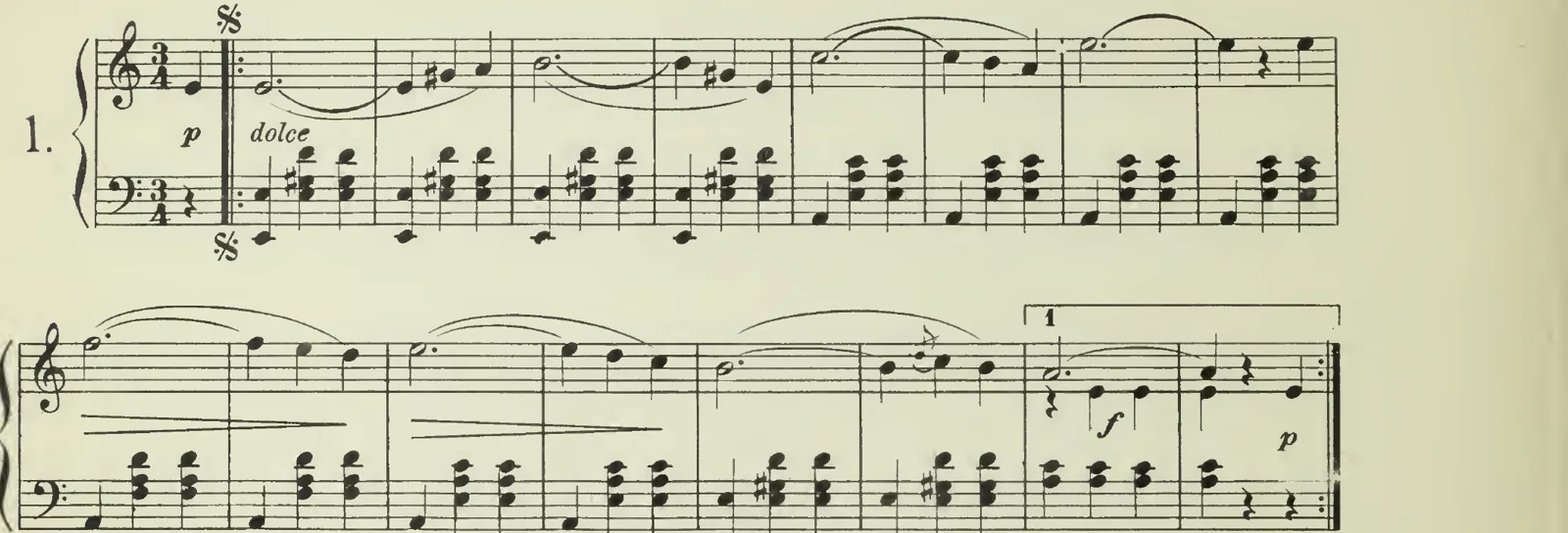
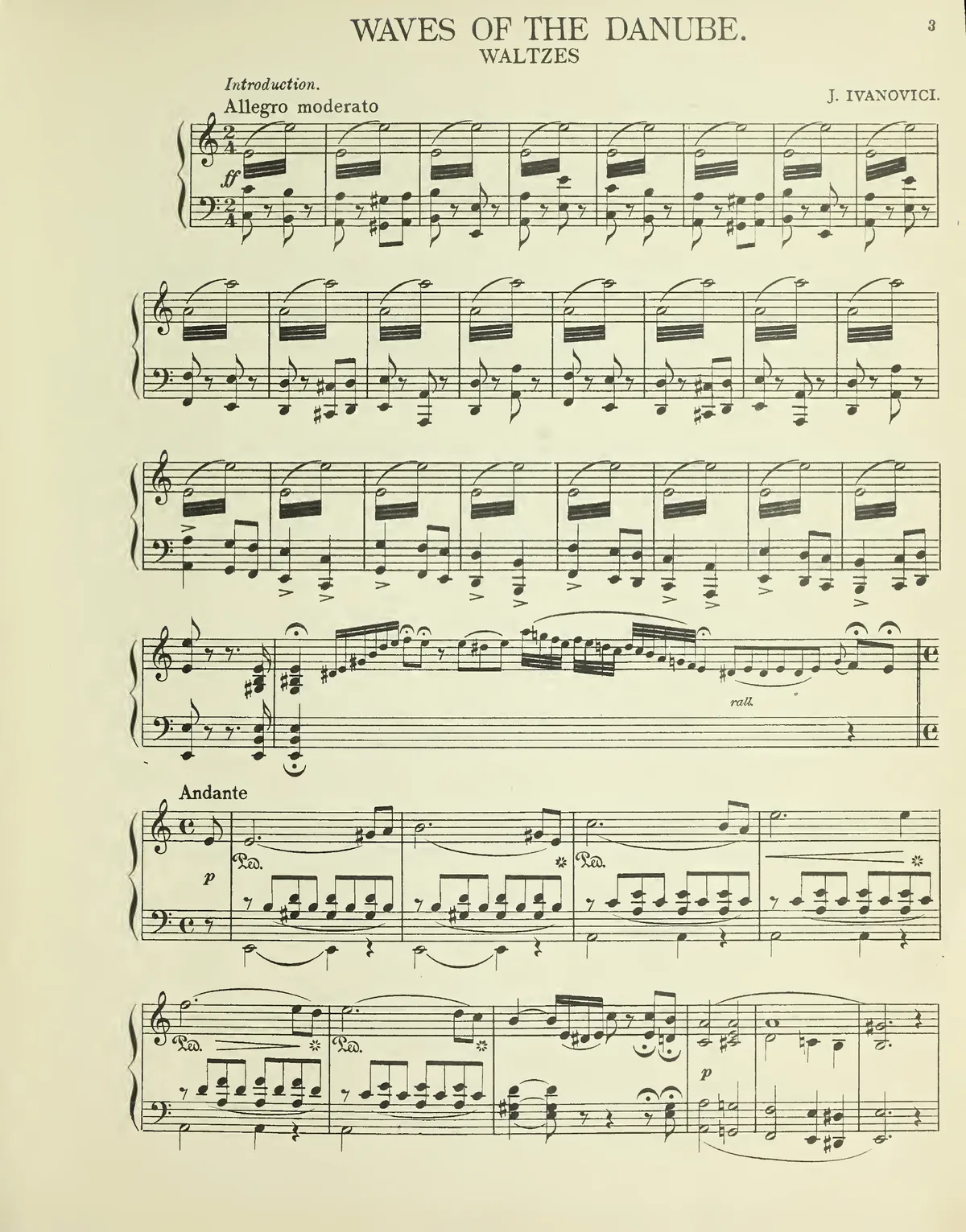
The theme everybody knows is the first waltz of the set, in A minor, marked “dolce”. The 1902 Philadelphia edition prints it as shown. The button beside it plays it on a piano generated by the page, with its repeat and a simplified accompaniment.
Al Jolson and Saul Chaplin set words to it for “The Jolson Story”, which premiered in New York on 10 October 1946 and went on general release in January 1947, according to AFI. The sheet music Mood Music published that year names the two of them as writers and adds “Based on a theme by Ivanovici”.
In its issue of 12 April 1947, Billboard put the song at the top of its Honor Roll of Hits, listing 13 commercial records, and credited it to Jolson and Chaplin. Jolson’s own record climbed to No. 2 on the retail chart.
The tune had carried new words before. In 1926 the Korean singer Yun Sim-deok recorded “사의 찬미” (“In Praise of Death”) in Japan, her own lyrics on Ivanovici’s waltz. In Japan, Polydor 1324-A, a separate version with Japanese words, calls it “ドナウ河の漣” and credits the music to “イヴァノヴィチ”. No source found shows a lawsuit or a payment to Ivanovici’s heirs over “Anniversary Song”.
The score
From the Gebauer score to the Berliner disc
The first edition is Constantin Gebauer’s, in Bucharest. The bibliographer James Fuld dates the edition to 1880, titled “Valurile Dunării” and dedicated to Emma Gebauer, the publisher’s wife. A Gebauer cover reproduced by Mirela Lungu also carries the French title “Vagues du Danube”. A legal report from 1898, however, puts the Bucharest publication at “around 1885”, so the year remains disputed.
The report, published in the journal Le Droit d’Auteur, says Ivanovici, with his publisher’s agreement, assigned the rights for France and Belgium to the Paris publisher Colombier, who used them from 1886. Colombier’s widow transferred the business to Émile Gallet by notarial deed. A Leipzig publisher, Ruhle, printed the waltz in a cheap series, and copies were sold in Belgium through the distributor Frey in Antwerp. Gallet sued them both.
The defendants argued that Romania was outside the Berne Union, so the waltz could be copied freely. The Antwerp court rejected that argument for Belgium on 24 May 1898.
M. Ivanovici est l’auteur de la valse « Les flots du Danube ». (Mr Ivanovici is the author of the waltz.)
Le Droit d’Auteur, September 1898, p. 103
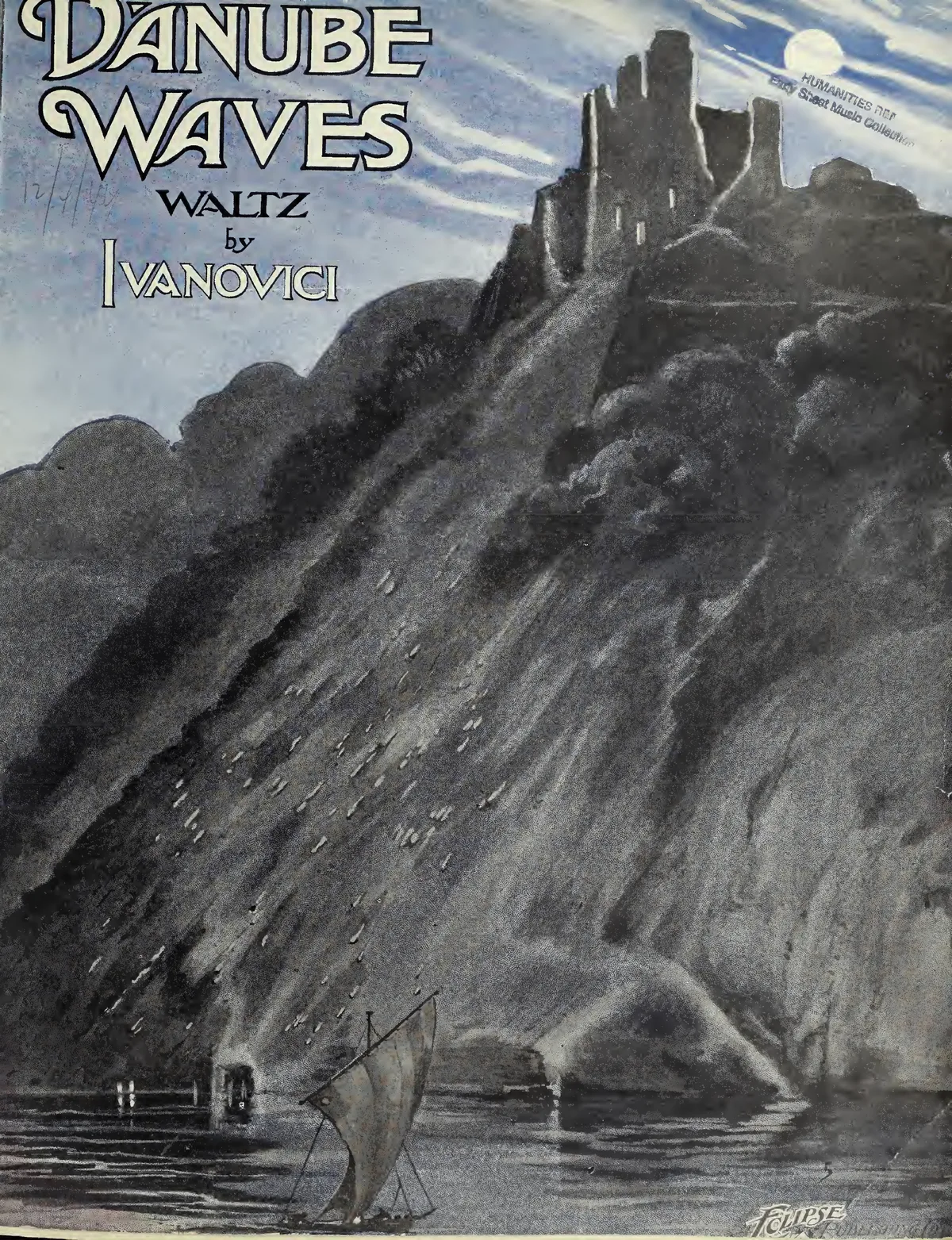
By then the waltz was everywhere. In August 1887 the Hofmeister monthly listed three piano editions, from Schlesinger (1.50 marks), Eulenburg and Hug (1.25 each). A Hug copy kept in Madrid carries three titles at the head of the score. In Warsaw, the Hösick edition bears an 1887 censor’s date. In Philadelphia, Eclipse issued it in 1902 with the composer’s name large on the cover.
One of the earliest documented recordings is a 17-centimetre Berliner disc, “Flots du Danube”, played by the band of the Garde républicaine in Paris in the summer of 1899. In the American discography DAHR, the earliest recordings of the waltz date from 1902.
The titles it travelled under
- Valurile DunăriiRomanian · Gebauer edition, Bucharest
- Vagues du DanubeFrench · also on the Gebauer cover
- DonauwellenGerman · Leipzig, Berlin, Zurich
- Les Flots du DanubeFrench · title used in the 1898 legal report
- Waves of the DanubeEnglish · Philadelphia, 1902
- Danube WavesEnglish · on Victor, Columbia and other labels
- Na falach DunajuPolish · Hösick score with an 1887 censor’s date; Vocalion and Harmonia labels
- Le onde del DanubioItalian · Cetra
- Ondas del DanubioSpanish · Brunswick, Mexico, 1931
- Dunojaus vilnysLithuanian · Victor, 1919
- Dunári keringöHungarian, as printed on Victor 72485-A
- Dunajské vlnkyCzech · Ultraphon
- DonaubølgerDanish · Gramophone, HMV, Tono
- Vågorna å DonauSwedish · listed for Victor matrix B-23270, recorded 1919
- Donaugolven walsDutch · listed for Victor matrix B-23270, recorded 1919
- Dunavski valoviCroatian · listed for Victor matrix B-23270, recorded 1919
- Tonavan aallotFinnish · 1936 record
- Дунайские волныRussian · Soviet scores, 1956 and 1961
- ドナウ河の漣Japanese · Polydor disc, music “イヴァノヴィチ”
- 多瑙河之波Chinese · sheet music
- Anniversary SongEnglish · a new song, Hollywood, 1946
- 사의 찬미Korean · a new song, 1926
The man
The bandmaster from Galați
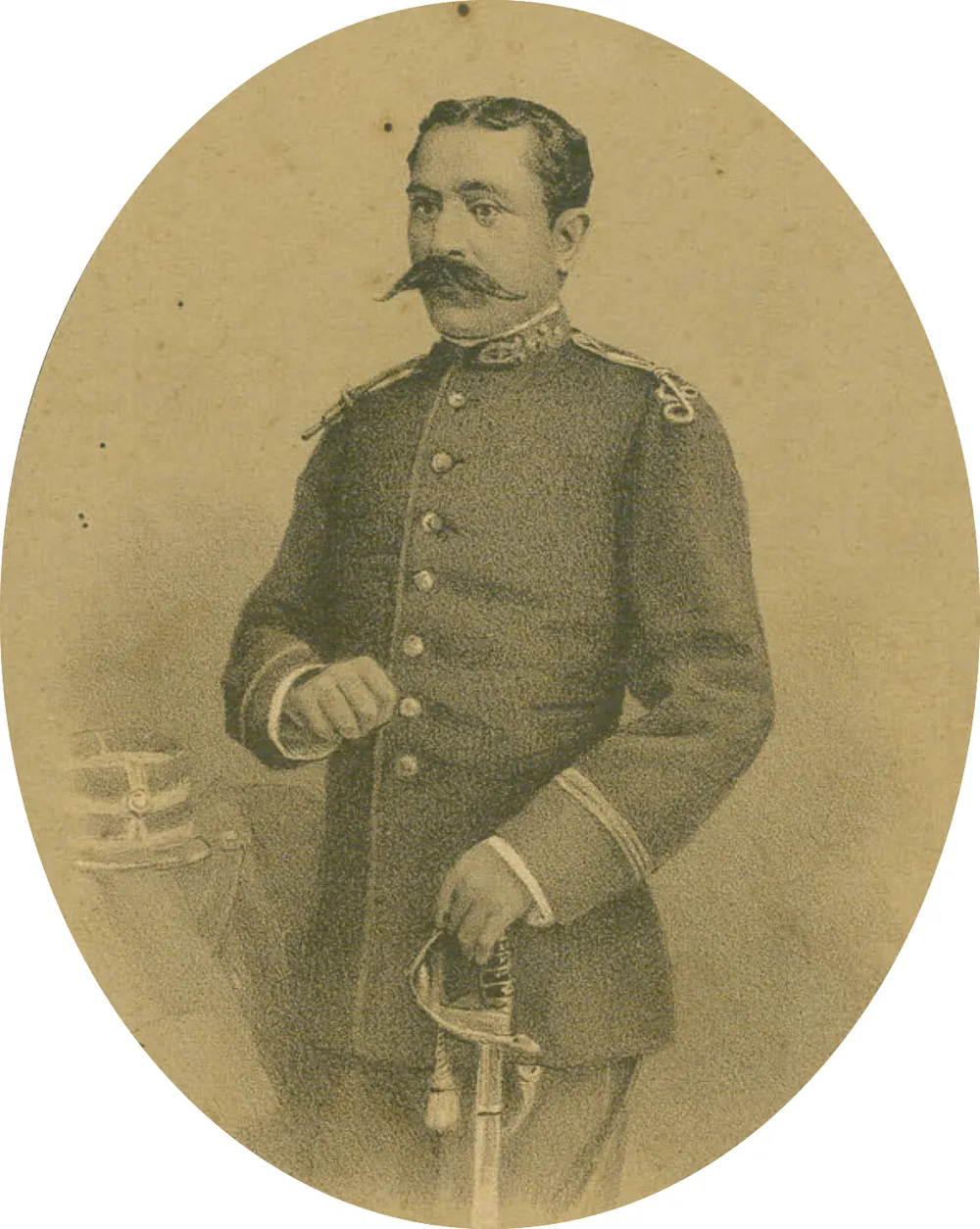
The Timiș archives, cited by the V. A. Urechia Library in Galați, give his birth as 28 January 1845 in the Fabric district of Timișoara, christened Ioan, son of Axinte and Persida. An army certificate calls him Ion. Other sources give 1844 or 1848. Biographies speak of Serbian origins, but no document found settles it.
In Galați, a Romanian port on the Danube, he led the band of the National Guard and those of the 6th Line and 11th Siret regiments. In Iași, between 1874 and 1879, he was sergeant major in the band of the 2nd Roșiori (cavalry) Regiment and studied with Emil Lehr. He became a Romanian citizen in 1895, the year a royal decree made him inspector general of military bands.
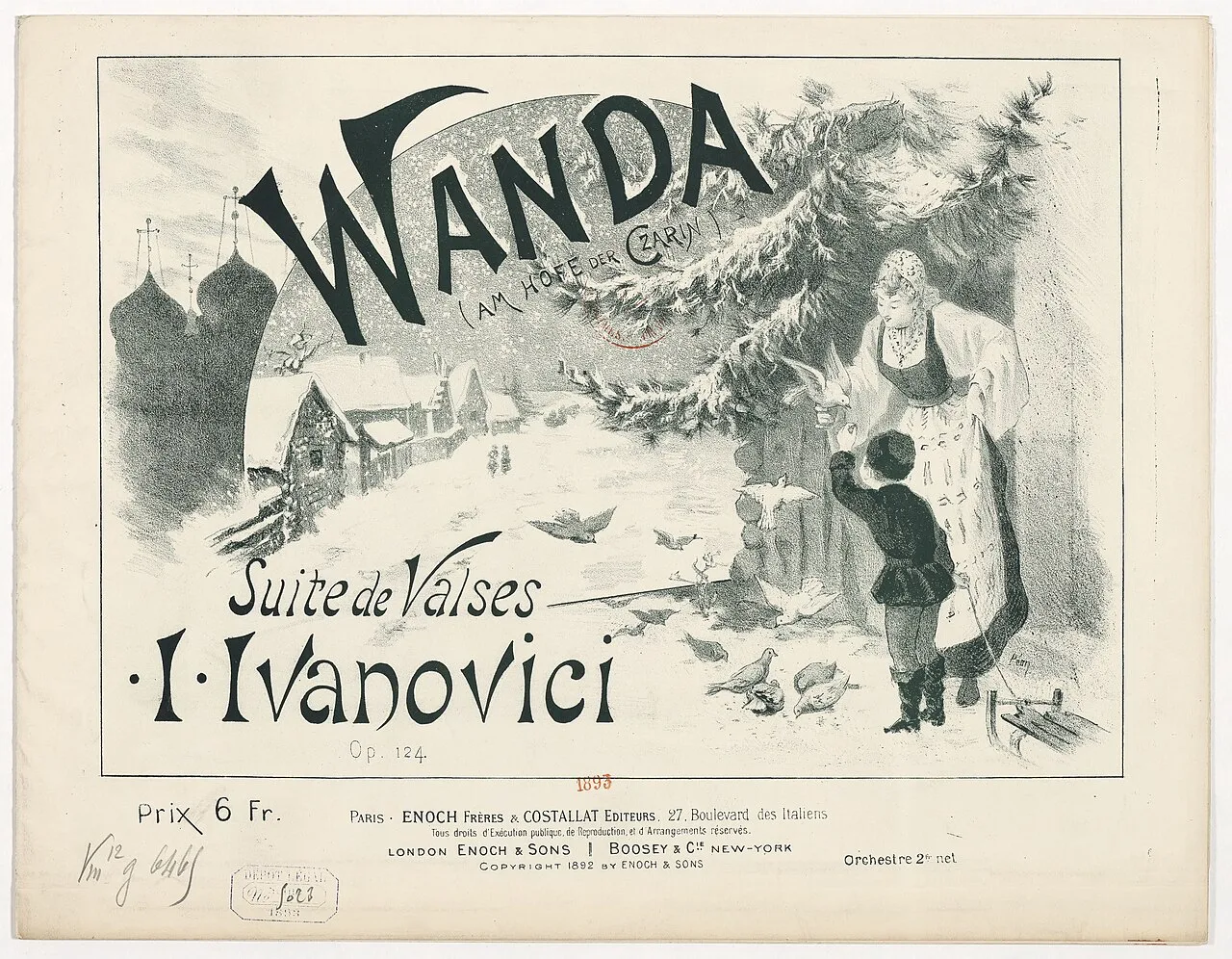
He died in Bucharest on 16 September 1902 in the Old Style calendar, 29 September in the New, aged 57, according to the family’s notice in the newspaper Adevărul. Other sources give 28 September. He wrote other waltzes too, such as “Rumänisches Liebesleben”, printed in Leipzig with his portrait on the cover, and “Wanda”, printed in Paris.
What could not be proved
Five stories about the waltz
The waltz has gathered more myth than paperwork. Here is what the documents found actually say.
The Paris prize, 1889
The V. A. Urechia Library in Galați attributes the 1889 prize to a march and reports 116 entrants. Other accounts speak of the waltz. The jury’s result has not been found.
The Titanic’s last tune
No testimony found names the waltz. The surviving wireless operator Harold Bride recalled a tune called “Autumn”. What was played last remains uncertain.
Sold for a pittance
The story that the rights were sold for a small sum has no document behind it. The one record found, the 1898 report, says who received the rights for France and Belgium, but not for how much.
The fair’s anthem, scored by Waldteufel
The Daniels catalogue credits Émile Waldteufel with an orchestration of the waltz. Its reported status as the fair’s official anthem remains unconfirmed.
Jolson’s mother’s tune
The story that Al Jolson learned the tune from his mother is treated as legend even by the society named after him.
The name
What stayed on the label
In this sample, Ivanovici’s name is missing from 7 of the 46 issues that carry the waltz’s own title. On “Anniversary Song”, the Hollywood song, it is missing from 8 of 13. And today’s digital records sometimes misspell it even where the label is correct.
Timișoara made him an honorary citizen posthumously in 2019. His great-grandson, the pianist Andrei Ivanovici, accepted the award, 117 years after the composer’s death.
Sources
Each disc on the turntable links to its Internet Archive entry. The statements in the text come from the sources below.
- Internet Archive, 78 rpm collections (Great 78 Project and National Jukebox mirrors): records and photographs of the 63 issues, linked from each disc on the page. archive.org
- Library of Congress, National Jukebox: Victor B-23270 (Lager and Olson, 22 September 1919), eight titles; Columbia 21732 (Pietro Deiro); Victor C-6897 (1909); Victor B-23211 (1919). www.loc.gov
- “Waves of the Danube”, Eclipse Publishing Co., Philadelphia, 1902, piano score. archive.org
- Le Droit d’Auteur, September 1898, pp. 103–104: Colombier, Gallet, Ruhle, Frey and the Antwerp court, 24 May 1898. tind.wipo.int
- Hofmeister, Monatsbericht, August 1887, p. 349: the Schlesinger, Eulenburg and Hug editions. hofmeister-os.kdl.kcl.ac.uk
- James J. Fuld, The Book of World-Famous Music, 3rd ed., 1985, pp. 622–623: the Gebauer edition, Bucharest, 1880. www.worldradiohistory.com
- Mirela Lungu on Iosif Ivanovici, Artes (Iași): army certificate, the obituary in Adevărul, the Gebauer cover. artes-iasi.ro
- V. A. Urechia Library, Galați: Iosif Ivanovici entry (baptism, bands, citizenship, inspectorship). www.bvau.ro
- Sibley Music Library, Eastman: “Anniversary Song”, Mood Music Co., 1946, “Based on a theme by Ivanovici”. www.esm.rochester.edu
- Billboard, 12 April 1947 (Honor Roll of Hits) and 19 April 1947. www.worldradiohistory.com
- AFI Catalog: The Jolson Story (1946). catalog.afi.com
- Phonobase: Berliner 30091, “Flots du Danube”, Garde républicaine, July 1899. www.old.phonobase.org
- Discography of American Historical Recordings: Ivanovici, Iosif (list archived in 2021). web.archive.org
- Academy of Korean Studies: “사의 찬미”, Yun Sim-deok, 1926. encykorea.aks.ac.kr
- Showakan: Polydor 1324-A, “ドナウ河の漣”. search.showakan.go.jp
- Agerpres, 27 November 2019: Ivanovici made an honorary citizen of Timișoara posthumously. agerpres.ro
Images and sound
- Cover and page 4 of “Waves of the Danube”, Eclipse Publishing Co., Philadelphia, catalogued as 1902. Harold B. Lee Library, Brigham Young University, via the Internet Archive. Public domain.
- “Wanda”, a waltz suite by I. Ivanovici, Enoch frères et Costallat, Paris; catalogued 1893, copyright 1892. Bibliothèque nationale de France, via Wikimedia Commons. Public domain.
- Ivanovici’s portrait from an undated edition of “Rumänisches Liebesleben”, Carl Rühle, Leipzig; Hofmeister lists the piano edition in October 1889. IMSLP, via Wikimedia Commons. Public domain.
- Label photographs and the 1909–1923 recordings: Internet Archive (Great 78 Project) and the US Library of Congress (National Jukebox). The recordings play because they were published before 1926: in the US, sound recordings first published by the end of 1925 were in the public domain by 1 January 2026, and all are over 70 years old.
- Where the turntable shows a redrawn label, the wording is from the disc and the layout and colours are approximate.