Bucharest 1857 · Tierra del Fuego 1886 · Buenos Aires 1893
Julius Popper
Carmen Sylva, Sinaia and Filaret on the map of Tierra del Fuego, and the people who already lived there
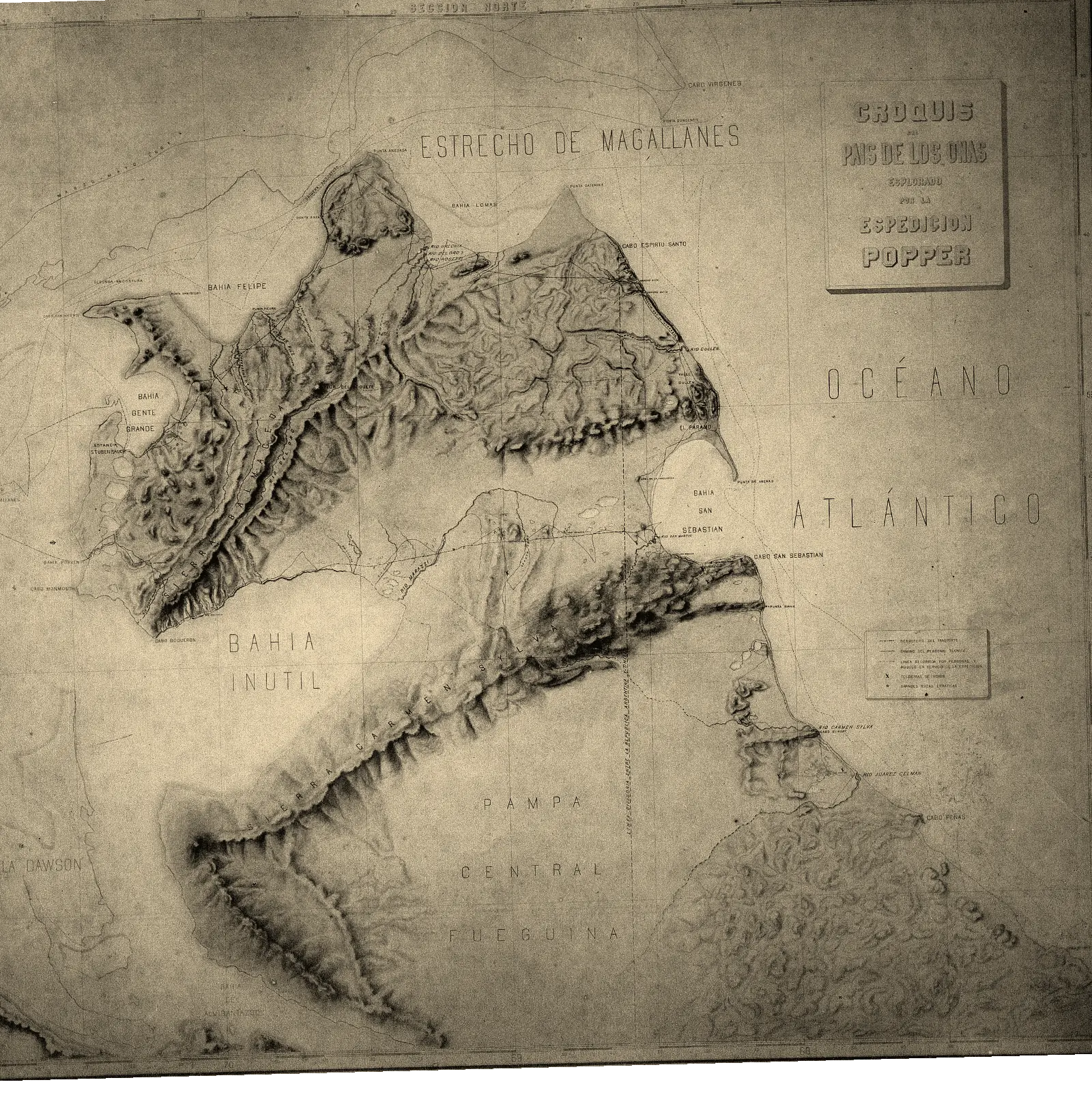
In 1887 the Bucharest-born engineer Julius Popper said he had painted the names of seven waterways on a boulder on a beach in Tierra del Fuego. Drag the slider to compare his 1887 map with today's.

I · Cape San Sebastián, 1886
Seven names painted on a boulder
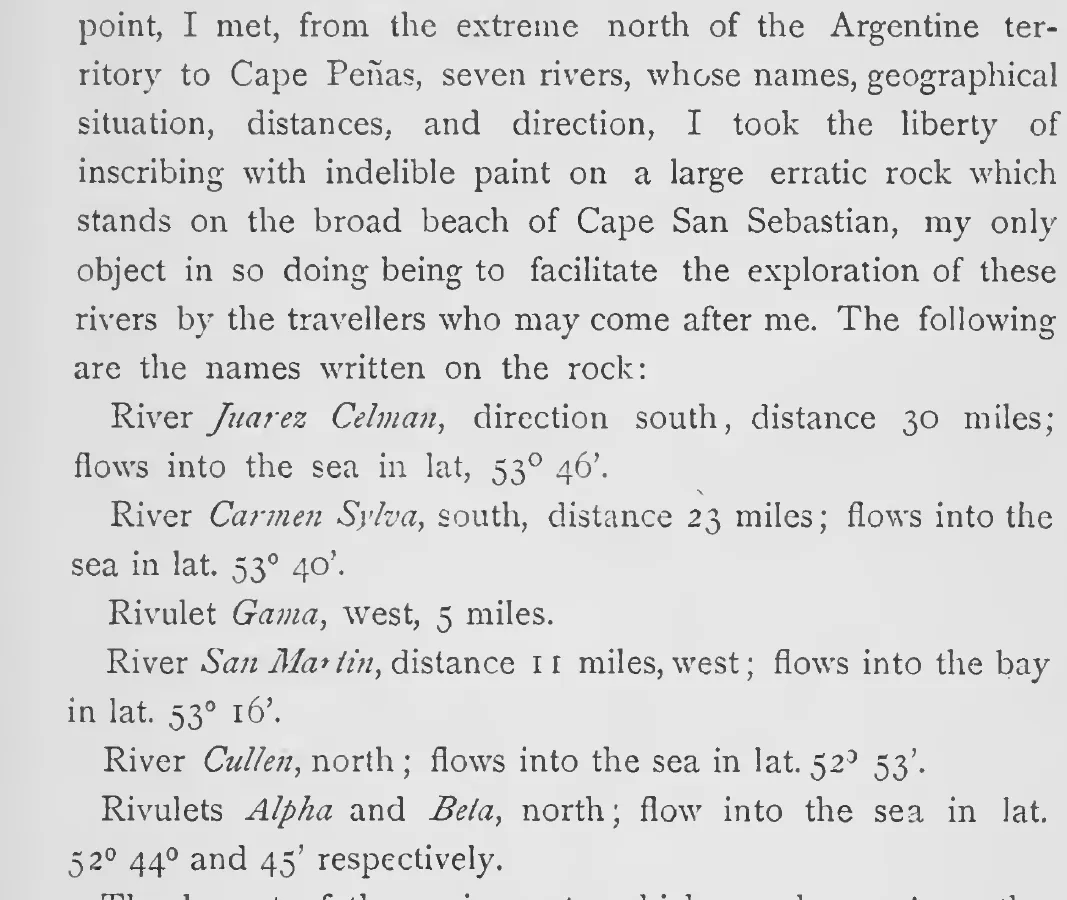
On 5 March 1887, at the Argentine Geographical Institute in Buenos Aires, Julius Popper described his expedition of the previous austral spring. Heading south from Cape Espíritu Santo he met seven rivers, and he “took the liberty”, he said, of “inscribing with indelible paint on a large erratic rock” on the beach at Cape San Sebastián their names, directions and distances, to help the travellers who might come after him.
The list is printed in the English edition of his lecture, which supplies the wording on the boulder here. One river is named for Argentina's new president, another for the pen name of the Queen of Romania. Three streams are named after the first Greek letters. The expedition album also has a photograph of the men lined up on a river bank, titled “Bautismo de un río”, the baptism of a river.
Tap each name to see where the river is on today's map and what it is called now.
II · The 1887 map
The 1887 map against today's coastline
The album that Charles Rouvier, France's minister plenipotentiary in Buenos Aires, gave the Société de Géographie in Paris (the first board is stamped 17 June 1887) opens with the expedition's map: “Tierra del Fuego 1887. Croquis del País de los Onas explorado por la Expedición Popper”. It was drawn after a three-month journey, from September to December 1886.
It is laid over today's map here by matching ten capes and points that can be recognised on both. Leaving each landmark out in turn and predicting it from the other nine, the eight northern and eastern landmarks, from Cape Vírgenes to Cape Peñas, had a median error of 2.2 kilometres and a maximum of 6.2. The two western landmarks, where the expedition did not go, were off by 4.5 and 8.9 kilometres.
On the map, an X marks a “toldería de indios”, a Selk'nam camp.
III · Bucharest, 1857
The son of a teacher from Calea Văcărești
Julius Popper was born in Bucharest, most probably on 15 December 1857, into a Jewish family. His birthplace is given either as Piața Filaret or as Calea Văcărești. His father, Naftali Popper, was a teacher at a Jewish school and an antiquarian bookseller; the newspaper Epoca described him so in his son's lifetime. Biographers report that he studied in Paris from around 1874. The published register of the École des ponts et chaussées has no entry for him, and his diploma and graduation year remain unverified.
The surviving sources document parts of the next decade of his travels. Popper himself mentions Egypt, Japan, Cuba and North America. Two maps with his name survive from 1883: a commercial plan of Mexico City and a map of New Orleans's trade links. He was home again in 1881. He reportedly heard about the southern gold in Brazil, and was in Buenos Aires by 1886.
- Constantinople, India, Chinareported in 1888
- Egypt, Sueznamed by Popper
- Japannamed by Popper
- Siberiareported in 1887
- New Orleans, 1883map survives
- Mexico City, 1883plan survives
- Havana, 1884plan reported in 1888
- Brazil, Buenos Airesdocumented from 1886
IV · Romania at the end of the world
The queen, Sinaia and Filaret
In 1881, back home, Popper was introduced by V. A. Urechia to King Carol I and Queen Elisabeth at Sinaia, according to reports published in Epoca. Five years later, at the other end of the world, he named a mountain range and a river after the queen's literary pen name, Carmen Sylva, and a point after Sinaia.
The Romanian Geographical Society elected him a corresponding member on 6/18 June 1887. In a letter of 29 April 1887 to Urechia, Popper announced that he was sending the Society an album of photographs bound in sealskin, with a title plate made of gold washed between Punta Sinaia and the Carmen Sylva river.
Anca Tudorancea suggests that Popper inspired Pierre Vaillant, a character in Radu Tudoran's novel Toate pânzele sus (All Sails Up), a Romanian classic.
Romanian names on the map of Tierra del Fuego
- Sierra Carmen Sylvasurvives
- Río Carmen Sylvanow Río Chico
- Punta Sinaiasurvives as Punta Sinaí
- Laguna Filaretsurvives
- Cordillera Carlos de Rumania1891, for King Carol I; Holmberg associated the name with the Darwin range and extensions of the Valdivieso range
- Río Ureche, Río Rosettinamed for V. A. Urechia and C. A. Rosetti; not identified on today's maps
- Monte Lahovaryan 833 m peak named in 1891 for George I. Lahovari; not identified today
V · The album
The expedition album
The Paris album holds 65 photographs mounted on boards printed “Expedición Popper · Tierra del Fuego”. Next to many of them someone pasted cuttings from the French translation of the lecture, with the passage each photograph illustrates. Some photographs carry titles on the print itself: “Abriendo camino”, “En busca del vil metal”, “Bautismo de un río”.
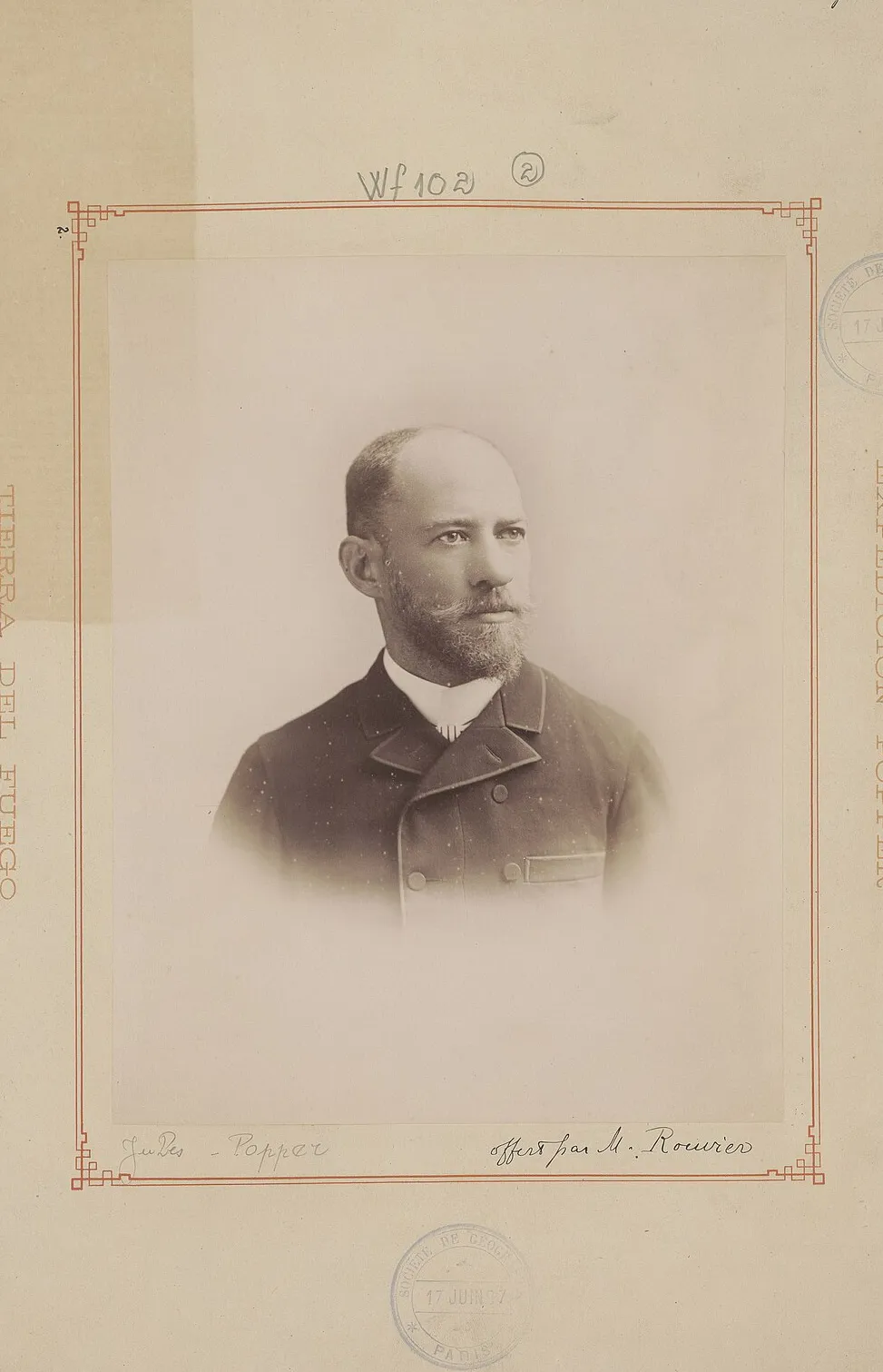
The catalogue credits Popper, though who took each photograph remains uncertain. The first two boards are the map and the portrait; below are the 63 expedition images in board order, with Popper's words where a cutting points to them. Four show a person who was killed and are covered; you can open them if you choose.
VI · El Páramo
Gold washed from beach sand
Gold had been found in the Magellan region before Popper. What he built, on the sand-and-gravel spit of El Páramo at the entrance to San Sebastián Bay, was an industrial operation: a seawater intake feeding four gold-washing devices, a workshop, barracks and a short railway. In 1891 he claimed that more than 600,000 grams of gold had been extracted from Tierra del Fuego's beaches. For El Páramo he cited two entries totalling 265,000 grams: 175,000 melted at the Buenos Aires mint and 90,000 shipped to Hamburg.
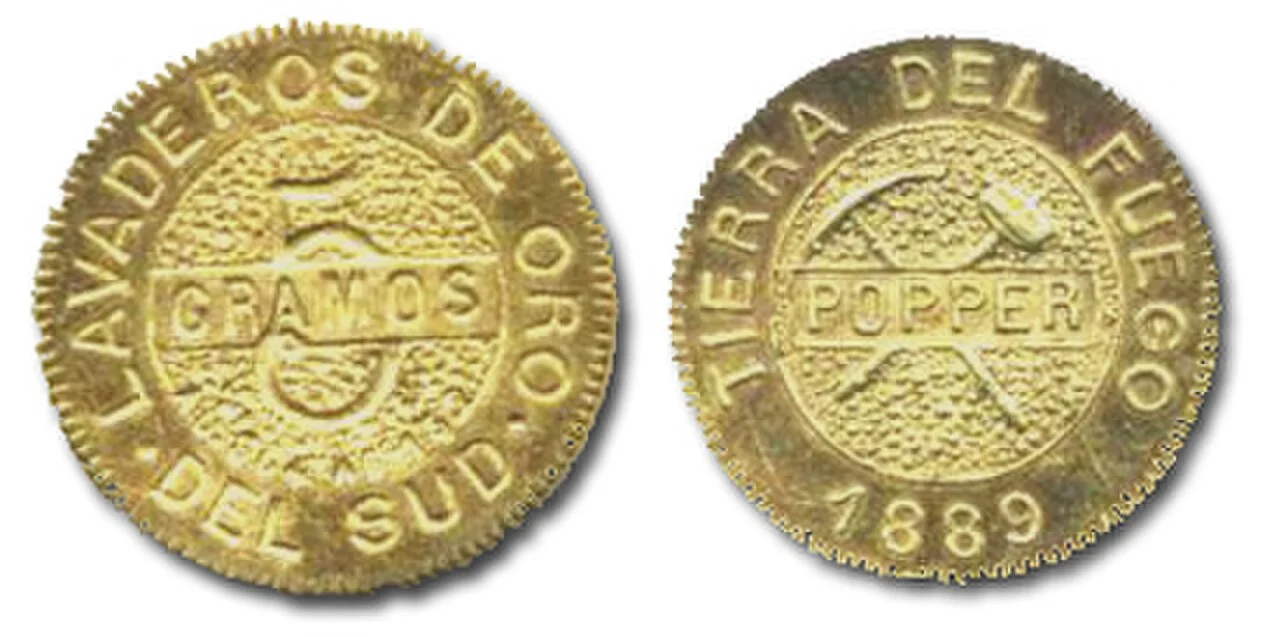
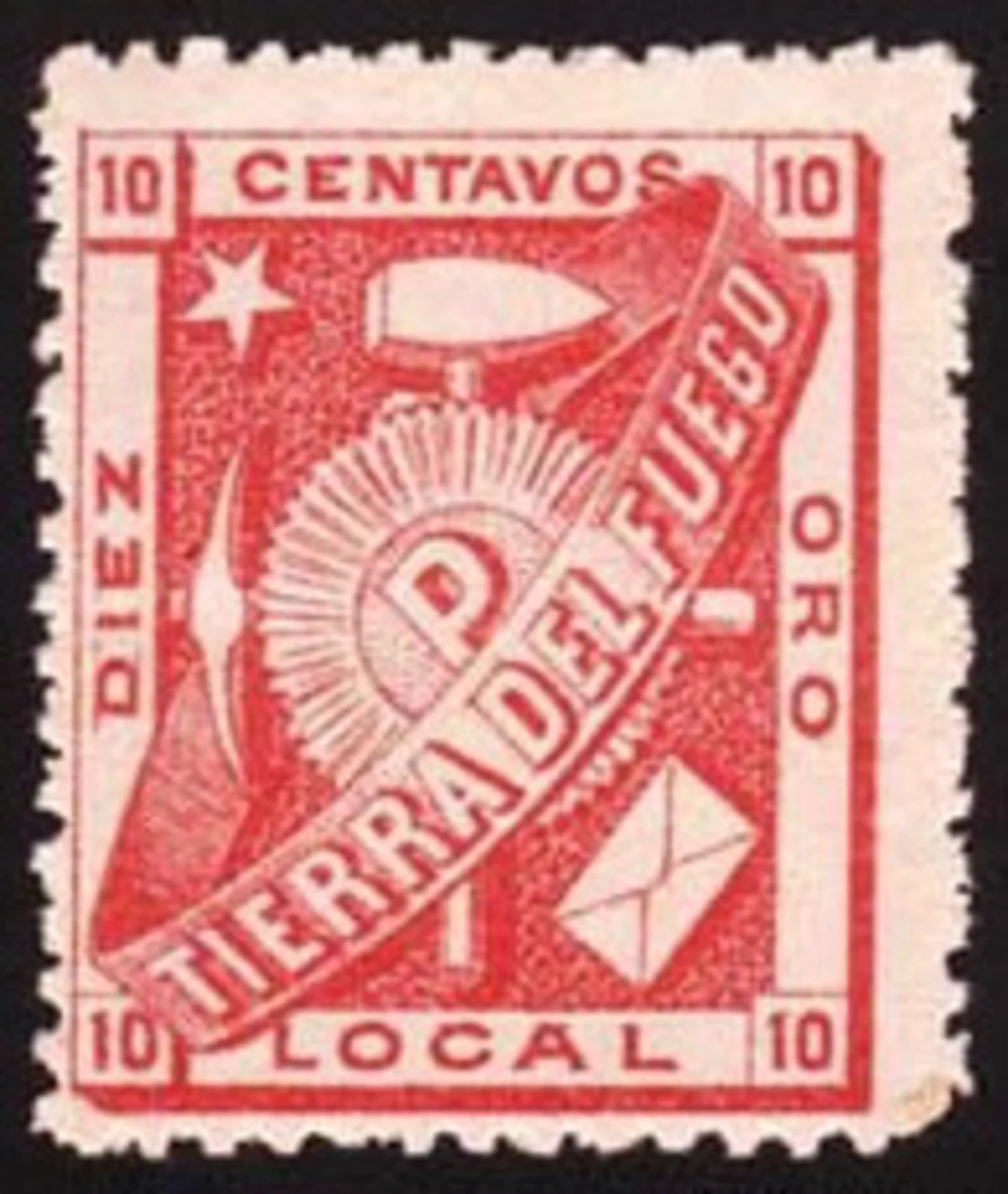
In 1889 the operation issued gold pieces of one and five grams, with his name on one face. In 1891 Popper issued a 10-centavo stamp for the local post. He had a uniformed armed guard, and his younger brother Máximo was appointed police commissioner at San Sebastián. All of this rested on concessions and appointments from the Argentine state, with whose territorial governors he had repeated disputes.
VII · Selk'nam
The Selk'nam and colonial violence
Northern Tierra del Fuego was Selk'nam country; Popper called them “Onas”. His map marks their camps. His 1887 lecture tells of the clashes as calmly as the journey. Popper says he ordered his men to fire toward the opposite bank of the Juárez Celman river. Of another encounter he says his men fired their rifles and “two Indians were left dead on the field”. He blamed the encounters, which he described as happening “almost daily”, on a shortage of supplies.
The album holds a sequence of photographs of armed men over a dead Selk'nam man. Carolina Odone and Marisol Palma show that the scene was arranged for the camera: the bow and arrows move between frames and the men pose. Titles inscribed on the prints frame the scene as combat: “Lluvia de flechas”, rain of arrows, and “¿Muerto en el terreno de honor?”, dead on the field of honour?
In 1891 Popper condemned several abuses against the Selk'nam: he rejected the cannibalism stories, said sheep ranchers were taking their food and denounced their kidnapping for exhibitions in Europe, while continuing to describe them in the racial and evolutionary terms of the time. At the same time he was asking for land and proposing to settle them in an agricultural colony. The historian Alberto Harambour places him in the early phase of colonial violence that formed part of the genocide, and identifies the expansion of sheep ranching in the 1890s as a larger driver. The San Sebastián massacre of 25 November 1886 belongs to another expedition, Ramón Lista's. Chile formally recognised the Selk'nam as a people in 2023.
Some of the places Popper christened already had names. The provincial place-name catalogue records Okeis for the Río Fuego, Uarrs for the Río Chico and Hoiken for Punta Sinaí. Ramón Lista's 1886 expedition had called the Río Chico the “Río de los Toldos”.
VIII · Buenos Aires, 1893
Dead at 35
Popper was found dead at his home at 373 Calle Tucumán in Buenos Aires on the morning of 6 June 1893. The civil register records his death on 6 June; the Argentine Geographical Institute's memorial gives 5 June. The death certificate and the autopsy gave different natural causes. Rumours of poisoning were never substantiated. He was buried in the Ayerza family vault in Recoleta cemetery. His brother Máximo had died two years earlier, aged 23, and was buried at El Páramo.
Punta Popper lies at the mouth of the Río Grande; GeoNames also lists a Cerro Popper, and Laguna Popper as an alternate name for Lago Fuego. The El Páramo mining site was designated a national historic site in 1999.
Sources
The photographs and the 1887 map are in the public domain (BnF album, PD-France); the coin and the stamp via Wikimedia Commons. The 1887 map was aligned by matching ten capes to their GeoNames positions; errors are computed by leaving each point out in turn.
- Julius Popper, The Popper Expedition, Tierra del Fuego, lecture at the Argentine Geographical Institute, 5 March 1887 (English edition). archive.org
- Album “65 phot. de l'expédition J. Popper à la Terre de Feu”, given by Rouvier to the Société de Géographie, Paris, 1887 (Bibliothèque nationale de France, via Wikimedia Commons). commons.wikimedia.org
- Julio Popper, Apuntes geográficos, etnológicos, estadísticos e industriales, Boletín del Instituto Geográfico Argentino XII, 1891. upload.wikimedia.org
- Carolina Odone and Marisol Palma, on the Popper expedition photographs. www.rchav.cl
- Alberto Harambour, “There Cannot be Civilization and Barbarism on the Island”: civilian-driven violence and the genocide of the Selk'nam. www.academia.edu
- Mateo Martinic, history of gold mining in Magellan, Magallania. www.scielo.cl
- Gheorghe Romanescu, on Julius Popper, Studia et Acta Historiae Iudaeorum Romaniae VII, 2002. biblioteca-digitala.ro
- Anca Tudorancea, articles on Julius Popper, Realitatea Evreiască, 2023. www.jewishfed.ro
- Epoca, 23 June 1888 (the Romanian Geographical Society's report on Popper). upload.wikimedia.org
- Popper's letters to George I. Lahovari, ed. Boleslao Lewin (UNLP). sedici.unlp.edu.ar
- Petru Moga, Popper's letter to V. A. Urechia (29 April 1887), Anuar Câmpina 5, 2014. www.academia.edu
- Archivo General de la Nación, Argentina, on Julio Popper. www.argentina.gob.ar
- Banco de la Nación Argentina, Monedas de la República Argentina I (Popper's coins). www.bna.com.ar
- Present-day names: GeoNames (Argentina, Chile); relief: ETOPO 2022 (NOAA); coastline: Natural Earth. www.geonames.org