Marius Comper RO
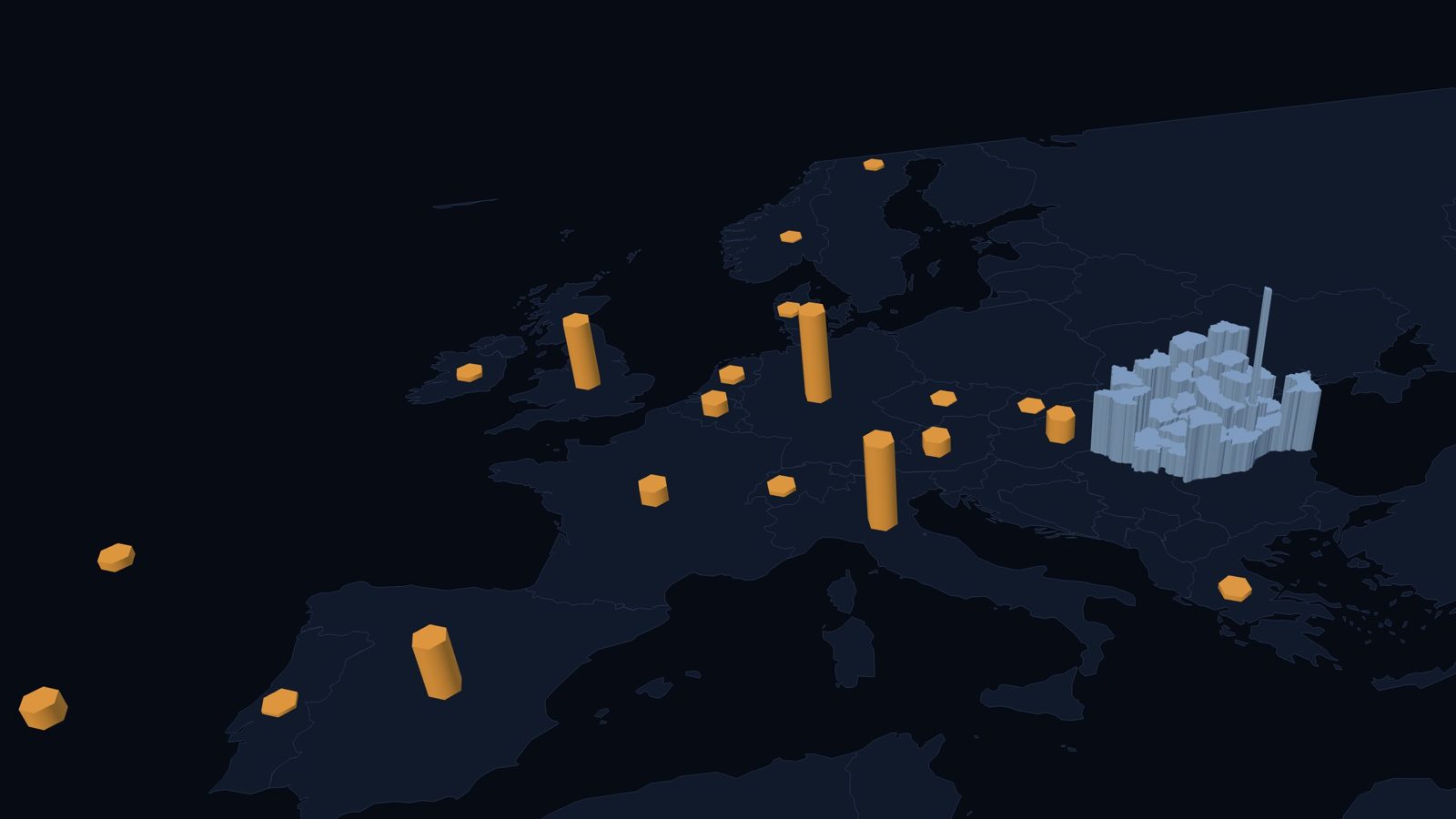
Romania’s counties and its communities abroad on one scale, on a map of Europe.

Romania’s diaspora, in 3D

The 43rd countyPeople born in Romania who live abroad, beside Romania’s 41 counties and Bucharest

If they formed a county, it would be Romania’s largest: 4,583,819 people, 2.7 times the population of Bucharest. Every column on the map uses one scale: counties from the 2021 census, communities abroad from the UN’s estimate for 2024.

1990: under a million

For 1990, the UN estimates 957,791 people born in Romania living in another country. Most were in Germany (321,795), Hungary (194,128) and Israel (138,204).

Italy had 31,588, the UK 3,697. For Spain, the UN’s 1990 estimate is zero.

A million in five years

Between mid-2005 and mid-2010 the number grew by 1,018,937, the largest jump in the whole series. Romania joined the European Union during that interval, on 1 January 2007.

By 2010, Italy (775,003) and Spain (730,550) were ahead of Germany (440,929).

For countries where the estimate rises, each flying dot is roughly 1,000 more people between the two years shown.

2024: 4.58 million

The UK had 69,898 in 2010 and 713,578 in 2024. Germany is first again, with 968,697.

In Italy the number fell from 953,353 in 2015 to 880,402, and in Spain from 730,550 in 2010 to 522,578. The totals cannot tell how many people arrived, returned to Romania, moved elsewhere or died.

The community in Germany would be Romania’s second “county”

Take one community at a time and set it among the 41 counties and Bucharest. There are more people born in Romania living in Germany (968,697) than residents in any Romanian county; only Bucharest has more. The same goes for Italy (880,402).

The UK (713,578) would come third, after Iași (760,774) and ahead of Prahova (695,119). Spain (522,578) would be 14th, between Ilfov and Mureș, and Hungary (253,045) 37th, between Giurgiu and Ialomița.

The counties, Bucharest and five countries, in one row

The 41 counties, Bucharest and, in orange, the five communities abroad that outnumber Tulcea County’s 193,355 residents, in order of size.

Each county keeps its shape from the map; each column’s height is its population at the 2021 census.

The 43rd county

The orange column stacks every community abroad: 4,583,819 people, 2.7 times Bucharest’s 2021 census population (1,716,961).

The next column stacks the 16 least populous counties, from Tulcea to Vrancea: 4,382,428 residents, 201,391 fewer. The UN estimate is equivalent to about 24 people for every 100 residents of Romania.

The name refers to parliamentary constituency no. 43, which Law 208/2015 provides for Romanian citizens domiciled or resident abroad, after the 41 counties and Bucharest.

Who is counted here

The UN counts people by the country they were born in: anyone born in Romania who lives in another country, whatever their citizenship or the language they speak at home. Children born abroad to Romanian parents are not in the figure. People who left decades ago are.

The figures come from the host countries’ censuses and population registers; the UN estimates are for 1 July 2024. For Hungary, Greece, Portugal and Norway, the UN extrapolated from its 2020 edition. The UN publishes estimates for 69 countries and territories; for Japan, Libya and San Marino they are based on citizenship (3,037 people in all). For Ukraine, the UN table gives no separate estimate of people born in Romania.

The comparison mixes two dates: the census figures refer to 1 December 2021, the UN estimates for the diaspora to 1 July 2024.

The UK: from 3,697 to 713,578

For 1990 the UN estimates 3,697 people born in Romania living in the UK. There were 69,898 in 2010, 189,427 in 2015, 502,169 in 2020 and 713,578 in 2024.

The rise between 2015 and 2020, 312,742, is the third-largest five-year rise in the UN series; only Italy and Spain rose more, both in 2005–2010. On 1 January 2014 the UK lifted the transitional work restrictions on Romanian nationals. Taken alone, the community in the UK would rank third among Romania’s counties, after Bucharest and Iași.

A county beside a community abroad

Choose a county or Bucharest, then a country. You can also click the columns on the map. The comparison uses the UN’s 2024 estimates.

2024

Where do the most people born in Romania live?

Five years from the UN series for the 23 countries with estimates above 10,000 on 1 July 2024. The last column says where each community, taken alone, would rank among the 41 counties and Bucharest (2021 census). The other 46 countries and territories in the UN data account for 46,965 people.

Country19902000201020202024As a county
Germany321,795399,018440,929865,707968,6972nd
Italy31,58885,677775,003947,155880,4022nd
UK3,6977,20169,898502,169713,5783rd
Spain043,435730,550571,347522,57814th
Hungary194,128146,208214,330214,514253,04537th
United States90,801139,788169,276177,875178,498below Tulcea
Austria18,03137,18262,864131,700160,281below Tulcea
France15,80828,29875,414142,701156,668below Tulcea
Belgium3,3906,43033,976100,844131,417below Tulcea
Israel138,204127,01795,551109,973116,289below Tulcea

How many Romanians live abroad?

The UN’s estimate for 1 July 2024 is 4,583,819 people born in Romania living in another country. Children born abroad to Romanian parents are not included.

Which country has the most people born in Romania?

Germany (968,697), then Italy (880,402), the UK (713,578) and Spain (522,578).

How many people born in Romania live in the UK?

713,578 in mid-2024, up from 3,697 in 1990, according to the UN.

What is the “43rd county”?

The name refers to parliamentary constituency no. 43, which Law 208/2015 provides for Romanian citizens domiciled or resident abroad.
Share

The page opens on the whole map; from “A county beside a community abroad” you can share a link to your own comparison.

Related

Sources

The diaspora estimates and population comparisons use UN data and Romanian census results.

  1. United Nations, Department of Economic and Social Affairs (UN DESA), Population Division: International Migrant Stock 2024, Table 1 (destination × origin, 1990–2024), CC BY 3.0 IGO. www.un.org
  2. National Institute of Statistics (INS), Romania: 2021 Population and Housing Census, resident population by county and locality (and the 2002 and 2011 censuses). www.recensamantromania.ro
  3. Law 208/2015 on the election of the Senate and the Chamber of Deputies, consolidated text (annex of electoral constituencies; no. 43: Romanian citizens living abroad), Permanent Electoral Authority. roaep.ro
  4. Natural Earth: country (1:50m) and county (1:10m) boundaries, public domain. www.naturalearthdata.com