Johannes Kepler asked what the planets would sound like to someone standing on the Sun. He worked out six voices from Tycho Brahe's observations and printed the numbers. Played against today's orbits, every voice is still in tune to within 2 %.
Scroll to listen
Terra
The Earth sings two notes
Seen from the Sun, the Earth crosses about a degree of sky a day. It is not a steady degree. Nearest the Sun it covers 61′18″ a day, by Kepler's figures; farthest away, 57′3″.
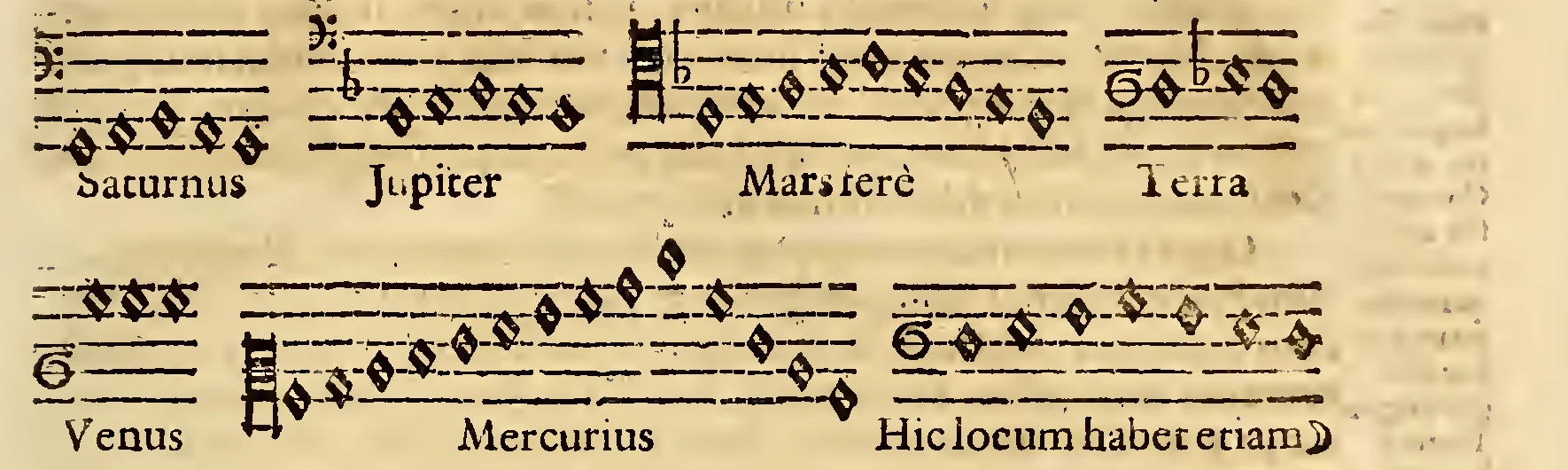
Kepler treated speed as pitch. He matched the pair to a semitone, ideally 15 to 16: the step from mi to fa.
In the margin a little lower he wrote MI FA MI and turned it into a grim pun: on the Earth, he said, MIseria and FAmes, misery and famine, hold sway.
Ellipse
Nearer the Sun, faster and higher
Every orbit is an ellipse with the Sun off-centre. A planet speeds up as it falls towards the Sun and slows as it climbs away, so its voice slides up and down once every orbit.
Here each ring is lifted by its pitch. The high point is perihelion, the planet's closest pass; the low point is aphelion, its farthest.
The numbers on the rings are Kepler's, printed on p. 198 of the 1619 edition: the angle each planet covers in a day as seen from the Sun, at its slowest and at its fastest. Saturn manages 1′46″ to 2′15″. Mercury covers 164′ to 384′.
Intervals
Six voices, six intervals
Kepler named each glide as a musical interval: Saturn a major third (4:5), Jupiter a minor third (5:6), Mars a fifth (2:3), the Earth a semitone (15:16), Venus almost a unison (he offered a diesis, 24:25, for comparison), and Mercury an octave and a minor third (5:12).
His own speeds do not land exactly on those ratios. Saturn's span a little more than a major third, and Mars's fall short of a fifth by six-tenths of a semitone. Under the Mars stave he printed Mars ferè: Mars, roughly.
Kepler's six voices as he printed them, with the Moon's added at the end. Harmonices Mundi (Linz, 1619), p. 207. Public domain, Internet Archive.
p. 203
Seven octaves folded into one
Mercury runs 90 to 220 times faster than Saturn at its slowest, six and a half to nearly eight octaves higher. Kepler halved the faster speeds again and again to bring every voice's two extremes into one octave, with Saturn's slowest motion as his reference note, G.
Halving a speed lowers its note by exactly one octave, so a glide keeps its interval when both ends move down together. Folded, the six rings share one stave: the common harmonies Kepler went looking for in the next chapter.
His table of halvings is on p. 203: Mercury's fastest speed divided by 128, Saturn's left alone. To make the voices easier to tell apart, the sound then sets them in different registers, whole octaves apart, with Saturn lowest, like a choir.
Then and now
Is the choir still in tune?
Kepler's speeds came from orbits he fitted to Tycho's observations. Modern orbits are fitted independently of his printed figures. Take each planet's eccentricity, how stretched its ellipse is, from today's tables taken back to 1600, and compute the two speeds again.
First, circles centred on the Sun: every voice flattens to a single note. Then the older picture, a circle with the Sun off-centre and the planet moving at an even pace (the dotted rings): the glides return, but too narrow: the ratio of the two speeds misses Kepler's by 1.5 % for Venus and by 35 % for Mercury.
Then the ellipse, with Kepler's rule that a planet sweeps equal areas in equal times. The vermilion rings rise and land on his ink ones.
Centred circleEven circleTodayKepler, 1619
Kepler and JPL
Within 2 %, four centuries apart
All six of Kepler's speed ratios fall within 1.7 % of the modern ones: Venus −0.1 %, the Earth −0.4 %, Mars +0.2 %, Jupiter −0.9 %, Saturn −1.4 %, Mercury −1.7 %. All twelve of his speeds are within 1.6 %.
What this does not prove is the ellipse itself. At the two extremes an older device, a circle with an equant placed symmetrically to the Sun, gives exactly the same ratio. The test confirms the size of every orbit's stretch, in either model, which is what Kepler had wrung out of Tycho's numbers.
His speeds are computed from those orbits, not timed with a clock, so the comparison tests his orbits rather than his eyesight. And the planets make no sound: this is his thought experiment, played aloud.
Your turn
Take the baton
Tap a planet's name to hear it alone; tap it again to bring back all six. Switch the orbits the voices follow, and the tempo: one orbit per bar, so that slow Saturn can be heard gliding, or real periods, in which Saturn takes 29½ years to sing its phrase once.
Orbits
Tempo
Send it to someone
The planets start from their estimated positions for today. Tap the sound button to hear the choir.
Share
Sources
The speeds, distances, halvings and staves were read from the 1619 edition. The modern orbits are JPL's fitted orbital elements, taken back to the year 1600 (for the Earth, the Earth–Moon pair). Sound: each voice's frequency is proportional to the planet's angular speed seen from the Sun; Saturn's slowest speed, 1′46″ a day, is played as G2 (98 Hz).
Johannes Kepler, Harmonices Mundi libri V (Linz, 1619), book V: extreme distances p. 195, daily motions p. 198, octave halvings p. 203, staves p. 207. The last pair on p. 195, 470 and 307, is Mercury’s, though the table prints Saturni. Scan of a copy in the Smithsonian Libraries, Internet Archive, public domain.
E. M. Standish, Approximate positions of the planets, JPL Solar System Dynamics, Tables 2a and 2b (valid 3000 BC to AD 3000): eccentricities and mean motions for 1600, and approximate orbital phases for any date in that range.
Earlier performances of the same idea: Laurie Spiegel’s Kepler’s Harmony of the Worlds (1977), which opens the sounds of Earth on the Voyager Golden Record; Willie Ruff and John Rodgers, The Harmony of the World: a realization for the ear of Johannes Kepler’s astronomical data from Harmonices Mundi 1619 (LP, 1979). What is new here: Kepler’s own printed numbers, set against modern orbits.
How the comparison is made: for each planet the aphelion speed divided by the perihelion speed is ((1 − e)/(1 + e))² for an ellipse swept at equal areas, (1 − e)/(1 + e) for an even circle with the Sun off-centre, and 1 for a circle centred on the Sun; e is the modern eccentricity for 1600. The absolute speeds use the modern mean motion.