.jpg)
The grain that crossed the ocean
Maize was domesticated in Central America and reached Europe after the voyages of Columbus at the end of the fifteenth century (Revilla et al. 2022). Nothing about it belonged here: neither the tall stalk with its wrapped cobs, nor the hard yellow kernels, nor the sweet taste of the cake baked on the hearth.
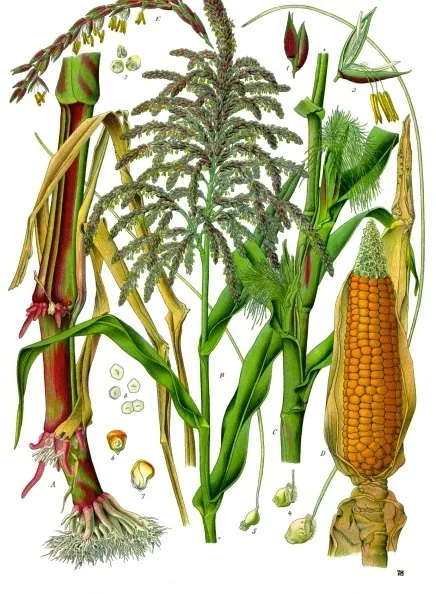

By the beginning of the seventeenth century, maize was already an established field crop in the Romanian lands (Șuteu et al. 2013). What followed was a journey of almost three hundred years, at the end of which millet had retreated from the fields and maize covered up to half of the cultivated surface in the late nineteenth century.
What simmered before
Before maize, people cooked millet and buckwheat. The thick porridge made from these grains already carried the name we know: mamaliga. When Transylvanians nicknamed Michael the Brave “Mălai vodă”, the joke more likely hid a millet mamaliga than one made from maize flour (review in Revista Istorică, 2023).
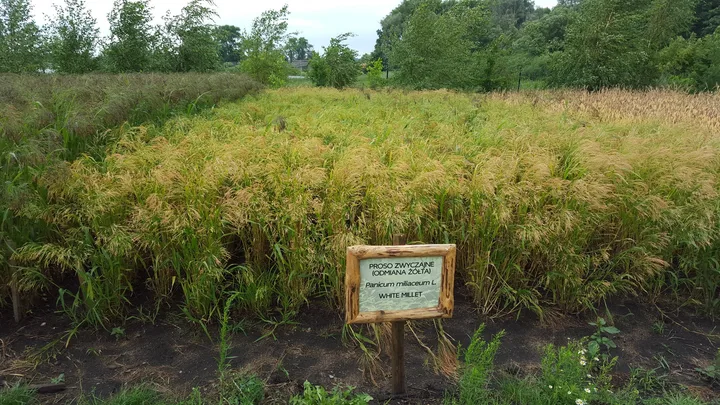

The switch demanded no new taste. The cauldron stayed, the fire stayed, the stirring hand stayed. Only the kernel changed: farmers saw in maize more food from the same ground, and cobs that keep through winter. Taste followed the plough.
Three lands, three rhythms
The dates of arrival differ from one land to another. Three separate tracks follow, with years as ranges; where the evidence runs out, the gap is stated plainly.
-
Transylvania
Attested in the seventeenth century; the crop spread onwards from here. The range covers 1600–1700.
-
Wallachia
No certain year. The advance came from Transylvania at a pace the documents do not fix.
-
Moldavia
No certain year. The same advance from the west, with the same gaps in the record.
For the eastern Mediterranean and the Balkans there is no clear evidence of a very early presence — the absence is information too, and it is marked as such.
The bench: one pogon, three years
A pogon is almost 5,000 square metres — half a hectare. Pick a year and a crop, and see what grows on it, how many steps stand between field and cauldron, and how long the stirring takes.
Upper bound in the agronomic literature: up to half the cultivated surface (Șuteu et al. 2013).
By 1900 maize covers up to 50 in every hundred pogons. Its mamaliga feeds everyone.
At the mill and the cauldron
Grind first.
Epilogue: the maize country
The foreign grain never left. In 2024 maize covered 41.8% of Romania's cereal area — about 42 in every hundred pogons — and supplied a third of the cereal harvest (33.5%). Romania stood first in the European Union for cultivated area and third for production, after France and Poland (National Institute of Statistics, provisional data).
The two shares do not compare with each other: 42 is of the cereal area, while 50 is of all cultivated land.

Method and limits
The American origin follows an open scientific synthesis (Revilla et al., Frontiers in Nutrition, 2022). The old figures — an established crop by the beginning of the seventeenth century and a share of up to half the cultivated surface in the late nineteenth — come from the Romanian agronomic literature (Madgearu 1931, Ionescu-Șișești 1955, Pascovschi 1957), quoted through a 2013 PLOS ONE article. The regional tracks follow the 2023 Revista Istorică review of Alex Drace-Francis's monograph (CEU Press 2022, Humanitas 2023). The epilogue uses the statistics office release with provisional 2024 data.
A pogon is exactly 5,011.79 square metres (DEX). The text rounds it to thousands, with the rule stated at each use: “about 42 in a hundred” means 41.8 rounded to the whole; “a third” means 33.5%. The shares for 1700 and 1800 are indicative reconstructions, marked as such; the only measurements shown are the 2024 ones, and the 1900 figure is the literature's upper bound. Armies and merchants bought grain in bulk, which rewarded volume — that is the monograph's documented frame, presented here as the mechanism beside the yield farmers saw in it, with no unverified tax rates or decrees.
Sources
- Revilla, P. et al., “Traditional Foods From Maize (Zea mays L.) in Europe”, Frontiers in Nutrition 8 (2022). Open full text.
- Șuteu, D. et al., “Romanian Maize (Zea mays) Inbred Lines…”, PLOS ONE 8(12) (2013). Open full text.
- Review of Alex Drace-Francis's monograph, Revista Istorică nos. 4–6/2023. PDF. The book at its publisher.
- National Institute of Statistics, “Crop production of main crops in 2024 — provisional data”. PDF.
- DEX ’98, “pogon”, via dexonline. Definition.
- Village Museum: muzeul-satului.ro · National History Museum: mnir.ro · Library of the Romanian Academy: biblacad.ro.