Crash tests · United States, 2011–2026
Frontal crash stars are earned with a male dummy at the wheel. What the tests show when a small woman drives
In the frontal test behind the safety stars of cars sold in the United States, the driver is always a dummy built like an average man; a dummy built like a small woman rides beside him. NHTSA, the US road-safety agency, has also crashed 14 cars into a rigid wall at almost the same speed with the small woman at the wheel, in compliance tests that award no stars. We ran their sensor readings through NHTSA's own star formula: none of the 14 reaches five. It is one test per car, the cars were chosen by NHTSA, and the Volvo XC40 is borderline.
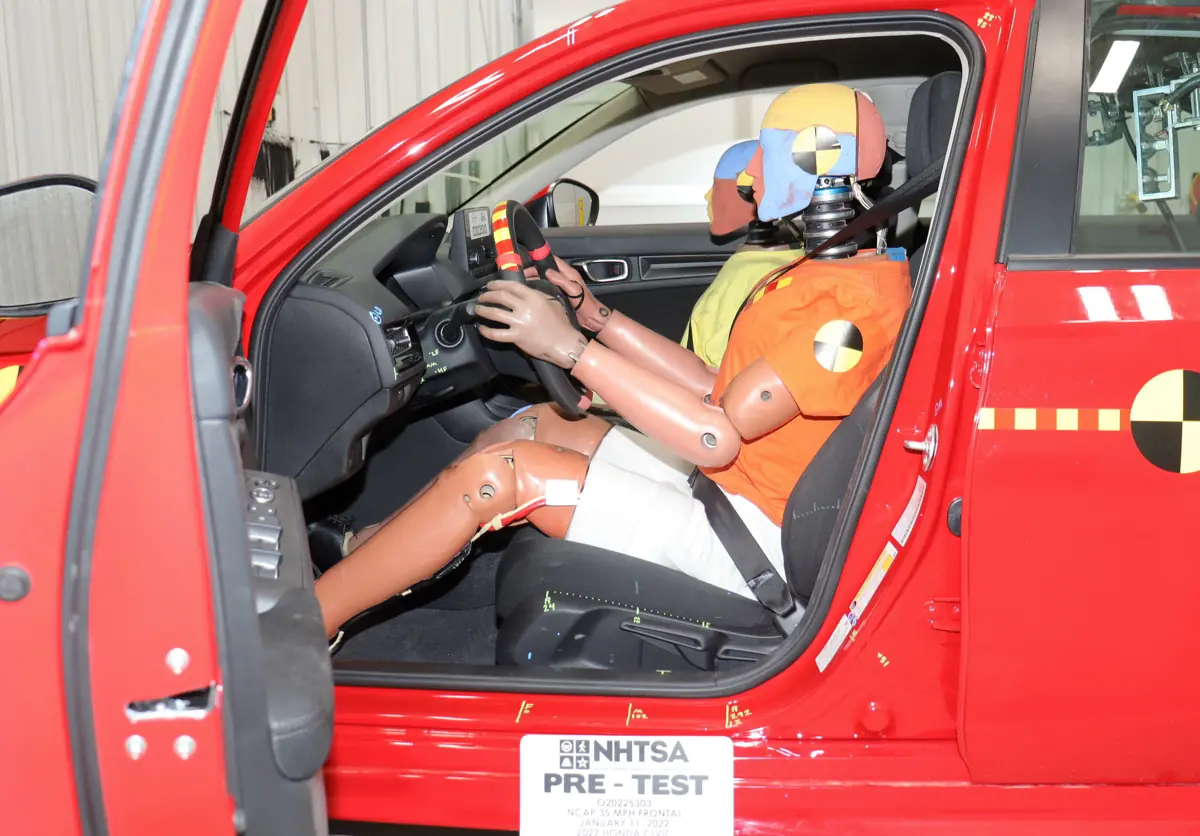
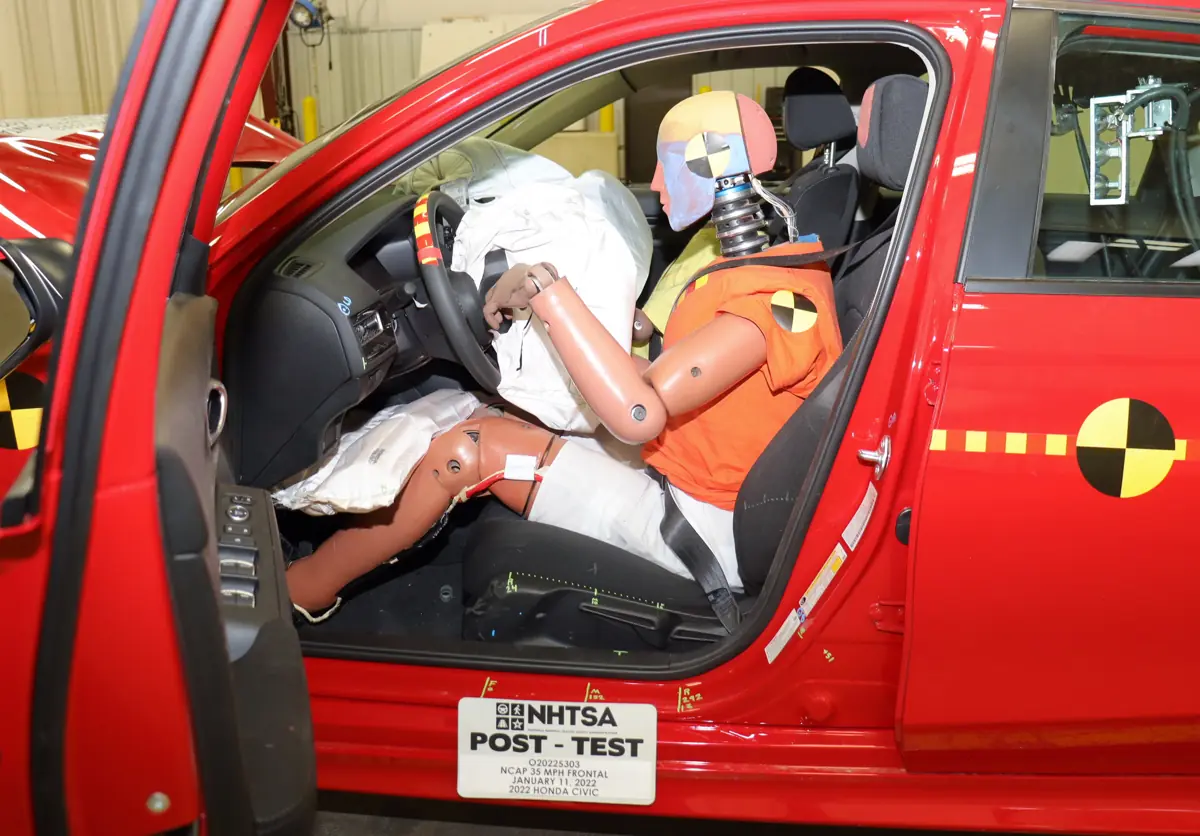 Him, at the wheel
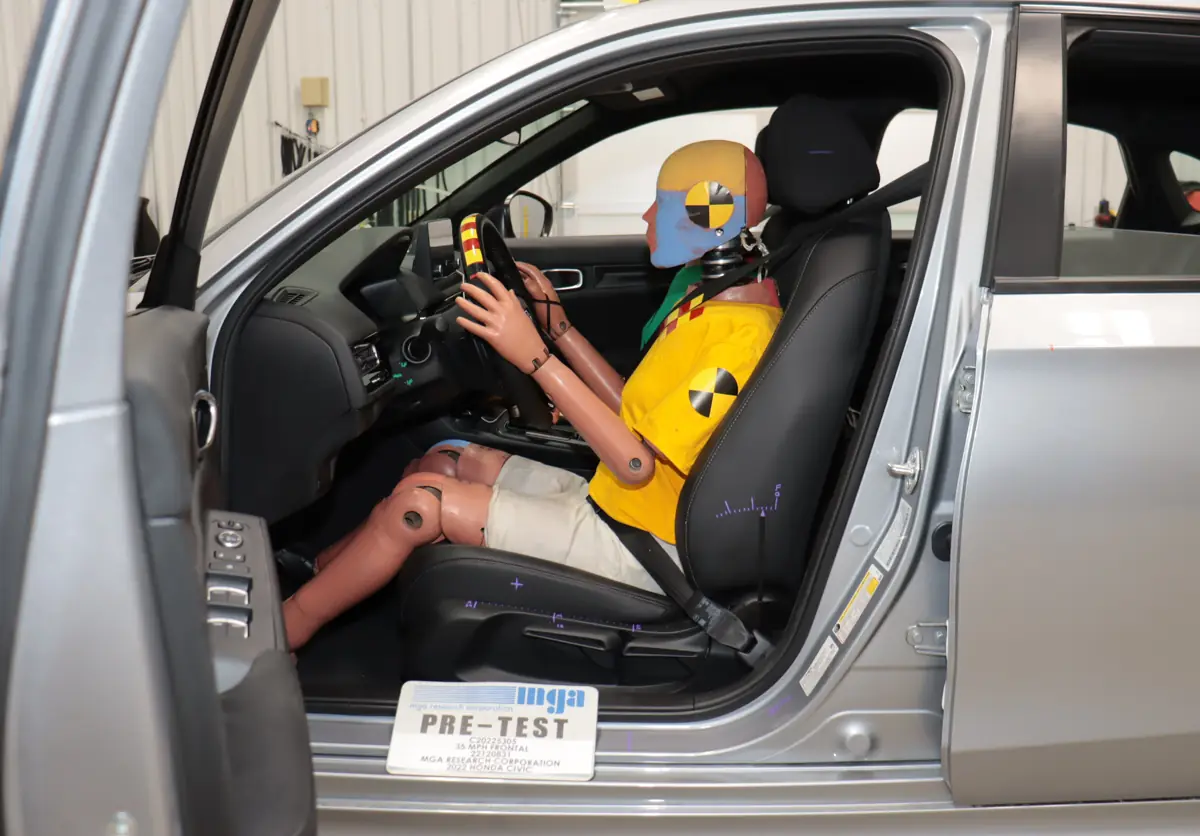
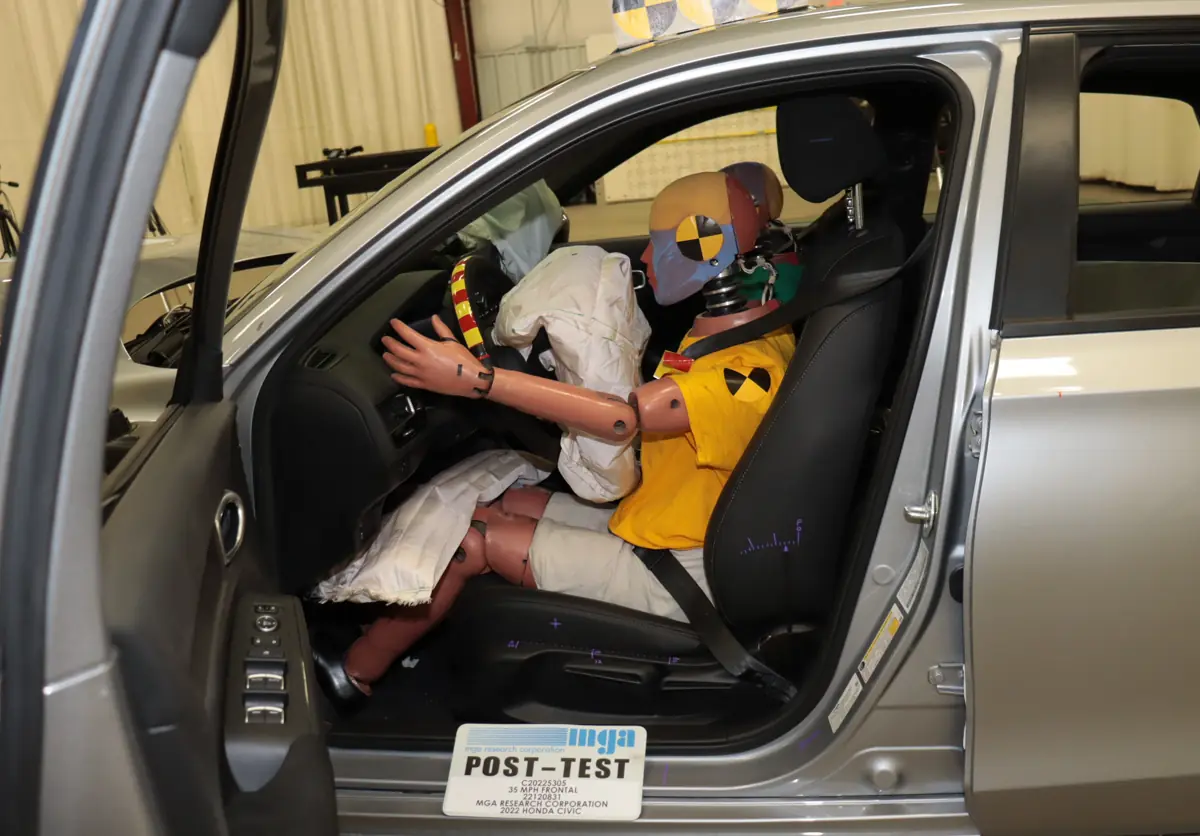 Her, at the wheel
Photographs: NHTSA Vehicle Crash Test Database, tests 14048 and 15485 (both run by MGA Research). Public domain, US government.
0 of 14
cars crashed with the small woman at the wheel that would get five stars by NHTSA's formula. The Volvo XC40 misses the line narrowly (10.2% against 10%).
10 of 10
models where her risk at the wheel comes out higher than his in the same model. Typically 1.34 times as high.
10 cm
how much closer to the wheel her chest sits: 21 cm against his 31 cm (medians of NHTSA's measurements, with her seat fully forward as the test requires).
#Who sat in the seats when a particular car was crash-tested
Pick the make, model and year. The list covers 5,796 versions of cars that received NHTSA frontal stars from 2011 to 2026, from 632 tests. Many are sold in Europe under the same name (Toyota, Honda, Hyundai, Kia, Volkswagen, BMW, Tesla, Volvo), though the European version can differ in structure or airbags. Brands sold only in Europe are not tested in the US; for them, see the section on Europe.
For each test you see the two dummies, the published stars and the calculated risk by body region. The third seat shows the small woman at the wheel, where NHTSA ran that test too.
Examples: 2022 Honda Civic · 2021 Toyota RAV4 · 2020 Volkswagen Passat
The car list could not be loaded. Reload the page.
#The 14 cars in which the small woman sat at the wheel
Besides the tests that award stars, NHTSA checks that cars meet the federal standard FMVSS 208. There the small female dummy sits in both front seats, the driver's included, belted, and the car hits the wall at up to 56 km/h (35 mph). The test has pass-or-fail limits only, and its results never reach the window sticker. But the sensors record the same things as in the star test: head, neck, chest, thighs.
Since 2011, NHTSA's database holds 14 such tests with complete signals. We applied NHTSA's star formula to them: seven cars would get four stars, six would get three, one would get two. None would get five.
For 11 of them there is also an NCAP test of the same model and year, with the man at the wheel; for 10, NHTSA also published the sensor readings. In all 10, her risk at the wheel is higher than his. She gets fewer stars in six of 11 models and never more. The compliance tests ran at 54.8–55.9 km/h, slightly below NCAP's 56 km/h, which if anything favours her.
- him at the wheel (NCAP)
- her at the wheel (compliance)
Could it just be a different test?
Compliance and NCAP testing are different programmes, and two tests of the same model never give exactly the same readings. We measured how much they differ. For the same small female dummy in the right-hand seat of the same 10 models, the compliance-test risk ranged from −35% to +82% of the NCAP-test risk; typically 8% higher. The man at the wheel, by contrast, has a lower risk in compliance tests in all three models where that comparison is possible.
So test-to-test variation is large, as large as the gap between him and her in some cars. What makes chance a poor explanation is the regularity: in all 10 pairs, her risk at the wheel is higher. Take the typical 8% off every one of her results and it is still higher in all 10, but the Volvo XC40, already very close, would cross the five-star line.
| Car | Him at the wheel (published) | Her at the wheel (calculated) | His risk | Her risk |
|---|---|---|---|---|
| 2023 Tesla Model S | – | ★★☆☆☆ | – | 20.5% |
| 2024 Nissan Ariya | ★★★★☆ | ★★★☆☆ | 12.0% | 19.1% |
| 2024 BMW 530i | – | ★★★☆☆ | – | 19.0% |
| 2024 Buick Envista | ★★★★★ | ★★★☆☆ | 9.2% | 18.1% |
| 2013 Nissan Frontier | – | ★★★☆☆ | – | 17.8% |
| 2020 Kia Niro | ★★★★☆ | ★★★☆☆ | 10.3% | 16.4% |
| 2020 Buick Encore | ★★★★★ | ★★★☆☆ | 8.3% | 15.5% |
| 2022 Hyundai Tucson | ★★★★☆ | ★★★★☆ | 10.2% | 14.9% |
| 2023 Subaru Solterra | ★★★★☆ | ★★★★☆ | – | 13.0% |
| 2020 Acura RDX | ★★★★☆ | ★★★★☆ | 11.0% | 12.4% |
| 2021 Toyota RAV4 | ★★★★☆ | ★★★★☆ | 10.2% | 12.3% |
| 2020 Volkswagen Passat | ★★★★☆ | ★★★★☆ | 10.4% | 11.7% |
| 2022 Honda Civic | ★★★★★ | ★★★★☆ | 9.6% | 11.4% |
| 2023 Volvo XC40 | ★★★★★ | ★★★★☆ | 9.2% | 10.2% |
#Same crash, two seats: for him the driver's seat is almost always the lower-risk one; for her, more often the higher-risk one
The cleanest comparison sits inside a single test: same car, same wall, same instant, two identical dummies, one driving and one beside. Compliance tests are run either with two men or with two small women, so we can see what the driver's seat does for each.
With men in both front seats, the driver has the lower risk in seven tests of 11, about the same in four and the higher in none; three of those tests are of the same 2014 Toyota Tundra. With small women in both, the driver has the higher risk in seven tests of 13, about the same in three and the lower in three. “About the same” means within 5%. With so few tests, her side is a tendency, not a rule.
Two men in front
Two small women in front
#Why: the neck, and the distance to the wheel
In all 14 cars, the most exposed part of the woman at the wheel is her neck. NHTSA scores it with an index that adds the force pulling or pushing the head along the neck and the moment bending it, each against the injury limit set for a person of that size. Typically the index reaches 0.54 for her at the wheel, 0.39 for her in the passenger seat in NCAP tests, and 0.29 for him at the wheel.
A likely explanation is geometry. In the compliance test the standard puts her seat fully forward, where many short people slide it to reach the pedals. In NHTSA's pre-crash measurements, the man's chest is 31 cm from the wheel (623 NCAP tests); the small woman's is 21 cm (13 compliance tests). The steering-wheel airbag has less room before it reaches her and meets her earlier. The data show where the risk rises; the exact mechanism is not measured here.
#In 632 NCAP tests, the woman in the passenger seat fares worse nearly three times as often as the man at the wheel
In the star test, the small woman rides in the passenger seat. From 2011 to 2026, in 632 frontal tests, she got fewer stars than the driver in 228, more in 78 and the same in 326. Her calculated risk is higher than his in 394 tests of 578.
The overall stars hide the difference. Of 352 tests behind a five-star overall rating, 176, half of them, gave the woman in the passenger seat fewer than five frontal stars. The man at the wheel: 110.
The gap is narrowing. She fared worse than the driver in 46% of the tests from 2011–2015, 31% in 2016–2020 and 26% in 2021–2026. But in these tests she never drives, and the comparison mixes two things: a different body and a different seat.
#In Europe, the small woman has been at the wheel since 2015
Euro NCAP, the programme that rates cars sold in Europe, has run a frontal test since 2015 with the small female dummy itself at the wheel, the 49 kg Hybrid III: the car hits a rigid wall at 50 km/h across its full width. The offset test against a deformable barrier has used a newer male dummy, THOR, at the wheel since 2020.
From 2026 the full-width test runs into a deformable barrier at a lower speed (35 km/h in the new protocol), still with the small woman driving, and in the offset test she now rides in the passenger seat. Euro NCAP does not publish her points separately, only colours for each body region; you can find them on euroncap.com for each car, in the diagram of the full-width frontal test. We have not reproduced them here, because the site's terms require permission for reuse.
In the US, NHTSA proposes to put the small woman at the wheel of the star test only from late 2029, and the newer female dummy THOR-05F, unveiled in November 2025, from 2031, according to the plan it put out for comment in August 2026; the THOR-05F date has not moved since 2024. A bill that would speed this up, the She DRIVES Act, has sat on the Senate calendar since July 2025.
#What real crashes show
Dummies are not people, and the question that matters is what happens on the road. Studies of US crashes found that belted women had higher odds than men of serious injury in comparable crashes: 47% higher odds for female drivers according to Bose and colleagues (2011, crashes from 1998–2008), and 73% higher odds for belted female occupants in frontal crashes according to Forman and colleagues (2019, crashes from 1998–2015, the figure from the University of Virginia's release).
The gap has narrowed. A 2023 NHTSA study (Atwood, Noh and Craig) estimates that, in a crash of the same severity, a woman in the front seat had an 18.3% higher risk of dying than a man in cars built up to 2009, and about 6% in cars built in 2010–2020 (6.3%, with a margin of ±5.4 points). IIHS, the US insurers' institute, found in 2022 that much of the difference, though not all, comes from the smaller, lighter cars women drive and the crashes they are in, rather than from their bodies.
In Romania, 68 people per million inhabitants died on the roads in 2025, the second-highest rate in the European Union after Bulgaria. In 2024 Romania was the highest.
#How to sit at the wheel if you are short
- NHTSA recommends at least 25 cm (10 inches) between the airbag cover in the middle of the wheel and your breastbone.
- Move the seat as far back as you can while still reaching the pedals comfortably. On the same principle, the front passenger sits as far from the dashboard as possible.
- When choosing a car in Europe, look at Euro NCAP's driver result in the full-width test: that is the one with the small woman at the wheel.
For children the rules are different. On the front seat and the airbag (in Romanian): Copil pe scaunul din față: pragul de 135 cm și regula airbagului.
#How we calculated
NHTSA's frontal stars since 2011 come from a formula published in 2008 (Federal Register 73 FR 40016): four curves give the probability of a serious injury to the head, neck and chest and a moderate one to the thighs, combined into a total risk. Under 10% is five stars, under 15% four, under 20% three, under 40% two.
We checked the formula against NHTSA's public file of stars and readings: it reproduces the published stars in 567 of 578 tests for the driver and 569 for the passenger. For the compliance tests we downloaded the raw sensor signals from NHTSA's database and filtered them to the SAE J211 standard. The same calculation, run on 38 NCAP tests, matches NHTSA's published readings with a typical error under 1%.
We matched compliance and NCAP tests by hand, by make, model and year. For the Buick Envista, NHTSA bases the stars on a test of its twin, the Chevrolet Trax. The 14 cars are not a random sample: NHTSA chooses what it checks. Their results cannot be extended to every car, and one car tested once may come out differently a second time.
No star here says a car is dangerous. Four frontal stars mean a calculated risk between 10% and 15% of serious injury (or moderate, to the thighs), for one dummy, in one kind of crash.
#Questions
Which dummy sits at the wheel in crash tests?
In NHTSA's frontal star test, the driver is the Hybrid III “average male”, 77.7 kg. The 49 kg “small female” rides in the passenger seat. In Euro NCAP's full-width test, the small female has been at the wheel since 2015.
Are cars tested with female dummies?
Yes, but not everywhere. In the US, the small woman (Hybrid III) rides in the passenger seat in the frontal star test; a different dummy of the same size built for side impacts (SID-IIs) sits in the back in the side test and at the wheel in the pole test. In a frontal crash she drives only in compliance tests, which award no stars.
What does the “small female” dummy represent?
The Hybrid III 5th female was built to the measurements of the smallest 5% of American adult women by scaling down the male dummy. It weighs 49 kg. The average American woman today is 161 cm and 78 kg, according to the CDC; no dummy is built to her.
Does four stars mean the car is unsafe?
No. The difference between four and five stars is a few percentage points of calculated serious-injury risk, in one kind of crash. Wearing the belt and keeping your distance from the airbag matter more.
#Sources
- NHTSA, 5-Star Safety Ratings: public file of stars and readings (Safercar_data.csv)
- NHTSA, Vehicle Crash Test Database: signals, photographs and measurements for each test
- Federal Register 73 FR 40016 (2008): NCAP risk curves and star bands
- FMVSS 208, 49 CFR 571.208: compliance tests with the small female dummy
- Federal Register 65 FR 10961 (2000): how the Hybrid III 5th female was built
- Federal Register 91 FR 53339 (2026): NHTSA's ten-year plan, small woman at the wheel from 2029
- Euro NCAP, full-width frontal test protocol (2015)
- Euro NCAP, frontal impact protocol 2026
- Bose, Segui-Gomez, Crandall (2011), American Journal of Public Health
- University of Virginia (2019), on the study by Forman et al.
- Brumbelow, Jermakian (2022), Traffic Injury Prevention
- Atwood, Noh, Craig (2023), Traffic Injury Prevention
- NHTSA, Air Bags: recommended distance from the airbag
- European Commission, road deaths statistics for 2025
- European Commission, road deaths by country, 2024 and 2025
- CDC NCHS, body measurements of US adults, 2021–2023
- Humanetics, Hybrid III 50th male and 5th female data sheets