Marius Comper
RO

London, 1759 · Optics of celestial navigation

The Marine Sextant

In 1759, London instrument maker John Bird built a 60° brass arc capable of measuring angles up to 120° between Sun, Moon, and sea horizon—with no batteries and regardless of the ship's roll.

April–May 1916

The James Caird test

On 24 April 1916, the 6.85-meter lifeboat James Caird launched from Elephant Island toward South Georgia. Captain Frank Worsley carried a sextant, a chronometer, and nautical tables.

Across 16 days of Southern Ocean storms, heavy cloud gave him only four reliable sights of the Sun—yet those four angles landed the boat after 800 miles (1,300 km).
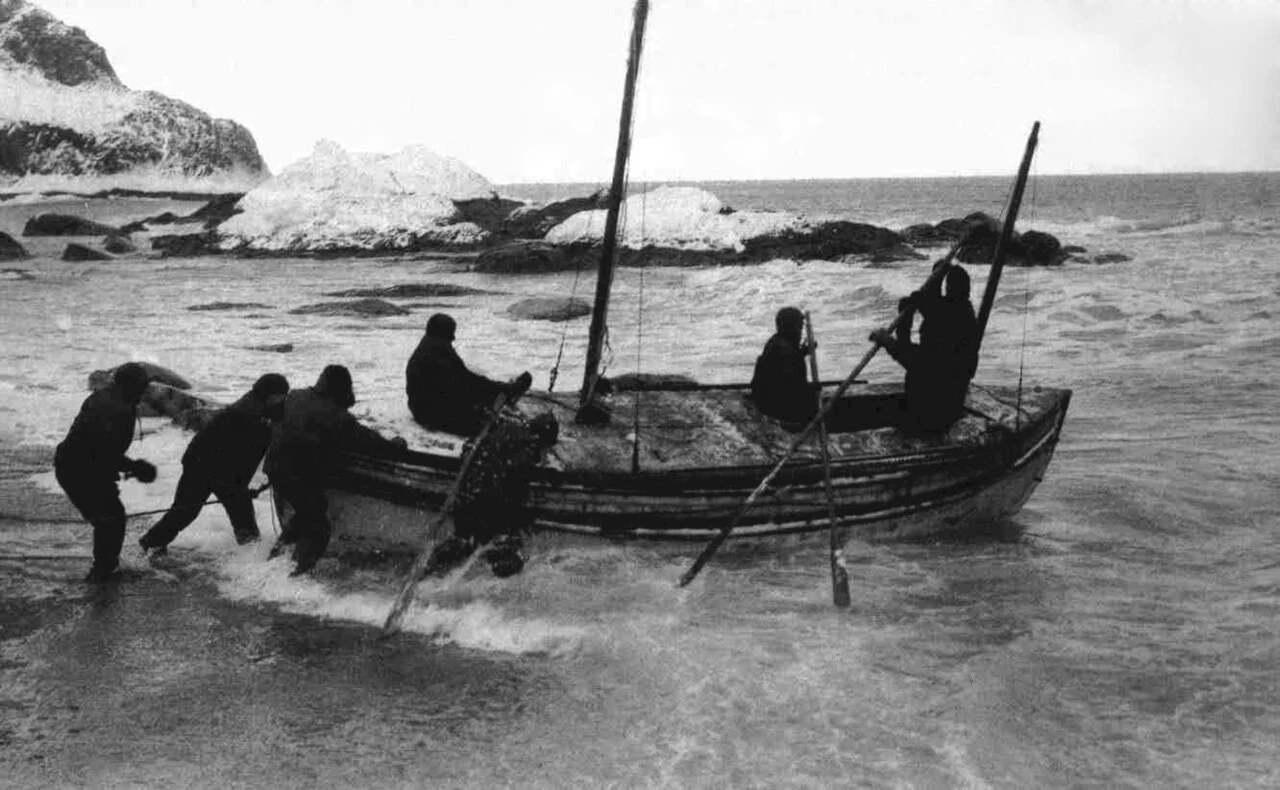
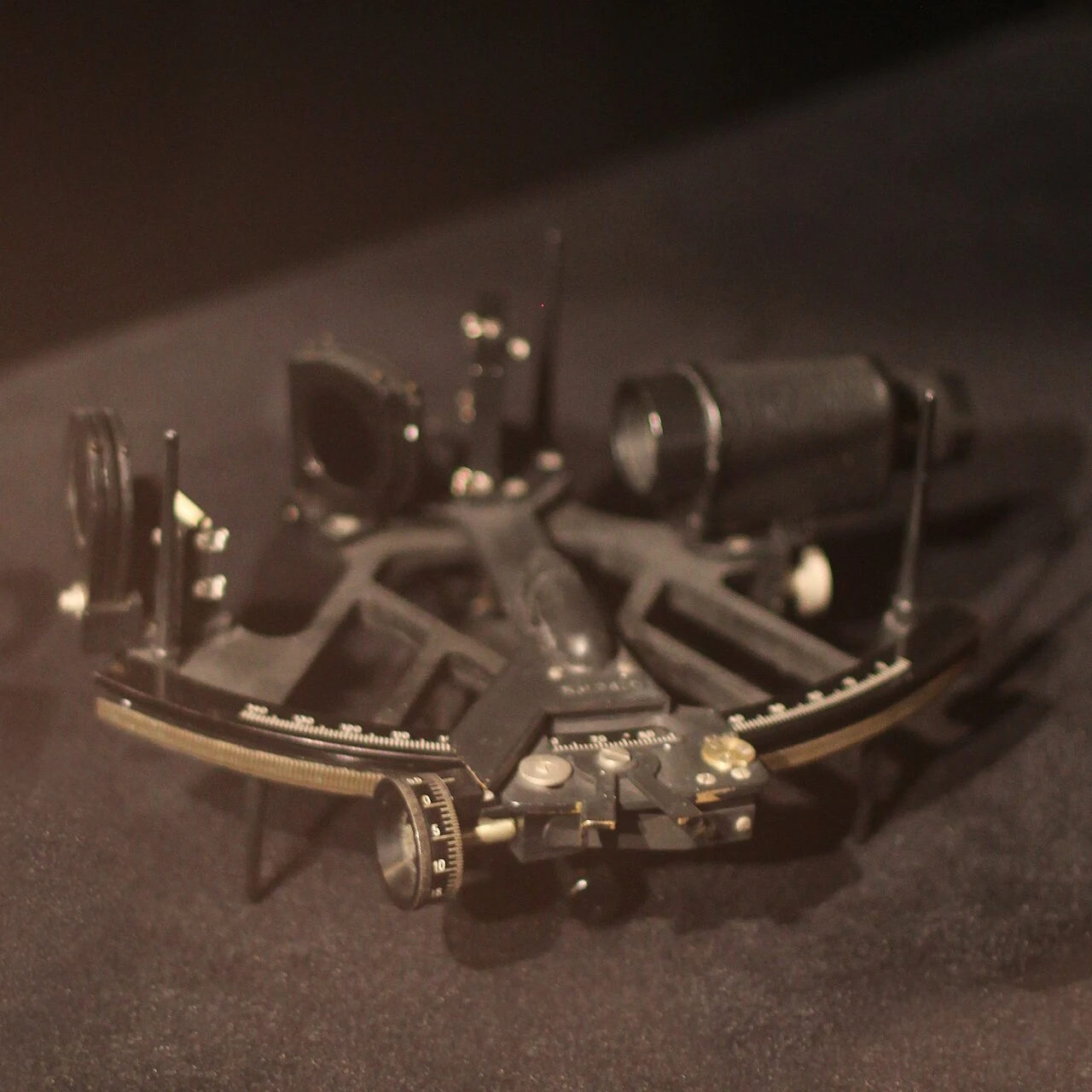
Launching the James Caird at Elephant Island, 24 April 1916. Photo: Frank Hurley, Wikimedia Commons, Public Domain.

1731–1759

From octant to sextant

In 1731, English mathematician John Hadley introduced the reflecting octant: a 45° physical arc (one-eighth of a circle) measuring angles up to 90°.

Measuring lunar distances for longitude demanded wider angles. Between 1757 and 1759, Captain John Campbell and instrument maker John Bird widened the arc to 60° (one-sixth of a circle), creating the 120° sextant.

Triangular brass

The A-frame architecture

A cast-brass A-frame with open lattice struts holds both mirrors coplanar against deck vibration and temperature swings.

Along the curved outer limb runs an inlaid silver scale graduated from 0° to 120°, read down to tenths of an arcminute.

Law of reflection

Optical doubling

Rotating the index arm by mechanical angle θ rotates the index mirror's normal by θ, steering the reflected beam through 2θ.

That optical doubling is why a 60° physical arc reads up to 120°: for a 60° solar altitude, the arm swings only 30°.

Pivoting mirror

The index mirror

Mounted squarely above the pivot, the large index mirror turns in lockstep with the arm, redirecting sunlight down toward the horizon glass.

Keeping this mirror perpendicular to the brass frame is the foundation of every accurate sight.

Split field

The horizon glass

Facing the telescope sits the horizon glass: its left half is silvered mirror reflecting the Sun from the index mirror, while its right half is clear glass looking straight at the sea horizon.

The navigator turns the arm until the lower limb of the golden Sun just kisses the cyan horizon line.

Eye protection

Hinged sun shades

Staring straight at the Sun through a telescope would blind a navigator in an instant. Hinged tinted glass shades pivot between the mirrors.

Flipped down individually or in combination, they tame solar glare without bending the light path.

0.1 arcminute

The micrometer drum

At the foot of the index arm, a worm screw engages teeth cut along the back of the limb. One full turn of the drum shifts the sight by exactly 1°.

The drum scale and adjacent vernier divide each degree into 60 minutes and tenths—0.1′ precision, less than 200 meters on the open ocean.

Finding true vertical

Swinging the arc

On a heaving deck, you cannot trust your eye for true vertical. Rocking the sextant gently around the telescope axis sweeps the Sun through a shallow U-shaped arc.

At the exact bottom of that swing, the frame passes through true vertical and the Sun touches the sea horizon.

Historic brass marine sextant with sun shades and telescope, Musée national de la Marine, Paris. Photo: Rama, Wikimedia Commons, CC BY-SA 3.0 fr.

−1.76 × √h

Dip of the horizon

Because Earth curves away beneath you, standing h meters above the water tilts the visible sea horizon slightly below true horizontal.

The dip correction is always negative: −1.76 × √h arcminutes (−3.94′ on a 5 m deck; −2.36′ from the 1.8 m eye height in Worsley's open boat).

Atmospheric lens

Refraction and semi-diameter

Earth's atmosphere bends starlight downward, making the Sun appear slightly higher than its geometric position—especially near the horizon.

Because navigators align the Sun's lower limb, adding the solar semi-diameter (mean +16.0′) recovers true center altitude Ho.

φ = 90° − Ho + δ

Noon latitude

At local apparent noon, zenith distance 90° − Ho combined with the Sun's daily declination δ yields latitude directly: φ = δ + (90° − Ho) when the Sun bears South, and φ = δ − (90° − Ho) when it bears North.

At Constanța (44.17°N) on the equinox (δ = 0°), the Sun bears South at 45.83°; from Worsley's boat at 54.50°S in May (δ = +16.80°N), it bears North at just 18.70°.

Up to 120°

Lunar distances

Before marine chronometers became affordable on every ship, navigators measured the angular distance between the Moon and bright stars—often between 90° and 120°.

John Bird's 60° frame proved that two simple mirrors could solve position across the entire globe.

Sight workbench

Reduce a sight on the 3D model

Adjust sextant altitude Hs, height of eye, and solar declination to watch the 3D light rays, split telescope field, and full sight reduction to noon latitude.

Split eyepiece: left reflects the Sun, right views the horizon.

Share

Send this 3D marine sextant reconstruction or copy the direct link.

Data and sources

Optical geometry, sight-reduction coefficients, and expedition records come from celestial navigation manuals and historical logs:

Parameter / SightVerified valueEquation or source
Hadley's octant (1731)45° arc → 90°Double reflection between two mirrors
Bird / Campbell sextant (1759)60° arc → 120°Needed for lunar distances > 90°
James Caird voyage (1916)800 miles (1,300 km)16 days, 4 Sun sights (Frank Worsley)
Dip of the horizon−1.76 × √h(m)′−3.94′ at 5 m; −2.36′ at 1.8 m
Atmospheric refraction (Bennett)−1 / tan(ha + 7.31/(ha+4.4))′Negative correction for apparent altitude
Solar semi-diameter (lower limb)+16.0′Added from lower limb to Sun center
  1. Nathaniel Bowditch, The American Practical Navigator — standard Dip and solar semi-diameter tables.
  2. G. G. Bennett (1982) — atmospheric refraction formula for celestial navigation.
  3. Frank Worsley, Shackleton's Boat Journey (1933) — James Caird navigation log, 24 April – 10 May 1916.
  4. Photographs: Marine sextant (Rama, Musée national de la Marine, CC BY-SA 3.0 fr) and Launching the James Caird (Frank Hurley, 1916, Public Domain).