Berlin, 1922–1923 · an engineer from Bucharest · German patent no. 402683
Persu’s car
Four wheels sealed inside a teardrop of aluminium. Put the patent drawing in the wind.
In November 1922 Aurel Persu, an engineer born on Bucharest’s Calea Victoriei and trained in Berlin, applied for a patent on a car with all four wheels inside the body. To fit the narrow tail, the rear wheels sit closer together than the front ones. Below is his own drawing in a stream of air. Pull the rear wheels out to the spacing of an ordinary car and watch the smoke.
The model is two-dimensional and the flow slow (a Reynolds number of a few hundred, against millions for a real car). It gives a rough picture of the wake behind the body, not the drag coefficient. The measured figures are in the “What was measured” panel.
The patent
A falling drop, laid on four wheels
Aurel Ștefan Nicolae Persu was born on 26 December 1890 in his parents’ house at 183 Calea Victoriei, Bucharest. In 1909 he went to Berlin, to the Technical College in Charlottenburg, where the first systematic measurements on motor cars had been made, and graduated with distinction in 1913. After the war he went back for courses in aerodynamics, and by 1922 he had a drawing.
According to the history of the Academy of Romanian Scientists, Persu took his inspiration from the elongated shape of a falling drop. He himself described the body differently: as the upper half of a bird’s body, “say a pigeon”, higher and broader in its first third, then narrowing gradually towards the rear.
The US patent, filed on 30 October 1923 and granted on 8 November 1927, states its aim in the first paragraph: to reduce wind resistance to a minimum. On the streamlined cars of the day, Persu wrote, the rear wheels and the spare wheel stayed outside the shape and caused considerable losses. His answer was a single surface that swallowed the wheels too, with the passengers at the front, where the body is highest, and the engine at the back, where the tail narrows.
“The endeavour of the motor designer should not lie in the continual increase in the motive power but in the reduction of losses.”
Aurel Persu, US patent 1,648,505 (1927)
A narrow tail needed narrow-set wheels. Persu turned the constraint into an argument: with the rear wheels so close together, a differential was no longer needed. A single bevel wheel on a through axle, he argued, would replace “the seven toothed wheels on the usual vehicles” and cut transmission losses. The patent admits the cost: four separate tracks could add rolling resistance on soft roads, and the rear tyres slip slightly in bends.
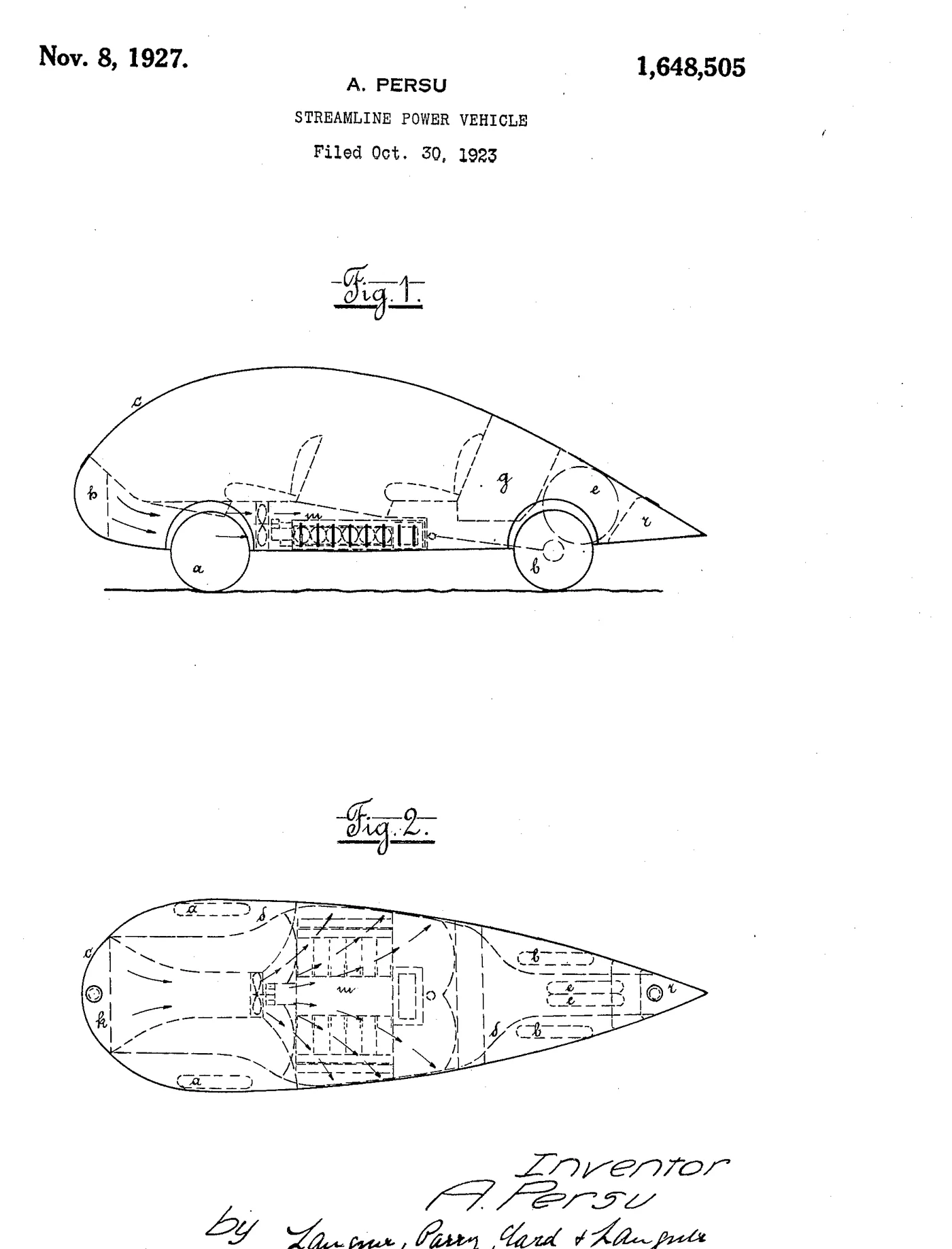
One drawing, six countries
- 13 Nov 1922German application; patent no. 402683 issued on 19 September 1924
- 25 Sep 1923Austria, no. 100478
- 9 Oct 1923Switzerland, no. 106911
- 17 Oct 1923France, no. 572002, logged at 13:51: “motor vehicle in the shape of a projectile”
- 19 Oct 1923Britain, no. 206823; address: 202 Calea Victoriei, formerly 90 Paulsborner Straße, Berlin
- 30 Oct 1923United States, no. 1,648,505, not granted until 1927
Berlin, July 1923
“Will this car shape catch on?”
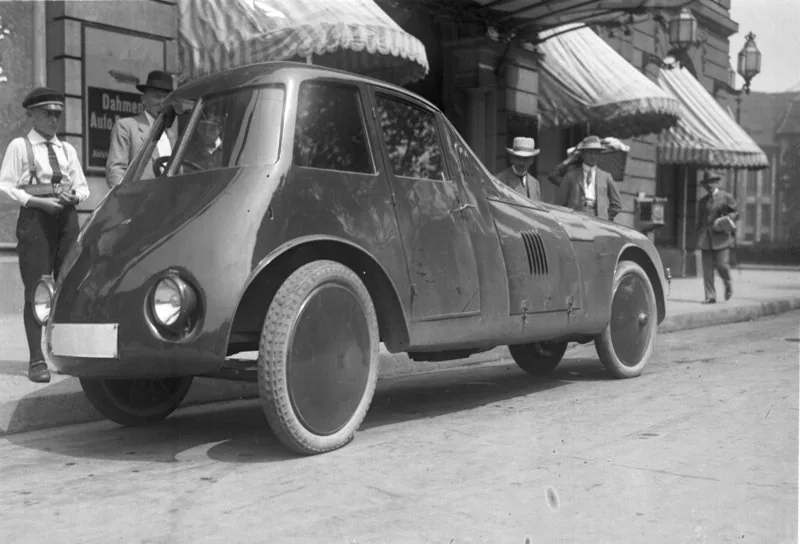
In July 1923 the photographer Georg Pahl photographed an unusual car on a Berlin street. It had a rounded nose with low-set lamps, wheels behind solid discs, cooling slots on the flank and a tapering tail. The German Federal Archives, which holds the negative, identifies it as Aurel Persu’s car. The original caption does not name him.
The caption asks a question and makes a promise: “Will this car shape catch on? A streamlined limousine in the streets of Berlin. The engine is mounted at the rear. The speed reaches up to 150 km per hour.”
The promise can be checked. On a level road in still air, top speed is where the power reaching the wheels just balances aerodynamic drag and rolling resistance. Gearing or the engine’s curve can only lower it, so a power balance gives a ceiling, not an estimate. Into it go the reported outputs of the 1.4-litre AGA engine, the drag measured on the scale model, and a frontal area of roughly 1.65–1.86 m².
The power budget
How fast could it go on 20 horsepower?
Choose the engine’s power, by the source that reports it, and the drag coefficient. On a level road in still air, the bar shows the speed at which the power reaching the wheels would balance aerodynamic drag and rolling resistance, under the chosen assumptions.
Engine power (metric hp)
Drag coefficient
Assumptions
At the 20 horsepower most sources give, the ceiling is 99 km/h on realistic assumptions and 115 km/h on the most generous ones. With the measured drag coefficient, 150 km/h would have needed 40 to 55 hp.
With the measured coefficient, no reported power clearly reaches 150 km/h. The 40 hp of the 1980 heritage valuation gives 133 km/h on realistic assumptions and 149 km/h on the most generous ones, within the margin of error. Only with an unmeasured coefficient of 0.22 would the same power clear the mark: 154 km/h.
At 20 hp, reaching 150 km/h would have needed a drag coefficient of 0.074 or less on realistic assumptions, or 0.145 or less on generous ones: two to five times lower than the scale model’s, and below any figure ever cited for the car.
The caption’s figure does not fit the engine most sources describe. The 80 km/h “cruising speed” on the museum label and the “70–100 km/h” of the 1980 valuation are plausible under these assumptions.
How it was calculated
The calculation: power at the wheels = ½ × air density (1.2 kg/m³) × drag coefficient × frontal area × v³ + rolling-resistance coefficient × mass × g × v; engine power in metric horsepower (1 hp = 0.7355 kW), multiplied by the transmission efficiency. Frontal area: the outline of the nose in a 2011 photograph fills 83% of the width × height rectangle. Applied to the dimensions in the Cazacu volume (1.40 × 1.60 m) and those given by the restorers (1.26 × 1.58 m), that gives roughly 1.65–1.86 m². The 1,050 kg mass comes from a Czech catalogue, with no weighing record. At 20 hp, changing the area by 0.15 m² moves the ceiling by 2–3 km/h; the reported power and the drag coefficient move it much more.
0.22 · 0.28 · 0.36
The cited coefficient and the measured one
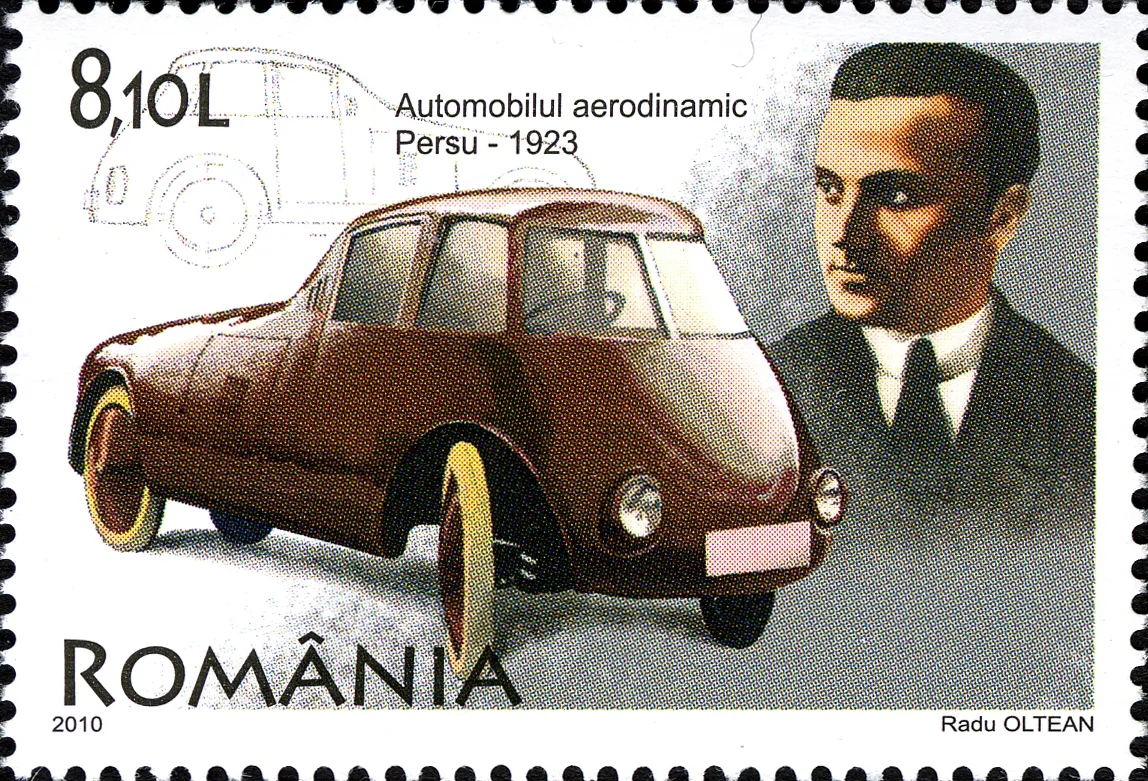
Online, in the press and in the notes to a Romanian stamp from 2010, Persu’s car has a drag coefficient of 0.28, or even 0.22, figures worthy of a modern sports car. Neither rests on a published measurement.
The first published measurement came only in 2025. Adrian Clenci and Victor Iorga-Simăn, of the Pitești University Centre of Politehnica Bucharest, with Amélie Danlos and Ivan Dobrev of Arts et Métiers in Paris, 3D-printed a 575-millimetre model at 1:8 scale and put it on the balance of a wind tunnel. The study, presented in September 2025 and published in January 2026, gives 0.364 at 10 m/s and 0.355 at 33 m/s in its measurement section; its abstract gives 0.364 for 33 m/s too. A computer simulation gave 0.353. On a second, 207-millimetre model they tracked olive-oil droplets by laser light: on average, the region where the air flows back behind the cabin extends about a quarter of the model’s length.
On 0.28, the authors write that no published measurement supports it, and suggest a mix-up. 0.28 is the figure measured in 1979, in Volkswagen’s tunnel, on Edmund Rumpler’s Tropfenwagen, the 1921 teardrop car Persu is always compared with. Rumpler had left his wheels outside. The 0.22 does not appear in the paper at all.
The authors set out the limits of their measurement. The model was eight times smaller, the Reynolds number several times lower than a real car’s at road speed, the wheels did not turn and the floor was fixed. The coefficient fell slightly with speed, but the authors expect the full-size value to be close to the model’s. Either way, far from 0.22.
Even at 0.36, the car is remarkable for 1923. A Ford Model T, by the measurements quoted in Road & Track, had 0.79 and a frontal area of 2.6 m². At 60 km/h the calculation gives about 5.7 kilowatts for aerodynamic drag alone on the Ford, and about 1.75 on Persu’s car. Persu’s idea was sound; it is the figures later attached to it that are inflated.
The car he built is not quite the drawing
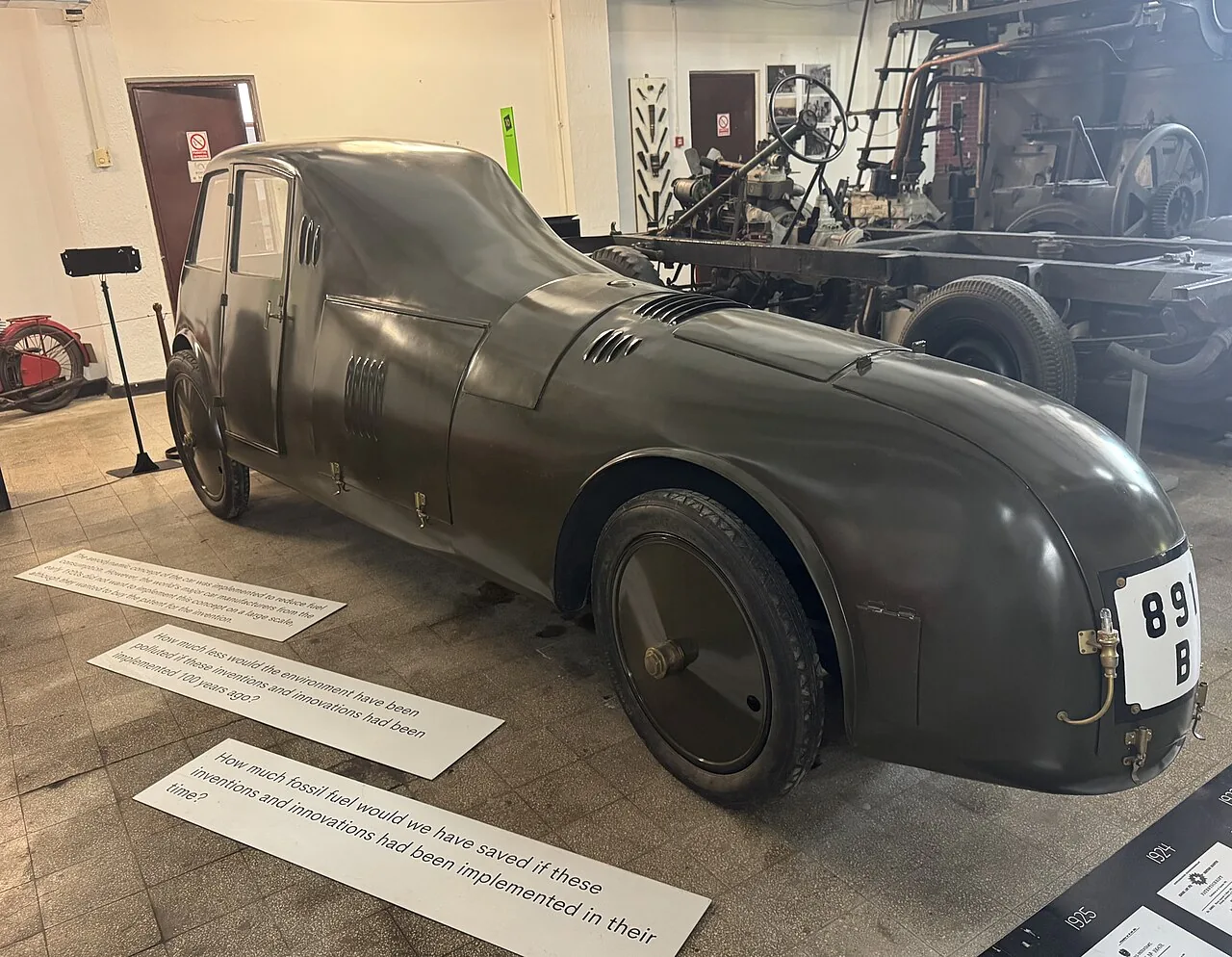
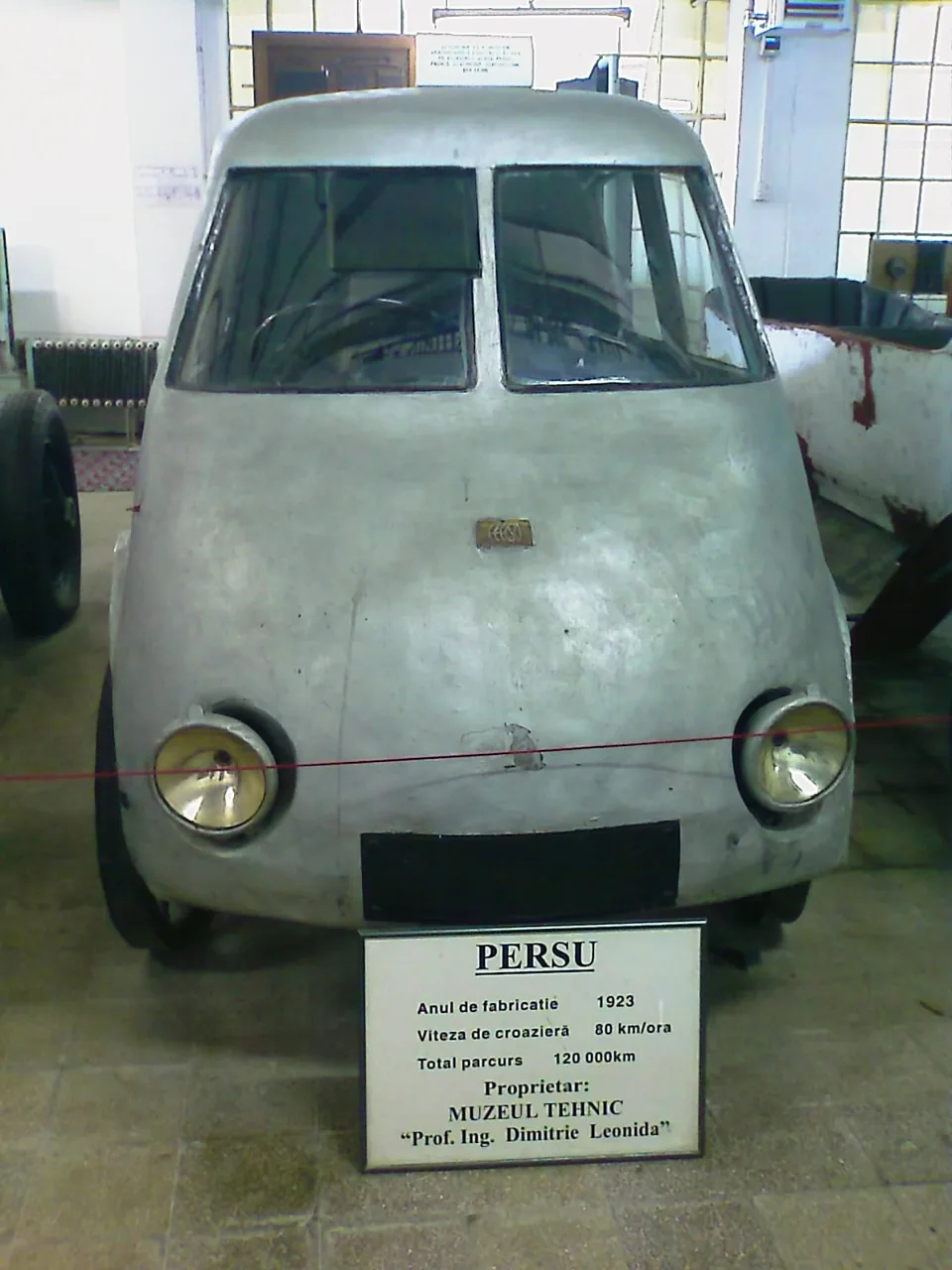
Persu built the car from standard parts, so he departed from the patented shape. The cabin is taller and more upright than in Fig. 1, and the front wheels are partly exposed. On the drawing the rear track is about 44% of the front; on the built car it is 58–60%, depending on the source (700 against 1,200 or 750 against 1,240 millimetres). The tunnel above uses the drawing; the Paris models use the car.
Aluminium, ash and an AGA engine
An AGA Typ A turned inside out
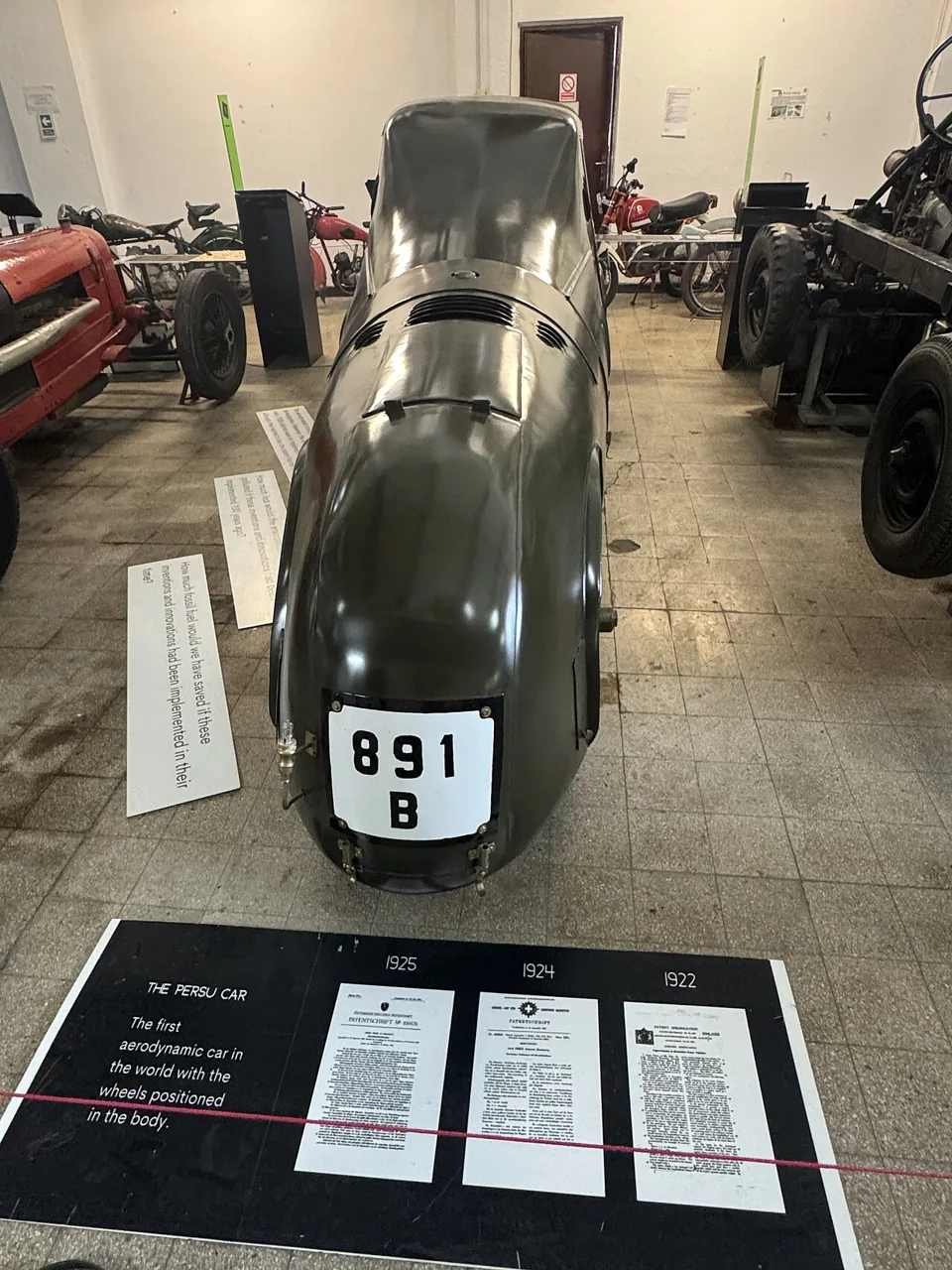
The chassis and engine came from an AGA Typ A, a small car made in Berlin; TurboMag puts production at about 6,000. Persu narrowed the frame, moved the 1.4-litre, 20-horsepower engine behind the driver, and ordered a radiator shaped to fit the tail from Norddeutsche Kühlerfabrik in Tempelhof. He fitted solid covers over the wooden-spoked wheels to cut the air friction further.
His son, Nicolae Persu, remembered that his father built a full-size wooden form and shaped the aluminium panels over it himself. The hole in the right flank is not damage: it was the outlet for the horn. And the shape is so unusual, the restorers write, that many visitors still mistake its front for its back.
The dimensions differ from source to source: 4.60 or 4.75 metres long, 1.40 or 1.26 wide, 1.60 or 1.58 high. The figures for distance driven differ even more. A 1970 magazine wrote “over 100,000 km”, the son spoke of 62,000 miles on the odometer, the museum label says 120,000 km, other sources 150,000 or 160,000. The logbook has not been found.
1890–1977
The professor who would not sell his patent
Persu came home in 1925 and brought the car with him. He taught mechanics at the Electrotechnical and Industrial Chemistry institutes, lectured on motor cars at the Polytechnic School, built oil pipelines for the Romanian railways, and at the Royal Automobile Club organised the Carpathian Cup and the Sinaia hill climbs. From 1938 to 1940 he was managing director of the aircraft manufacturer Industria Aeronautică Română (IAR) in Brașov. The Romanian Academy of Sciences elected him a corresponding member in December 1935.
According to the historian Ralf Kieselbach, who does not name his source, in 1924 an American manufacturer whose name has not survived wanted to buy the patent only to shelve it. Persu refused, convinced the car could go into production. A Romanian magazine in 1970 named Ford and General Motors. No letter or offer has been found.
After 1948 the communist regime pushed him out of teaching. From 1953 to 1962, until he was 72, he played the cello in the Cinematography Symphony Orchestra. In 1973 he printed a pamphlet in French addressed to the car industry, with an updated teardrop car and a panoramic windscreen. He died in Bucharest on 5 May 1977.
The Technical Museum
From a garage to the museum, then to Venice
The car stayed in Persu’s garage from 1925 until he gave it, in running order, to the Technical Museum. The year of the gift differs: 1961, according to the Academy of Romanian Scientists; 1969, according to Kieselbach and the restoration account. The February 1970 issue of Sport și Tehnică already showed it in the museum.
Between 5 January and 18 April 2023 a team led by Florian Marin restored it in time for the Venice Architecture Biennale; according to TurboMag, Marin met the costs. The original colour was recovered from traces of paint on the inside of the door pillars. The missing rear lamp was remade from old photographs and other AGA lamps. The museum’s historic wing reopened on 28 March 2026 with the car on show.
On 17 December 2010 the Romanian post put it on an 8.10-lei stamp, in a series on “world firsts”, printed in 22,600 copies. The issue’s presentation text on the Romfilatelia website repeats the 0.28.
Sources
Every statement above comes from the sources below. Where sources disagree, the text gives the versions and who holds them.
- Aurel Persu, US 1,648,505, Streamline Power Vehicle, filed 30 Oct 1923, granted 8 Nov 1927.
- Reichspatentamt, DE 402683, issued 19 Sep 1924; and the national patents FR 572002, GB 206823, CH 106911, AT 100478 (DEPATISnet).
- A. Clenci, A. Danlos, I. Dobrev, V. Iorga-Simăn, “On the Aerodynamic Characteristics of the Aurel Persu Car”, Engineering Proceedings 121(1):29, presented Sep 2025, published 21 Jan 2026 (CC BY 4.0).
- Bundesarchiv, Bild 102-09892, Georg Pahl, July 1923, with the original caption.
- Ralf J. F. Kieselbach, “Persu, a Romanian Study of Aerodynamics”, Automotive History Review 38, pp. 42–43.
- Aurel Persu, inventor of the aerodynamic car (the family and colleagues’ volume edited by Cazacu): biography, dimensions, patent list, cello.
- TurboMag, “Automobilul aerodinamic Persu”: the AGA Typ A donor, 20 hp, radiator, horn, restoration 5 Jan–18 Apr 2023.
- Dennis Simanaitis, “Tunneling Through Time”, Road & Track, 15 Mar 2010: Model T, 0.79 and 28.0 sq ft.
- W.-H. Hucho, Kultur & Technik 1/1990: the Rumpler Tropfenwagen at 0.28 in the Volkswagen tunnel, 1979.
- History of the Academy of Romanian Scientists (AOSR), vol. I, and its profile of Persu: the falling drop, the 1961 gift.
- Sport și Tehnică, February 1970: the car in the museum, “over 100,000 km”, Ford and GM.
- Norme de evaluare a bunurilor din patrimoniul cultural național, 1980, p. 41: 40 CP, 70–100 km/h.
- Auta5P catalogue: 1,050 kg, 1,418 cm³, 20 hp at 2,200 rpm.
- AGERPRES, 23 Jan 2019; L’Automobile Ancienne (22 hp, 120,000 km).
- Laura-Maria Albani, Arhitectura, June 2023: the car at the Venice Biennale; AGIR: the wing reopened on 28 Mar 2026.
- Piața Auto, August 2023: “about 10 hp”, 120,000 km; Romfilatelia: the stamp issue text with 0.28.
- Philatelica 11/2010, p. 28: the 8.10-lei stamp, 22,600 copies.

Images
- Bundesarchiv, Bild 102-09892 / Georg Pahl / CC BY-SA 3.0 DE
- AlexTop26, Wikimedia Commons, CC0
- AlexTop26, Wikimedia Commons, CC0
- L. Kenzel, Wikimedia Commons, CC BY 3.0
- Romanian Post, 2010, public domain (PD-RO-exempt)
- US Patent Office, 1927, public domain