Fish, person and depth share one scale. Distance along the river is compressed.
Danube beluga · Iron Gates · km 943
The fish older than the dam
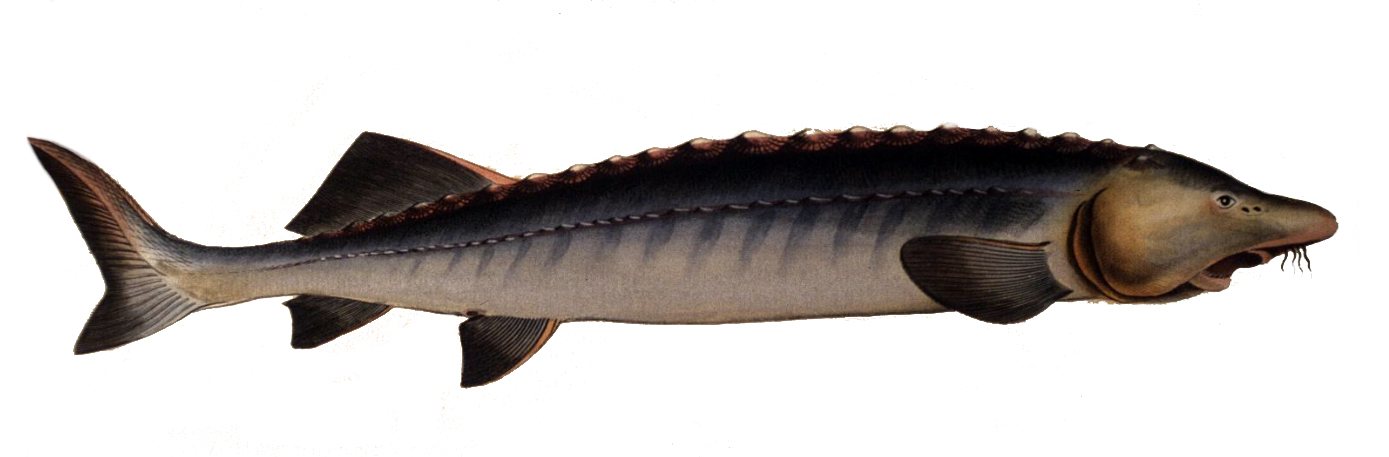
Belugas once swam up the Danube to spawn in Slovakia and Hungary. They were already vanishing in 1972, when a dam closed the river at the Iron Gates. Here is one, drawn to scale beside you, swimming up toward it.
scroll
How big, how old
The largest size on record is a published figure, not a weighing: 800 cm and 3.2 tonnes (FishBase, citing Kottelat and Freyhof 2007). The longest fish measured in a sample of 7,791 Caspian belugas was a 63-year-old female, 420 cm to the fork of the tail (Fazli et al. 2020).
Ages of 100 years or more are estimates for single giants: a 490 cm, 1,004 kg female caught in the northern Caspian in 1937 was put at 91 to 101 years, and a 400 cm, 725 kg male of 1940 at 107 to 118. The review lists recorded ages of 60 years in the Caspian and 36 in the Black and Azov Seas (Reinartz 2002); Fazli et al. later aged a 63-year-old.
A fish that fed an army
In 1053 the troops of Emperor Henry III marched along the Danube. A report of the time says they would most probably have starved without 50 huge belugas (quoted by Reinartz 2002).
Belugas ran up to Austria and, by one account, to the German stretch at km 2,320 (Siebold, 1863). Fishing for migratory sturgeons in Austria collapsed in the 18th century.
Where it went to spawn
The main spawning sites lay between km 1,766 and km 1,866, in what is now the Slovak–Hungarian stretch of the river (Hensel and Holčík 1997, quoted by Vassilev 2003). From the sea that is a run of about 1,800 km, past every town on this page.
Already fading
Overfishing of the adult spawners made beluga catches in the Middle Danube decline from the 16th century. By the 19th century only a few belugas were caught. The last one recorded in the Slovak–Hungarian stretch was a 3.1 m, 150 kg female taken near Štúrovo in 1925. Serbian fishermen still fenced the Iron Gate gorge with weirs until the First World War (Reinartz 2002).
The last open stretch
Until 1972 no dam crossed the river at the Iron Gates. Barges now pass the dams through ship locks, and migratory sturgeons only occasionally pass both dams that way. Reinartz documents one beluga, a 3 m, 181 kg male caught at Paks in Hungary (km 1,526–1,528) on 16 May 1987; Guti (2014) lists two, in 1972 and 1987, most likely through ship locks. A fish pass was still at the feasibility stage in the latest source found (WePass2, 2021–24).
The first wall
Iron Gates I stands at about km 943 (sources give 942 or 943). The dam is 1,278 m long and 60 m high. The lake behind it reaches 69.5 m above sea level and runs more than 140 km up the river (Nistor et al. 2021, citing Aquaproiect). It opened in 1972.
Fish gathered below it
From 1972 to 1976, 115.7 tonnes of beluga and Russian sturgeon together were caught below the dam, 23.1 tonnes more than in the five years before dam construction. In the five years 1980–84 the same catch totalled 37.3 tonnes (Reinartz 2002, whose timeline table calls these Serbian catches).
A fish of several metres against a 60 m wall: the picture is zoomed out, and fish, person and depth keep one scale.
A second wall, 80 km closer
Iron Gates II, at about km 863, was finished in 1984 (one table in Reinartz 2002 gives 1980) and has two ship locks (Bloesch 2016). The stretch between the walls became a lake, and the end of the beluga’s river moved 80 km downstream.
A tagged male swam 747 km, at 41.5 km a day, to reach the Iron Gates II dam in time for the spawning season (Suciu et al. 2016).
The catch was already low before the dam
The official Romanian catch of all sturgeon species was about 1,144 tonnes in the 1939/40 season. It averaged about 650 tonnes a year in 1920–39 and about 210 in 1941–50, and stayed between about 110 and 390 tonnes a year from 1941 to 1973. In 1995 it was under 8 tonnes (Navodaru et al. 1999, compiled by Reinartz 2002).
Official catch of all sturgeon species, Romania, metric tons a year, 1920–1997. Bars read from the printed graph, one per year; the graph prints two-year labels on three bars (1929/30, 1934/35, 1939/40), and its bar for 1953 is missing.
In 1972, the year the wall closed, the catch was 222 tonnes, close to the decade before (average 213 tonnes, 1962–71). The decade after averaged 111 tonnes (1973–82). It fell under 100 tonnes in 1978.
The series has one break the source does not explain: from about 1,144 tonnes in the 1939/40 season to 339 and then 126 in the next two years. A change in what was counted, such as territory or reporting, cannot be excluded. After that, it shows no abrupt fall in 1972. By 1972 the official catch was already about a third of its 1920–39 level, and belugas had been vanishing from the upper river for centuries. A second fall began in the mid-1970s. The dam, fishing pressure and everything else that changed in those years move together in this series; it cannot separate them.
What it does not say: no beluga-only annual series was found open. For the Lower Danube as a whole, annual beluga catch between 1958 and 1981 ranged from 19.7 to 240.4 tonnes, averaging 105.6 (Joint Commission figures, quoted by Reinartz 2002). In 2002 Reinartz reported that illegal and unreported fishing could, regionally, make up about half of all fish caught and up to 90 per cent of the sturgeon catch, so official figures understate it.
Spawning reaches, then and now
Below the walls, 13 spawning sites between km 755 and km 840 were listed in the Bulgarian stretch in May 2002, on gravel 9 to 22 m deep (Vassilev 2003). Kynard and colleagues placed five more potential sites between km 150 and km 600 (quoted second-hand by Vassilev; not opened).
Above the walls, the old main reach lay between km 1,766 and km 1,866. A beluga from the Romanian Danube met the first wall about 820 km short of it. By then the last beluga recorded there, a female near Štúrovo, was 47 years in the past (1925).
Caviar and the 2006 ban
CITES gave Romania yearly export quotas for beluga caviar: 1,750 kg for 1999, 3,200 kg for 2000 and 3,100 kg for 2001 (table in Reinartz 2002).
From April 2006 a joint order of Romania’s agriculture and environment ministers banned, for ten years, commercial fishing of wild sturgeon and trade in products from wild sturgeon caught in Romania. Accidental catches must be released, and live breeding fish may be taken for hatcheries with authorisation. Reports say the ban was later extended and, in 2021, made indefinite (Emerging Europe).
What changed after the ban cannot be shown here: the official series above ends in 1997, and no later series was found. The order’s number was not printed in the text read.
What the picture draws, and what it does not
- The river bed is drawn, not surveyed. No open depth profile along the Danube was found. The only published depth used is 24 m in the Cerna Gulf, km 953–955 (Nistor et al. 2021). Water level behind each wall is drawn as a step; its height is not measured here.
- The growth curve is from the Caspian. It was fitted to 5,202 aged fish of the southern Caspian (Fazli et al. 2020). No open length-at-age table for the Danube was found. Other published Caspian fits give much smaller maximum lengths: 265 cm for males and 276 cm for females, against 440 cm (Bakhshalizadeh et al. 2021).
- Distances are along the river, in the Romanian kilometre numbering with zero at Sulina. Sources differ by 1 km on the walls’ positions.
- The fish at the start is drawn just under the surface beside you, for size. Its depth in the river is not drawn from data.
- Records are few. GBIF holds only 57 records of Huso huso from Romania: 49 are tissue samples from one set in 2019, and the rest are museum specimens (1935–2007) or undated. They show who records, not where the fish are.
Sources and method
Sources
- Reinartz R. (2002). Sturgeons in the Danube River: biology, status, conservation. WWF / Bezirk Oberpfalz. Catch figures: Fig. 4A (Romania, official data compiled by Navodaru et al. 1999), Table 5 (CITES quotas), section 4 (1972–76 and 1980–84 catches, Joint Commission figures, the 1053 report). link
- Fazli H. et al. (2020). Growth and population dynamics of beluga sturgeon in the southern Caspian Sea. Croatian Journal of Fisheries 78: 1–10. 5,202 aged fish; von Bertalanffy fork-length parameters; the 63-year-old female; the 118-year and 50–55-year ages as quoted. link
- FishBase: Huso huso summary (800 cm and 3.2 t as published figures, citing Kottelat and Freyhof 2007; 118 years reported). link
- Vassilev M. (2003). Spawning sites of the beluga on the Lower Danube (Bulgarian stretch, May 2002); quotes Hensel and Holčík (1997) on km 1,766–1,866 and Siebold (1863) on km 2,320. WWF. link
- Bloesch J. (2016). Major obstacles to the Danube sturgeon spawning migration. Danube News. Dams at river km 943 and 862; 1972 and 1984; two ship locks at Iron Gates II. link
- Guti G. (2014). Sturgeons in Hungary. Acta Zoologica Bulgarica, Supplement 7: 63–67 (Iron Gate I at rkm 943, II at rkm 863; two belugas, 1972 and 1987, most likely through ship locks). link
- Nistor M.-M. et al. (2021). Sediments in the Iron Gates I reservoir. Acta geographica Slovenica 61(2). Dam length and height, maximum retention level 69.5 m, reservoir length, Cerna Gulf depth. link
- Suciu R. et al. (2016). Danube beluga sturgeon monitoring. Danube News (telemetry of a tagged male: 747 km at 41.5 km a day to the Iron Gates II dam). link
- Joint order of the Romanian ministers of agriculture and of environment on sturgeon conservation, April 2006 (English text hosted by WWF; draft form, order number not printed). link
- Emerging Europe (29 April 2021): Romania bans fishing and sale of wild sturgeon indefinitely. link
- WePass2 (2021–2024): feasibility study of fish passage at the Iron Gates, Institute for Multidisciplinary Research, Belgrade. link
- Bakhshalizadeh S. et al. (2021). Age and growth of beluga in the southern Caspian Sea. Oceanological and Hydrobiological Studies 50(3): 325–332 (L∞ 265 cm males, 276 cm females, fork length). link
- GBIF.org: occurrence records of Huso huso in Romania, counted 13 November 2026 (57). link
- Krüger J. F. (1795–97), Huso huso, hand-coloured plate. Public domain, Wikimedia Commons. link
- River kilometres and towns: AFDJ Galați maintenance presentation (Danube Commission 2024), Navrom, via donau port sheets, as compiled for the project on the Danube’s own ruler. link
mariuscomper.uk · Catch data: Navodaru et al. 1999, via Reinartz 2002 · Plate: J. F. Krüger, 1795–97