mariuscomper.uk RO
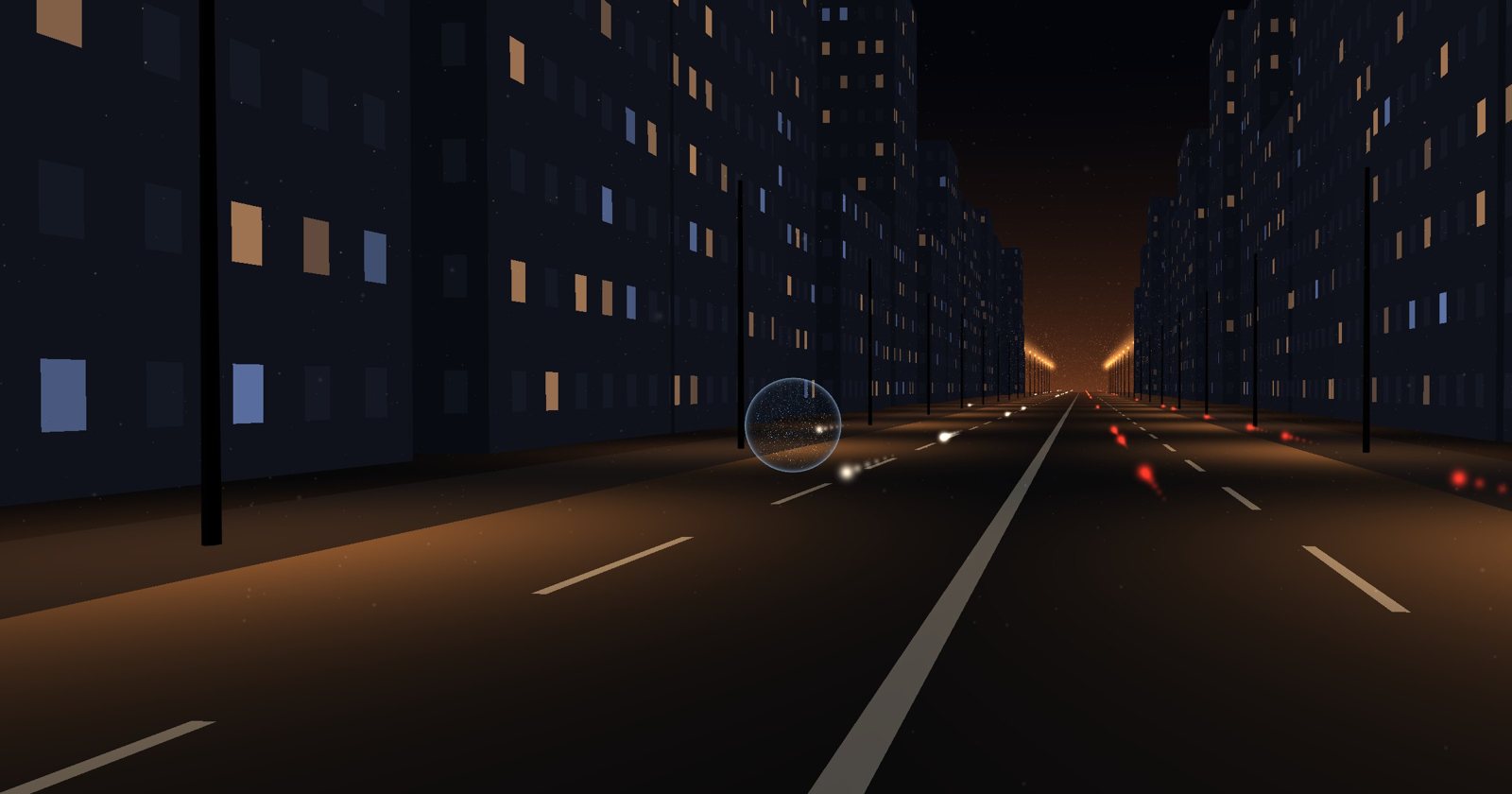
A boulevard at night, with street lamps and a glass sphere the size of one breath.

Air pollution, followed inside the body

One breath

At rest you breathe about 12 times a minute, some 17,000 times a day, half a litre each time. Follow one breath taken on a busy boulevard, from the street into the blood, and see where each kind of particle ends up.

half a litre

What half a litre of air holds

An ordinary breath at rest moves about half a litre of air. Gathered into a ball, it would be just under 10 centimetres across: it is drawn here at true size.

Next to heavy traffic, a single cubic centimetre of air can hold anything from ten thousand to a million particles. The World Health Organization treats more than 10,000 particles per cubic centimetre, averaged over a day, as a high level. At that level, the breath in front of you holds 5 million particles.

You can see almost none of them. Together they weigh very little: at the annual average of fine particles (PM2.5) that people in Romania breathe, 15.7 micrograms per cubic metre, the breath holds about eight billionths of a gram.

a human hair · 70 µm

A hair and a grain of dust

The brown cylinder is a human hair, about 70 micrometres thick (µm, thousandths of a millimetre). The grain beside it is 10 µm: the upper limit of what monitoring stations call PM10, such as dust thrown up from the road.

The smaller bead is 2.5 µm, the upper limit of fine particles, PM2.5. About 30 of them would fit side by side across the hair. The last one is 1 µm.

Air-quality reports weigh these particles. In a breath, though, most particles are far smaller and weigh almost nothing.

smaller than a wavelength of light

Soot from an exhaust pipe

Exhaust soot looks roughly like this: carbon spheres of 20–30 nanometres (nm, thousandths of a micrometre) stuck together in a loose cluster. The clusters are between 30 and 500 nm. The blue dot beside it is 20 nm.

Particles below 100 nm are called ultrafine. Near traffic they are the majority: beside one London road, in a study cited by a 2008 review, they were between 71% and 95% of the total by number. By mass they count for very little, so a PM2.5 reading barely registers them.

nose and throat

The big ones stop at the door

Now the breath goes in. A 10 µm particle is too heavy to follow the air round the bends of the nose and throat: it hits the wall and stays there.

The lung model used by the International Commission on Radiological Protection (ICRP) gives the shares for every size. Of the 10 µm particles drawn in with the air, 96% stop in the nose and throat. Mucus then carries them to the back of the throat, where they are swallowed.

windpipe and bronchi

Twenty-three branchings

Below the throat, the windpipe, about 1.8 centimetres wide, splits in two. Each branch splits again, and so on, 23 times, down to the alveoli. The drawing shows the first 12 levels.

Particles of 0.2–0.3 µm get through most easily: too light to hit the walls at the bends, too large to drift to them quickly as air molecules knock them about. In the ICRP model, almost nine in ten are breathed back out.

the alveolar region

The smallest go deepest

Ultrafine particles neither fall nor crash at the bends. Air molecules knock them in every direction, and that random motion carries them to the walls. The deeper the air goes, the narrower the passages, the slower the air, and the more time they have.

Of the 20 nm particles you breathe in, the model puts 48% in the alveoli, the region where oxygen passes into the blood. That is close to the largest share for any size.

you pick the size

Breathe in a size

Pick a particle size and hold the button to breathe in. Each dot follows the model’s odds for that size: where it stops, or whether it comes back out.

20 nm
Nose and throat0%
Airways0%
Alveoli0%
Breathed out0%

Shares are of the particles drawn in with the air, from the ICRP model, averaged over men and women at three levels of activity; very large particles are partly not drawn in at all.

~0.2 mm

480 million alveoli

The airways end in about 480 million alveoli, from a count made in 2004 in six adult human lungs (between 274 and 790 million). The average one is about 0.2 millimetres across.

Spread out flat, their walls would cover between 130 and 143 square metres, depending on the estimate: about half a doubles tennis court. Between the air and the blood, the tissue thickness that matters for diffusion, an average weighted towards the thin places, is 0.62 µm, more than a hundred times thinner than the hair from earlier.

the cell that cleans up

The cell that cleans up

Macrophages crawl over the alveolar walls and swallow what lands there. The cleaning is slow: particles that do not dissolve are removed from the alveolar region over months or years.

the capillaries round the alveoli

Some cross over

Every alveolus is wrapped in capillaries. Some ultrafine particles pass through the wall into the blood.

In 2017, at the University of Edinburgh, 14 healthy volunteers breathed in gold nanoparticles for two hours, used as a tracer. Gold appeared in blood and urine between 15 minutes and 24 hours after exposure and was still there three months later. In three patients due for surgery on a carotid artery who breathed in gold the day before, gold was found in the fatty plaque removed during the operation.

in the blood

Carried round the body

Once in the blood, particles are carried round the body. In the gold study, more gold turned up after 5 nm particles than after 30 nm ones: in that study, the smaller particles crossed more readily.

brain · placenta

In the brain and the placenta

In 2016, researchers from Britain and Mexico examined brain tissue from 37 people in Mexico City and Manchester, aged 3 to 92. They found rounded particles of magnetite, mostly 10 to 150 nm, of the kind formed at high temperatures and common in polluted air. The authors think the particles came from outside the body, possibly through the nose. Whether they do harm was not tested.

In 2019, researchers in Belgium found black carbon particles, the kind found in soot, in all 25 placentas they examined, including on the side facing the foetus. Other researchers dispute that interpretation.

Finding a particle somewhere does not on its own show that it does harm. The evidence of harm comes from elsewhere: from studies that follow the health of millions of people.

the air you breathe

What it means for Romania

The annual average PM2.5 that people in Romania breathed was 15.7 micrograms per cubic metre in 2023. WHO recommends no more than 5. In Bucharest in 2024, the official stations measured annual averages between 12.1 and 14.1, highest at the Cercul Militar traffic station. One indicative monitoring point, with an optical monitor, reached 25.1.

The European Environment Agency estimates that in 2023, exposure to PM2.5 above the WHO level led to 14,066 deaths in Romania. Per head of population over 30, that is almost double the European Union average: 108 per 100,000 against 60.

The EU’s legal limit for annual average PM2.5 is now 25. From 2030 it falls to 10, and Bucharest’s own air-quality plan notes that every automatic station with valid data is above the new limit.

the next breath

The next breath

Your lungs filter the same way every time. What changes is the air. Beside a Los Angeles freeway, the number of ultrafine particles fell exponentially with distance, and 300 metres downwind it could not be told apart from the air upwind of the road.

A quieter street a few hundred metres from the boulevard means a different breath.

Pass it on

For someone who lives by a main road, walks to work, or is bringing up children in a city.

Sources and method

Every percentage about where particles land comes from the ICRP 66 model, computed for each size from Hinds’s simplified equations fitted to it.

How the percentages are computed

For every particle size, the page computes the fractions deposited in the nose and throat, the bronchi and the alveoli from Hinds’s equations, which reproduce the ICRP 66 model to within 0.03, for spheres of the density of water, averaged over men and women at three levels of activity. The rest of the inhalable fraction is breathed out. Where the fitted fractions add up to more than the inhalable fraction, within the 0.03 error, they are scaled down to 100%. Above 0.5 µm, size means aerodynamic diameter. The interactive simulation draws each dot’s fate from these fractions.

The scenes are reconstructions: the airway tree is grown by computer in the shape of the lungs, not copied from any one person, and the alveoli, capillaries and blood cells are drawn at roughly their real scale. The 5 million particles per breath multiply half a litre by the WHO threshold of 10,000 per cubic centimetre; beside a busy road it can be dozens of times higher.

  1. ICRP Publication 66 (1994), human respiratory tract model; simplified regional deposition equations from W. C. Hinds, Aerosol Technology, 2nd ed., Wiley, 1999, ch. 11, eqs 11.1–11.4. Also the source for resting breathing (0.5 litres, 12 a minute), Weibel’s airway model and slow alveolar clearance. ftp.cdc.gov
  2. World Health Organization, WHO global air quality guidelines, 2021: PM2.5 annual 5 µg/m³; good practice statement on ultrafine particles (above 10,000 per cm³ as a 24-hour mean = high). www.who.int
  3. L. Morawska et al., “Ambient nano and ultrafine particles from motor vehicle emissions”, Atmospheric Environment 42 (2008): 8113–8138 (roadside concentrations, ultrafine share, soot agglomerate sizes). doi.org
  4. US EPA, “Particulate Matter (PM) Basics” (human hair, about 70 µm). www.epa.gov
  5. M. Ochs et al., “The number of alveoli in the human lung”, Am J Respir Crit Care Med 169 (2004): 120–124. doi.org
  6. M. R. Miller et al., “Inhaled nanoparticles accumulate at sites of vascular disease”, ACS Nano 11 (2017): 4542–4552. doi.org
  7. B. A. Maher et al., “Magnetite pollution nanoparticles in the human brain”, PNAS 113 (2016): 10797–10801. doi.org
  8. H. Bové et al., “Ambient black carbon particles reach the fetal side of human placenta”, Nature Communications 10 (2019): 3866. doi.org
  9. European Environment Agency, Harm to human health from air pollution in Europe: burden of disease status 2025 (2023 data), with ETC HE Report 2025/8. www.eea.europa.eu
  10. Bucharest City Hall, Planul integrat de calitate a aerului în Municipiul București (integrated air quality plan), rev. 02, 2026, tables 3-9 and 3-10 (national monitoring network data). doc.pmb.ro
  11. P. Gehr, M. Bachofen, E. R. Weibel, “The normal human lung: ultrastructure and morphometric estimation of diffusion capacity”, Respiration Physiology 32 (1978): 121–140 (143 m², barrier 0.62 µm); E. R. Weibel, “Lung morphometry”, Cell and Tissue Research 367 (2017), table 1 (130 m²). doi.org
  12. U. Mathis et al., “Influence of diesel engine combustion parameters on primary soot particle diameter”, Environ. Sci. Technol. 39 (2005): 1887–1892 (primary soot spheres, 17.5–32.5 nm). doi.org
  13. Directive (EU) 2024/2881 on ambient air quality: the annual PM2.5 limit falls from 25 to 10 µg/m³ from 2030. eur-lex.europa.eu
  14. Y. Zhu et al., “Study of ultrafine particles near a major highway with heavy-duty diesel traffic”, Atmospheric Environment 36 (2002): 4323–4335. doi.org