The version circulating today says African elephants have a form of religion: they recognize the moon's cycles, wave branches at the waxing moon, bathe ritually on full-moon nights. The sources usually named are real — the American researcher Ronald K. Siegel, and an ancient line from Pliny the Elder. What they actually say is something else. The gap between what they say and what gets repeated today was built link by link, over nearly two thousand years.
The citation chain
In Book 8 of "Naturalis Historia," Pliny the Elder writes that herds of elephants in Mauretania come down to a river called Amilo at the new moon, bathe, and salute the planet that way, as if after a purification. That's it. No branch, no waxing moon, no word about religion. Four links later, the same story had become elephants practicing "moon worship." Each link added something the previous one didn't contain. The widget below shows exactly what.
- 77 — Pliny the Elder: "When the new moon rises, herds of elephants come down to a river called Amilo, bathe, and, as if after a purification, salute the planet that way." No branch, no waxing moon.
- 1967 — a popular bestiary: Pliny's anecdote, retold as literary curiosity, no new evidence (Colin Clair, "Unnatural History").
- 1977 — Ronald K. Siegel: Clair's bestiary becomes a cited source in a scientific paper on "religious" behavior in animals, with no fieldwork behind it.
- Today — the viral claim: "Elephants are aware of natural cycles and practice moon worship, waving branches at the waxing moon..." — the branch-waving detail is absent from every earlier link, and the wording closely mirrors a former Wikipedia passage later flagged as poorly sourced.
What the real science shows
Near Mikumi National Park in Tanzania, researchers tracked elephants that leave the forest at night to raid crops. The result, published in 2013–14 in African Journal of Ecology: a significant decrease in raids specifically on full-moon nights — the opposite of "worship." The explanation is straightforward. A full moon makes elephants more visible to the farmers guarding their fields, so elephants prefer dark, new-moon nights to pass unnoticed.
The Tanzanian African elephant isn't the whole story. A parallel Sri Lankan study, tracking male Asian elephants' movements toward human-occupied land by telemetry, found no significant effect of moon phase at all. The two species — Loxodonta africana in Tanzania, Elephas maximus in Sri Lanka — don't respond to moonlight the same way. A 2023 paper in Ethology Ecology & Evolution proposes treating moonlight as a variable risk factor, specific to each population.
| Population | Species | Effect of the moon on nocturnal behavior |
|---|---|---|
| Tanzania, Mikumi area | Loxodonta africana | Crop-raiding significantly rarer at full moon |
| Sri Lanka | Elephas maximus (males) | No significant effect of moon phase |
A different Tanzanian study shows the mechanism clearly. Between 1988 and 2009, around the Selous region, lion attacks on humans were two to four times more frequent in the ten days after a full moon than in the ten before it: darkness helps lions hunt more effectively. The mechanism runs opposite for elephants. For lions, darkness helps the predator hunt; for elephants, it helps the animal go unseen. An adult elephant has very few natural predators — on a bright night, its real risk looks more like a farmer with a torch.
Lion attacks on humans were two to four times more frequent in the ten days after a full moon than in the ten days before it, based on 450 attacks and 474 victims, 1988–2009.
Packer, Swanson, Ikanda & Kushnir, "Fear of Darkness, the Full Moon and the Nocturnal Ecology of African Lions," PLOS ONE, 2011.
How other animals put the moon to use — and why elephants don't
Some animals put the moon's cycle to active use, each with its own mechanism. Dung beetles steer by the polarized light of the moon, using it as a real-time compass — research led by Marie Dacke at Lund University shows they manage it even at a last-quarter moon, when the signal is a fifth as strong as at full moon. Coral reefs synchronize mass spawning to the dark interval between sunset and moonrise, an interval that grows longer as moonrise keeps lagging later after the full phase. Palolo worms rise to spawn at a fixed lunar phase, though the exact phase differs from population to population. Sea turtles nest more often around the full moon; hatchlings emerge faster in the waning phase than in the waxing one.
The mechanisms differ, but each is a structured response, built for a specific purpose, tied tightly to the moon's regularity. No study has documented anything like that in elephants: everything found is an opportunistic reaction to the ambient light level on a single night, with no pattern that recurs month after month. A dung beetle uses the moon as a compass; an elephant only notices whether tonight happens to be too bright to pass unseen.
Where the elephant and the moon actually meet
The real, textually well-documented connection between elephants and the moon belongs to Asian tradition — Hindu mythology and the Buddhist religious calendar.
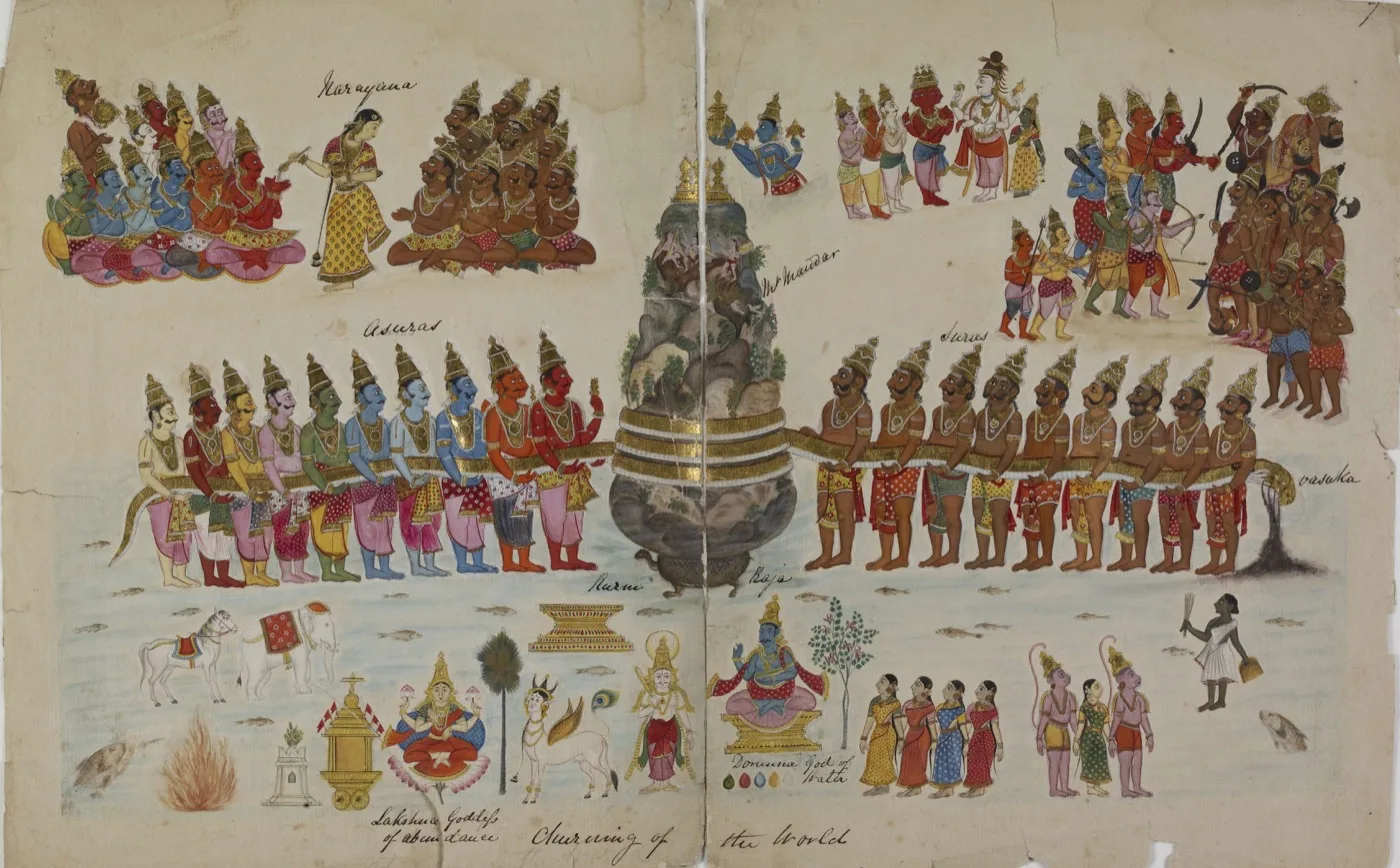
In Hindu mythology, the Churning of the Ocean of Milk (Samudra Manthan) tells how gods and demons used Mount Mandara as a mixer and the serpent Vasuki as a rope to draw fourteen treasures out of the cosmic ocean. Among them: Airavata, the four-tusked white elephant who would become the god Indra's mount, and Chandra, the moon itself. The two don't appear in separate stories — they emerge from the same ocean, in the same episode, in the same scene.
A less internationally known Hindu story concerns Ganesha's curse — the elephant-headed god — on the moon itself. In a widely told version, Ganesha falls off his mouse-vehicle after overeating, Chandra laughs at him, and Ganesha curses him to wax and wane without end, decreeing that anyone who looks at the moon on the evening of Ganesh Chaturthi risks being falsely accused of wrongdoing. The story fused, over time, with a second, originally separate legend about the theft of the Syamantaka jewel. The custom survives: many Hindus still avoid looking at the moon that evening; anyone who looks by accident has a remedial recitation, passed down for generations.
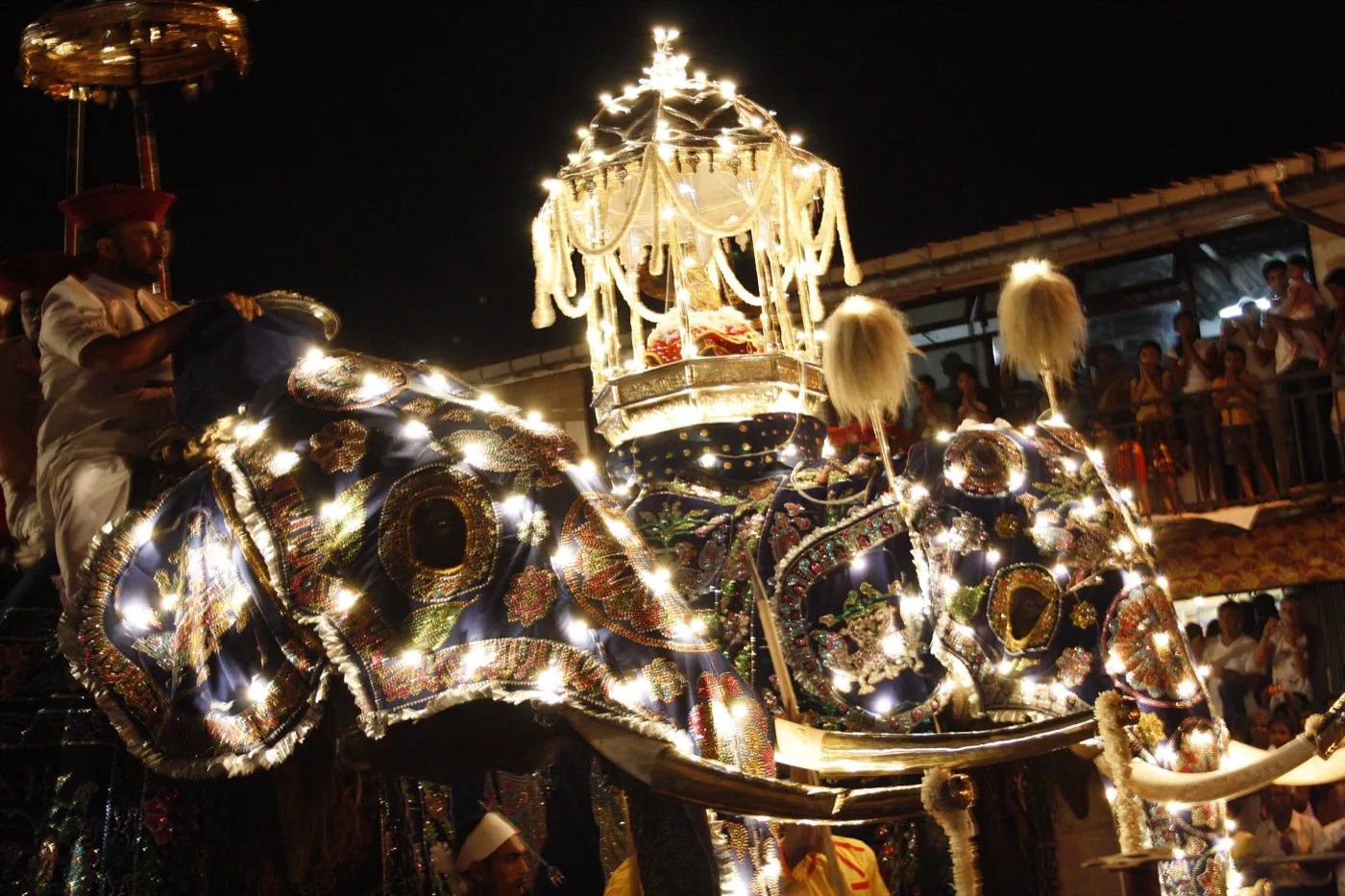
The most visible meeting of elephant and moon, though, is a living festival, held every year. The Esala Perahera procession in Kandy, Sri Lanka, organized by the Temple of the Sacred Tooth Relic, is timed to climax exactly on the full-moon night of the Esala lunar month, calculated year by year against the Buddhist lunar calendar. In 2026 the procession runs from 9 to 19 August. More than a hundred caparisoned elephants, led by the tusker carrying the casket with the Tooth Relic, parade through the city under a full moon — a different phase from the one Pliny described, but the same planet he said elephants saluted by instinct. Here, though, people choose the night, and the elephants are costumed and led.
The white elephant as a sacred symbol also appears in Thailand, Myanmar, and Cambodia, tied to Queen Maya's dream before the Buddha's birth, in which a white elephant is said to have entered her womb. How closely each local festival ties to the lunar calendar varies by country. Where this research couldn't confirm a deliberate lunar link — the case of the Sayaboury elephant festival in Laos — this page doesn't claim one.
Africa, where the myth stops
The viral claim turns out wrong twice over: the elephants in the story don't worship the moon, and the tradition it should have reflected, if it existed, doesn't even come from Africa. A search for a genuine African myth linking elephants to the moon — across Kamba, Akan, Zulu, and Yoruba folklore, among others — turned up nothing comparable to the Hindu or Buddhist material above. African lunar folklore exists in its own right: the Maasai have their own story about Olapa, the moon goddess struck by the sun god Enkai, a traditional explanation for the moon's dark patches. But in the sources checked, that folklore and elephant folklore never meet in the same character or story. It's a genuine absence, within the limits of this research — the viral myth appears to have borrowed the wrong continent.
The elephants' real ritual
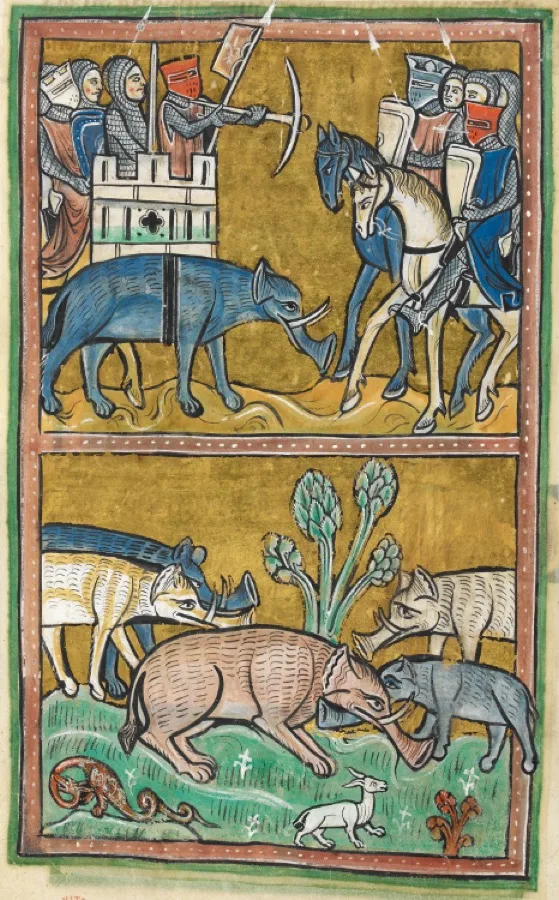
The final irony: elephants do have a rigorously documented ritual behavior — it just has nothing to do with the moon. Since the early 1970s, Cynthia Moss and, a few years later, Joyce Poole have followed the same elephant population in Amboseli, Kenya. They've repeatedly documented elephants stopping at the bones and tusks of dead elephants, touching them with trunk and foot, lingering for hours near a carcass, and sometimes covering it with soil or vegetation. Later research, including a 2006 study by Karen McComb, Lucy Baker, and Cynthia Moss, shows elephants prefer the bones and tusks of their own species. That's a real behavior, measured and repeatedly observed over decades of fieldwork — unlike "moon worship," which no field researcher has ever observed.
Method and limits
The "1,900 years" figure compares the year "Naturalis Historia" was dedicated to Titus, AD 77 — the date classicists generally accept for the work, though Pliny died in AD 79 and some scholars treat 77–79 as a completion window — with the year Siegel's paper was published, 1977. The difference, 1977 minus 77, is exactly 1,900. Pliny's quotations were cross-checked against two independent translations (Philemon Holland, 1601, and Bostock & Riley, 1855). The exact percentage decrease in Tanzanian elephants was not confirmed from the full text of Gunn and colleagues' paper; this page states only the documented direction of the effect. The list of fourteen treasures from Samudra Manthan varies slightly across popular Puranic retellings; it's the most widely repeated enumeration, with minor variation between retellings. The Ganesha moon-curse story, as told today, fuses two originally separate episodes — the moon curse and the Syamantaka jewel theft. This page names that fusion explicitly. The absence of an African elephant-moon myth reflects the limits of the research carried out across the sources consulted.
Sources
- Pliny the Elder, Naturalis Historia, Book 8, ch. 1. Trans. Philemon Holland (1601), via LacusCurtius/Penelope; trans. Bostock & Riley (1855), via Perseus Digital Library and Attalus.org.
- Colin Clair, Unnatural History: An Illustrated Bestiary (1967) — the exact passage was not independently checked in this research.
- Siegel, R.K. (1977). "Religious Behavior in Animals and Man: Drug-Induced Effects." Journal of Drug Issues 7(3). Abstract, SAGE; full text, gwern.net mirror.
- IFLScience, "The Internet Appears To Believe Elephants Worship The Moon"; Wikipedia, "List of citogenesis incidents."
- Gunn, J., Hawkins, D., Barnes, R.F.W., Mofulu, F., Grant, R.A., Norton, G.W. (2013/2014). "The influence of lunar cycles on crop-raiding elephants: evidence for risk avoidance." African Journal of Ecology 52(2), 129–137. ResearchGate.
- "Asian elephant movements between natural and human-dominated landscapes mirror patterns of crop damage in Sri Lanka." Oryx, Cambridge Core. Article.
- "Lunar phase as a dynamic landscape-of-fear factor affecting elephant crop-raiding potential." Ethology Ecology & Evolution 36(3), 2023. Article.
- Packer, C., Swanson, A., Ikanda, D., Kushnir, H. (2011). "Fear of Darkness, the Full Moon and the Nocturnal Ecology of African Lions." PLOS ONE 6(7):e22285. Article.
- Dacke, M. et al., Lund University — research on dung beetles steering by polarized moonlight. Press release.
- Komoto et al. (2023), Journal of Biological Rhythms. Article; related research, PNAS (2021) — coral spawning synchronized to the dark interval between sunset and moonrise.
- Bhagavata Purana; Vishnu Purana; Mahabharata, Adi Parva — the Samudra Manthan episode, per popular retellings, not a single critical edition.
- Ganesha Purana — Ganesha's curse on the moon, per popular retellings.
- Temple of the Sacred Tooth Relic (Sri Dalada Maligawa), Kandy — official Esala Perahera calendar.
- McComb, K., Baker, L., Moss, C. (2006) and the Amboseli Elephant Research Project (Cynthia Moss, Joyce Poole) — elephant behavior toward the bones of dead conspecifics.