mariuscomper.uk RO
The roofs of Sibiu at dusk, with their eyes.

Sibiu, Romania, seen from above

The city with eyes

On the old houses of Sibiu, the tiles curve over narrow openings that let air into the attics. From the street, they look like eyes watching you. Where they came from, what they were for, and what the town looks like from above them.

The eyes of Sibiu

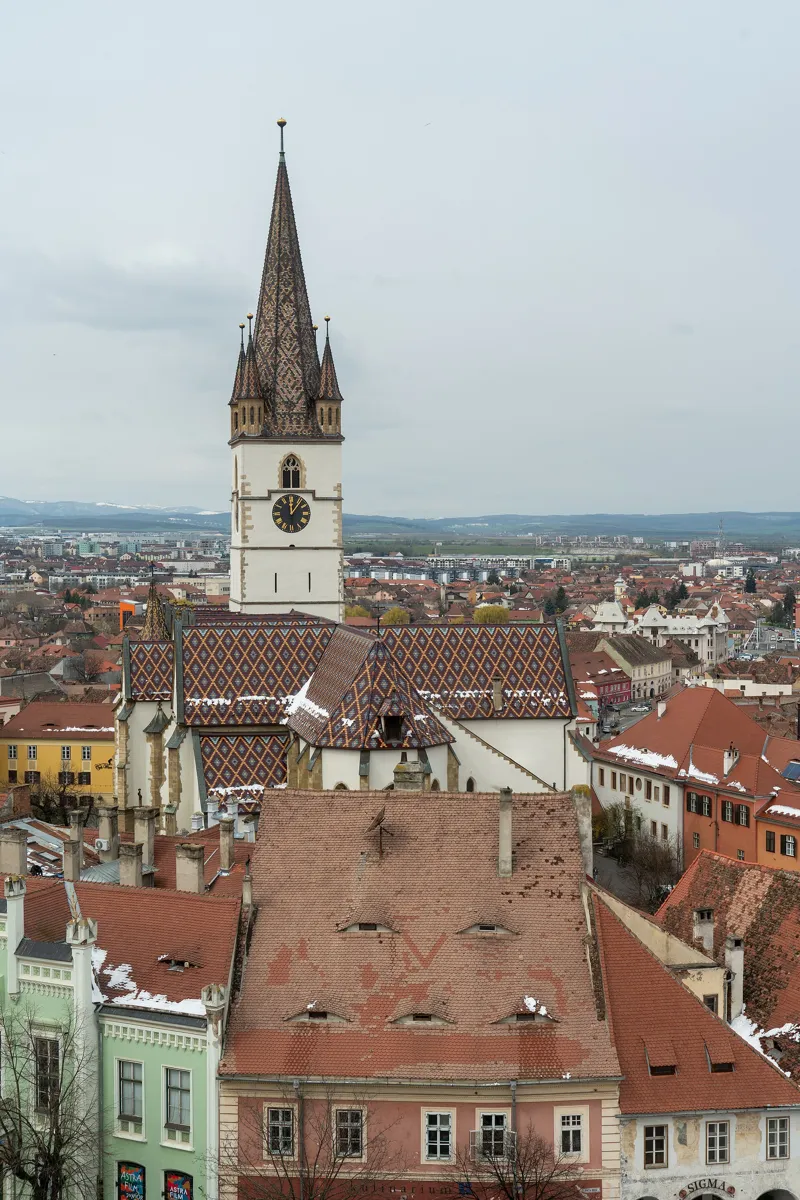
Architects call them dormers. The historian Răzvan Pop, then Sibiu’s deputy mayor, told the Romanian news agency Agerpres in 2018 that they appeared around 1700, in the Baroque period, and that this eye shape is not found in Sighișoara, in Brașov or in the Saxon villages.

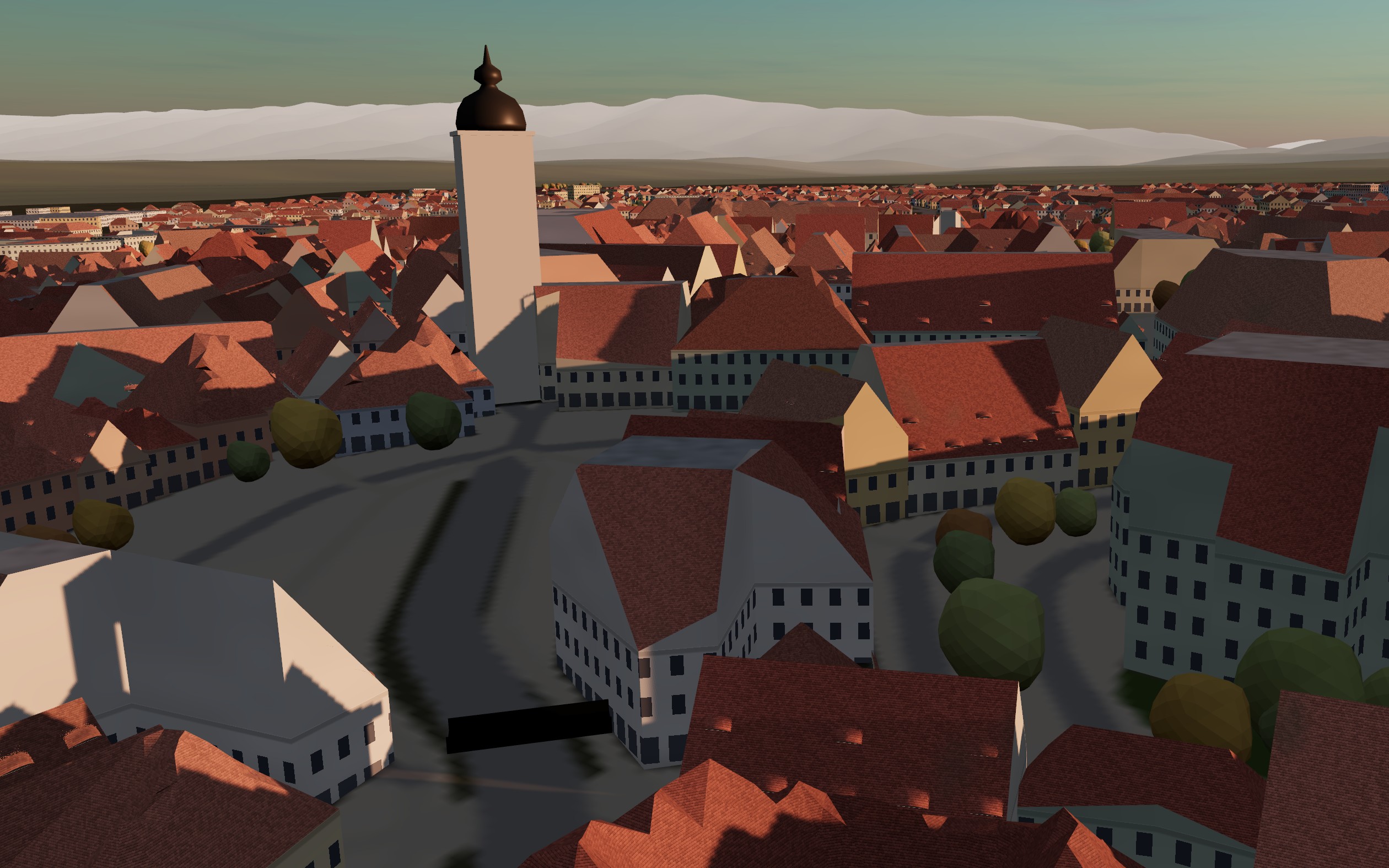
The houses, streets and walls in the scene are those on the city map. The eyes on the roofs follow the pattern seen in photographs.
The lungs of the house

According to Răzvan Pop, flour soon went mouldy in the damp cellars of the old town, so food and hay were stored in the attics.

To make room, people built very tall roofs and gave up one or two storeys. Some roofs were tall enough for two attic levels, one above the other. The eyes let air move through them; the Agerpres report called them the lungs of the historic houses.

Bent wood

Carpenters bent the timber and set it in masonry so the eye kept its shape. They are hard to make, and few craftsmen can still rebuild them the same way, Agerpres wrote in 2018.

On a house in the historic area, Răzvan Pop said, the law obliges you to keep the eye.

Sibiu on two levels

The big squares and the towers are in the Upper Town. The Lower Town spreads towards the river Cibin, more than ten metres lower.

Steep streets, passages and stairs climb between the two.

The Passage of Stairs

The Passage of Stairs links the Upper Town with the Lower Town. Its steps and arches follow the old defensive wall of the Upper Town.

The Bridge of Lies

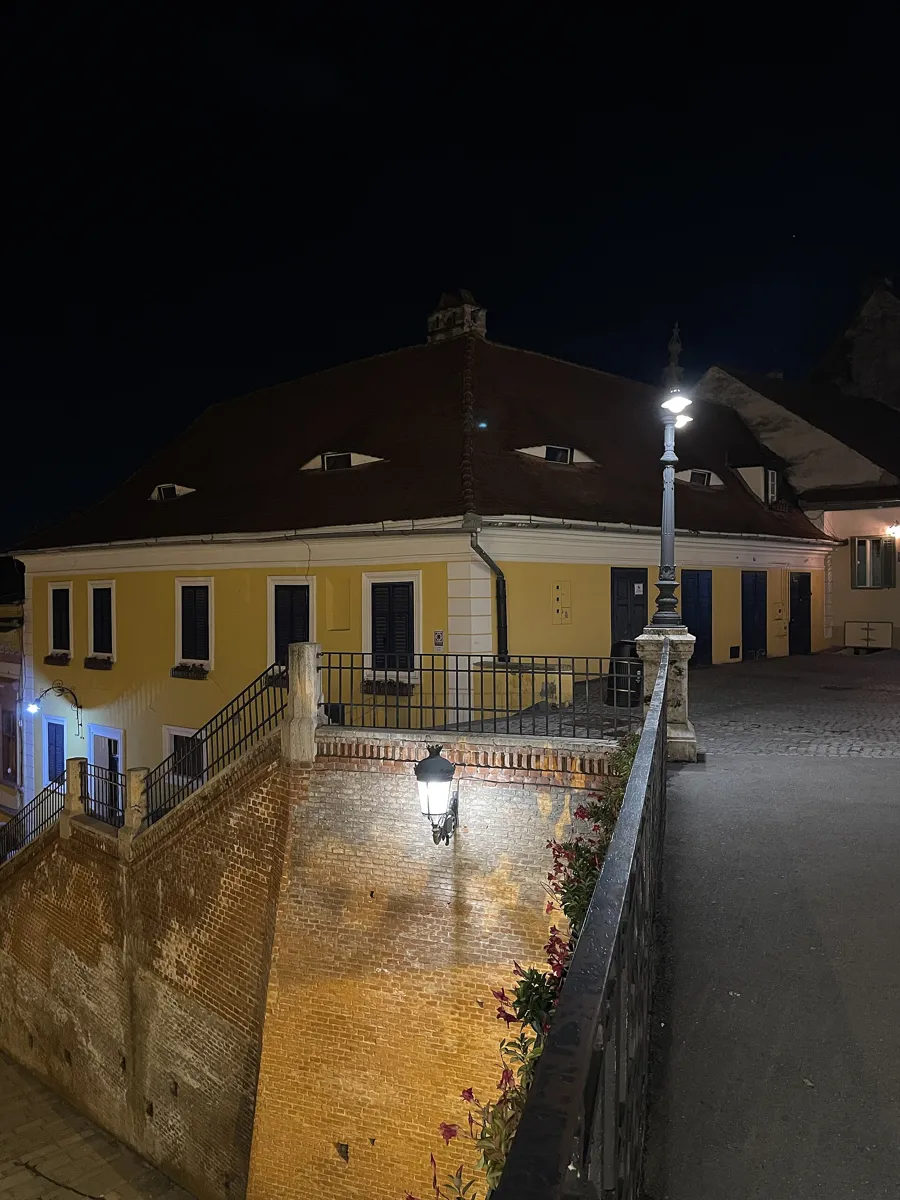
The cast-iron footbridge by Piața Huet crosses Strada Ocnei, the street that climbs from the Lower Town, and links the two sides of Piața Mică. It bears the date 1859 and opened in 1860.

One explanation of the name: because it does not rest on piers, it was called Liegenbrücke, the “lying-down bridge”, a word that sounds almost like Lügenbrücke, the “bridge of lies”. The stories about liars are legends.

The Council Tower

The gate of the town’s second ring of walls passed through the ground floor of the tower between Piața Mare and Piața Mică, in the 13th century. After its upper floors collapsed on 17 February 1585, the tower was rebuilt between 1586 and 1588.

From the top you can see the whole town and its eyes, and on clear days the Făgăraș mountains.

The walls on Cetății Street

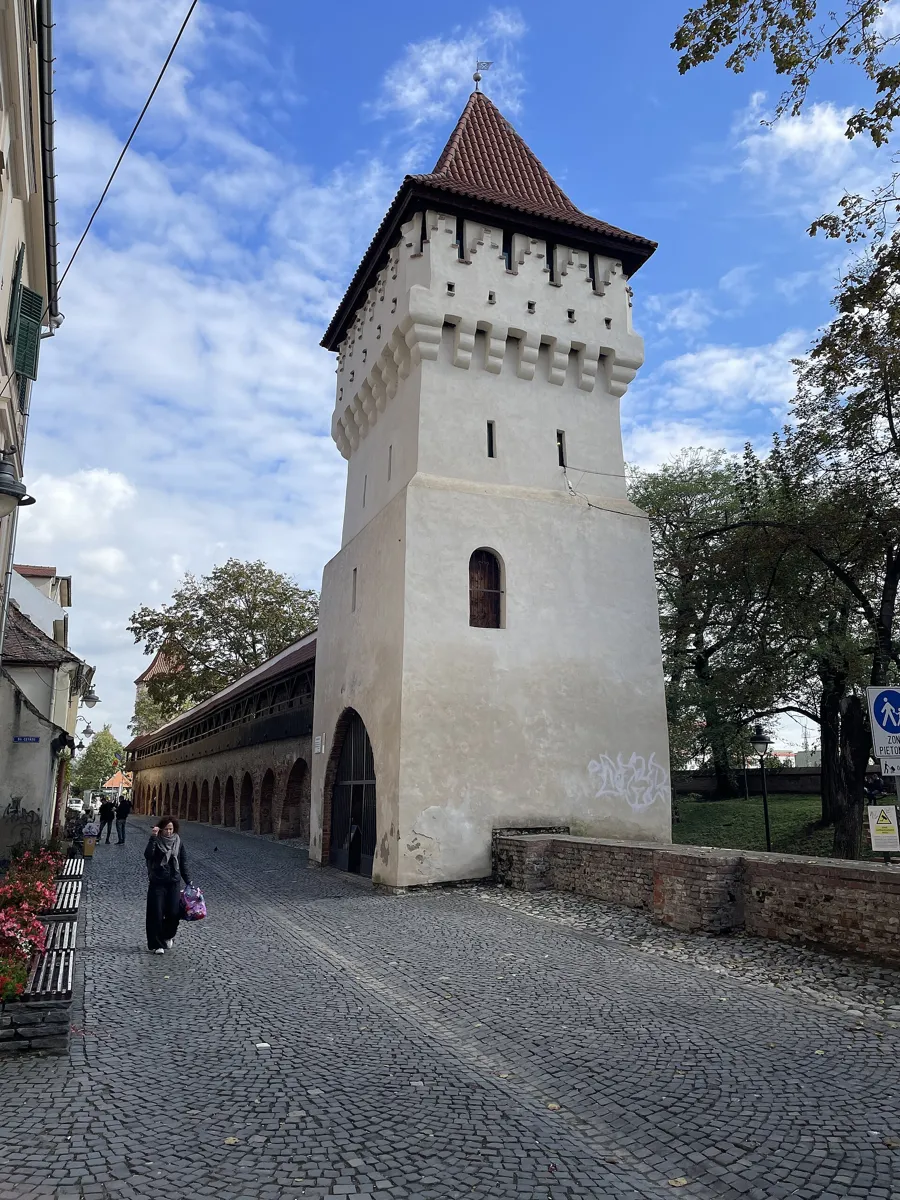
The town defended itself with several rings of walls, built one after another as it grew. On the south side, along Strada Cetății, a long stretch of wall and three towers survive: the Arquebusiers’, the Carpenters’ and the Potters’.

In 1191 Pope Celestine III confirmed the provostry of the Transylvanian Saxons, based in Sibiu. The act is counted as the town’s first documentary attestation.

Evening over Sibiu

In 2007 Sibiu and Luxembourg City were European Capitals of Culture. In 2018 Agerpres wrote that the eyes on the roofs were sought out especially by tourists.

The eyes are watching you

During the protests of 2017, people in Sibiu drew two open eyes on sheets of paper, and the sign also appeared on posters, T-shirts and in projections on buildings. The town’s eyes became the sign of a silent protest.

Move your mouse over the town, or tap it: the eyes near you open. Drag to turn the view, or use the buttons below.

The eyes, in photographs

Eyes on the roofs in front of the Lutheran Cathedral, seen from above (2023).
Eyes on the roofs in front of the Lutheran Cathedral, seen from above (2023). Photo: Paul Colin Hennig firstdorsal.eu, Wikimedia Commons, CC BY-SA 4.0.
The Bridge of Lies at night, with a house behind it whose roof has eye-shaped dormers.
The Bridge of Lies at night, with a house behind it whose roof has eye-shaped dormers. Photo: Tomasz Chralowicz, Wikimedia Commons, CC BY-SA 4.0.
A defensive tower and the wall on Cetății Street.
A defensive tower and the wall on Cetății Street. Photo: Tomasz Chralowicz, Wikimedia Commons, CC BY-SA 4.0.

Send the city with eyes

For anyone who walks through Sibiu and looks up.

Sources

House outlines come from OpenStreetMap. Heights start from the storeys on the map where they are given; where they are not, height and roof are inferred from each house’s shape. The dormers are placed using a pattern taken from photographs.

  1. Agerpres (9 January 2018), report with the historian Răzvan Pop on Sibiu’s “eyes”: origin, what the attics held, bent wood, the legal duty to keep them, the protests. agerpres.ro
  2. Sibiu City Hall, building inventory: the Bridge of Lies, inscriptions 1859 and FRIEDRICHS HÜTTE, opened in 1860. patrimoniu.sibiu.ro
  3. Wikipedia (Romanian), Bridge of Lies, Sibiu: Liegenbrücke / Lügenbrücke, one explanation of the name; monument code SB-II-m-A-12107. ro.wikipedia.org
  4. Wikipedia (Romanian), Council Tower of Sibiu: a gate in the second ring of walls; the collapse of 17 February 1585 and the rebuilding of 1586–1588; lookout. ro.wikipedia.org
  5. Wikipedia (Romanian), Passage of Stairs, Sibiu: the link between the Upper and Lower Town, along the old wall. ro.wikipedia.org
  6. Sibiu City Hall, the fortification system: successive rings of walls. turism.sibiu.ro
  7. Sibiu City Hall, fortification inventory: the Arquebusiers’ Tower on Strada Cetății. patrimoniu.sibiu.ro
  8. Evangelical parish of Sibiu (Stadtpfarrkirche): Pope Celestine III’s act of 1191, counted as the town’s first documentary attestation. hermannstadt.evang.ro
  9. List of European Capitals of Culture: 2007, Luxembourg City and Sibiu. en.wikipedia.org
  10. OpenStreetMap contributors (ODbL): house outlines, streets, squares, walls and towers, Geofabrik extract of 30 October 2026. www.openstreetmap.org
  11. Copernicus GLO-30 (ESA, 2021): relief of the town and the mountains around it; the ground is estimated from the surface model. dataspace.copernicus.eu