“21,000 people founded Palmares.”
The figure adds two Dutch military estimates from the 1640s, roughly 6,000 and 15,000 people in two forested areas. It is neither a census nor a count of founders.
See where the number came from →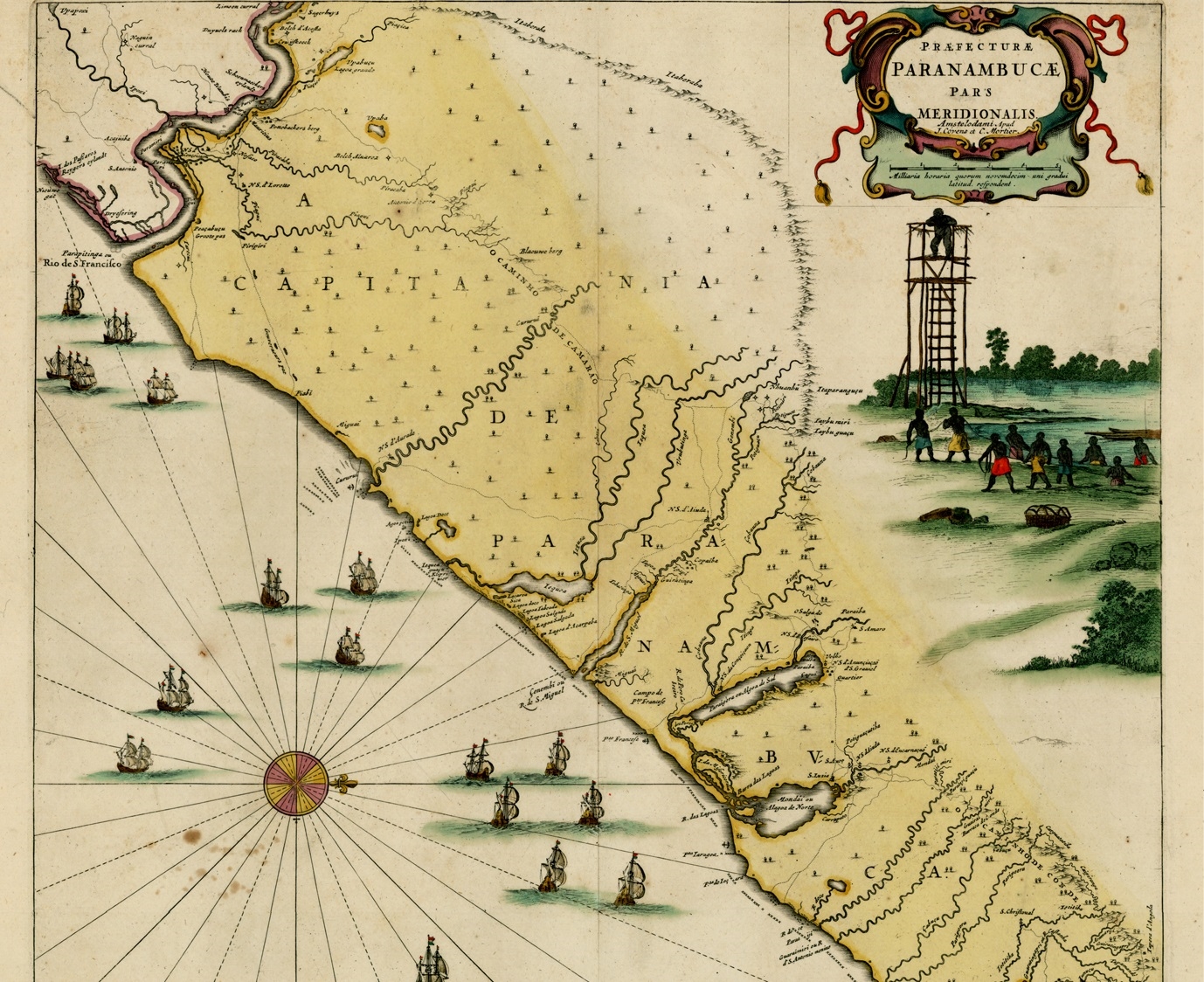
In colonial Brazil, 21,000 people escaping enslavement built a kingdom in the interior.
Palmares had a centre called Macaco, rulers, local chiefs, justice, religious life and an army that raided Dutch and Portuguese plantations. The traces appear in different years, in accounts written by people who tried to destroy the communities.
Palmares was a network of autonomous communities in colonial Brazil. The number 21,000 makes sense only after you see the place and people inside it.
1595–1714
Colonial BrazilIn Portuguese Brazil, people fleeing enslavement sought refuge in communities in the interior. Palmares grew through those communities.
In colonial sources, an individual settlement often appears as a mocambo. Quilombo is the broader term for communities built by people who escaped enslavement and defended their autonomy. Palmares was a network of mocambos that could move, join or divide.
By the 1670s, documents describe a system coordinated by Ganga Zumba. Macaco appears as the principal centre, with more than 1,500 houses. The same world includes subordinate chiefs, guards, a “minister of justice”, a chapel, baptisms and marriages.
1,500+houses attributed to Macaco in a 1678 account
This power took shape over time. Its enemies measured its scale while trying to destroy it.
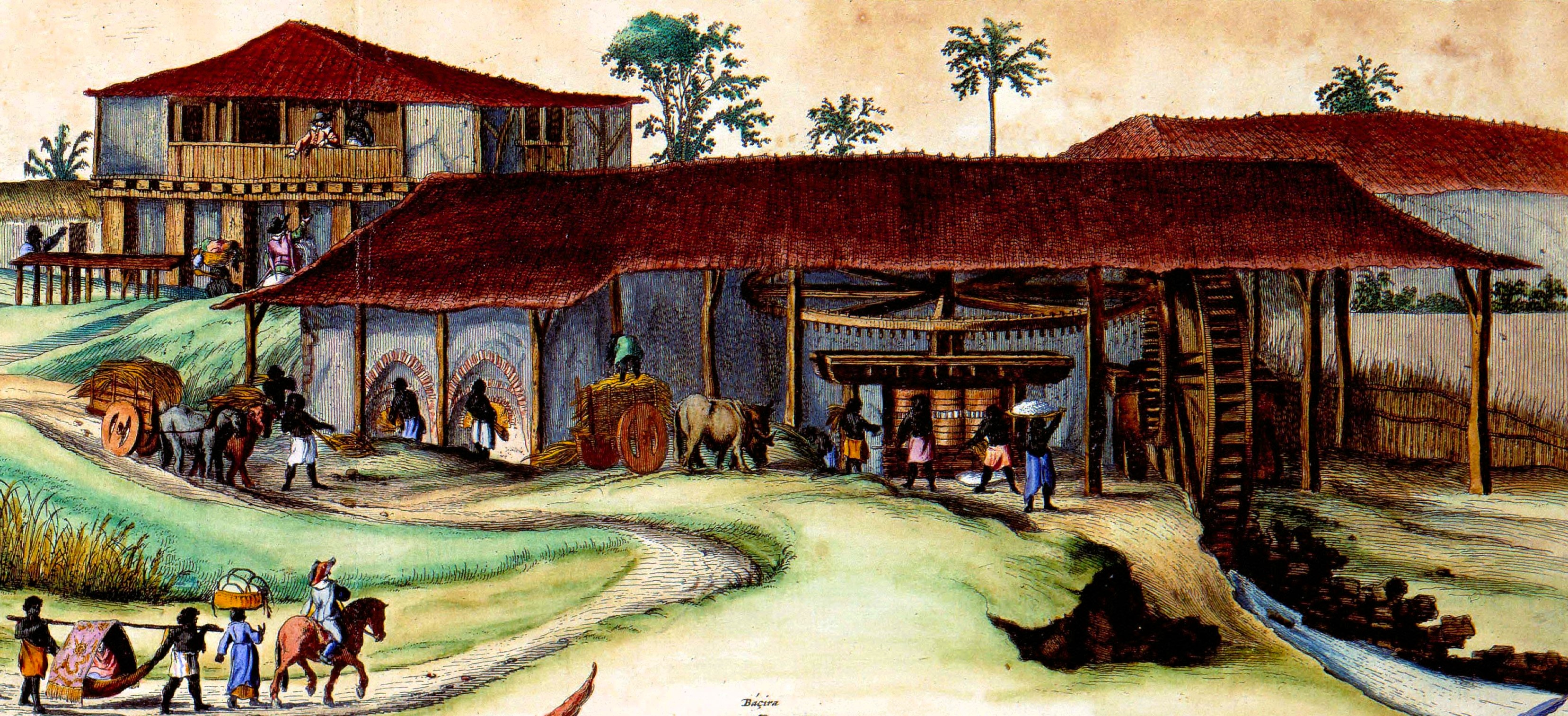
The 1643 engraving shows a sugar plantation in Pernambuco and the enslaved people who made it work. Palmares is not in the scene; the image shows the colonial economy from which interior communities tried to break away.
Cornelis Golijath / Georg Marcgrave · 1643 · Wikimedia Commons ↗ · public domain
In the 1640s, Dutch officers estimated roughly 6,000 and 15,000 people in two forested areas. Added together later, the estimates became 21,000. The phrase “founded Palmares” turned them into a single moment.
The claims stay here in the form in which they circulate. The lines below show what the records support and where they stop.
The labels show the confidence level:
The figure adds two Dutch military estimates from the 1640s, roughly 6,000 and 15,000 people in two forested areas. It is neither a census nor a count of founders.
See where the number came from →1612 marks an early expedition. It is not a secure date of foundation. The Serra da Barriga stronghold fell in 1694, Zumbi was killed in 1695, and Mouza's mocambo endured until 1714.
What happened after 1694 →“Kingdom” describes de facto autonomy, hierarchical leadership and diplomatic capacity. Palmares was not a recognised state. Its institutions changed over time and between settlements.
How to read the colonial account →A colonial account says Macaco contained more than 1,500 houses. Nearly 5,000 inhabitants is a modern houses × occupants extrapolation, not a contemporary count.
Test the household assumption →The 1675–1678 war account describes a paramount leader, subordinate chiefs, guards, a “minister of justice,” a chapel, baptisms and marriages. Its terminology is a colonial translation of institutions the writer did not fully understand.
Document, inference and the unknown →Palmares resisted expeditions from both colonial powers and organised raids for supplies, weapons and people. Its relations with neighbours also included clandestine trade, intelligence and negotiation.
The negotiation of 1678 →Congada preserves Kongo traditions of kingship and Afro-Brazilian Catholic forms. Palmares belonged to the same Central African Atlantic world. The sources do not document a line of descent from Palmares to the festival.
Where the evidence stops →Lourenço da Silva Mendonça lived in Brazil and later led a legal campaign against slavery in Rome. An alliance with Palmares remains a recent, contested hypothesis. The sources do not document his participation in Palmares or Congada.
The Mendonça hypothesis →Palmares was made up of mocambos, settlements that could grow, be destroyed, move, join a political system or disappear. The diagram shows how relationships changed over time. It is not a map with exact coordinates.
By the 1670s, sources describe a network of mocambos connected by leadership, alliances and defence. It was not one fixed settlement.
The names and relationships come from colonial documents. Their spelling and locations vary. The diagram shows political change, not a geospatial reconstruction.
The estimates come from wartime reports. The men who made them were seeking resources and prestige for new campaigns. The figures give a sense of scale. The calculator shows how an assumption about people per house produces 5,000 inhabitants.
Two Dutch estimates from the 1640s, for communities in two forested areas, were later added together. They describe a scale observed or reported during wartime.
The 1678 account attributes this number to the principal centre. Houses do not directly tell us the population: we do not know how many people lived in each or how many buildings were dwellings.
Change the assumed average number of people in each house.
The account of the 1675–1678 campaigns is the richest description of internal political life. Its author translated Palmares institutions into familiar Portuguese words: king, palace, minister, republic.
Ganga Zumba negotiated with the Pernambuco government under terms that divided freedom into categories. Colonial authorities decided who could remain free, where people had to live and who would be returned to enslavement.
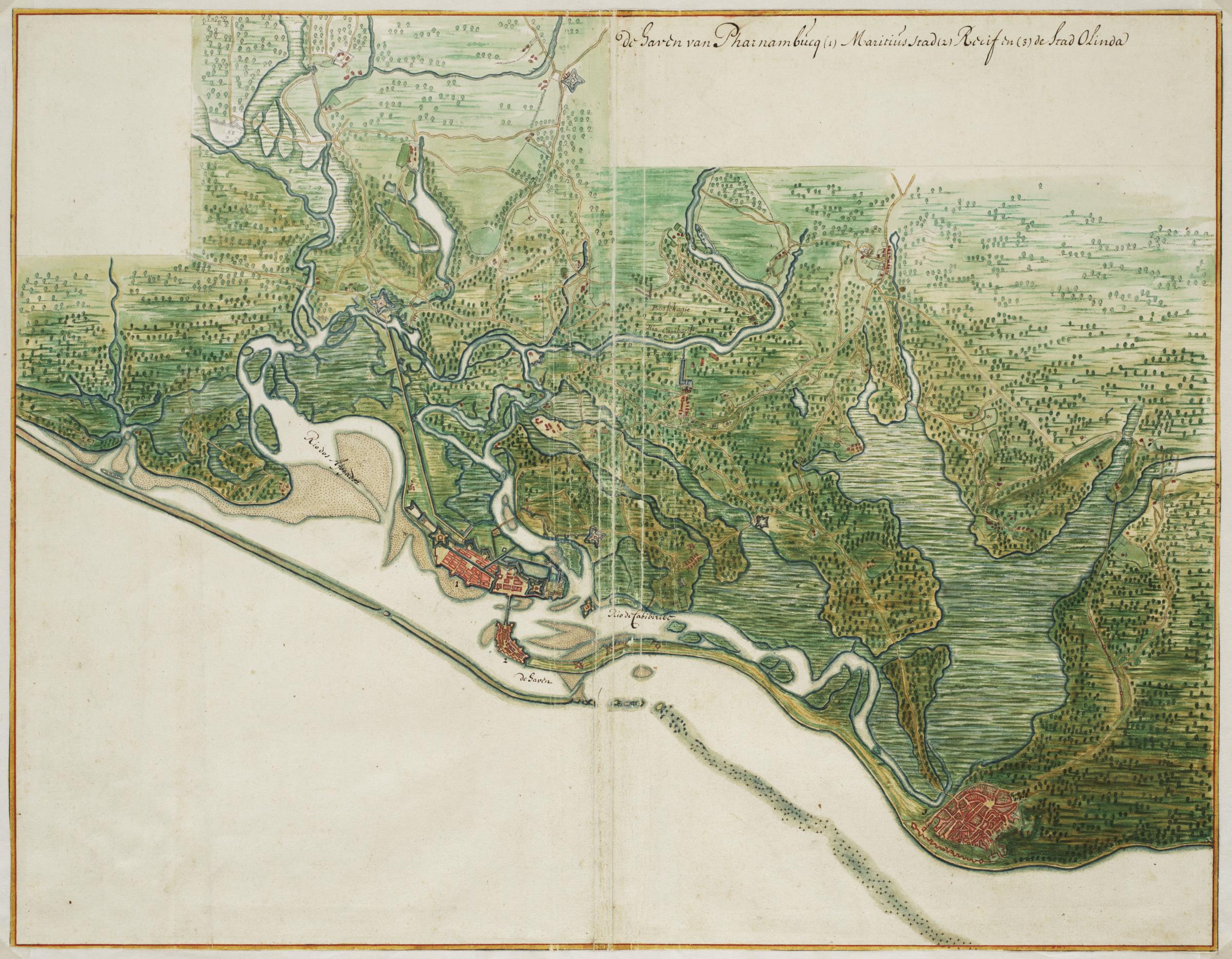
Johannes Vingboons's map shows Recife, Olinda and Mauritsstad, the ports and rivers around which colonial power was organised. The 1678 agreement put interior communities into direct negotiation with that system.
Johannes Vingboons · c. 1665 · Wikimedia Commons ↗ · public domain
People born in Palmares were promised recognition of their freedom and a pardon.
The accepting group had to settle closer to colonial supervision and control.
People who had recently escaped enslavement were to be surrendered to their former enslavers.
Cucaú's inhabitants were later attacked, captured and re-enslaved, producing legal disputes inside the empire itself.
After devastating campaigns, the capture of relatives and the loss of settlements, the agreement may have been an attempt to save part of the community. Reducing it to “betrayal” erases the constraints under which it was negotiated.
Zumbi and other leaders rejected terms that made freedom a colonial privilege and demanded the surrender of recent escapees. Resistance reorganised around Serra da Barriga.
This timeline starts with the earliest surviving mentions and follows the communities, the wars, the 1678 agreement and what continued after 1694.
The digital archive gathers documents explicitly mentioning Palmares from 1595 to 1800. The first surviving mention tells us when Palmares enters this archive, not when the communities began.
The year later became a “foundation date,” although it records a colonial response to something already present.
Two wartime estimates, 6,000 and 15,000, were later added into the viral figure of 21,000.
The war account supplies information about houses, fortifications, rulers and institutions, but was written for authorities financing attacks.
One part of Palmares moves to Cucaú; another rejects the conditions and continues resistance.
The period of the principal late military centre ends. Other Palmarista communities continue after 1694.
His death later anchors public memory around Black agency and resistance. That memory does not begin with abolition bestowed by the Crown.
Records still place him in prison in 1715. Palmares continued to generate flight, regrouping and colonial fear long after 1694.
The site enters official public memory.
The law enacted in 2023 declares the National Day of Zumbi and Black Consciousness a federal holiday throughout Brazil.
Palmares, Kongo political traditions and Mendonça's campaign belonged to the same Atlantic world. The sources show regional cultural connections. They do not show a documented line from Palmares to the festival.
Crowns, processions, titles and Christian forms of authority circulated from Central Africa through the Atlantic world.
Black Catholic brotherhoods organised elections and royal celebrations in several regions, in forms that changed over centuries.
Names, languages and political practices indicate strong Central African ties without making Palmares the single source of Afro-Brazilian traditions.
The sources do not trace institutional or ritual transmission from Palmares to the festival. The term “congada” itself appears only around the beginning of the nineteenth century.
José Lingna Nafafé argues that exiled Ndongo royals could have mattered to Palmares. Silvia Hunold Lara finds the sources insufficient to establish the connection.
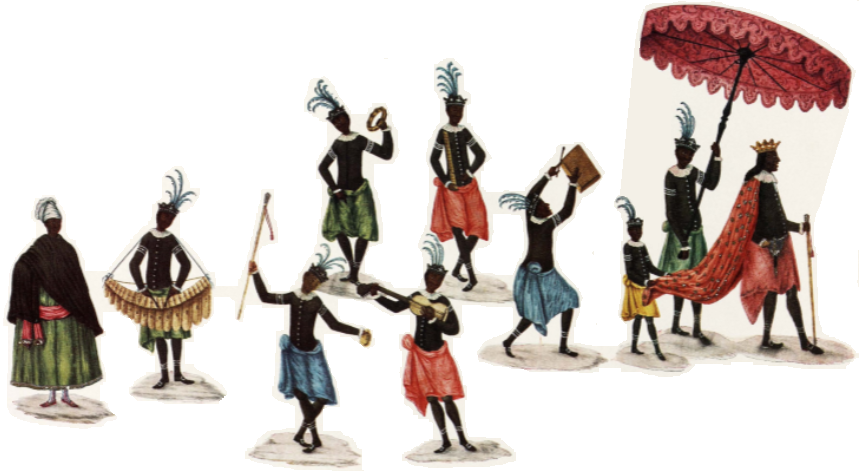
Carlos Julião's work shows Afro-Brazilian royal festivals in the later eighteenth century. It helps explain the tradition from which Congada emerged. It does not show Palmares or prove that the festival began there.
Lourenço da Silva Mendonça was a member of the Ndongo elite who lived in Brazil and pursued a legal campaign against slavery in Rome during the 1680s. The documents preserve no meetings or alliances with Palmares.
Military records see leaders, fortifications, captives and threats. Women, children, farmers and people without visible office appear rarely and often only at the moment of capture.
Figures such as Dandara and Aqualtune do not appear in the seventeenth-century sources identified so far. Their biographies cannot be treated as documented. The archive does not allow us to say that women did not fight, lead, negotiate or sustain the communities.
Colonial documents were written to see certain people. They leave the rest in shadow.
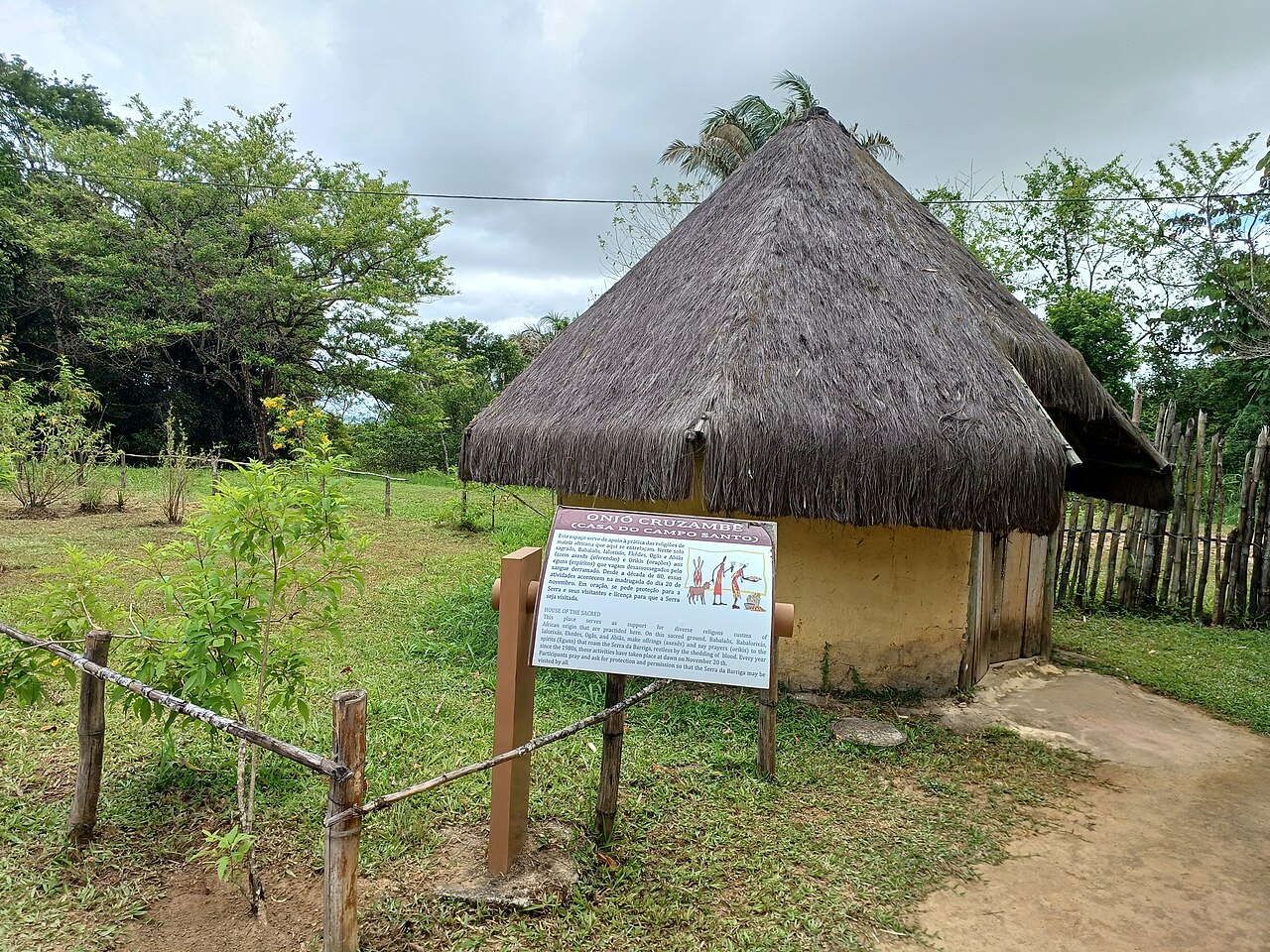
Serra da Barriga is protected as Brazilian cultural heritage, has housed the Quilombo dos Palmares Memorial Park since 2007 and became Mercosur Cultural Heritage in 2017. Since 2024, 20 November has been a national public holiday in Brazil.
These sources begin with manuscripts and documentary databases, then move to scholarship that re-reads them critically. Popular sources helped with orientation and with finding claims that needed checking.
More than 1,800 digital copies of documents explicitly mentioning Palmares from 1595 to 1800, together with maps and bibliography.
Open the database ↗A classic analysis of how colonial accounts entered the literature and were sometimes over-interpreted.
Read the PDF ↗Reconstructs the negotiations, conditional freedom, Cucaú and the re-enslavement of its inhabitants.
View the study ↗Explains the manuscript work, documentary limits and the difference between historical Palmares and its memory.
Read the PDF ↗Follows diaspora, inheritance and Zumbi's afterlives; its chronology includes Mouza's capture in 1714.
View the book ↗An extensive interview with Silvia Hunold Lara on Cucaú, original manuscripts and Palmares's continuation through Mouza.
Read the article ↗Traces Black royal festivities, their Kongo connections and the late appearance of the term Congada.
Read the PDF ↗The case for a seventeenth-century Atlantic legal movement against slavery and the proposed Palmares connection.
View the book ↗The site's status, the memorial park and its recognition as Mercosur Cultural Heritage.
View the official page ↗Declares 20 November a national holiday for the National Day of Zumbi and Black Consciousness.
Read the law ↗About the images: the 1647 map attributed to Frans Post supplies colonial context, not precise Palmares boundaries. The 1643 plantation engraving and the c. 1665 Pernambuco map are public domain. The festival group derived from Carlos Julião is CC0. The Serra da Barriga photograph is by Joalpe, CC BY-SA 4.0. Each image has its source in the caption below it.