Rome · the Pantheon · completed under Hadrian
Sunlight in the Pantheon: where the disc from the oculus falls, day by day and hour by hour
The Pantheon has no windows. Direct sunlight comes in only through the oculus, an opening about 8.3 metres wide at the top of a dome 43.3 metres across, and on a clear day it throws a disc of sunlight that moves around the interior. Choose a date and an hour, your birthday if you like, and see where the disc lands.
One opening, 8.3 metres wide
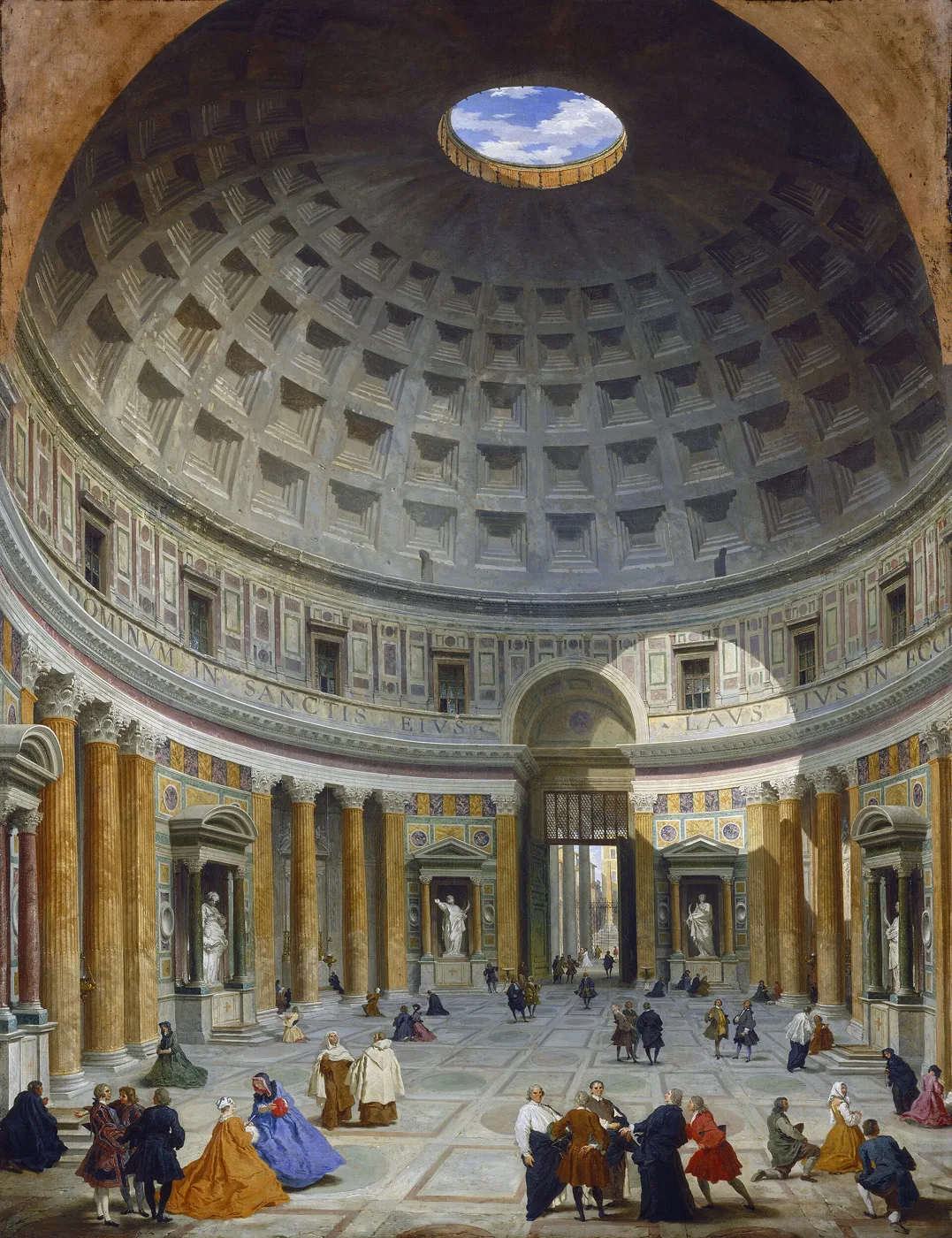
The building that stands today was completed under Hadrian and probably dedicated around AD 126, though it keeps Agrippa’s name on the porch. Its rotunda is a cylinder 43.3 metres across with walls as tall as its radius, under a hemispherical concrete dome: a sphere 43.3 metres in diameter would fit inside exactly. At the top is the oculus, open to the sky: 8.3 metres across in the dimensions Hannah and Magli use, the figures this page models. Because the entrance faces north, no direct sunlight comes in through the door at any time of year; the oculus admits the only direct beam.
A year of noons
At local solar noon the sun is due south, so the disc lies on the north–south line through the building, a few degrees off the axis of the entrance. Robert Hannah and Giulio Magli traced it through the year in a paper published in Numen in 2011. At the autumn equinox the disc straddles the springing of the dome, where the curved roof starts. Through the winter it climbs the dome above the entrance, highest at the winter solstice, and comes back down across the springing at the spring equinox.
Then it slides down the wall over the doors, and around 21 April, the day Rome celebrated its founding, the noon disc lights the entrance itself. From late April to late August it reaches the floor in the middle of the day (in this model, from 18 April to 24 August 2026), then climbs back, crossing the entrance again between the end of August and the autumn equinox.
| Date (2026) | Sun at solar noon | Where the noon disc lies, lowest to highest point |
|---|---|---|
| 20 March | 48.0° | wall 14.2 m → dome 23.5 m |
| 21 April | 60.1° | floor → wall 12.5 m |
| 21 June | 71.5° | floor → floor |
| 31 August | 56.6° | wall 3.7 m → wall 16.3 m |
| 23 September | 47.9° | wall 14.3 m → dome 23.6 m |
| 21 December | 24.7° | dome 32.4 m → dome 38.6 m |
Hannah and Magli argue that the size of the oculus was chosen so that the noon disc spends autumn and winter on the dome and reaches the springing at the equinoxes, and that the 21 April lighting of the entrance carried meaning for Hadrian’s court. Those are their hypotheses. The model here treats the oculus as a single opening; its real rim is thick, which would clip the edges of the disc slightly.
When the disc reaches the niches
The rotunda is divided into sixteen equal sectors of 22.5°, with niches and the entrance at floor level and blind windows under the springing. In Hannah and Magli’s model the building is turned 5.5° from true north (a later measurement on site gives a little less), so seen from the centre the first niche east of the entrance lies at azimuth 17°, the next at 39.5°, then 62°. To light a niche the sun must stand roughly 56° high at the opposite azimuth; to light a blind window, roughly 60°. Hannah and Magli worked out the dates with planetarium software. The dates this page finds (the first day the sun crosses each height, in 2026) broadly agree for four; for the first niche at 56° it finds 13 April, a week before their “around 20 April”, and at 62° the sun peaks near the solstice at 59.5°, just short of 60°:
| Niche or window | Sun needed | Hannah & Magli | This page |
|---|---|---|---|
| 17.0° | 56° | around 20 April | 13 April |
| 17.0° | 60° | end of April | 24 April |
| 39.5° | 56° | end of April | 26 April |
| 39.5° | 60° | around 10 May | 8 May |
| 62.0° | 56° | end of May | 25 May |
| 62.0° | 60° | around the summer solstice | not reached (max 59.5°) |
Then and now
The sky has hardly changed since Hadrian. The tilt of the Earth’s axis was about a quarter of a degree greater in AD 126, which moves the noon disc slightly; the “AD 126” switch shows that sky. Dates on this page are Gregorian; in AD 126 the Roman calendar’s 21 April fell on 20 April of ours. In that sky the hour is read on a fixed clock one hour ahead of Greenwich; today’s sky follows Rome’s summer time.
The paper is one reading of the building’s meaning. The geometry does not depend on it, and anyone in Rome can check it on a clear day at noon.
Sources
The building is modelled as a cylinder and hemisphere of 43.3 m with an 8.3 m oculus, the figures Hannah and Magli use; coffers, niches and the entrance are drawn schematically. The sun is computed for Rome with the standard NOAA formulae, without atmospheric refraction, for hours between 05:00 and 21:00 and a clear sky.
- Robert Hannah, Giulio Magli, “The role of the sun in the Pantheon’s design and meaning”, Numen 58 (2011) 486–513; preprint arXiv:0910.0128.
- Wikipedia, “Pantheon, Rome” (date, Agrippa’s inscription).
- Giovanni Paolo Panini, Interior of the Pantheon, Rome, c. 1734, National Gallery of Art, Washington, Wikimedia Commons, CC0.
- Solar position: NOAA formulae after Meeus, Astronomical Algorithms.
