mariuscomper.ukRomână

A game built on published physics

Skip a stone across a lake. How many bounces can you make?

Choose how hard you throw, how you hold the stone and how much you spin it. The world record is 88 skips.

The stone obeys published physics, but the score is for play, not a forecast. The lake and the child are drawings.

Throw

Drag the stone to the right and let go. Or set the four sliders below and press “Throw!”. The same settings always give the same throw, so you can send yours to someone else.

The height of the bounces is drawn six times larger.

The stone's speed as it leaves your hand.

The angle at which the stone reaches the water. Nearly flat to the water is better.

The stone's tilt against the water, front edge raised. Not the same as the throwing angle.

A flick of the finger sets the stone turning.

World record: 88 bounces

Ready-made throws

What makes a stone skip

Three things matter, and all three are sliders above. The charts show, for your current throw, what would happen if you changed just one of them. The big dot is your throw.

At every touch the water pushes the stone up and a little back. After a few skips the bounces get shorter and quicker, then the stone slides along the water and sinks. Competition skippers call that ending “pitty-pat”.

The tilt

Do not mix up two angles: the throwing angle (how low the stone comes in) and the stone's tilt (how it sits against the water). A group of physicists fired spinning discs at water and found that a tilt of about 20° gives the most bounces (Nature, 2004). The game was not given that number. For throws like these, at full spin, the best tilt comes out between 14° and 21°.

The stone's tilt, in degrees. The marker shows “about 20°”, the result in Nature.
The spin

A spinning stone behaves like a top: it holds its tilt. Without spin, the touch with the water gets complicated and a second bounce becomes much less likely. The researchers say the stone must turn about once while it is in contact with the water. In the game, the number of bounces that spin can hold grows with the square of the turns, which is why the curve flattens out.

Turns per second. The ceiling shows how many bounces the spin can hold; where the curve meets it, more speed does not help.

The speed

Faster means more bounces: in the lab, the number of skips rose roughly in proportion to the throwing speed. A 15 g disc, thrown at up to 10 m/s, made 20 skips. The game's 60 g stone, thrown nearly flat to the water (3°) with a 20° tilt and full spin, makes 10 at 10 m/s and 31 at 20 m/s.

Speed, in m/s. Past a minimum speed, close to a straight line; higher up, the spin ceiling stops the curve.

The best stones are flat and rather round, wrote the physicist Lydéric Bocquet in 2003. Throwers give them a flick of the finger to set them spinning, he and Christophe Clanet write in Physics World. The game's stone is a flat 60 g stone with a radius of 3.5 cm and a thickness of 5.8 mm.

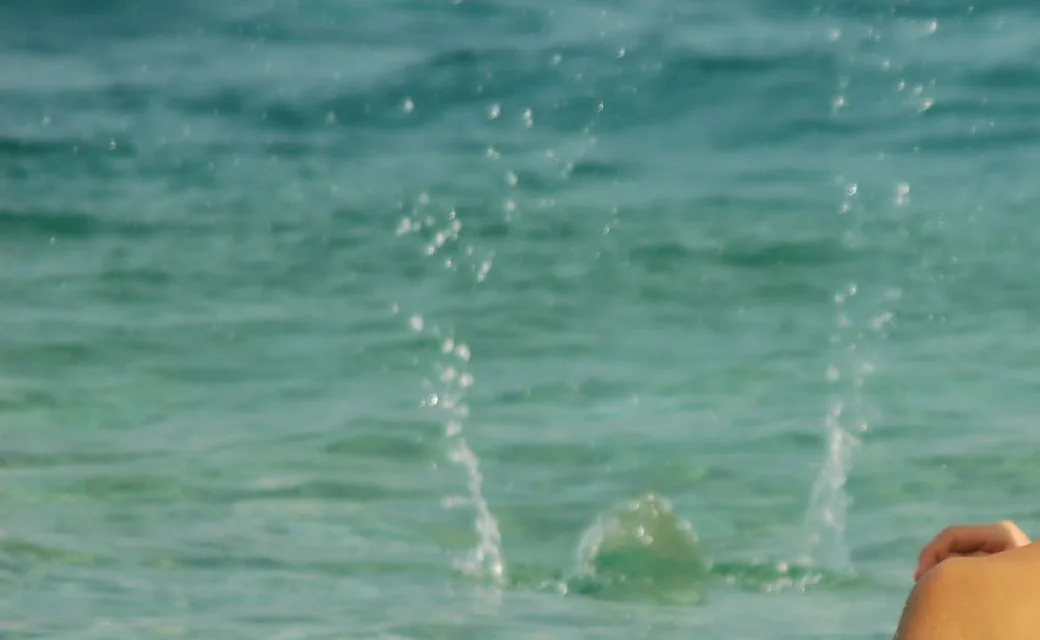
Several jets of spray rise above turquoise water where a stone has touched the sea.
Spray left by a stone on the sea at Çıralı, on Turkey's Mediterranean coast. photo: shioshvili (Flickr), CC BY-SA 2.0

Children did it in Roman times too

Minucius Felix, a Latin writer of the second or third century, describes in his book Octavius a walk along the seashore. At one point he and his friends stop beside some boys competing at a game. Here is how he describes it, in the English of an 1885 translation:

This play is: To choose a shell from the shore, rubbed and made smooth by the tossing of the waves; to take hold of the shell in a horizontal position with the fingers; to whirl it along sloping and as low down as possible upon the waves, that when thrown it may either skim the back of the wave, or may swim as it glides along with a smooth impulse, or may spring up as it cleaves the top of the waves, and rise as if lifted up with repeated springs. That boy claimed to be conqueror whose shell both went out furthest, and leaped up most frequently.

The Latin original

The Latin text

Is lusus est testam teretem iactatione fluctuum levigatam legere de litore, eam testam plano situ digitis comprehensam inclinem ipsum atque humilem quantum potest super undas inrotare, ut illud iaculum vel dorsum maris raderet enataret, dum leni impetu labitur, vel summis fluctibus tonsis emicaret emergeret, dum adsiduo saltu sublevatur. Is se in pueris victorem ferebat, cuius testa et procurreret longius et frequentius exsiliret.

A note on the text: the Latin testa means a shell but also a piece of pottery; the 1885 translation says “shell”. The phrase “inclinem ipsum atque humilem” can also be read as the thrower himself stooping as low as he can.

Read it again with the game above in mind. A smooth shell, held flat on the fingers, thrown slanting and as low as it will go: that is two of your sliders, the tilt and how low you throw. And the score is the game's score: whoever goes farthest and leaps most often. In 2004 the journal Nature wrote that the rules of the game have not changed since the time of the ancient Greeks.

The world record: 88 bounces

The most consecutive skips of a stone on water is 88. The record belongs to Kurt Steiner of the United States, who made the throw at Red Bridge, near Kane, Pennsylvania, on 6 September 2013 (Guinness World Records).

Steiner chooses his stones with care: between 85 and 227 grams (three to eight ounces), very smooth, flat on the bottom and only 6.4 to 7.9 millimetres thick (a quarter to five sixteenths of an inch), according to Guinness. The game's stone is smaller, at 60 g.

In 2004 the journal Nature considered the record to be 38 bounces, set in 1992. The 88 of 2013 is more than twice that.

Nature, 2004: 38

Guinness, 2013: 88

The game's best: 51

Your throw: –

The game cannot reach 88: its stone makes 51 at most. A real thrower controls many more things than four sliders.

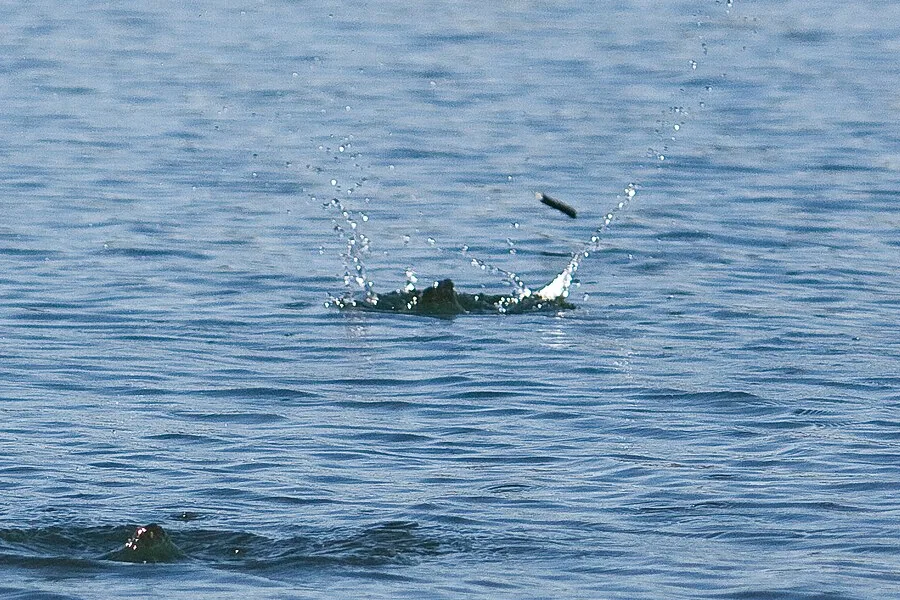
A stone has touched blue water: a small crown of spray rises from it.
A stone skipping over water in Patagonia. photo: Killy Ridols, CC BY-SA 2.0

Try it at a real lake

For a walk, a school lesson or a trip. You need calm water and a handful of stones.

  1. Look for flat, fairly round stones about the size of your palm, with one smooth face. Thick, angular ones sink.
  2. Hold the stone flat between your fingers, with your forefinger curled round the edge.
  3. Tilt it slightly, front edge raised, and throw sideways, as low as you can, nearly parallel to the water.
  4. Let go with a flick of the forefinger, so the stone spins.
  5. Count the bounces. On the next throw change just one thing and compare.

Throw only at open water, away from people, boats, birds and swimmers. Do not throw from bridges.

For lessons and trips

  • Each group picks what it changes: the tilt, the spin or how low it throws. One thing only, ten times.
  • Write the number of bounces from each throw in a table and work out the average.
  • Before they throw, the children guess which thing will matter most. Then they compare with the charts in the game.
  • Send them the link to a throw from the game and ask them to beat it.

Experiment sheet

One sheet per group. Before the first throw, write down what you think will matter most.

We think this will matter most:

ThrowWhat we changed (one thing only)BouncesDistance, in paces
1
2
3
4
5
6
7
8
9
10

After ten throws, the average of our bounces is

What is measured and what is imagined

Taken from sources

  • The tilt of about 20° that gives the most bounces (laboratory, Nature 2004).
  • Spin of about one turn during the contact, and the number of skips roughly proportional to speed (laboratory, Physics World); a 15 g disc at 10 m/s made 20 skips.
  • The record of 88 bounces (Guinness) and Steiner's stones.
  • The text of Minucius Felix.

Computed by the game

How the game computes the stone's path: the water pushes the wet part of the stone, harder the faster the stone goes into it (the pressure grows with the square of the speed perpendicular to the stone's face), and the dry part feels no force. That is how Nagahiro and Hayakawa (2005) describe the touch, after an older model by Birkhoff. Between touches the stone flies like any thrown object. Spin follows an estimate by Bocquet: the stone is lost after a number of bounces that grows with the square of the turns. One number was chosen by trial: how hard the water pushes. It was tuned so the game lands close to two published figures, a 15 g disc making 20 skips at 10 m/s and about 20 m/s being needed to beat Steiner's 2002 record of 40 skips (Physics World). The game stays within a factor of two of them, so it is not a fit to measured skip counts.

Imagined

The lake, the child, the spray, the rings and the sound are drawn. The height of the bounces is drawn six times larger than it is, and the stone is drawn larger than life. In the game, without spin there is no bounce at all; in reality, a second bounce only becomes much less likely. The game does not reach the record of 88: its maximum is 51. The game's numbers show how things change, not what you would get at a real lake.

What we do not know

  • No Romanian name for this game turned up in a citable source, so the Romanian edition describes it in plain words.
  • Sources disagree on why the stone stops. Bocquet's simple model (2003) says it loses horizontal speed, while the experiments of Bocquet and Clanet (Physics World) say the horizontal speed holds and the path flattens. In the game the stone loses about 36% of its horizontal speed, from first to last touch, over a good throw (16 m/s, 5°, tilt of 20°, 14 turns per second), and its bounces flatten until it no longer leaves the water. The text keeps only what the sources share: the bounces get shorter and quicker, then the stone slides and sinks.

Sources

Images and text

  • photo: shioshvili (Flickr), CC BY-SA 2.0 (cropped from Skimming_stones2, with the child outside the frame)
  • photo: Killy Ridols, CC BY-SA 2.0 (cropped)
  • The Latin text and the 1885 English translation are in the public domain. The Romanian translation: Marius Comper, from the Latin.
  • The photographs are under CC BY-SA 2.0; their crops keep the same licence.