Marius Comper
RO

Shelburne Falls, 1865 · US Patent 48,475

The Pin-Tumbler Lock

Inside almost every front door sits a 4,000-year-old idea shrunk to millimeters by Linus Yale Jr.: five split brass pin stacks that refuse to let the plug turn until every single gap meets the same invisible line.

Egypt & Nineveh, c. 2000 BC

A 4,000-year-old idea

Around 4,000 years ago in Ancient Egypt and Nineveh, heavy doors were secured by hollow wooden bolts held shut by gravity-fed wooden pins.

A large toothbrush-shaped wooden key lifted all the pins at once so the bolt could slide. The principle was already complete—only its 60-centimeter scale kept it off a keyring.
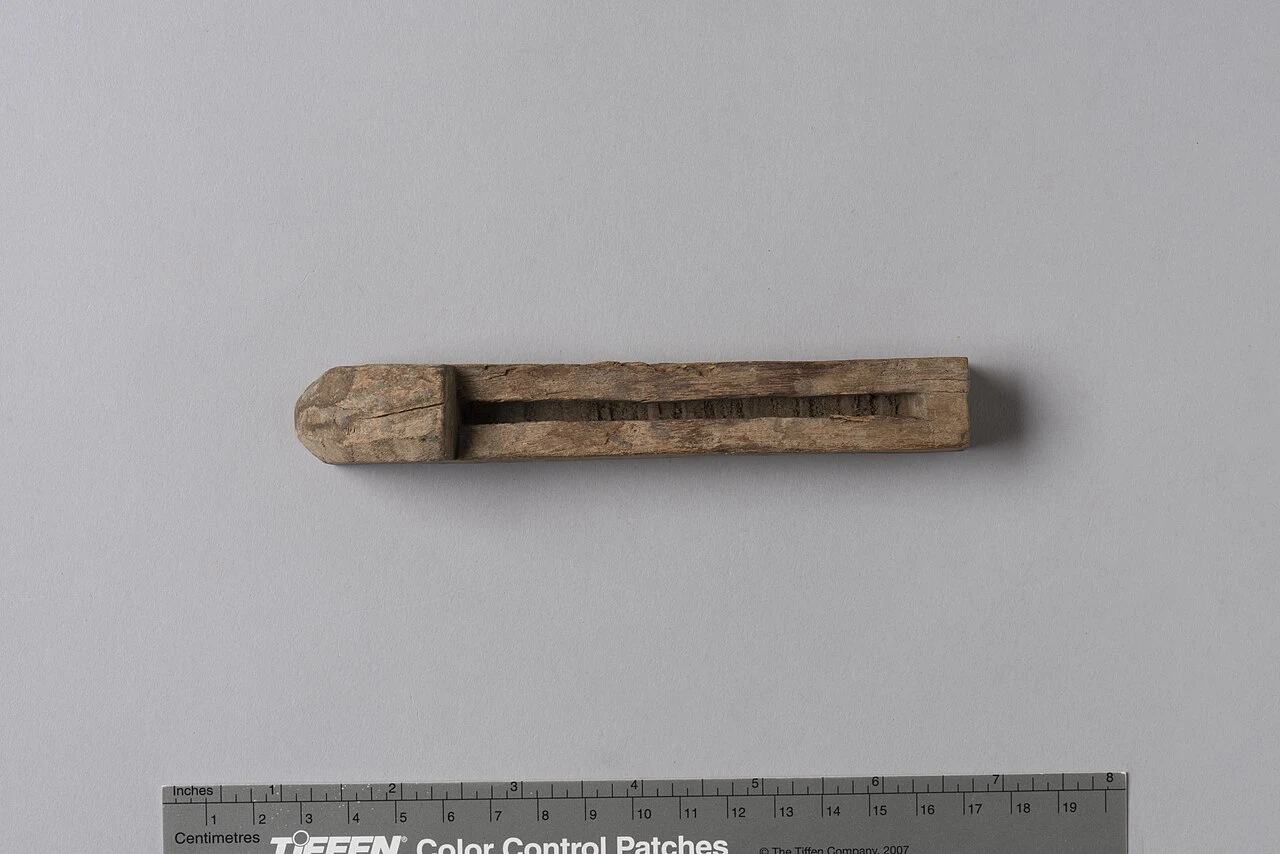
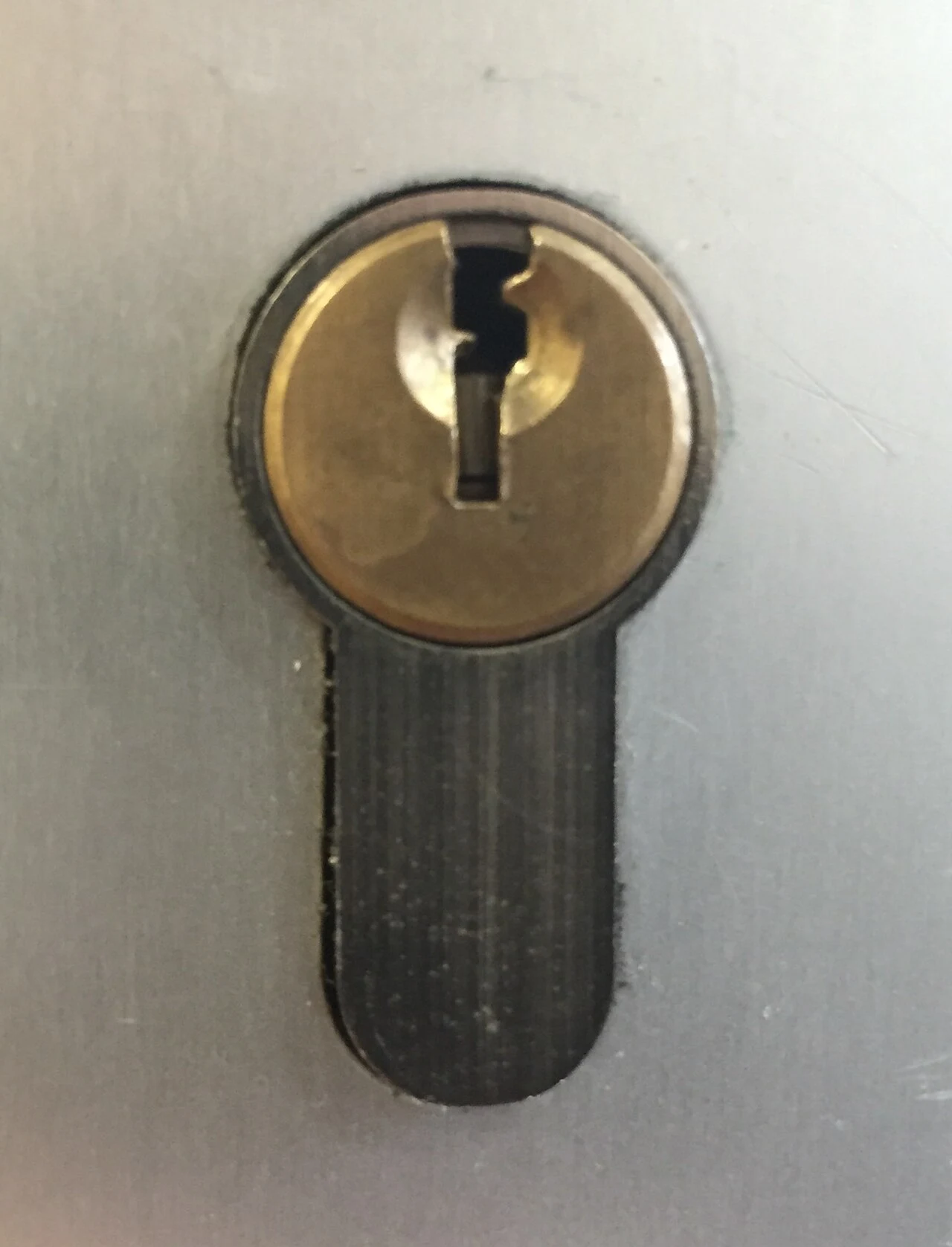
Original wooden Egyptian pin-tumbler lock components, Museo Egizio, Turin. Wikimedia Commons, CC0.

1861–1865

Linus Yale Jr.'s patents

On 29 January 1861, Linus Yale Jr. received US 31,278 for a compact revolving cylinder lock. On 27 June 1865, US 48,475 introduced the small flat serrated key and split pin stacks.

Instead of a heavy iron warded key, a thin pocket-sized blade lifted five tiny brass pin pairs cleanly.

Cutaway brass

Anatomy of the cylinder

Opening the outer brass housing reveals five vertical chambers. Each holds a coiled steel spring on top, a driver pin in the middle, and a key pin resting in the keyway below.

Only the inner cylindrical plug rotates—driving the steel cam that retracts the deadbolt.

Modern brass Euro-profile pin-tumbler cylinder and bitted keys. Photo: Willh26, Wikimedia Commons, CC BY-SA 4.0.

Drag the cylinder to orbit · test keys and picks in the bench below

The critical boundary

The shear line

The circular boundary between the rotating plug and fixed housing is the shear line. With no key inside, the springs push every driver pin down across this gap, jamming the plug.

Rotation happens only when all five gaps between key pins and driver pins sit simultaneously on that exact line.

Exact bitting

How the right key works

As the matching key (4-2-5-1-3) slides in, each tooth lifts its key pin to the exact matching height: short pins ride high ridges, long pins settle into deep valleys.

When the key seats fully, all five gaps flash green along the shear line—the plug rotates 90° and retracts the bolt.

One cut off

Why a wrong key jams

If even one cut is a single step too deep, its driver pin stays dropped across the shear line; if too shallow, the key pin itself pokes up into the housing.

Either mistake stops the plug dead against brass with zero give.

6⁵ = 7,776 · 10⁵ = 100,000

Key combinatorics

With 5 chambers and 6 standard bitting depths, a cylinder has 6⁵ = 7,776 theoretical combinations; with 10 depths, that rises to 10⁵ = 100,000.

Trying keys blindly one by one would take hours.

Inevitable imperfection

The 0.05 mm tolerance

Drilled pin chambers always carry microscopic offsets of roughly 0.05 millimeters relative to the plug axis.

That tiny manufacturing tolerance destroys pin independence: instead of 7,776 trials, a single-pin picker solves the lock in at most 5 + 4 + 3 + 2 + 1 = 15 probes.

Physics of picking

The binding order

Apply light turning torque with a tension wrench and the most misaligned chamber pinches its driver pin first: that is the binding pin.

Lift it until its gap hits the shear line—the plug rotates a hair and traps the driver pin on the shelf with a crisp click. Load immediately transfers to the next pin in binding order.

12° false set

Spool security pins

Standard driver pins are straight cylinders. Spool pins have a narrow waist: when caught at the shear line, they drop the plug into a deceptive 12° false set.

To clear the spool's wide lip, you must let the plug counter-rotate slightly as you lift before it clicks home.

2⁵ = 32 keys

Master-key systems

Offices and hotels insert thin brass master wafers between key and driver pins, creating two valid shear breaks per chamber.

With one wafer in every chamber, 2⁵ = 32 distinct keys open the same cylinder—doubling the shear points an attacker can exploit.

Momentum transfer

Lock bumping

Strike a maximally deep-cut bump key while holding light tension and the key pins transfer kinetic impulse straight into the driver pins like billiard balls.

For a few milliseconds, all five driver pins leap above the shear line at once.

Modern defense

How high-security cylinders fight back

Modern high-security cylinders combine spool and serrated pins, hardened anti-snap steel bars, and paracentric keyways that block straight pick access.

Every layer trades simple 15-probe speed for time and ambiguity.

Locksmith's bench

Pick or key the 3D cylinder

Switch between Key Mode (edit any of the 5 V-cuts and watch the shear line) and Lockpick Mode (hunt the real binding order 3 → 1 → 5 → 2 → 4 and feel the 12° spool false set).

Cylinder locked (0°). Insert the matching key or switch to Lockpick Mode to hunt the binding pin.

Share

Send this playable 3D pin-tumbler cutaway or copy the direct link.

Data and sources

Historical patents, combinatorics, and mechanical tolerances come from Linus Yale Jr.'s original filings, museum collections, and locksmithing references:

Parameter / PatentVerified valueTechnical note
Ancient Egyptian lock~4,000 years agoWooden bolt with gravity pins (Nineveh / Turin)
US Patent 31,278 (29 Jan 1861)Linus Yale Jr.Compact revolving drawer cylinder
US Patent 48,475 (27 Jun 1865)Linus Yale Jr.Flat serrated key and split pin stacks
Theoretical key space (5 pins)7,776 / 100,0006⁵ (6 depths) or 10⁵ (10 depths)
Chamber tolerance~0.05 mmCollapses search to at most 15 probes (5+4+3+2+1)
Spool pin / Master key12° false set / 32 keysCounter-rotation trap; 2⁵ = 32 keys with 1 wafer/pin
  1. Linus Yale Jr., US Patent 31,278 (1861) and US Patent 48,475 (1865).
  2. MIT Guide to Lock Picking — shear-line geometry, 0.05 mm tolerances, and binding order.
  3. Photographs: Egyptian wooden lock (Museo Egizio, Turin, CC0) and Pin-tumbler Euro cylinder (Willh26, Wikimedia Commons, CC BY-SA 4.0).