mariuscomper.uk RO
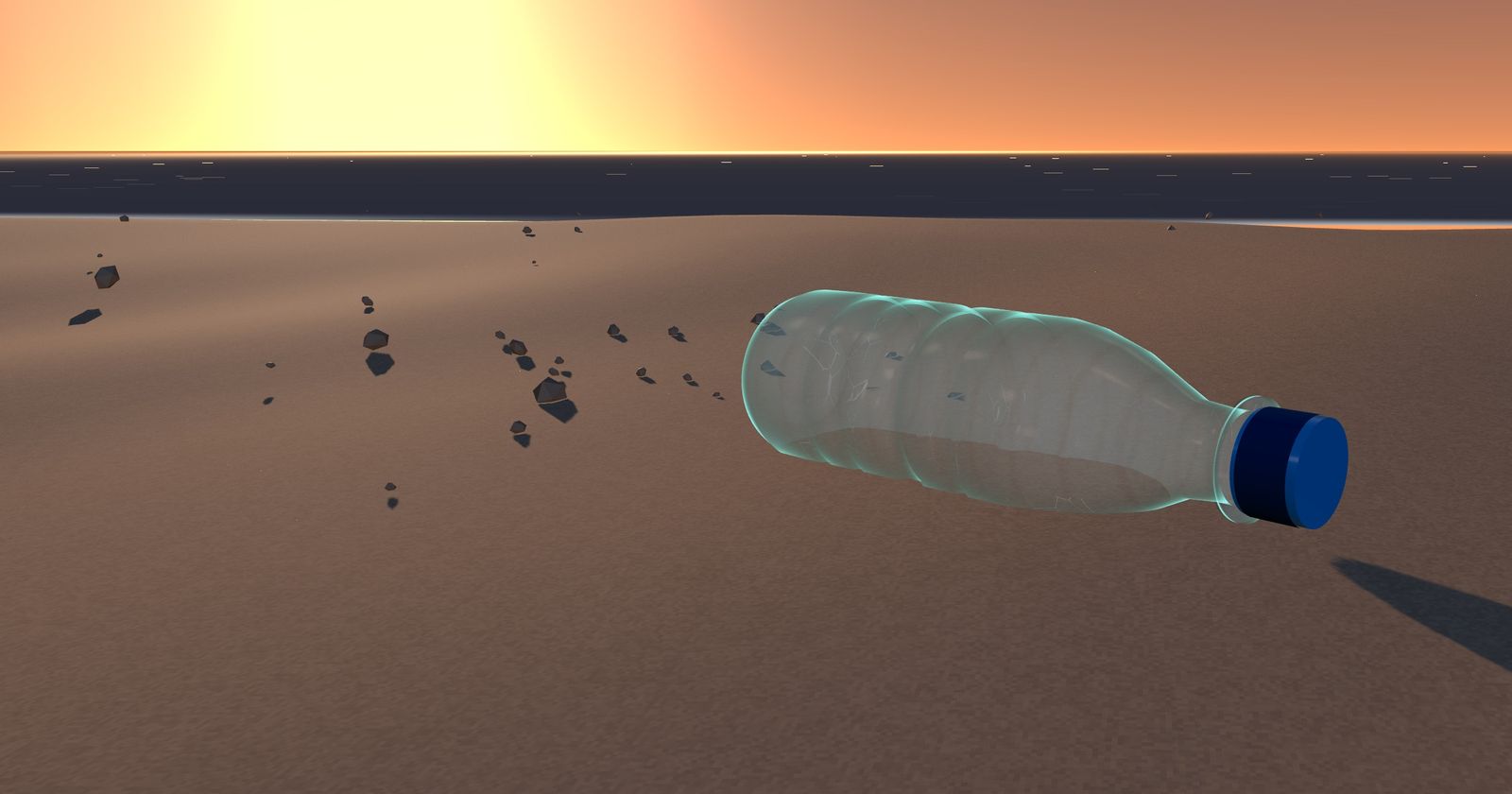
A plastic bottle on sand in low sunlight.

Microplastics, from a bottle to the lab bench

The plastic in you

A bottle left on a beach does not disappear. It breaks into smaller and smaller pieces, down to sizes an ordinary light microscope cannot see. Follow them, then see where they have been looked for in the human body, and how sure the findings are.

on the beach · centimetres

Light makes it brittle

The bottle is made of PET, polyethylene terephthalate, the same plastic that is spun into polyester for clothes. Ultraviolet light slowly breaks the polymer’s long chains; heat, waves and sand do the rest.

The surface crazes into a fine network, like the glaze on an old mug, and starts to come away in flakes. Plastic does not rot the way wood rots. It breaks.

microplastic · millimetres

Below five millimetres, it is called microplastic

A flake like this one, 5 millimetres across, is the threshold. The studies on this page call any piece smaller than 5 millimetres a microplastic, and anything below a thousandth of a millimetre, one micrometre, a nanoplastic.

Not every paper draws the line in the same place. This page uses the one from the studies it cites, so the words mean the same thing from one chapter to the next.

fibres and dust · tens of micrometres

Not only bottles

The plastic around people does not come only from bottles. A polyester jumper sheds fibres. Tyres wear down on tarmac into crumbs of synthetic rubber stuck to road dust.

Some of it comes loose right where it goes into the mouth. One plastic teabag steeped in water at 95 °C released about 11.6 billion microparticles and 3.1 billion nanoparticles into a single cup, in measurements published in 2019.

nanoplastic · below 1 micrometre

Smaller than a red blood cell

The red disc is a red blood cell, about 7.5 micrometres across. The shard beside it is 1 micrometre. Splinters of 100 nanometres are ten times smaller again, below what an ordinary light microscope can show.

In 2024 a team at Columbia University counted the particles in bottled water with a new laser-based technique: around 240,000 per litre, give or take 130,000, about 90% of them nanoplastics. Another researcher disputed the estimate, saying the measurements lacked proper blank samples; the authors rejected the criticism.

try it

One gram, ground all the way down

Pick the object, then hold the button. Every step ten times smaller means a thousand times more pieces: the plastic does not get less, it only multiplies.

1 mm

Pieces in a single gram725

The count assumes cube-shaped pieces of a plastic as dense as PET, 1.38 grams per cubic centimetre; for rubber or nylon it differs a little.

blood · Amsterdam, 2022

In the blood of 17 of 22 people

One of the first studies to measure the mass of plastic in human blood, at Vrije Universiteit Amsterdam, took samples from 22 healthy donors. In 17 of them there was enough plastic to be measured. PET turned up most often, in half the donors, then styrene-based plastics such as polystyrene in 36%, and polyethylene in 23%. On the plate, the lit dots are the 17 and the dim ones the other 5.

The method gives a mass, not a number of particles, and catches only what stays on a filter: pieces from 0.7 micrometres up. The authors call it a pilot study in a small group. The chemist Roger Kuhlman challenged the results in a letter to the same journal, and the authors disputed it. A 2025 analysis concluded that the method is not yet suitable for polyethylene or PVC, which fats can mimic, nor for PET in blood, whose signal the rest of the sample drowns out.

placenta · 2021

Four placentas out of six

Six women with uncomplicated pregnancies agreed to have their placentas analysed. In four, researchers found 12 fragments of 5–10 micrometres: five on the side facing the foetus, four on the side facing the mother and three in the membranes.

All were coloured. Only three could be identified as polypropylene; for the other nine only the pigments were recognised, of the kind used in paints, adhesives, cosmetics and plastics. Six placentas say nothing about how common this is, and nothing about any effect on the baby.

artery plaque · Naples, 2024

In the plaque of the neck artery

A widely reported study, from the University of Campania, followed people having surgery on the carotid artery, the large vessel in the neck that carries blood to the brain. Their narrowed artery had caused no symptoms. Surgeons removed the plaque, the build-up of fat and cells narrowing the artery, and the plaque was analysed.

Of the 257 patients followed to the end, 150 had polyethylene in their plaque, on average 21.7 micrograms per milligram of plaque. In 31 of them PVC was found as well.

foam cell · below 1 micrometre

Jagged splinters in cells full of fat

Under the electron microscope, in the plaque of ten patients chosen at random from those with both polyethylene and PVC, there were particles with jagged edges, probably of foreign origin. They sat inside foam cells, the clean-up cells swollen with the fat they have swallowed, and among the debris of the plaque.

Almost all were smaller than 1 micrometre. In four of the ten, some particles contained chlorine, as PVC does.

followed for 34 months on average

30 of 150, against 8 of 107

On the plate, each dot is a patient: green, with polyethylene; violet, with PVC as well; grey, with no plastic found; red, those who had an event. The patients were followed for 34 months on average. Of those with plastic in their plaque, 30 of 150, or 20%, had a heart attack or a stroke, or died of any cause. Of those without, 8 of 107, or 7.5%.

After adjusting for age, sex, cholesterol, diabetes, blood pressure and other risk factors, the hazard ratio was 4.53, with a 95% confidence interval from 2.00 to 10.27. Without adjustment, 2.84.

This is an association, not proof that plastic caused these events. The authors write that their results do not prove causality, that unmeasured factors may play a part and that laboratory contamination cannot be firmly ruled out. Polyethylene and PVC, the only plastics reported here, are also exactly the two the 2025 analysis considers hard to measure correctly in tissue with this method, because fats can give a similar signal.
brain · disputed

The brain study, in question

In 2025 a team at the University of New Mexico reported far more plastic in the brains of people who had died than in their livers or kidneys: a median of 4,917 micrograms per gram of tissue in the 2024 samples, about 50% more than in those from 2016, and more still in 12 people with dementia. Under the microscope there were mostly splinters of 100–200 nanometres; the chemical analysis averaged three-quarters polyethylene.

Criticism followed. The brain is rich in fat, and fat can be mistaken for polyethylene by this method. Germany’s Federal Institute for Risk Assessment (BfR) wrote that the amounts “appear implausibly high” and that in many cases suitable controls for contamination were lacking. A group of researchers published a critique in the same journal, and the authors replied. The journal also published a correction for duplicated images and other errors in the supplementary material.

The authors do not claim plastic causes dementia: a brain already damaged by disease could itself let particles build up.

what is known and what is not

What is certain, and what is not

Certain: plastic breaks into smaller and smaller pieces, and particles have been measured in bottled water and in tea from plastic teabags.

Less certain: how much gets into the body. Every study on this bench found plastic in at least some of the people tested, but in small groups, with methods still being checked, and with the risk that plastic from the lab, from tubes, gloves or air, ends up in the sample.

Least certain: what it does. In 2019 the World Health Organization said that, on the limited information available, microplastics in drinking water did not appear to pose a health risk at current levels, but that more needed to be found out; the smallest particles might be taken up more readily, but the data were “extremely limited”. The artery study shows an association, not a cause.

back on the beach

The bottle that never reaches the beach

Every piece in this story started as a whole object. In England and Northern Ireland, a deposit return scheme for drinks containers, PET plastic bottles included, comes into force on 1 October 2027, under regulations made in 2025.

A bottle that goes back is a bottle that is not ground down on the sand.

Pass it on

For someone who drinks bottled water, has seen a headline about plastic in the brain, or wants to know how solid these studies are.

Sources and method

Every figure about the human body comes from the paper cited below, read in full, with the limits the authors state and the criticism published since.

How to read the studies

The blood, artery and brain studies used the same basic method, pyrolysis followed by gas chromatography and mass spectrometry: the sample is heated until it breaks down, and each plastic is recognised by the fragments it leaves. The method gives a mass, not a number of particles, and cannot tell microplastic from nanoplastic. A 2025 analysis showed that fats in tissue break down into the same fragments as polyethylene and can give false positives for polyethylene and PVC. The placenta study used a different method, Raman spectroscopy, which identifies particles one by one.

The scenes are reconstructions: the bottle, the flake, the fibre, the cells and the samples are drawn at roughly their real scale, not copied from any one sample. On the plates of dots, each dot is one person in the study and the counts are the papers’ own; the order of the dots is only for reading. How many pieces come out of a gram is geometry: one gram divided by the density of PET and by the volume of a cube of the chosen side.

  1. R. Marfella et al., “Microplastics and Nanoplastics in Atheromas and Cardiovascular Events”, New England Journal of Medicine 390 (2024): 900–910. All the figures on artery plaque, events, the hazard ratio and the authors’ stated limitations. doi.org
  2. H. A. Leslie et al., “Discovery and quantification of plastic particle pollution in human blood”, Environment International 163 (2022): 107199. doi.org
  3. R. L. Kuhlman, “Letter to the editor, discovery and quantification of plastic particle pollution in human blood”, Environment International 167 (2022): 107400. doi.org
  4. A. Ragusa et al., “Plasticenta: First evidence of microplastics in human placenta”, Environment International 146 (2021): 106274. doi.org
  5. A. J. Nihart et al., “Bioaccumulation of microplastics in decedent human brains”, Nature Medicine 31 (2025): 1114–1119, with the author correction in Nature Medicine 31 (2025): 1367. doi.org
  6. F. Abdolahpur Monikh, D. Materić, E. Valsami-Jones et al., “Challenges in studying microplastics in human brain”, Nature Medicine (2025), with the reply by M. Campen et al. doi.org
  7. German Federal Institute for Risk Assessment (BfR), “Microplastics in the brain”, Communication No. 056/2025. www.bfr.bund.de
  8. C. Rauert et al., “Assessing the Efficacy of Pyrolysis–Gas Chromatography–Mass Spectrometry for Nanoplastic and Microplastic Analysis in Human Blood”, Environmental Science & Technology 59 (2025): 1984–1994. doi.org
  9. N. Qian et al., “Rapid single-particle chemical imaging of nanoplastics by SRS microscopy”, PNAS 121 (2024): e2300582121; critique: D. Materić, “Nanoplastics measurements must have appropriate blanks”, PNAS (2024), with the authors’ reply. doi.org
  10. L. M. Hernandez et al., “Plastic Teabags Release Billions of Microparticles and Nanoparticles into Tea”, Environmental Science & Technology 53 (2019): 12300–12310. doi.org
  11. World Health Organization, “WHO calls for more research into microplastics and a crackdown on plastic pollution”, 22 August 2019, on the report Microplastics in drinking-water. www.who.int
  12. D. Carrington, “‘A bombshell’: doubt cast on discovery of microplastics throughout human body”, The Guardian, 13 January 2026. www.theguardian.com
  13. IFA GESTIS substance database, polyethylene terephthalate: density 1.38 g/cm³. gestis.dguv.de
  14. RetuRO, administrator of Romania’s deposit-return system: return rate January–October 2026. returosgr.ro
  15. The Deposit Scheme for Drinks Containers (England and Northern Ireland) Regulations 2025, SI 2025/67. www.legislation.gov.uk