mariuscomper.uk RO
2013 front photograph of the astronomical dial on Prague’s Old Town Hall tower, showing the blue and black sky zones, gilded zodiac ring, and Gothic numerals.

A mechanical astrolabe and public clock documented from 1410

The Prague Astronomical Clock

Beneath the windows where crowds gather for the hourly procession of the Apostles (8 a.m. to 11 p.m.), a three-metre dial tracks three hour systems plus the Sun, Moon, and sidereal star on a North-Pole projection.

Old Town Square

Everyone looks up. The computer is below.

Every hour between 8 a.m. and 11 p.m., Prague’s Old Town Square fills with visitors pointing phones at two small blue windows near the top of the tower, waiting for the wooden Apostles.

Right below them, a three-metre dial turns almost unnoticed. Its 260-centimetre plate and 300-centimetre outer ring form a working mechanical astrolabe that displays the Sun, the Moon, and the sidereal star across three distinct hour systems.
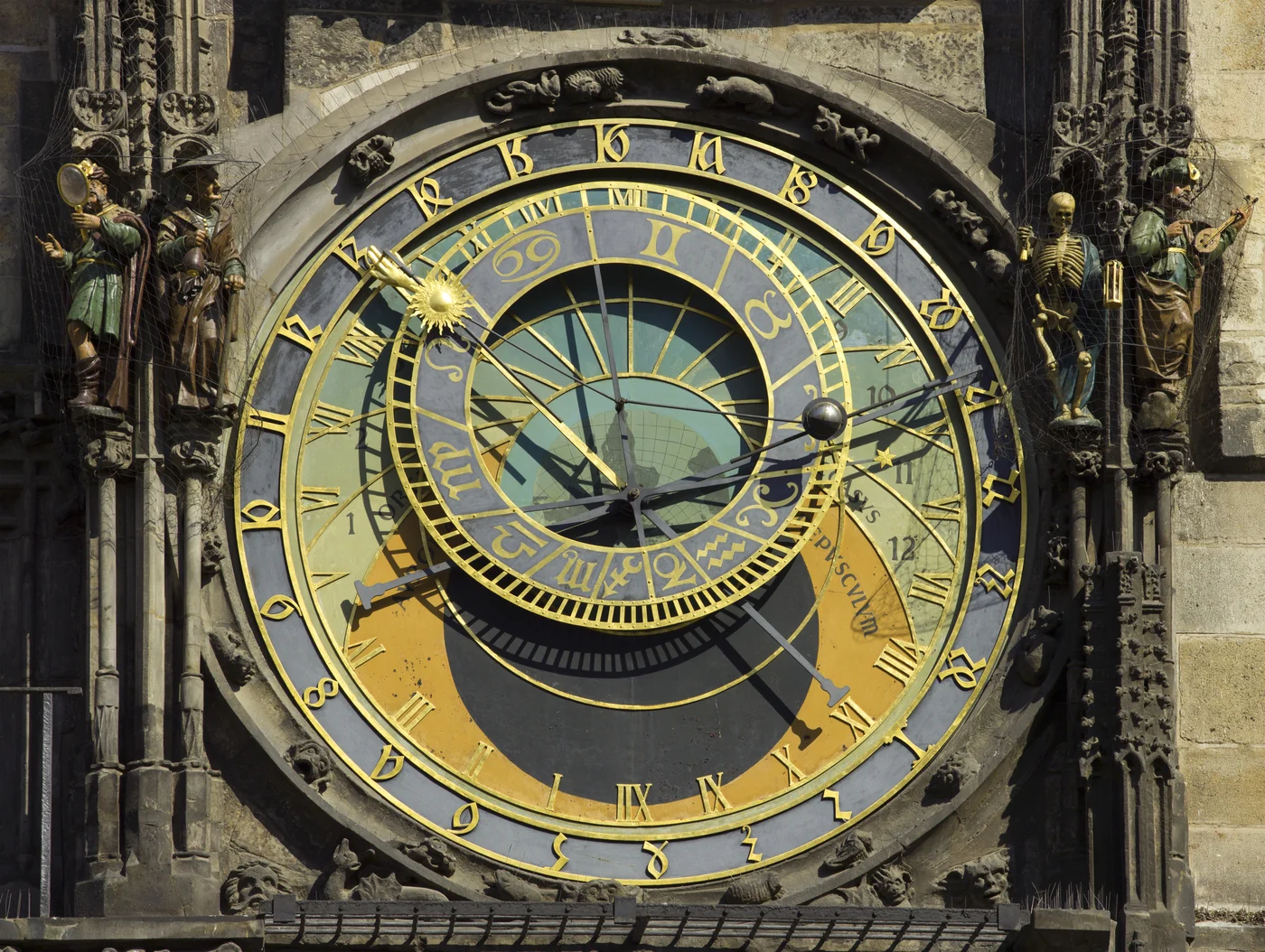
2013 front photograph of the astronomical dial on Prague’s Old Town Hall tower, showing the blue and black sky zones, gilded zodiac ring, and Gothic numerals.
The astronomical dial of the Prague Orloj in 2013 (pre-2018 appearance). Photo: Godot13, Wikimedia Commons, CC BY-SA 4.0.

The charter of 9 October 1410

Who actually built the clock

For centuries legend credited a master Hanuš around 1490, supposedly blinded by Prague councillors so he could never build its equal elsewhere (Hanuš worked on the clock later in the fifteenth century).

A copy of an Old Town Council charter dated 9 October 1410 (18 October proleptic Gregorian), identified in 1962, awards a house and stipend to imperial clockmaker Mikuláš of Kadaň for building the astrolabe. The attribution of its astronomy to Charles University professor Jan Šindel rests on an anonymous marginal note inside a copy of a work by Tadeáš Hájek.

Geometry in space

Flattening the celestial sphere onto a wall

To map the curved sky onto a flat 260-centimetre plate, the 1410 builders used a stereographic projection from the North Pole onto the plane of the celestial equator.

Watch the celestial sphere rise out of the dial: every ray dropped from the North Pole through the 3D Tropics, the Equator, and Prague’s tilted horizon at 50°05′13″N lands squarely on the painted circles below.

Polar inversion

Why summer sits on the outside

Because the projection centre is the North Pole, northern declinations lie closer to the pole and expand outward, while southern declinations shrink inward. The Tropic of Cancer (summer solstice) becomes the outermost circle at 1.52 times the Equator’s radius, and the Tropic of Capricorn (winter solstice) shrinks to 0.66 inside.

Guided by the eccentric zodiac ring, the golden Sun climbs high into the blue sky in June and hugs the lower horizon in December.

21 June at midnight

The night that never arrives in June

The stationary plate divides the sky by geometric solar altitude: lapis blue for daylight, vermilion bands for dawn (Aurora, Ortus) and dusk (Occasus, Crepusculum), and the black disc at the bottom for astronomical night, when the Sun’s centre drops below −18 degrees.

At Prague’s latitude around 21 June, the Sun’s centre dips at midnight only to 16.5 degrees below the horizon. Its centre skims outside the −18° disc without entering it: Prague stays in astronomical twilight all night.

Sky above horizonTwilight (0° to −18°)Astronomical night (below −18°)

The eccentric ring & star

A whole year on one gilded wheel

Floating above the sky plate is a pierced, off-centre gilded zodiac ring tangent to the Tropic of Cancer on one side and the Tropic of Capricorn on the other. A gilded star marks the vernal equinox (0° Aries) to read sidereal time.

Because the zodiac ring turns once every sidereal day while the Sun arm turns once every mean solar day, the Sun drifts steadily through all twelve signs, while both pointers ride directly on that shared ring.

Drag across the dial to wind the hour · right-drag to orbit

Clock one

Central European Time, year-round

The fixed ring of gilded Roman numerals (added in later restorations) tracks modern 24-hour civil time: XII at the top marks noon, and XII at the bottom marks midnight.

The golden hand at the tip of the Sun arm points straight to Central European Time (UTC+1). The Orloj never shifts for Daylight Saving.

Clock two

Old Bohemian hours, counted from sunset

The 300-centimetre outer black ring of twenty-four gilded Gothic (Schwabacher) numerals reads Old Bohemian hours, a medieval system that started each new day at sunset.

Because sunset shifts earlier in winter and later in summer, a cam mechanism (installed in its modern form in 1957) rocks the black ring across the year so that numeral 24 stays aligned with sunset.

Clock three

Babylonian hours: 81 minutes in summer, 39 in winter

Across the blue daytime sky curve twelve golden arcs numbered 1 to 12. They divide the geometric span between sunrise and sunset (h = 0°) into twelve equal parts.

On 21 June in Prague, geometric daylight lasts 16 hours and 10 minutes, giving 81 minutes per Babylonian hour (about 82 minutes with atmospheric refraction). On 21 December, daylight shrinks to 7 hours and 50 minutes, compressing every hour to 39 minutes.

17th-century gravity inside

57 internal teeth inside the Moon

Riding the lunar arm is a half-silvered, half-black sphere, added in the seventeenth century to show the Moon’s phase in three dimensions.

Inside the hollow sphere sits an internally toothed 57-tooth ring driven by a horizontal double-start worm and an eccentric lead weight hanging straight down. Gravity advances the shell two teeth per lunar circuit (28.5 lunar days = 29.5 solar days), drifting by only 44 minutes a month.

Behind the wall

Looking through the Gothic stone

Every pointer on the front is driven by the massive wrought-iron movement hidden behind the stone wall.

Turning the lapis plate translucent reveals how three coaxial wheels and one shared pinion split the same seconds into three different celestial rates.

365, 366, and 379

Three wheels of equal diameter driven by one pinion

Mounted on concentric sleeves around one main shaft are three forged wrought-iron wheels, each 116 centimetres across and roughly 10 millimetres thick: 365 teeth (zodiac), 366 teeth (Sun), and 379 teeth (Moon), all driven by a single 24-tooth pinion.

The 366/365 beat makes the zodiac wheel gain one full turn on the Sun in 365 days—about 5 hours and 49 minutes short of a tropical year.

1410 vs 1866

From −9 hours a month to +2 minutes

With the Sun wheel fixed at 366 teeth, the ideal count for a 29.53-day synodic month was 378.83, making 379 teeth the closest integer possible (379 / 13 = 29.15 days, roughly nine hours fast each month; 378 would give 31.50 days, and 380 would give 27.14 days).

In 1866, the Daněk–Schmidt mechanism added differential gearing that refines the lunar hand to 29.5323 days—an error of just 2 minutes 27 seconds a month. Switch between the two trains below.

The fire of 8 May 1945

Mánes’s calendar and restoration

Directly beneath the astrolabe hangs the calendar dial painted by Josef Mánes in 1865–1866 (replaced on the tower by E. K. Liška’s copy in 1880–1882, and later copies including the 2018 restoration).

On 8 May 1945, in the final hours of the Prague Uprising, fire engulfed the Old Town Hall and destroyed the woodwork. The iron movement survived and resumed running on 1 July 1948.

Interactive dial

Set the Orloj to any date and hour

Choose a date and time below, or run a 24-hour day or full-year time-lapse. Central European Time (permanent UTC+1), Old Bohemian hour, Babylonian hour, zodiac sign, and Moon phase compute live from the Prague geometry.

Pick any date and time or choose a preset above to read Prague’s dials simultaneously (the Orloj stays on permanent UTC+1).

Share this clock

Send the live 3D Prague Orloj—or the exact date and hour you set—directly to someone else.

Sources, calculations, and reference values

Every figure on this page comes from the 1410 charter copy, surveys of the wrought-iron movement, and stereographic geometry computed for Prague’s latitude (50°05′13″N).

ComponentCount / valueEffect / error
Fixed astrolabe plate260 cmOuter Gothic ring measures roughly 300 cm across
Zodiac wheel365 teethSidereal day; loses ~5 h 49 min per tropical year against the Sun
Sun wheel366 teethMean 24-hour solar day
Moon wheel (1410)379 teeth29.15-day synodic month (−9.04 h/month; closest integer to 366)
Lunar correction (1866)Daněk–Schmidt29.5323 days per month (+2 min 27 s vs mean synodic month)
Shared driving pinion24 teethEngages all three 116 cm wheels simultaneously
Moon sphere (17th c.)57 teeth2 teeth per lunar day = 29.5 solar days (−44 min/month)
21 June (geometric h = 0°)16 h 10 m daylight1 Babylonian hour = 81 min (with refraction: 16 h 23 m, ~82 min)
21 December (h = 0°)7 h 50 m daylight1 Babylonian hour = 39 min
  1. Copy of the Prague Old Town Council charter of 9 October 1410 (18 October proleptic Gregorian), identified in 1962 — naming imperial clockmaker Mikuláš of Kadaň (orloj.eu/cs/ledvinka.htm); Zdeněk Horský, Pražský orloj, Panorama, 1988.
  2. Attribution of the astronomy to Jan Šindel (c. 1375–1456) via an anonymous marginal note in a copy of a work by Tadeáš Hájek: Petr Skála (Staletá Praha 2016).
  3. Dial survey (260 cm plate, 300 cm outer ring), 116 cm wrought-iron wheels (365 / 366 / 379 teeth, 24-tooth pinion), 1957 sunset cam, and 1866 Daněk–Schmidt lunar correction: orloj.eu/cs/astro_cifernik.htm, orloj_jici.htm, and serizovani_astrolabu_orloje.pdf.
  4. Moon sphere internal mechanism (17th-century 57-tooth internal gear driven by horizontal double-start worm and eccentric lead weight): orloj.eu/cs/orloj_mesic2.htm.
  5. Stereographic projection for Prague (50°05′13″N, 14°25′15″E, obliquity 23.439°) and geometric Babylonian hour lengths (81 / 39 min at h = 0°; 82 min with −0.833° refraction): computed from spherical astronomy (USNO).
  6. Calendar dial by Josef Mánes (1865–1866, copies 1880/1882 and 2018), 8 May 1945 fire, and 1 July 1948 restart: orloj.eu/cs/orloj_historie.htm; Apostle show hours (8 a.m.–11 p.m.): Prague City Tourism.
  7. 2013 dial photograph: Godot13 (Andrew Shiva), Wikimedia Commons, CC BY-SA 4.0.