An industrial history
It took corn puffs 27 years to become "traditional"
In November 1971, an advertisement in the magazine Flacăra presented Romanian corn puffs, pufuleți, as "a new item" made with pecorino cheese, fit for breakfast as much as for an aperitif. Twenty-seven years later, the business press was already writing about "traditional puffs". This page follows what happened between the two dates: a Bucharest factory, a patent, an industrial cluster in Baia Mare, and thirty-three former state enterprises that in 1990 had the same word written into their founding charter: "expanded".
Starting point
A 45-gram bag
An ordinary bag of corn puffs holds corn, salt, oil and a great deal of air. An extruder turns hydrated corn grits, under pressure and heat, into a solid foam: as the mixture leaves the die, pressure drops suddenly, water flashes into steam, and the starch expands into a porous structure. What a customer feels as "it melts in your mouth" is, technically, a network of air cells fixed inside starch.
The customer buys crunch, volume and a particular sound when the bag tears open. The producer has to transport exactly that volume, and this physical property shaped the geography of the whole industry, as this history shows.
1971
A product launched as a sign of modernity
Popular memory ties corn puffs to the 1980s, to shortage, to one of the few cheap pleasures on the shelf. The 1971 archive tells a different story.
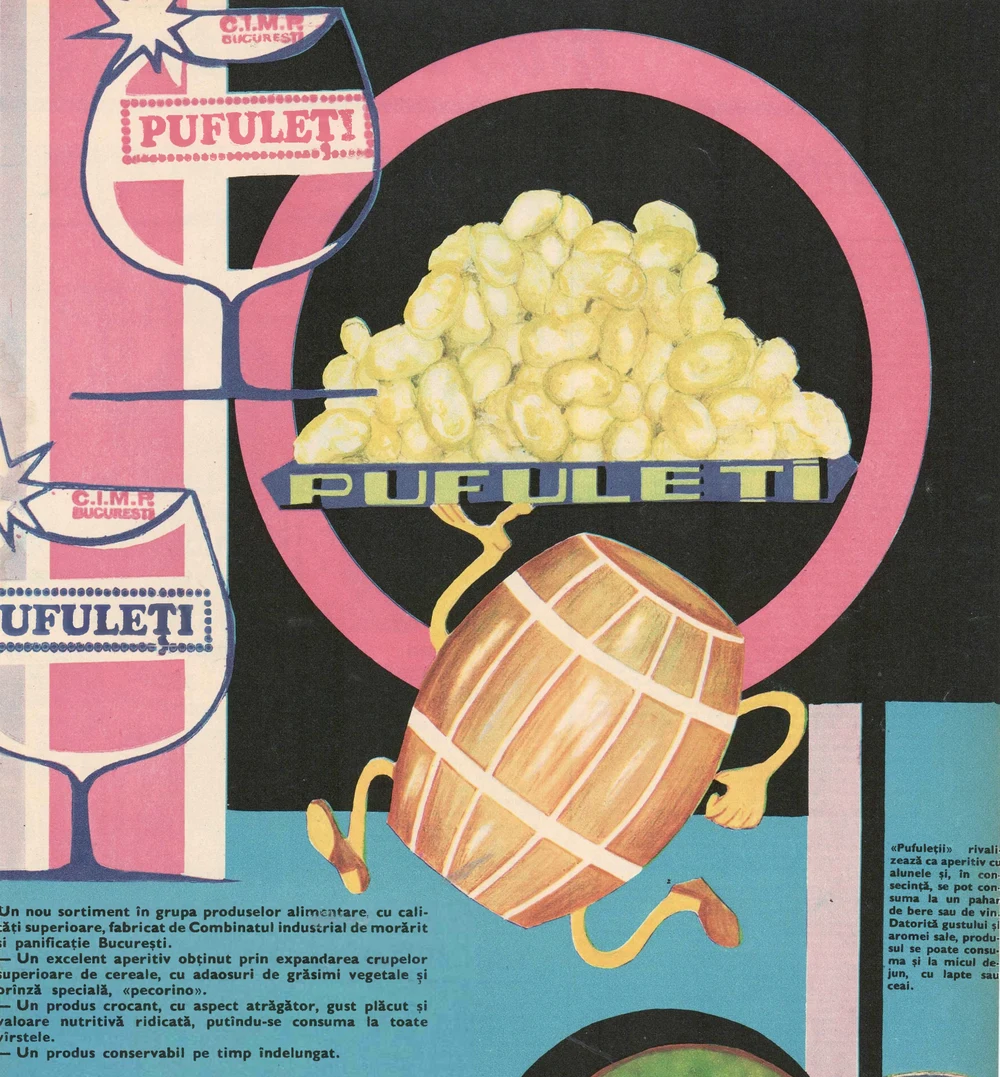
Flacăra, November 1971
"PUFULEȚI — a new item in the food products group"
The advertisement from Bucharest's industrial milling and baking combine describes the product as obtained by expanding superior cereal grits, with added vegetable fats and special "pecorino" cheese. It is positioned equally as an aperitif and as a breakfast food, with milk or tea.
Source: Flacăra, November 1971Nine months earlier, on 21 February 1971, a report on the Titan factory already describes a "corn-expansion sector", with a flake line running at 4 tonnes per 24 hours, and announces that a new line producing 3,200 kilograms a day of "corn doughnuts" would be installed in the second quarter. The same figure resurfaces two years later.
Scînteia tineretului, 29 March 1973
Titan's special expansion section produces 4 tonnes a day of corn flakes and 3.2 tonnes a day of "corn-colletts (pufuleți)".
The article calls the section a "small jewel of Romanian industry", with fully automated equipment.
Source: Scînteia tineretului, 29 March 1973The 3.2-tonne-a-day figure is identical in 1971 (planned) and 1973 (reported), which makes it plausible that the same line is meant. The equipment's commissioning record is missing and the supplier remains unidentified, so this continuity is a hypothesis, not an established fact.
The product's name follows a clear lexical path: expanded corn product (process language, February 1971) → corn doughnuts (a provisional technical label) → PUFULEȚI (commercial name, November 1971) → corn-colletts ("pufuleți") (trade press, 1973). It is not a name change; it is the process by which a technology becomes an everyday object.
Why this matters
The word's etymology confirms this cultural role: Romanian dictionaries trace "pufuleț" to "puf", fluff or down, a physical state. Other names in the same product family pick different reference points: "corn curls" names the shape and the ingredient, while "Bamba" was chosen for its baby-talk sound. The Romanian name describes a sensation.
International comparison
One technology, named differently on four continents
Romanian corn puffs are not an isolated case. Corn extrusion spread as a single technological platform, and each market gave it its own name, flavour and memory.
USA, 1930s
Korn Kurls
A Flakall feed-processing machine produced puffy ribbons when it met wet corn. Farmhands already ate them; Edward Wilson flavoured them and turned them into a business.
France, ~1960 / Germany, 1963
Curly and ErdnußLocken
Company Lorenz places the French Curly snack's origin in the early 1960s, and the German peanut version in 1963.
Israel, 1964-1965
Bamba
Launched in 1964 with a cheese flavour for children. Weak sales led, in 1965, to the peanut coating that became its identity.
Romania, 1971
Pufuleți
"A new item", made with pecorino cheese, from Bucharest's industrial milling and baking combine.
Yugoslavia, 1972
Smoki
The company presents itself as the first "flips" in Southeast Europe. That is a marketing claim, not a regional priority date: Romanian corn puffs are already documented from 1971.
The comparison shows something more interesting than a priority ranking: each country adopted the same technological platform and attached its own name, audience and memory to it. The technology is global; national identity appears only in the recipe, the brand and the memory.
Memory versus archive
What people remember, and what the archive says
Ask someone what corn puffs meant under communism, and the answer is almost always the 1980s: the bag, the salt, the crumbs on your fingers, splitting a bag between children. The archive from 1971-1973 describes the era of planned food modernisation. Both images are true, each for its own period; memory has compressed them into one.
What people remember
- The bag, the salt, the crumbs at the bottom
- Splitting a bag between children, during clandestine video nights
- One of the few cheap pleasures of the 1980s
- "Baia Mare puffs" made with milk powder
What the archive says
- 1971: "a new item", with pecorino cheese, aperitif and breakfast food
- 1973: production at scale, a "fully automated" line
- 1988: "expanded cereals" — a planned national supply category
- 1999: EXTRUDER's Baia Mare recipe — corn grits, salt and oil
The more interesting reading is different: memory keeps the value regime that mattered to each generation and projects it back over the product's whole history.
1977–1990
The state's network: thirty-three companies could make "expanded" products
Corn puffs did not stay a single factory's product for long. In 1977, an administrative decree transfers Bacău work units with the explicit profile "halva, corn puffs" to the local milling and baking enterprise: proof that, by then, the category had outgrown the Bucharest combine and entered regional food infrastructure. The same year, another decree adds a unit for "expanded products and corn flakes" in Bucharest and one for "wafers and expanded cereal products" in Brăila.
By 1988, "expanded cereals" appear as a separate line in the national population-supply programme: 5,000 tonnes, alongside 11,200 tonnes of cereal flakes. The category had moved from a showcase of modernity into the ordinary bookkeeping of the state.
The clearest snapshot of this network comes from December 1990. Government Decision 1353, which turned state food enterprises into joint-stock companies, preserved each new company's legal object of activity. At least thirty-three companies in milling and baking list the term "expanded" or "expandante" explicitly, from Alba Iulia to Iași, from Suceava to Constanța.
| Company | Locality | County | Terms in the object of activity |
|---|---|---|---|
| Albapam SA | Alba Iulia | Alba | expandate |
| Spicul Argeș SA | Pitești | Argeș | sticksuri; expandate |
| Pambac SA | Bacău | Bacău | expandate |
| Panimon SA | Onești | Bacău | «expandante»; arome alimentare |
| Postăvarul SA | Brașov | Brașov | expandate; sticksuri |
| Spicul Buzău SA | Buzău | Buzău | expandate; surogate de cafea; arpacaș |
| Prodpan Călărași SA | Călărași | Călărași | expandate |
| Dobrogea SA | Constanța | Constanța | expandate |
| Mopaco SA | Sfântu Gheorghe | Covasna | expandate |
| Compan SA | Târgoviște | Dâmbovița | expandate |
| Morărit-Panificație Dolj SA | Craiova | Dolj | expandate |
| Morărit-Panificație Galați SA | Galați | Galați | expandate |
| Panem SA | Giurgiu | Giurgiu | expandate |
| Gorjpan SA | Târgu Jiu | Gorj | expandate; sticksuri |
| Harmopan SA | Miercurea-Ciuc | Harghita | expandate |
| Rusca SA | Hunedoara | Hunedoara | expandate |
| Cetate Deva SA | Deva | Hunedoara | expandate |
| Spicul Valea Jiului SA | Petroșani | Hunedoara | expandate |
| Aurora SA | Drobeta-Turnu Severin | Mehedinți | expandate |
| Morărit-Panificație Neamț SA | Piatra-Neamț | Neamț | expandate |
| Morărit-Panificație Roman SA | Roman | Neamț | expandate |
| Aluta SA | Slatina | Olt | expandate |
| Extrapan SA | Ploiești | Prahova | expandate; fulgi de ovăz |
| Prodpan Sălaj SA | Zalău | Sălaj | sticks; expandate |
| Mopan Suceava SA | Suceava | Suceava | expandate; arpacaș |
| Germino SA | Alexandria | Teleorman | expandate; arpacaș |
| Bega-Pam SA | Timișoara | Timiș | expandate |
| Deltapan SA | Tulcea | Tulcea | expandate |
| Iris SA | Bârlad | Vaslui | expandate |
| Ceres Vrancea SA | Focșani | Vrancea | expandate |
| Titan SA | București | București | expandate și extrudate; sticksuri |
| Lujerul SA | București | București | expandate |
| Pangran SA | Iași | Iași | expandate |
Source: Government Decision no. 1353/1990, Annex 1.4. A legal object of activity is not a production report: it does not prove that all 33 companies made corn puffs in December 1990, only that the state was handing successor companies a technological category widespread enough to appear repeatedly in the industry's legal architecture.
The finding overturns the usual intuition about "Baia Mare puffs": making expanded products was not rare. The reputation was. The technical capacity existed across dozens of counties; what needs explaining is why one city's name came to function almost like a trademark.
Technology
The machine travelled before the market bought it
A common assumption credits 1990s private enterprise with bringing corn-puff technology to Romania. The archive tells a different story: the equipment was already moving, from factory to workshop and back, well before 1989.
- 1971The industrial line, TitanA new line is planned for the second quarter, at 3,200 kg/day. The supplier is unidentified; a later account mentions German engineers said to have coordinated the training of staff on a nearby automated line.
- 1980The first machine for sale, Reghin"Selling a working corn-puff machine": the equipment already circulates as a secondary asset, outside any state factory.
- 1986A locally designed installation, DomneștiGheorghe Vasiliu designs and builds the local platform's corn-puff installation himself. It fails on the first try; he modifies it until it works.
- 1989A machine built from scrap, VâlceaA collective farm produces corn puffs with a machine assembled by its mechanics from parts of scrapped equipment.
- 1992A 33 kg/h expander, ICPIAF Cluj-NapocaThe Cluj food-machinery institute offers, with immediate delivery, a "corn-puff expander", proof of a Romanian technology market right at the start of the transition.
- 1996One machine, 600 Deutsche MarksA classified ad for a corn-puff machine, a benchmark price for entering the business with minimal capital.
- 2008Patent RO 125072, Phoenixy / GustoThe tacit knowledge of the 1990s becomes intellectual property: 10–14% moisture, single-stage extrusion-cooking, 170–200°C, a 2–3 mm die, final bulk density of 14–16 g/l.
Gusto's founders describe years of adjustments, replaced bushings and consultations with lathe operators, trying to understand why the same expander sometimes produced good puffs and sometimes crooked, hard ones. They place the breakthrough in 1995; the formal patent arrives only in 2008. Between the two moments lies exactly the shift from tacit knowledge to a reproducible process.
Parameters published in the EXTRUDER patent, RO 114071 B1 (filed 1997, published 1999). The 2008 Phoenixy/Gusto patent describes a single-stage process at a higher temperature (170–200°C) and a final bulk density of 14–16 g/l: a different variant of the same technology family.
Case study
Baia Mare: an industrial cluster built from the archive
"Pufuleți de Baia Mare" sounds like a protected geographical name. The archive shows something else: an ecosystem of firms, machinery and cross-border routes, dense enough to earn the analytical label cluster, even though that was never an official designation.
Archive anomaly
The same Government Decision 1353/1990 that lists 33 companies with "expanded" products does not include that term in the object of activity of the successor to the Maramureș milling and baking enterprise, headquartered in Baia Mare itself. Three years later, the city already had a fast-growing private producer. The simple genealogy "state factory → private firm" has, so far, no document to support it here.
EXTRUDER SRL: a network of five sites
According to a profile published by Hermes Contact in January 1999, EXTRUDER was founded in 1993 by two local investors, Paul Mureșan and Gheorghe Lupșa, after they visited a comparable factory in Hungary and partnered with its owner, Andras Boldog. The first section produced 40,000–50,000 bags a month; by 1998 the company reported roughly 1.5 million bags a month, across five sections:
- two sections in Baia Mare
- Satulung, Maramureș
- Drobeta-Turnu Severin
- Tușnad Sat, Harghita
The Satulung, Drobeta and Tușnad branches are independently confirmed through trade-register traces. Some of the raw material, degerminated corn grits, came from Hungary; staff were trained in both countries.
The logistics link Hypothesis
Corn puffs have low value and high volume: a former Baia Mare producer summed up the problem bluntly: "you were hauling more air than product." EXTRUDER's five-section network can be read as a solution to exactly this problem, with expansion capacity moved close to the market instead of shipping the finished, bulky product over long distances. EXTRUDER's own source does not state this was the reason: the link remains a plausible logistics hypothesis.
The factory, and the machine that builds the factory
The former machine-tool enterprise IMUAS, renamed Ramira after 1991, tried to survive the market economy by manufacturing, among other things, corn-puff machines. The continuity into the present is unusually clear: DunavProd, in Cavnic, has produced corn puffs since 1996 and currently sells 40–50 kg/hour flour extruders, drying and glazing systems, pneumatic conveying and packaging machines. Baia Mare made the snack and the capital goods needed to make it.
The Baia Mare recipe that never existed
Popular memory often ties the city to corn puffs made with milk powder. But in 1999, EXTRUDER describes its own product with three ingredients: corn grits, salt and oil, the same formula its own patent codifies. The three columns below show why there is no single "true" recipe:
Documented
- EXTRUDER, 1999: corn grits, salt, oil
- EXTRUDER patent, 1997/1999: three-stage oil-and-salt glaze
Remembered
- Puffs "with milk", in many Baia Mare residents' memory
- The dust at the bottom of the bag, as the favourite part
Unconfirmed
- Which specific firm made the milk-powder variant
- Whether the milk recipe preceded or followed the plain one
"Baia Mare puffs" worked as a geographic reputation for a whole ecosystem of producers, rather than as a single protected formula.
The product's economics
A good worth little that takes up a great deal of room
For the same weight, corn puffs occupy a far larger volume than the corn they come from. The customer buys exactly that space, the tactile satisfaction of a large, cheap bag. The producer has to carry it.
Eliodor Apostolescu, Gusto's founder, states the product's economics directly: large volume and handling, small value. An independent account of production in Baia Mare puts it even more sharply: a lorry could only load about two tonnes of corn puffs, because "you were hauling more air than product."
Source contradiction Flagged, unresolved
Even the lower bound of the EXTRUDER figure, annualised, exceeds the retrospective national estimate. The explanation could be a memory error, a figure quoted with the wrong time unit, or a narrow definition of the market segment. A founder's memory is a valuable historical source, but it is not automatically market statistics. The two figures stand here side by side, unreconciled.
This single physical property, small mass and large volume, explains why the corn-puff industry fragmented regionally instead of staying concentrated in one factory: it is often cheaper to expand corn close to the market than to ship the air already trapped inside it.
Four moral economies
The same object, four different meanings
Expanded cereals have not carried a single cultural meaning over fifty years. Each decade assigned the product a different regime of value.
1971 – ~1979
Technocratic value
Corn is put to "superior use". The product is new, rational, presented as modern nutrition.
1980s
Availability value
In an economy with few options, a cheap, shelf-stable snack becomes part of everyday life and childhood.
1990s
Entrepreneurial value
Affordable equipment and a long shelf life turn the product into a small-capital, regional business.
2000s – present
Affective and brand value
"The taste of childhood", authenticity, natural, export: nostalgia reclaims the object as identity.
Today's market
From a garage extruder to exports in 29 countries
The path from tacit knowledge to brand shows most clearly at Gusto. The company says it started in 1992, in the family home in Băicoi, with a cheap Romanian extruder and incremental distribution. Today it claims more than a million bags produced daily and sales in 29 countries; business press confirmed a similar figure in 2023: about 1.2 million bags a day and more than 40 export markets.
At the opposite pole sits multinational production: PepsiCo acquired Star Foods in 2004 and later invested $100 million in the Popești-Leordeni factory, with automated lines and a robotic warehouse. Between the two poles, regional producers still operate, Nicoole, in Maramureș, or Laleli, in Baia Mare, directly linking today's market to the 1990s cluster.
Pufarine form their own branch, distinct from corn puffs: the professional standard defines pufuleți through degerminated expanded corn, while today's pufarine are made from expanded wheat groats with a sugar glaze. The earliest press attestation found for "pufarine" comes from October 1973, at a workers' food point in Lupeni, where the term already appears without any explanation, a sign it had become ordinary.
A word nobody managed to trademark
In Romania, the question was settled early: an official trademark bulletin from 2010 registers a mark that explicitly excludes the generic word "PUFULEȚI" from protection. The word was tested twice more outside the country, at intellectual-property offices that knew nothing about Titan or Baia Mare, and lost both times.
In March 2018, someone filed an application with the German Patent and Trade Mark Office (DPMA) for the word mark "Pufuleti", covering cereal-based snacks. The office refused it in June 2018 and confirmed the refusal in December 2019: its own research found that several manufacturers already sold products in numerous German supermarkets labelled "Pufuleti" or "Pufuletti", the name used descriptively alongside their real brands, "Gusto", "Buggy" or "Clarkys". In April 2021, the Federal Patent Court in Munich dismissed the final appeal: the Romanian-origin word had become, in the German market, an ordinary name for corn snacks.
In August 2019, someone tried the same move across the whole European Union, filing the mark "PUFULETI" with EUIPO. The application was refused in 2020-2021, on the same grounds: no distinctive character, and a purely descriptive term. Three different offices, in three different countries, reached the same conclusion: the word is too descriptive to belong to anyone.
Method
How this page was built
The text draws on 91 sources from the initial research: press archives (Flacăra, Scînteia, Scînteia tineretului, Drumul socialismului, Steagul roșu, Cuvântul Liber), legislation (decrees and government decisions from 1977, 1980, 1990), patents published by OSIM, company profiles from trade bulletins, current corporate pages and press interviews, plus three intellectual-property decisions (OSIM, DPMA, EUIPO) added afterwards, at a reader's suggestion. Every number on the page links directly to its source. Where the archive falls short, as with the bag weight in 1994, the supplier of the 1971 Titan line, or the exact identity of the "Baia Mare recipe", the page says the information is missing, instead of filling the gap.
Sources
The archive used
The complete list, with access and rights notes, is kept in the project record. Key sources cited on this page:
- Flacăra, "PUFULEȚI — a new item", November 1971 — archive
- Scînteia, Titan report, 21 February 1971 — archive
- Scînteia tineretului, Titan report, 29 March 1973 — archive
- Decree no. 220/1977 — legislatie.just.ro
- Decree no. 53/1977 — lege6.ro
- Scînteia, "expanded cereals" in the 1988 supply programme, 26 December 1987 — archive
- Government Decision no. 1353/1990 — legislatie.just.ro
- Drumul socialismului, classified ad, Reghin, February 1980 — archive
- Scînteia, Domnești, 1 March 1986 — archive
- Europa Liberă, scrap-built machine, Vâlcea, 24 April 1989 — archive
- Adevărul de Cluj, ICPIAF advertisement, March 1992 — archive
- Hermes Contact, "EXTRUDER — a many-sided business", January 1999 — archive
- Patent RO 114071 B1, EXTRUDER, 1999 — OSIM
- Patent RO 125072 A1/B1, Phoenixy, 2009/2011 — OSIM
- Decât o Revistă, "Banalii pufuleți", 2009 — dor.ro
- EVZ, "Epoca dulce a comunismului", 2009 — evz.ro
- Progresiv, interview with Eliodor Apostolescu, 2010 — revistaprogresiv.ro
- Observator, Gusto retrospective, 2021 — observatornews.ro
- Ziarul Financiar, Gusto, January 2023 — zf.ro
- ROMPAN, SP-2530-97, "Pufuleți" — rompan.ro
- dexonline, "pufuleți" — dexonline.ro
- OSIM, BOPI Mărci 08/2010 (mark excluding the generic term "PUFULEȚI") — osim.ro
- Bundespatentgericht (Federal Patent Court, Munich), decision 30 W (pat) 21/20, 15 April 2021 — full text
- EUIPO, trademark file "PUFULETI" no. 018113399, application refused — eSearch plus