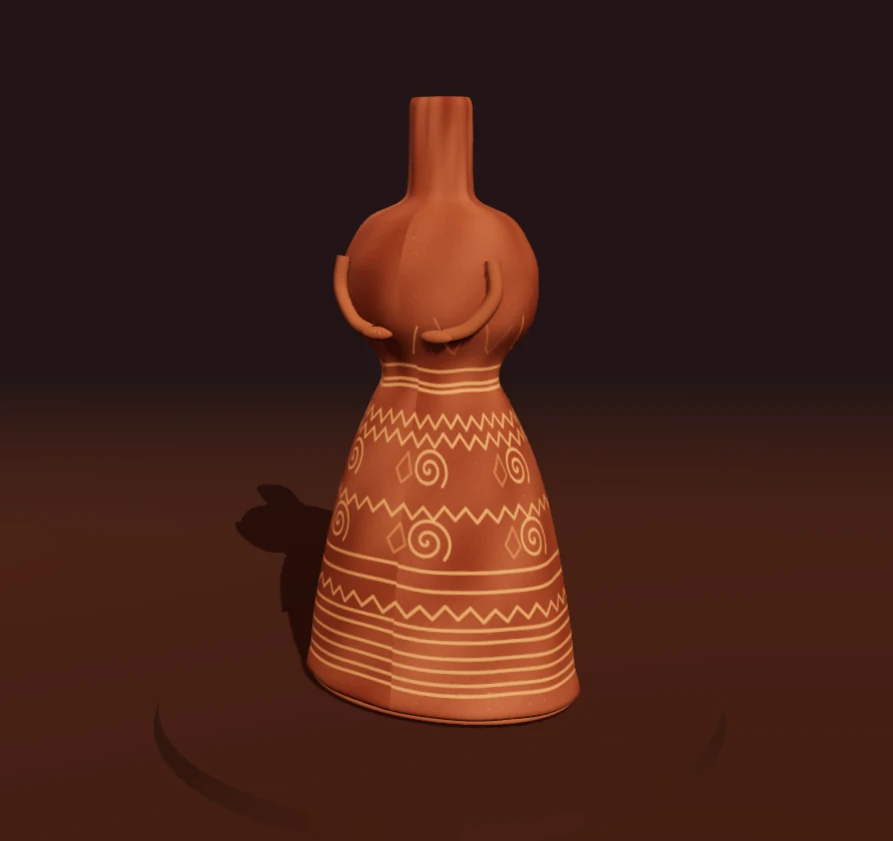
Figurine from Cârna · model based on the museum record.
Cârna, Dolj County · Bronze Age
The clay dress
On the Danube floodplain at Cârna, archaeologists found a clay figure with hands resting on its belly and a skirt shaped like a bell. It stands 17.5 cm tall. Follow the lines on its surface and look at what the find site adds to its story. 1
Object 13459 · National Museum of Romanian History
The shape of a skirt
A narrow neck rises from the oval torso. Below the hands, the waist draws in and the skirt widens towards the base. The museum records an 88 mm diameter and dates the find to the fourteenth century BCE. 1
The catalogue describes a bell-shaped dress. The clay shows how the maker represented the silhouette. The material of any real garment remains unknown.
Look closely
Light brings out the lines
Seen under frontal light, colour catches the eye first. When light comes in from the side, small ridges cast shadows. Follow the same line as you change the angle.
The model uses schematic lines and relief to make the comparison visible. The museum record shows the original ornament. 1
Move the light. Watch the shadows beside the lines in the clay.
Grindul Tomii · 1942, 1955 and 1956
116 excavated graves
The figurine came from a cremation cemetery. A team led by Vladimir Dumitrescu identified 116 graves over three field seasons. Each mark on the display represents one grave from that count. 1
The rise lay between the Cârna and Nasta pools. The museum records that seasonal floods washed away part of the cemetery. The number describes the graves the team found. The original extent of the cemetery is unknown. 1
Danube floodplain · two finds
A socket at the top of the Plosca figure
A related figure from Plosca, held by the Museum of Oltenia, is 14.9 cm tall. The restorer describes an opening at the top. It may have held a peg for a separately made head. 2
Switch between the two figures to compare their profiles. The socket survives. The shape of the head it might have held remains unknown.
Cârna · 175 mm, museum record
Plosca · research and conservation
Reading a repaired object
The Plosca figurine has been repaired more than once. The conservation report describes misaligned fragments, adhesive stains and plaster spilling over the gaps it was meant to fill. The restorer took the old joins apart, cleaned the fragments and assembled them again. 2
Read the fragments and the report together. The clay retains traces of the original maker. The report accounts for what happened to those traces after excavation.
Sources and model
The objects are schematic models based on written descriptions. Their heights and recorded diameters come from the sources. The 116 marks encode the documented count in regular rows.
The Museum of Oltenia restorer describes the 149 mm object, its form, ornament, upper socket and conservation. The figures document the separate object from Plosca.