Law · Paris, 12 June 1890 · The Civil Code
In 1890 Sarmiza Bilcescu challenged six rules of the Civil Code that put fathers before mothers
She became the first woman to earn a law doctorate in France. Not the first in the world: Leipzig, Zurich and Brussels had already had women doctors of law. Her thesis ends with an exact list of rules. France changed them between 1906 and 1965, sometimes by another route than the one she proposed. Romania, whose Civil Code had taken similar rules from the French, repealed them all at once on 1 February 1954.
Drag the timeline slider or press “Play the years”. A rule is struck in red in the year the law changed it. Tap a row to see her sentence, underlined on the page printed in 1890, and switch between the French and the Romanian code.
Civil Code, Book I
1884–1887 · Paris Faculty of Law
“Ladies do not enter”
Sarmiza Bilcescu was born in Bucharest, Romania’s capital, in April 1867, into a family close to that of Ion Brătianu, the Liberal leader. In 1884, aged 17, she came to Paris with her mother and became the first woman formally registered at the Faculty of Law.
She later recalled that the porter would not let her in: ladies do not enter. Only after a vote of the faculty council could she attend lectures. The professor of civil law, Edmond Colmet de Santerre, admitted, as she remembered it, why the faculty had hesitated.
At the end of her first year, she remembered, the same professor thanked the students for treating her with the respect they would show a sister.
“We hesitated to grant Mademoiselle Bilcescu the authorisation she asked for, fearing that we would have to police the lecture halls.”
Edmond Colmet de Santerre, as she recalled his words; quoted by Carole Lécuyer, Clio, 1996
She took her licence, the basic French law degree, on 17 June 1887. Le Temps would note that she passed the licence examinations with seventeen and a half white balls out of eighteen. She was 20, and she stayed in Paris for the doctorate.
Thursday, 12 June 1890, 2.30 p.m.
Four white balls
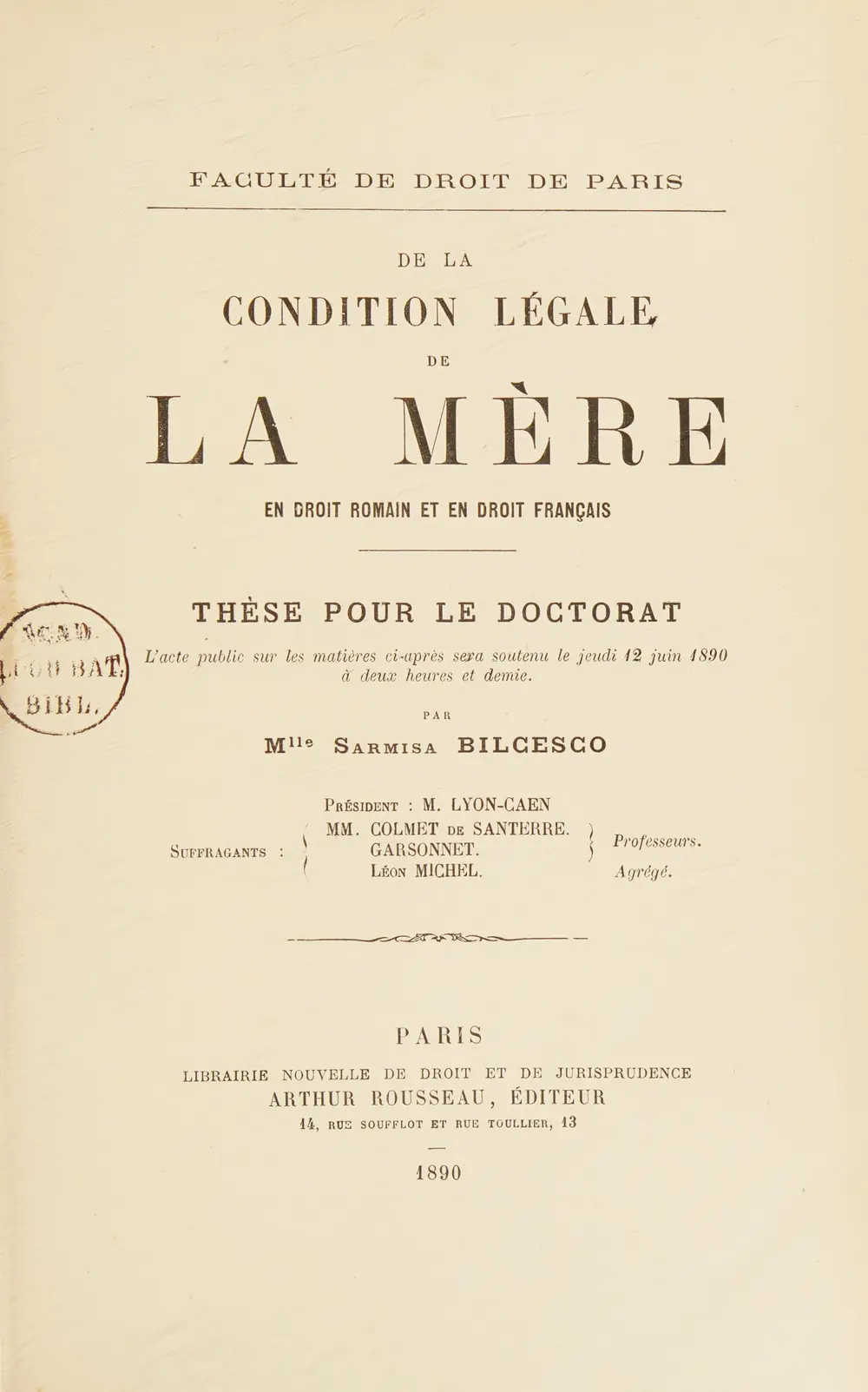
The title page sets the public defence for 2.30 p.m. on Thursday 12 June 1890. The jury: Charles Lyon-Caen, president; Edmond Colmet de Santerre, by then dean; Eugène Garsonnet; and Léon Michel, an agrégé (a lecturer qualified by national competition).
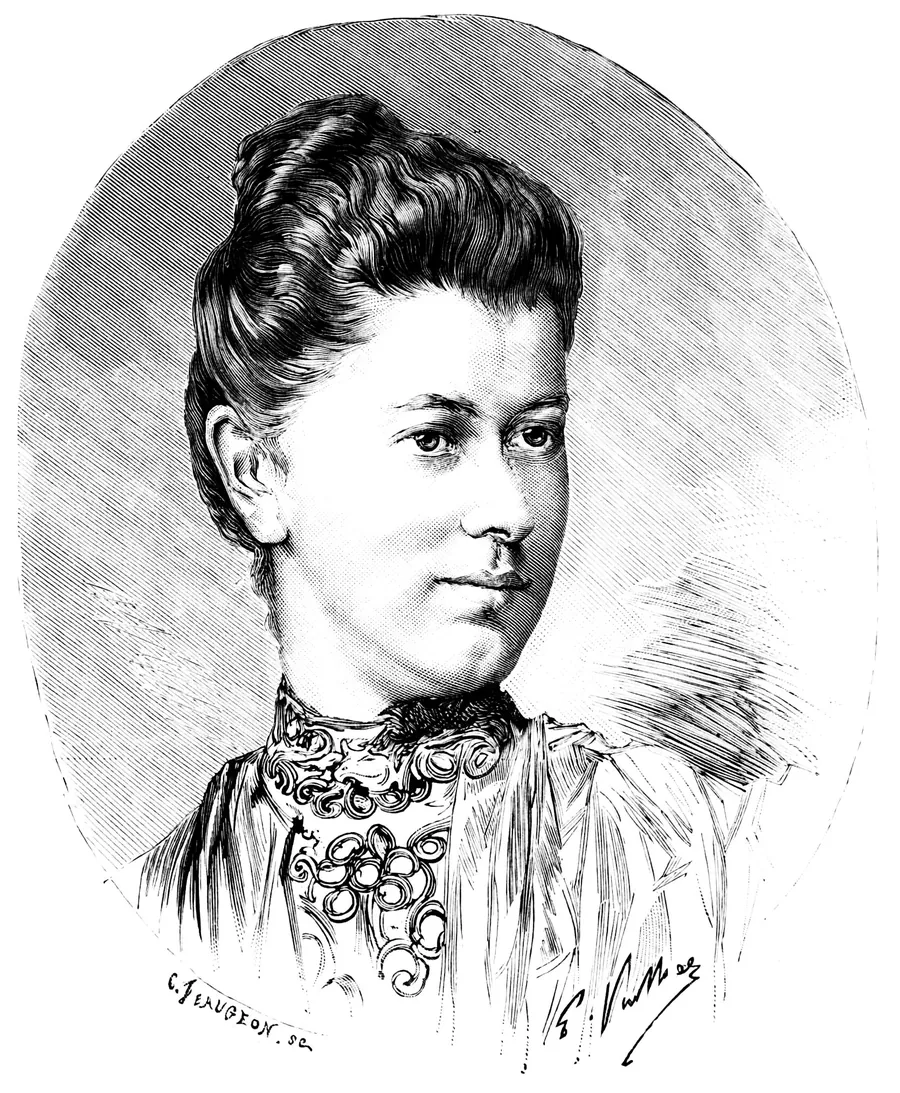
Le Figaro reported that she was allowed to appear before the examiners without an academic gown. Many came to listen. Colmet de Santerre questioned her and criticised a few points of the thesis, Le XIXe siècle reported. The defence lasted about an hour and a half.
Le Temps and La Gazette de France reported the same result: four white balls and the examiners’ praise. The audience applauded, Le Matin wrote, and Le Temps noted that the thesis had been retained for the faculty’s annual prize competition.
The papers called her a “doctoresse en droit”, a woman doctor of law. Le Monde illustré was more careful: the first woman to obtain the diploma of doctor of law at the Paris Faculty. The formula was exact.
De la condition légale de la mère
A thesis about mothers, written with the Code in hand
The title says it all: the legal condition of the mother, in Roman law and in French law. The first part follows the mother from the Twelve Tables to Justinian. The second works through Napoleon’s Civil Code: the mother within marriage, the widow, the remarried mother, the mother of a child born outside marriage, the foreign mother.
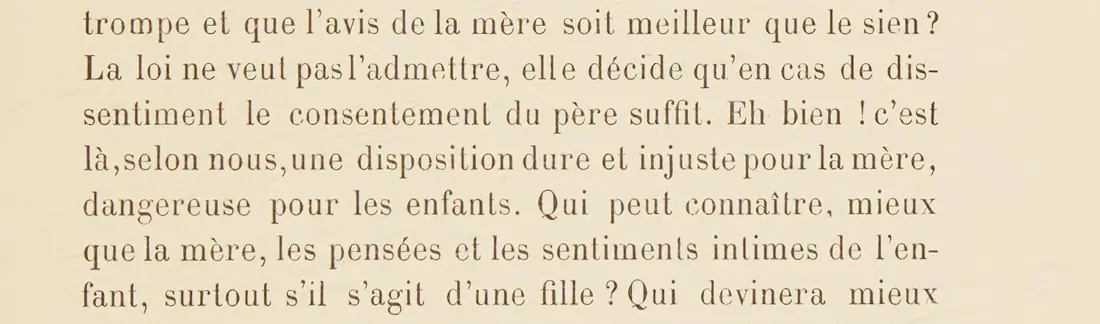
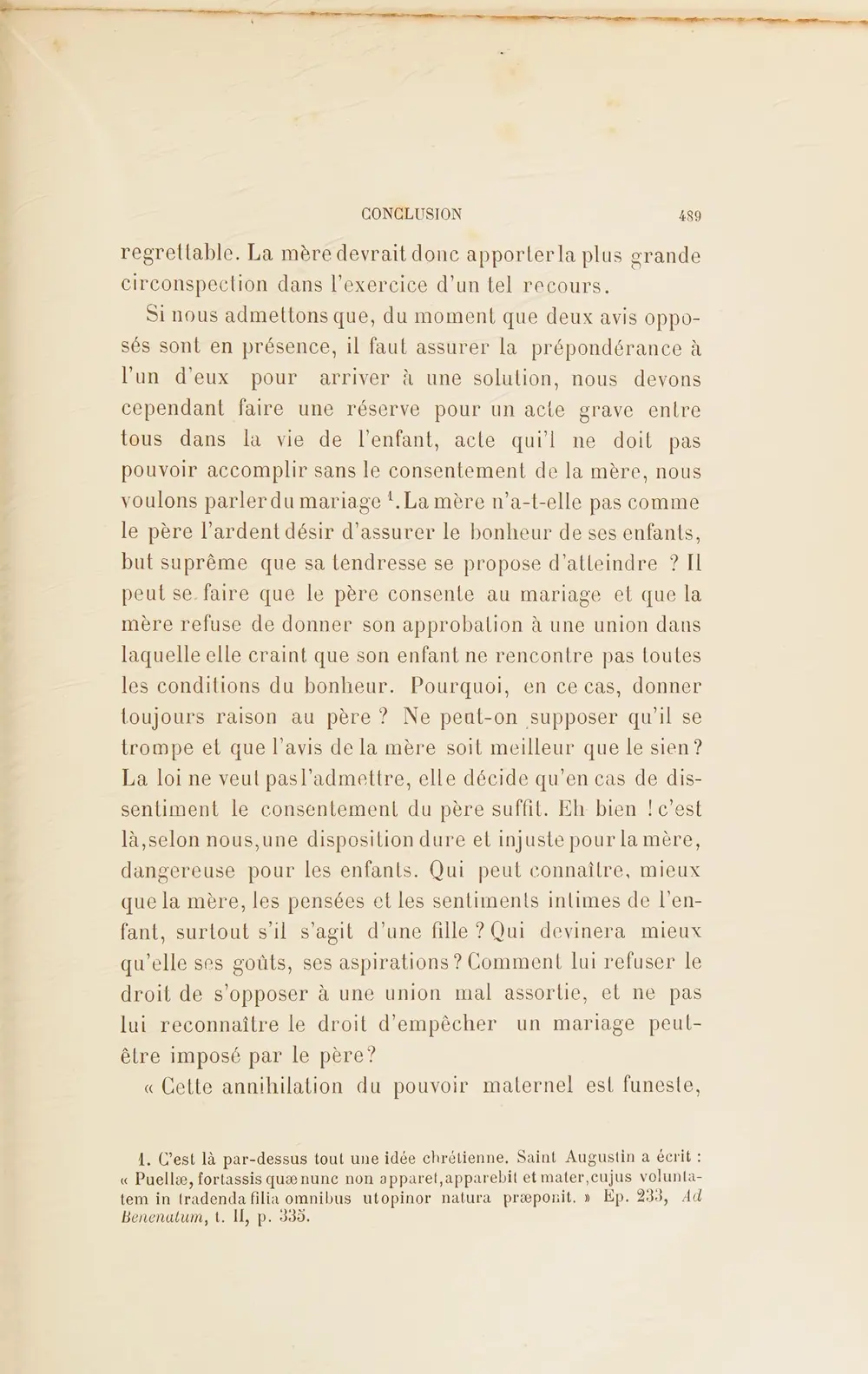
The conclusion runs from page 487 to page 500 and is not a summary. It is a list of articles. For each one she shows where a father and a mother in the same position are treated differently, and asks for the difference to go. The register at the top sets them against the text of the Code.
The book carries a plain dedication:

Bilcescu argued for equal parental rights where the husband’s marital authority was not at stake. She left the father’s authority within marriage standing and thought full equality in guardianship “premature” while married women lacked civil capacity. She wrote that the mother of a child born outside marriage was “far less worthy of interest”.
The law sometimes took another road. Bilcescu wanted both parents’ consent wherever the law required parental consent (sons under 25, daughters under 21); the 1927 law decided that, if they disagreed, the marriage could go ahead. She wanted a remarried father to lose the use of a child’s property too; the 1906 law let the mother keep it.
Her last sentence: if her modest efforts helped spread these ideas, “we shall be glad to have tried, in our turn, to improve the position of women, especially mothers”. The plural is the academic one, usual in theses of the time.
From thesis to law
The conclusion sets out the rules Bilcescu wanted changed. The register follows 6 provisions she challenged, across five articles of the French Civil Code; art. 381 appears twice, for the widow and for the remarried mother. The seventh row shows the rule she accepted, art. 373. Left out are her request that a mother consent before a child enters a religious order, which lies outside the Code, and the right of a mother who declines guardianship to name a substitute herself (art. 394).
The French text is that of 1804: the rules discussed in the thesis; the register rows are excerpts. The Romanian text is from C. Hamangiu’s annotated edition of 1925, which prints the corresponding French article alongside; the Romanian rules were similar, not identical, and in 1925 all six were still in force.
A rule is struck in the year the law that changed it came into force: 22 February 1906 (art. 386), 19 July 1927 (art. 148), 31 October 1935 (the remarried mother, art. 381, with the family council’s unanimous approval), 2 September 1945 (the widow, art. 381: the separate conditions for father and mother disappear), 15 June 1965 (arts 391 and 395), 1 January 1971 (art. 373: joint exercise by married parents; from 1942 the authority belonged to both, but the father normally exercised it). For Romania: 1 February 1954, the Family Code and Decree no. 32/1954.
What “first” means
First in the world? No. First in France
Sarmiza Bilcescu is often described as the first woman in the world to earn a doctorate in law. French Wikipedia says so too, citing a 2023 study by the historian Ophélie Colomb; in 2025 the same author writes “the first woman, in France”. The dates bear her out.
In Leipzig, Anna Evreinova had become a doctor of law on 21 February 1873. In Zurich, Emilie Kempin-Spyri in July 1887. In Brussels, Marie Popelin received Belgium’s “docteur en droit” degree in July 1888. In Ireland, Letitia Walkington took an LL.D. from the Royal University of Ireland in 1889, according to university records (another account gives 1890). Long before, in 1777, Maria Pellegrina Amoretti had taken a degree in civil and canon law at Pavia.
The degrees were not of one kind. The Paris doctorate came after the licence and required a thesis defended in public. The first woman to earn a law doctorate in France: that is the exact formula. Le Monde illustré said something narrower still, the first at the Paris Faculty.
| Degree | Who, where | Which degree | The bar |
|---|---|---|---|
| 21 Feb 1873 | Anna EvreinovaUniversity of Leipzig | Dr. jur., doctorate with dissertation; by her biographers' account the King of Saxony intervened so she could sit the examination | she returned to Russia and published legal studies |
| 17 Jun 1881 | Lidia PoëtUniversity of Turin | laurea in law, with the title of dottore (Italy's professional degree) | entered on the Turin roll on 9 Aug 1883; the Court of Appeal annulled it and the Court of Cassation upheld that in 1884. Italian law opened the profession to women in 1919. |
| 16 Jul 1887 | Emilie Kempin-SpyriUniversity of Zurich | Dr. iur., doctorate with dissertation | refused leave to plead: she lacked active citizenship. Zurich opened the profession to women in 1898; she died in 1901 without joining the Zurich bar. |
| 12 Jul 1888 | Marie PopelinFree University of Brussels | docteur en droit, the Belgian degree required to apply to the bar | oath refused by the Court of Appeal (12 Dec 1888), appeal rejected by the Court of Cassation (11 Nov 1889). Belgium opened the profession in 1922; she had died in 1913. |
| 1889 | Letitia WalkingtonRoyal University of Ireland | LL.D., doctorate in law (another account gives 1890) | could not be admitted; in Britain and Ireland the profession opened to women by the 1919 Act, which removed the sex bar |
| 12 Jun 1890 | Sarmiza BilcescuParis Faculty of Law | doctorate in law, after the licence; a 508-page thesis | the council of the Ilfov bar (the county that included Bucharest) ordered her enrolment in June–July 1891; a 1902 newspaper said the Court of Appeal kept her from the oath. No case in which she pleaded has been documented. |
| 1892 | Jeanne ChauvinParis Faculty of Law | doctorate in law, the second woman to earn one at the Paris faculty | oath refused in 1897; the law of 1 Dec 1900 admitted women with a licence, and she was sworn on 19 Dec 1900, after Olga Balachowsky-Petit. |
The table shows what followed. Those who asked to join the bar each met a different obstacle: a court of appeal, the lack of active citizenship, a law that did not yet exist. Among the cases in the table, two bars voted to admit a woman: Turin in 1883, where the courts annulled the enrolment, and Bucharest in 1891.
Bucharest, 1891
The bar voted for her. Refusals followed
On 8 July 1891, or 26 June in the calendar Romania then used, the council of the Ilfov bar, the county that then included Bucharest, ordered her name entered on the roll of advocates. The vote was unanimous and without discussion. In Paris, the legal newspaper Le Droit reported the decision on 15 July. There, Jeanne Chauvin would be refused in 1897.
What came next is less clear. A German newspaper of 1902, cited by the historians Sara Kimble and Marion Röwekamp, said the Court of Appeal had kept her from taking the oath. Other sources say she gave legal consultations. No case in which she pleaded has been documented. In 1897 she married the mining engineer Constantin Alimănișteanu.
The council’s decision did not prevent later refusals. In 1902 the Bucharest Court of Appeal dismissed Elena B. Popovici’s appeal. In Iași, lawyers challenged Ella Negruzzi’s admission as a trainee in 1913. In March 1920 Negruzzi was admitted to the Ilfov bar and began appearing in court in Bucharest; in 1936 she was among the defence counsel of the Romanian communist activist Ana Pauker.
Nearly 29 years had passed since the vote for Sarmiza Bilcescu.
- 12 June 1890Doctorate in Paris
- 26 June / 8 July 1891The Ilfov bar council orders her enrolment
- 1 December 1900France admits women to the bar by law
- 1902Elena B. Popovici’s appeal dismissed in Bucharest
- 1913Ella Negruzzi admitted at Iași as a trainee, challenged by lawyers
- March 1920Ella Negruzzi admitted to the Ilfov bar
After 1891
Sarmiza Alimănișteanu
In 1894 she was among the founders of the Society of Romanian Young Ladies (Societatea Domnișoarelor Române). Married in 1897, she appears in the press of the time as Sarmiza Alimănișteanu. In 1916 she sat with Ana Haret, Sabina Cantacuzino and Maria N. Filipescu on the committee organising advanced courses for women in Bucharest.
She died on 26 August 1935. Married women in Romania had gained civil capacity in 1932, but the Romanian rules resembling those she had challenged in her thesis stayed in force until the Family Code of 1954.
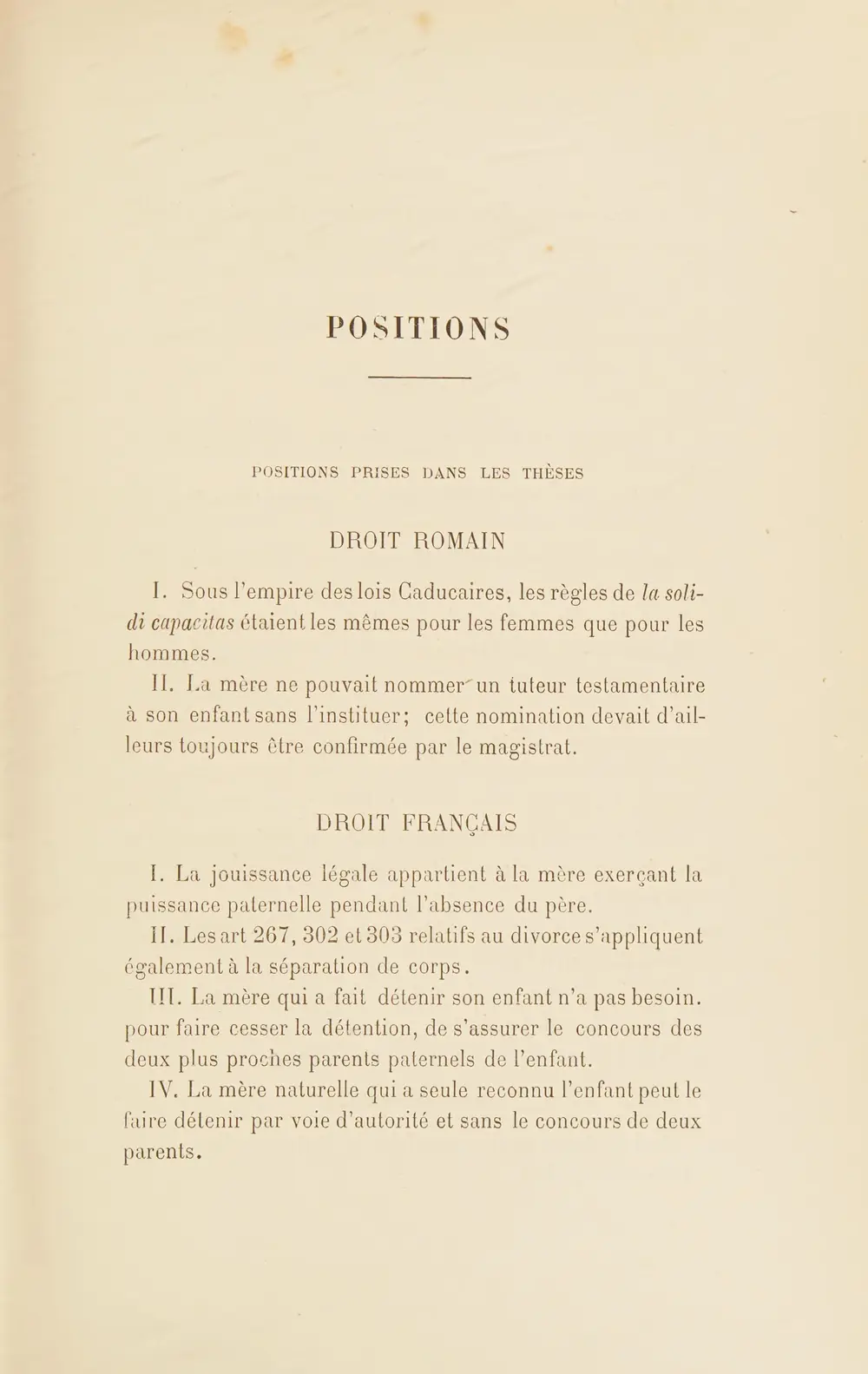
Among the legal propositions she had to defend orally at the defence is one that sounds odd today: “A married woman may engage in trade with the authorisation of the courts.” Article 4 of the French Commercial Code then required her husband’s consent for her to trade independently; she argued that a court could stand in for it.
Sources
The thesis, the codes with their successive versions and the press of 1890–91 can be read in the scans below.
- Sarmisa Bilcesco, De la condition légale de la mère en droit romain et en droit français, doctoral thesis, Paris Faculty of Law, Paris, A. Rousseau, 1890, 508 pp.; title page (jury, day and hour), dedication, conclusion (pp. 487–500), propositions for the oral examination (pp. 501–503). Internet Archive
- Code civil des Français, 1804, Book I, titles V, IX and X. Wikisource
- Successive versions of arts 148, 373, 376, 381 and 386 and the text of Book I in 1960 (arts 391, 394, 395), each with the law that introduced it: Criminocorpus, Musée d’histoire de la justice. art. 386, art. 381, art. 373, art. 148 (1927), title X (1960)
- Law no. 64-1230 of 14 December 1964 on guardianship (in force 15 June 1965) and law no. 70-459 of 4 June 1970 on parental authority (in force 1 January 1971). Légifrance, Légifrance
- C. Hamangiu, Codul civil adnotat (the Romanian Civil Code annotated, with the corresponding French, Italian and Belgian articles), vol. I, Bucharest, Alcalay, 1925 (arts 131, 327, 335, 340, 345, 347). Internet Archive
- Law no. 4/1953, the Family Code, published in Romania’s Official Bulletin (Buletinul Oficial) no. 1 of 4 January 1954, in force 1 February 1954; Decree no. 32/1954, art. 49. cdep.ro, archived
- Le Matin, 13 June 1890, “Doctoresse en droit”, pp. 1–2. Gallica
- Le Figaro, 13 June 1890, p. 1. RetroNews
- Le Temps, 13 June 1890, p. 2; 14 June 1890, p. 3. RetroNews; RetroNews
- Le XIXe siècle, 14 June 1890, p. 1. RetroNews
- La Gazette de France, 14 June 1890, p. 2. RetroNews
- Le Monde illustré, 21 June 1890, p. 4. RetroNews
- Her recollections of the faculty (the porter, the faculty council, Colmet de Santerre’s speech), reproduced by the Musée du Barreau de Paris. museedubarreaudeparis.com; Sorbonne inter-university library, “Les femmes à la conquête”: the first woman formally registered at the faculty, 1884. nubis.bis-sorbonne.fr
- Minute no. 14 of the Ilfov bar council, 26 June 1891 (Old Style), reproduced in La femme en Roumanie. BCU Bucharest; Le Droit, 15 July 1891, after L’Indépendance roumaine of 28 June / 10 July. RetroNews
- Sara L. Kimble and Marion Röwekamp, on the first women in law, pp. 79–80 and n. 101 (Berliner Tageblatt, 1902, on the oath). rcin.org.pl
- Sanda Safta, on the birth record (no. 361/1867, 25 April Old Style) and the civil marriage of 19 June 1897, Orizonturi culturale italo-române. orizonturiculturale.ro
- Committee of the Cursurile Superioare Feminine (advanced courses for women), 1916 notice (BCU Cluj). dspace.bcucluj.ro; Câmpulung museum, on the 1894 society. muzeulcampulung.ro
- Elena B. Popovici: Gazeta Transilvaniei no. 263, November 1902. bibliotecadeva.ro; Ella Negruzzi at Iași: Dreptul no. 47, 20 June 1913. biblioteca-digitala.ro; the 1920 admission: Zargidava 10 (2011). biblioteca-digitala.ro
- Ophélie Colomb, “«Une doctoresse en droit». Sarmiza Bilcescu (1867–1935): itinéraire d’une juriste «pionnière» entre France et Roumanie”, Les Études sociales 178 (2023), pp. 35–60, doi; and her 2025 article “Une approche juridique et féministe de la maternité: étude au prisme du genre de De la condition légale de la mère (1890) par Sarmiza Bilcescu”, calling her “la première femme, en France, à obtenir le grade de doctoresse en droit”. Criminocorpus
- Anna Evreinova (Leipzig, 21 February 1873): German Wikipedia and the sources it cites; a study of the Leipzig doctoral register. de.wikipedia, oaji.net. Letitia Walkington: a study based on university records, p. 53; the year 1890 in History Ireland. historyireland.com TARA, Trinity College Dublin
- Emilie Kempin-Spyri: University of Zurich chronology. uzh.ch. Lidia Poët, Marie Popelin, Jeanne Chauvin: the respective Wikipedia articles and their sources.
- Alin Ciupală, Femeia în societatea românească a secolului al XIX-lea (Women in 19th-century Romanian society), Bucharest, Meridiane, 2003, pp. 59–60, 85.
Images
- The thesis “De la condition légale de la mère”, Paris, 1890; Internet Archive scan (Leiden University collection), public domain
- Wood engraving by Charles-Auguste Jeaugeon after a drawing by Gaston Vuillier, Le Monde illustré, 21 June 1890; Bibliothèque nationale de France (Gallica) via Wikimedia Commons, public domain