The Earth seen from high above the north at 20:15 UTC on 25 September 1983, the moment of the alarm. Moscow is in darkness; Montana, on the far edge, is in afternoon sun.
26 September 1983 · 00:15, Moscow time
What would you have told Moscow?
A Soviet satellite reported American missiles in flight. The officer on duty, Lieutenant Colonel Stanislav Petrov, had minutes to judge whether they were real. Take his seat.
The edge of the Earth
This is the Earth at the moment of the alarm, seen from about where a Soviet early-warning satellite hung: 32,000 km up, high over the north. Moscow lies in the dark. It is 00:15 there on Monday 26 September.
On the far edge, in the Sunday afternoon sun, is Montana. The United States kept Minuteman missiles there, around Malmstrom Air Force Base. The satellites were built to watch that edge, because a missile's burning engine stands out best against black space.
A year of fear
In March 1983 Ronald Reagan called the Soviet Union an “evil empire”, and two weeks later announced a plan to defend America against Soviet missiles. In April, US Navy F-14s flew a mock bombing run over Zeleny, a Soviet island in the Kurils.
Moscow had been looking for an attack since May 1981. Under Operation RYaN, KGB officers abroad were told to watch for signs that the West was preparing a surprise nuclear strike. Yuri Andropov, the KGB chief who started it, was now the country's leader.
Twenty-five days earlier
On 1 September a Korean Air Lines Boeing 747, flight 007 from Anchorage to Seoul, strayed far off course, over Kamchatka and then Sakhalin. A Soviet Su-15 fighter shot it down. All 269 people on board died, 62 of them Americans, among them a congressman, Larry McDonald.
Reagan called it “a crime against humanity”. Marshal Nikolai Ogarkov, chief of the Soviet General Staff, insisted at a press conference that it had been a spy mission. Petrov's night came 25 days later.
Serpukhov-15
South of Moscow, in the command centre of the satellite early-warning system, Stanislav Petrov began his duty shift at 20:00. He was 44, a lieutenant colonel and an engineer: deputy head of the department that wrote the system's combat algorithms. Some Russian accounts say he was standing in for a colleague that night.
The system, Oko (“eye”), had been accepted into service nine months earlier. Petrov had worked on it since the 1970s and called it “raw”. Seven of its satellites were in orbit that night.
Your shift
Scroll slowly. The clock runs from 00:15 as you go.- Automatic alertAlready sent up the chain to the General Staff
- Visual operatorsTarget not detected
- Ground radarsNo data. They see a missile only minutes after the satellites do
The command post is on the line. What do you tell them?
The sequence, as Petrov told it
- 00:15: a siren, and a red banner reading СТАРТ (launch). One missile from the United States. Reliability: highest.
- Then another, and another, about a minute apart in his 2013 telling, until there were five. The banner changes to missile attack.
- The visual operators see nothing. The ground radars cannot see anything yet. The automatic alert has already gone to the General Staff.
- Petrov phones the command post and reports that, in his assessment, the alarm is false.
Five missiles
Petrov did not have the option of scrolling on. He told the command post the alarm was false.
His reasons were an argument and a hunch. “When people start a war, they don't start it with only five missiles,” he told the Washington Post in 1999. And: “I had a funny feeling in my gut.” A first strike would come with hundreds of missiles, not a handful.
He decided in less than five minutes. Then he waited. “Twenty-three minutes later I realised that nothing had happened,” he told the BBC in 2013.
The console is a reconstruction from Petrov's accounts to the Washington Post (1999), the BBC (2013) and Russian television; no photograph of the real screen is public. The minutes between missiles are compressed and approximate; the order of events and the words on the banner are his. The accounts differ on the count: five in 1999 and 2013, four in a 1991 interview.
What the satellite saw
Nothing had been launched. The five “missiles” were points on the sunlit edge of the Earth, where the Sun was shining towards the satellite.
An inquiry blamed the combat software: it had mishandled the signal in difficult lighting. The explanation most often told comes from three researchers, Geoffrey Forden, Pavel Podvig and Theodore Postol, in 2000. Near the equinox, with Cosmos 1382 near the top of its orbit, the satellite, the Sun and the missile fields lined up, and sunlight glinting off high clouds looked like rocket flames. They called the clouds a guess. The filtering software was rewritten.
The minutes above him
Petrov had no launch button and no authority to fire anything. The alarm did not wait for him either: the reports arrived so fast that the system had already passed them up to General Staff headquarters. His job was to judge the signal, and his judgement went up the same line, minutes behind it.
Every step up the chain would have had less time. A Minuteman needs roughly half an hour to cover the 8,170 km from Montana to Moscow. The radars would have shown nothing for the first part of that. At the top, the leader's nuclear briefcase was, according to Hoffman, still being developed.
- Serpukhov-15, satellite command centre
- Command post of the early-warning army
- Air defence main command centre
- General Staff central command post
- The country's leadership
The chain as described by Pavel Podvig (2025) and David Hoffman (1999).
Did he save the world?
Pavel Podvig, who has studied the Soviet early-warning system for decades, says it was complicated. The Soviet Union planned to strike back after being hit, not on a warning alone. At worst, he argues, the General Staff would have sent out a preliminary command, the alarm would probably have been recognised as false anyway, and “a catastrophic outcome was extremely unlikely”.
Yuri Votintsev, who commanded the Soviet missile-warning forces, drew a darker lesson in his memoir. He wrote that it was not hard to imagine what decision the country's leaders might have faced. In 2006 Russia's mission to the UN said no single person could start or prevent a nuclear war, because several systems had to confirm an attack.
Petrov put his own odds at 50-50. What is not in dispute is smaller and harder: a machine said, with its highest confidence, that the war had begun, 25 days after the airliner, in the autumn of the war scare. The man in the chair was the first person asked to judge the alarm, and within minutes, with no rule to tell him how, he told his superiors it was wrong.
Six weeks later
The danger did not end that night. From 7 to 11 November NATO ran Able Archer 83, an exercise that rehearsed the release of nuclear weapons. Soviet forces put nuclear-capable aircraft on alert in East Germany and Poland. A US intelligence review written in 1990 and declassified only in 2015 concluded that America “may have inadvertently placed our relations with the Soviet Union on a hair trigger”. The two events are often merged; they were six weeks apart.
Reagan screened The Day After, a television film about nuclear war, in October; it “left me greatly depressed”, he wrote. On 18 November he noted that the Soviets seemed “so paranoid about being attacked”. The first Pershing II missiles reached West Germany on 23 November, and that day the Soviets walked out of the arms talks in Geneva.
American machines had cried wolf too. On 9 November 1979 a training tape loaded into a NORAD computer showed a Soviet attack in progress. In June 1980 a faulty chip worth 46 cents did the same.
How many there were
In 1983 the world had 60,818 nuclear warheads: 35,130 Soviet and 23,305 American. Each dot is ten.
- Soviet Union / Russia
- United States
- Everyone else
Early in 2026 there are about 12,200: roughly 5,400 Russian and 5,000 American. The Doomsday Clock, set at four minutes to midnight in 1981 and moved to three in 1984, was set in January 2026 at 85 seconds, the closest it has ever been.
The man in the chair
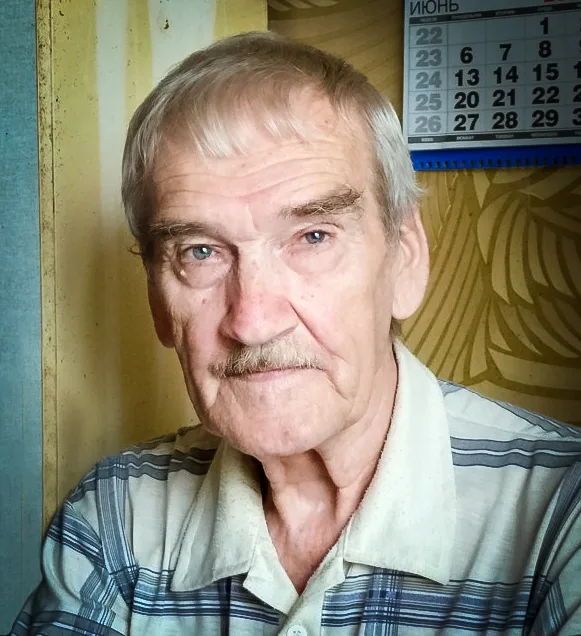
He was first praised, then questioned. Why hadn't he written everything in the logbook as it happened? He had had “a phone in one hand and the intercom in the other”, he told Hoffman, and “I don't have a third hand”. Hoffman wrote that he was neither punished nor rewarded; Petrov told the BBC he was formally reprimanded over the logbook. The incident was an embarrassment for the Soviet army, and it stayed secret.
He left the army in 1984 and lived in Fryazino, outside Moscow. Votintsev described it in his memoir in 1993, and English-language readers learned of it in 1998 and 1999. His wife Raisa died in 1997. He received World Citizen awards in 2004 and, at the United Nations, in 2006, and the Dresden Peace Prize in 2013. “They were lucky it was me on shift that night,” he told the BBC in 2013. In a 2014 documentary he said: “I was simply doing my job.”
Stanislav Petrov died on 19 May 2017, aged 77. The world learned of it in September, when a German friend, Karl Schumacher, called to wish him a happy birthday and his son answered.
The same view, now
This is the Earth from the same point in the sky, lit as it is at this moment.
About two in three people alive today were born after that night. In Romania, just under half.
Somewhere tonight a screen will tell someone, with its highest confidence, that something terrible is happening. Petrov's question is worth carrying: would it really begin like this? Tell someone his name.
Sources
Where accounts disagree, the text gives the variants. Short quotations are from the sources named.
How the scene is made
The Earth is drawn for 20:15 UTC on 25 September 1983, which was 00:15 in Moscow (summer time, UTC+4). The position of the Sun is computed for that instant. The satellite's viewpoint is an illustration: 32,000 km up, as Forden, Podvig and Postol give for Cosmos 1382, over 63° N, where orbits of this kind reach their highest point, and placed where Montana sits about 11° above the horizon, low enough for a rising missile to be seen against space. Putting the false launches at Malmstrom follows Forden, Podvig and Postol; the console named only the United States. The real satellite's position that night is not published. The airliner's route is drawn approximately.
The share of people born after that night is an estimate from UN population figures for 2026 in five-year age groups: 65% worldwide and 48% in Romania. Your local time that night comes from the time zone of your connection and the historical rules of the time zone database; nothing is stored.
The night
- David Hoffman, “I Had a Funny Feeling in My Gut”, Washington Post, 10 February 1999
- Pavel Aksenov, “Stanislav Petrov: The man who may have saved the world”, BBC News, 26 September 2013
- Yuri Votintsev, memoir, Voenno-istoricheskii zhurnal, nos. 8–11, 1993 (Russian)
- Diletant, 18 September 2017, quoting Petrov's interview on Channel 5 (Russian)
The system
- Pavel Podvig, “History and the Current Status of the Russian Early-Warning System”, Science & Global Security 10 (2002)
- Geoffrey Forden, Pavel Podvig, Theodore Postol, “False alarm, nuclear danger”, IEEE Spectrum, March 2000
- Pavel Podvig, “Soviet and Russian false alarms and nuclear weapons incidents” (2025)
- Pavel Podvig, “Did Stanislav Petrov save the world in 1983? It's complicated”, 2022
1983
Numbers
- Our World in Data, nuclear warhead stockpiles (FAS data), 1983
- Federation of American Scientists, Status of World Nuclear Forces, 2026
- Bulletin of the Atomic Scientists, Doomsday Clock timeline and 2026 statement
- Union of Concerned Scientists on missile flight time
- UN World Population Prospects 2024, via PopulationPyramid.net and Our World in Data
- IANA time zone database (Moscow on summer time, UTC+4, until 1 October 1983)