The International Space Station · seen from Romania
The space station flies over your house. Here is when to look up
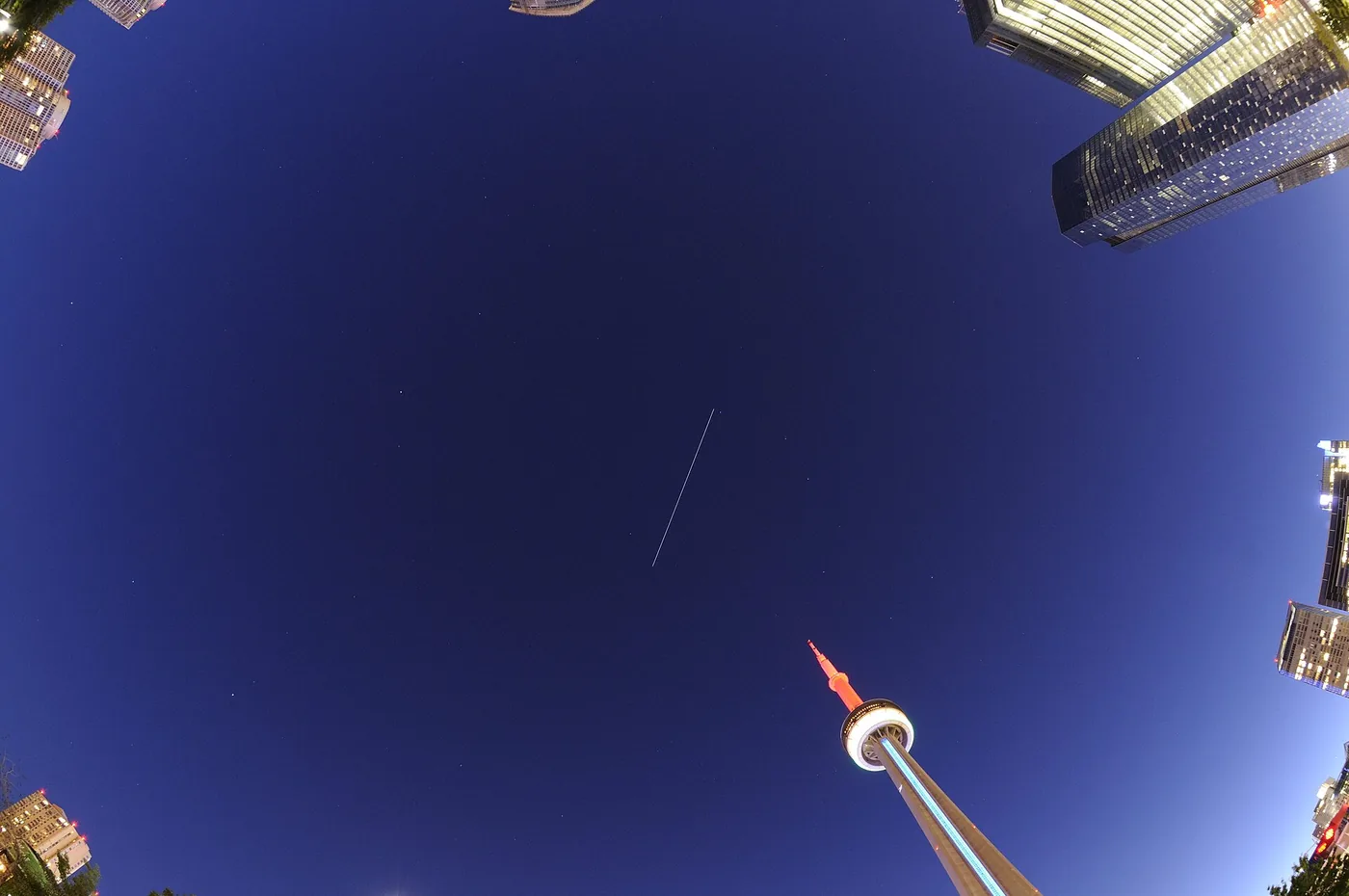
You can see it with the naked eye, like a very bright star that does not blink. Pick your town and see the next passes, to the minute: where to look, how high it climbs, how long it lasts.
Example from 22 September 2026: at 20:46 the station climbed to 42 degrees over Bucharest, from the north-west.
See the passes
The predictor
When it passes over you
Pick your town. The list shows the visible passes of the next seven days: dates and times in Romania, where to look at the start and at the end, how high it climbs, how long it lasts.
Three towns, computed on 22 September 2026
Bucharest — 8 passes
Tue 22 Sep · 19:09–19:14 · NW → NE · 23° · 6 min · twilight sky
It appears at 19:09 towards north-west, climbs low, near the horizon to 23 degrees at 19:11, then sinks towards north-east and winks out at 19:14. It lasts 6 minutes.
Tue 22 Sep · 20:46–20:51 · NW → E · 42° · 6 min · dark sky
It appears at 20:46 towards north-west, climbs halfway up the sky to 42 degrees at 20:49, then sinks towards east and winks out at 20:51. It lasts 6 minutes. Near the end it enters the Earth's shadow and winks out suddenly.
Wed 23 Sep · 19:58–20:04 · NW → E · 33° · 6 min · dark sky
It appears at 19:58 towards north-west, climbs halfway up the sky to 33 degrees at 20:01, then sinks towards east and winks out at 20:04. It lasts 6 minutes. Near the end it enters the Earth's shadow and winks out suddenly.
Wed 23 Sep · 21:35–21:41 · NW → SE · 54° · 6 min · dark sky
It appears at 21:35 towards north-west, climbs high in the sky to 54 degrees at 21:38, then sinks towards south-east and winks out at 21:41. It lasts 6 minutes. Near the end it enters the Earth's shadow and winks out suddenly.
Thu 24 Sep · 19:10–19:16 · NW → E · 28° · 6 min · twilight sky
It appears at 19:10 towards north-west, climbs halfway up the sky to 28 degrees at 19:13, then sinks towards east and winks out at 19:16. It lasts 6 minutes.
Thu 24 Sep · 20:47–20:53 · NW → SE · 76° · 7 min · dark sky
It appears at 20:47 towards north-west, climbs right overhead to 76 degrees at 20:50, then sinks towards south-east and winks out at 20:53. It lasts 7 minutes. Near the end it enters the Earth's shadow and winks out suddenly.
Fri 25 Sep · 19:59–20:05 · NW → E · 62° · 6 min · dark sky
It appears at 19:59 towards north-west, climbs high in the sky to 62 degrees at 20:02, then sinks towards east and winks out at 20:05. It lasts 6 minutes. Near the end it enters the Earth's shadow and winks out suddenly.
Fri 25 Sep · 21:37–21:41 · W → S · 21° · 5 min · dark sky
It appears at 21:37 towards west, climbs low, near the horizon to 21 degrees at 21:39, then sinks towards south and winks out at 21:41. It lasts 5 minutes. Near the end it enters the Earth's shadow and winks out suddenly.
Iași — 8 passes
Tue 22 Sep · 19:08–19:14 · NW → E · 37° · 6 min · twilight sky
It appears at 19:08 towards north-west, climbs halfway up the sky to 37 degrees at 19:11, then sinks towards east and winks out at 19:14. It lasts 6 minutes.
Tue 22 Sep · 20:45–20:52 · NW → E · 73° · 7 min · dark sky
It appears at 20:45 towards north-west, climbs high in the sky to 73 degrees at 20:48, then sinks towards east and winks out at 20:52. It lasts 7 minutes. Near the end it enters the Earth's shadow and winks out suddenly.
Wed 23 Sep · 19:58–20:04 · NW → E · 58° · 6 min · dark sky
It appears at 19:58 towards north-west, climbs high in the sky to 58 degrees at 20:01, then sinks towards east and winks out at 20:04. It lasts 6 minutes. Near the end it enters the Earth's shadow and winks out suddenly.
Wed 23 Sep · 21:35–21:40 · W → SE · 31° · 6 min · dark sky
It appears at 21:35 towards west, climbs halfway up the sky to 31 degrees at 21:37, then sinks towards south-east and winks out at 21:40. It lasts 6 minutes. Near the end it enters the Earth's shadow and winks out suddenly.
Thu 24 Sep · 19:10–19:16 · NW → E · 46° · 7 min · twilight sky
It appears at 19:10 towards north-west, climbs halfway up the sky to 46 degrees at 19:13, then sinks towards east and winks out at 19:16. It lasts 7 minutes.
Thu 24 Sep · 20:47–20:53 · W → SE · 48° · 6 min · dark sky
It appears at 20:47 towards west, climbs halfway up the sky to 48 degrees at 20:50, then sinks towards south-east and winks out at 20:53. It lasts 6 minutes. Near the end it enters the Earth's shadow and winks out suddenly.
Fri 25 Sep · 19:59–20:05 · NW → SE · 74° · 6 min · dark sky
It appears at 19:59 towards north-west, climbs high in the sky to 74 degrees at 20:02, then sinks towards south-east and winks out at 20:05. It lasts 6 minutes. Near the end it enters the Earth's shadow and winks out suddenly.
Fri 25 Sep · 21:37–21:40 · W → S · 14° · 4 min · dark sky
It appears at 21:37 towards west, climbs low, near the horizon to 14 degrees at 21:39, then sinks towards south and winks out at 21:40. It lasts 4 minutes. Near the end it enters the Earth's shadow and winks out suddenly.
Cluj-Napoca — 8 passes
Tue 22 Sep · 20:45–20:51 · NW → E · 59° · 6 min · dark sky
It appears at 20:45 towards north-west, climbs high in the sky to 59 degrees at 20:48, then sinks towards east and winks out at 20:51. It lasts 6 minutes. Near the end it enters the Earth's shadow and winks out suddenly.
Tue 22 Sep · 22:22–22:27 · W → S · 29° · 6 min · dark sky
It appears at 22:22 towards west, climbs halfway up the sky to 29 degrees at 22:24, then sinks towards south and winks out at 22:27. It lasts 6 minutes. Near the end it enters the Earth's shadow and winks out suddenly.
Wed 23 Sep · 19:57–20:03 · NW → E · 46° · 6 min · dark sky
It appears at 19:57 towards north-west, climbs halfway up the sky to 46 degrees at 20:00, then sinks towards east and winks out at 20:03. It lasts 6 minutes. Near the end it enters the Earth's shadow and winks out suddenly.
Wed 23 Sep · 21:34–21:40 · W → SE · 45° · 6 min · dark sky
It appears at 21:34 towards west, climbs halfway up the sky to 45 degrees at 21:37, then sinks towards south-east and winks out at 21:40. It lasts 6 minutes. Near the end it enters the Earth's shadow and winks out suddenly.
Thu 24 Sep · 19:09–19:15 · NW → E · 39° · 6 min · twilight sky
It appears at 19:09 towards north-west, climbs halfway up the sky to 39 degrees at 19:12, then sinks towards east and winks out at 19:15. It lasts 6 minutes.
Thu 24 Sep · 20:46–20:52 · NW → SE · 70° · 6 min · dark sky
It appears at 20:46 towards north-west, climbs high in the sky to 70 degrees at 20:49, then sinks towards south-east and winks out at 20:52. It lasts 6 minutes. Near the end it enters the Earth's shadow and winks out suddenly.
Fri 25 Sep · 19:58–20:05 · NW → SE · 78° · 7 min · dark sky
It appears at 19:58 towards north-west, climbs right overhead to 78 degrees at 20:02, then sinks towards south-east and winks out at 20:05. It lasts 7 minutes. Near the end it enters the Earth's shadow and winks out suddenly.
Fri 25 Sep · 21:36–21:40 · W → S · 19° · 5 min · dark sky
It appears at 21:36 towards west, climbs low, near the horizon to 19 degrees at 21:38, then sinks towards south and winks out at 21:40. It lasts 5 minutes. Near the end it enters the Earth's shadow and winks out suddenly.
Times are in Romania's time zone. Example computed on 22 September 2026.
A pass makes the list when the station climbs past 10 degrees above the horizon, lit by the Sun, while the Sun has already set where you stand. The calculations assume a clear sky.
To confirm on the night: Spot the Station (NASA) and Heavens-Above.
In the sky
How to recognise it
Three signs give it away among the aeroplanes and stars.
One-question test: what do you see in the sky when the station passes?
The second one.
That is how NASA describes it: like an aeroplane or a very bright star, but with no blinking lights and no changes of direction.
It looks like an aeroplane or a very bright star, NASA writes. Two things tell it apart: it has no blinking lights and it never changes direction.
The third sign is speed. An airliner flies at about 965 km/h; the station at about 28,000 km/h, roughly 29 times faster. It crosses the sky in a few minutes.
Size
How big it is
How big is a house for seven people, 400 kilometres above you?
Before you read on: how long do you think the station is, from end to end?
109 metres, four metres past the 105-metre pitch drawn below.
NASA measures 109 metres from end to end. International pitches run 100 to 110 metres; the drawing shows the 105-metre one.
Schematic drawing, to scale.
- It weighs almost 420 tonnes.
- NASA gives it a wingspan of 109 metres, more than the 80 metres of the largest passenger aeroplane.
- Inside, the pressurised volume comes to about 1,000 cubic metres.
The orbit
Around the Earth in 93 minutes
The speed, height and path of one full lap, on a map and in numbers.
93 minutes
one full lap
28,000 km/h
the speed, almost eight kilometres a second
400 km
the usual height (today about 425)
16
sunrises in 24 hours
Height and lap time are computed from the orbital elements of 22 September 2026 (NASA writes about 90 minutes, ESA writes 92).
The orbit tilts 51.6 degrees to the Equator, so its path reaches latitude 51.6 degrees. All 42 towns in the list sit south of that line, between 43.9 and 47.8 degrees. That is why the station can pass right over you.
More than 90% of the world's population lives under its path, NASA writes.
The correction
Can you see the Great Wall from space?
The most repeated story about what can be seen from space does not survive its sources.
Can you see the Great Wall from space with the naked eye?
No. At least, not without help.
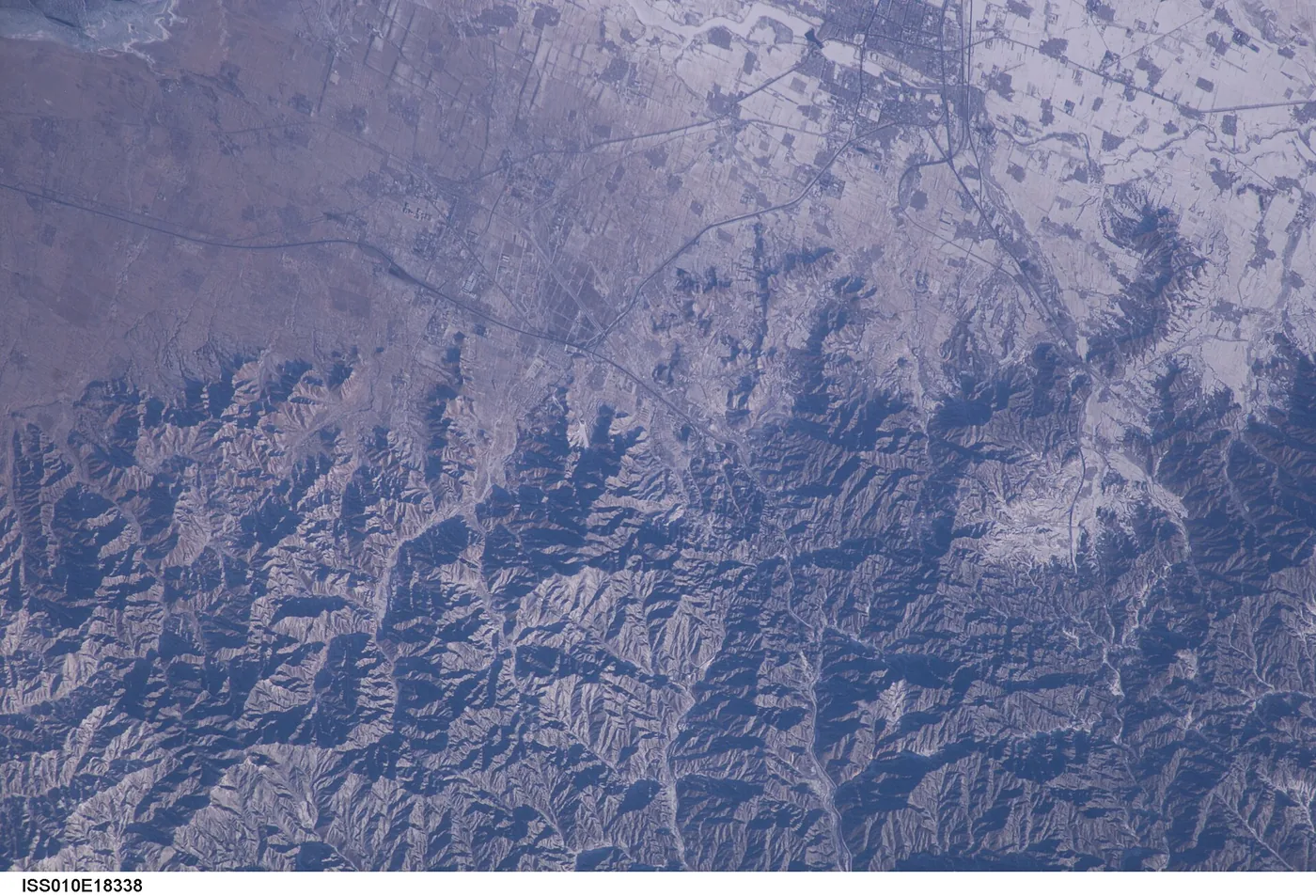
‘difficult or impossible to see from Earth orbit without the high-powered lenses used for this photo’
NASA, on the photograph taken by Commander Leroy Chiao from the station during Expedition 10 — nasa.gov
The photograph was taken from the station through high-powered lenses during Expedition 10. In command was Leroy Chiao, who took the famous Great Wall picture.
Find the wall in the photograph with the naked eye. That is how the crew sees it too: without high-powered lenses, the wall dissolves into the landscape.
1998–2030
From the first piece to the last descent
Three dates: the first piece, the first crew, the last descent.
1998
The first piece
The Russian Zarya module reaches orbit on 20 November 1998. On 6 December the shuttle Endeavour brings the American Unity module and joins them together.
2000
The first crew
The first crew arrives in November 2000, and the station has stayed lived in ever since. A standard crew numbers seven.
2030
The last descent
After its working life ends in 2030, a SpaceX-built vehicle will bring the station down from orbit. The contract is worth up to $843 million.
The last chapter is a plan announced by NASA. No exact date exists yet.
The game
Eight statements, true or false
Eight statements about the station. Pick true or false for each; the answer only appears once you commit.
All the statements, with answers:
- True. You can see the space station with the naked eye. NASA publishes lists of visible passes for any town. It looks like a very bright star crossing the sky. NASA, Spot the Station
- False. It shines with its own lights. It shines because it reflects sunlight. That is why it shows in the hours after sunset and before sunrise. NASA, Spot the Station
- True. It circles the Earth in about 90 minutes. On the elements of 22 September 2026, one lap takes 93 minutes. NASA writes about 90, ESA writes 92. NASA, ESA + the orbital elements
- True. It is almost as long as a football pitch. It measures 109 metres from end to end, and pitches for international matches run 100 to 110 metres. NASA + the Laws of the Game
- False. You can see the Great Wall from the station with the naked eye. NASA writes that the wall is ‘difficult or impossible to see from Earth orbit’ without high-powered lenses. The famous photograph was taken through such lenses. NASA, Great Wall
- True. It passes over Romania. The orbit reaches 51.6 degrees of latitude, and Romania's towns sit between 43.9 and 47.8. The pass list above shows it. NASA + the orbital elements
- True. It has been lived in without a break since 2000. The first crew arrived in November 2000, and someone has been aboard ever since. A standard crew numbers seven. NASA, Facts and Figures
- True. NASA already plans to bring it down after 2030. SpaceX is building the deorbit vehicle, under a contract worth up to $843 million. No exact date is set. NASA, US Deorbit Vehicle
Honesty
What the sources cannot say
- Clouds. The predictor assumes a clear sky; a cloudy evening hides any pass, however high the station climbs.
- The exact time a fortnight out. Orbital elements age fast (the orbit is adjusted regularly, and NASA publishes new elements as it adjusts it), so the page always shows the age of the elements used.
- An official brightness. No agency publishes an official number for the peak brightness. So the page only says ‘a very bright star’, in NASA’s words.
- The exact date of the descent. There is a plan and a contract, not a fixed day.
Sources
Sources and method
Passes are computed from the orbital elements CelesTrak publishes for the station (NORAD 25544), dated 22 September 2026. The position is propagated with the SGP4 model, and a pass makes the list when the station climbs past 10 degrees above the horizon, sunlit, with the Sun below the horizon for the watcher. All times use Romania's time zone.
The calculations were checked with the Skyfield library and the JPL DE440 ephemeris. The football pitch is drawn at 105 metres, the middle of the regulation 100–110 metre range, and the reference reader is 1.70 metres tall. Town coordinates come from GeoNames.
- NASA, International Space Station Facts and Figures nasa.gov — size, mass, crew, the 16 daily orbits
- NASA, Spot the Station nasa.gov — when it shows, what it looks like, the 51.6-degree inclination, speed
- ESA, Where is the International Space Station? esa.int — 400 km up, 92 minutes a lap
- NASA, Great Wall (image article) nasa.gov — Chiao's photograph and what NASA says about the wall
- NASA, 25 Years Ago: The First Pieces of the International Space Station nasa.gov — the Zarya module, 20 November 1998
- NASA, NASA Selects International Space Station US Deorbit Vehicle nasa.gov — the post-2030 plan, the $843 million vehicle
- IFAB, Laws of the Game 2024/25, Law 1: The Field of Play thefa.com (PDF) — pitch length for internationals: 100–110 metres
- CelesTrak, the station’s orbital elements (NORAD 25544) celestrak.org — the 22 September 2026 position and velocity the passes are computed from
- GeoNames geonames.org — the 42 towns' coordinates