Physics · Paris, 1922–1930 · Comptes rendus
Ștefania Mărăcineanu and the lead roof of the Paris Observatory
In 1923, at the Radium Institute, she measured polonium’s half-life: 139.5 days, 0.8% above today’s value. In 1927 she took an electrometer onto the lead roof of the Paris Observatory and found it radioactive. She attributed it to the Sun.
Her tables of readings survive in the Comptes rendus. Each run of the needle below uses one of the times she wrote down.
Choose a sample and press Start. Press Stop when the needle reaches division 5, marked on the scale; with the eyepiece selected, the space bar works too. Your time appears next to the one she wrote down; the last figure says how many times faster the instrument discharged than on its own.
Samples from 1927
Each run uses the next reading in her table.
1922–1923 · The Radium Institute
How long does it take half the polonium to decay? Her estimate: 139.5 days
Ștefania Mărăcineanu taught physics and chemistry at the Central School for Girls in Bucharest. By March 1922 she was measuring polonium at the Radium Institute in Paris, in Marie Curie’s laboratory. One question about the element the Curies had discovered in 1898 was still open: how long it takes for half of it to decay. Published values, she wrote, varied “within fairly wide limits”, from 134.5 to 143 days.
Her polonium came from radium-emanation ampoules used in medical treatment and had been purified in the institute’s chemistry laboratory. She put drops of a very dilute solution on small plates of metal and glass and followed, for months, the ionisation current from the alpha rays, using an electrometer balanced with Pierre Curie’s piezoelectric quartz. Thirty-eight curves measured without screens gave 139–140 days, with one exception: on lead, 135. Under thin aluminium foil the metals gave 136–137, while glass stayed the same.
She then checked the possible explanations one by one: a trace of radium D on Marie Curie’s 1910 plate (the plate was now inactive), polonium thrown onto the screens (the screens were clean), an unsaturated current (hers was saturated). What remained was Marie Curie’s hypothesis: polonium slowly sinks into the metal it sits on, and the metal blocks part of its rays. On glass, the curves were the most regular. Hence her advice: deposit the material on glass, without heating and in small quantities.
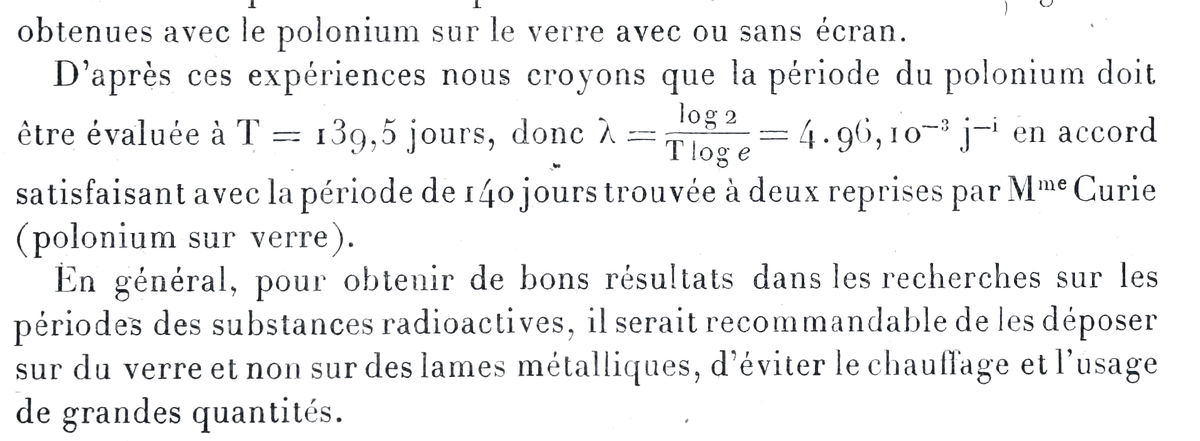
“From these experiments we believe that the period of polonium should be put at T = 139.5 days.”
S. Maracineanu, Comptes rendus 176, p. 1881, 1923
Today’s evaluated value is 138.376 days. Her 139.5 is 0.8% too long. The 135 days she measured on lead were 2.4% below today’s value; the 144 days measured through gold foil, 4.1% above. Her closest figure, 138 days, read directly on gold, came from a metal support, the kind she considered unreliable.
In 1931 an international committee recommended 140 days, Marie Curie’s figure. A 1952 report from Mound Laboratory in Ohio, which handled polonium for the American nuclear programme, noted that the project handbook still used 140 days, although 13 of the 15 measurements made after 1920 had come out lower. The report’s weighted mean, Marie Curie’s 1920 result included: 138.387 days. Ștefania Mărăcineanu’s three values are in that report’s table.
Her note of 25 June 1923 also has a misprint: the third series of measurements supposedly began “on 7 December 1923”, after the note was already in print. December 1922 is the likely intended date.
Dashed line: 138.376 days, today’s evaluated value (LNHB). Grey band: the range she cited for earlier measurements.
1923–1928
A signal on the far side of lead
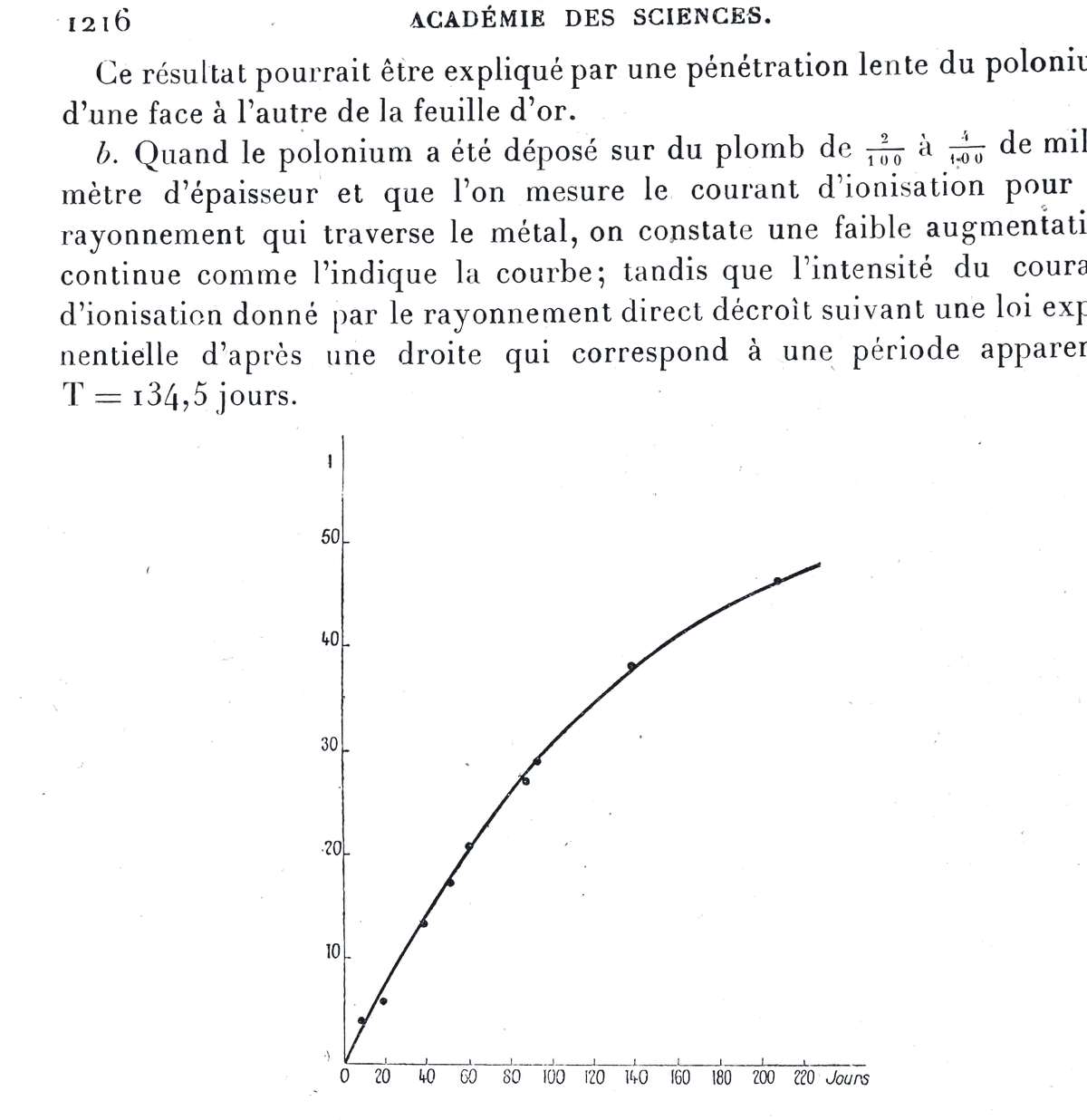
In a note published on 3 December 1923 she described a drop of polonium on a lead foil two to three hundredths of a millimetre thick. Beyond the foil, where polonium’s alpha rays should not reach, the ionisation current rose from zero to 0.002 electrostatic units in 92 days, against 1.44 from the drop itself. The curve on the right is hers.
At first she explained the signal as polonium slowly working its way through the metal, faster after heating. In 1926 she changed her mind: adding up both faces, she found no large loss of polonium inside, and the curve looked like polonium forming from radium E. She proposed that sunlight could run the decay backwards and rebuild radium E from polonium.
Miruna Popescu, Marelene and Geoffrey Rayner-Canham suggested that the recoil of decaying atoms might explain some of these observations: an atom that fires off an alpha particle jumps back and can lodge in the metal next to it. Marco Fontani and colleagues note that Éliane Montel found polonium passing through lead only through cracks.
May–June 1927 · Paris Observatory
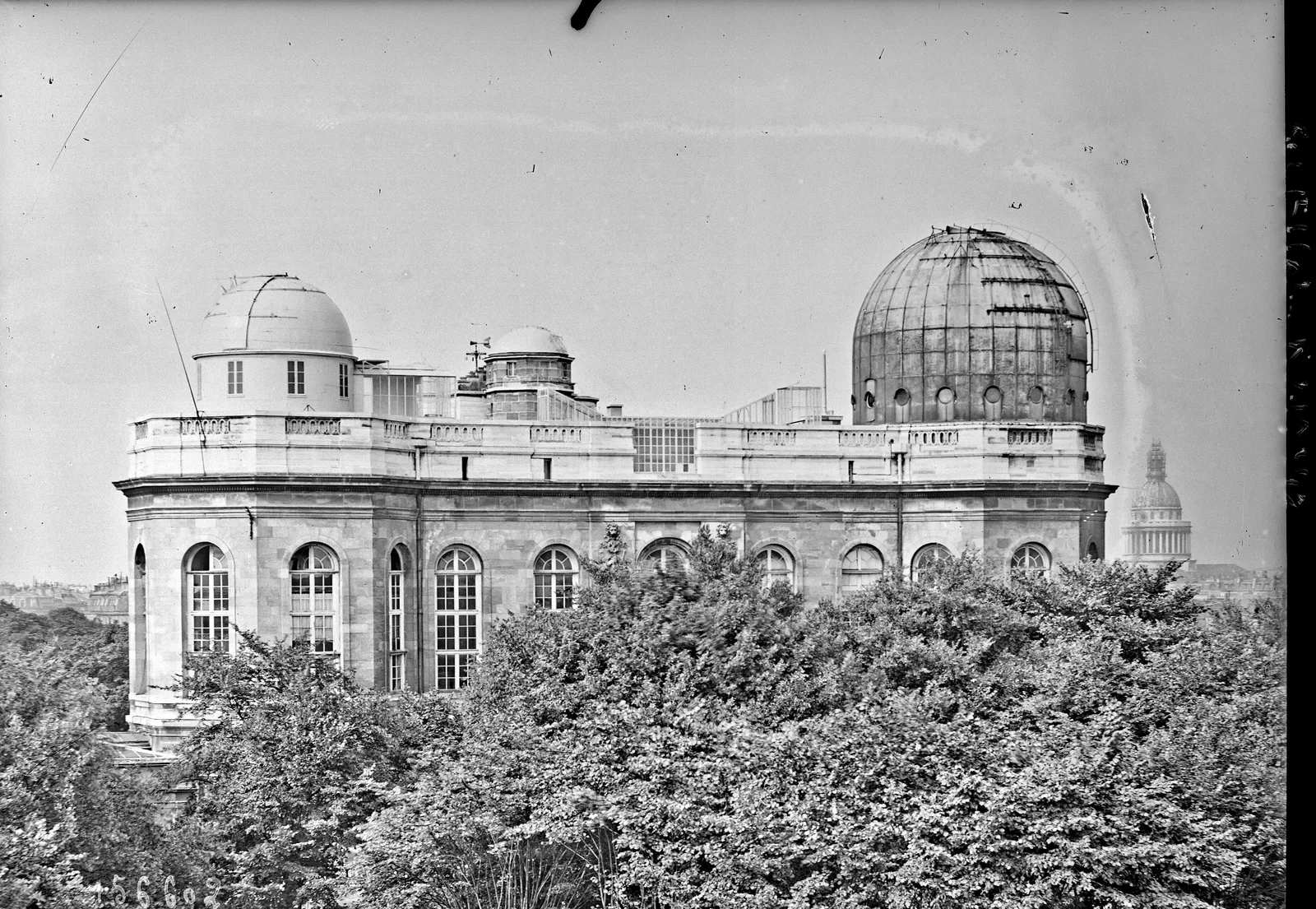
An electrometer on the roof of the Paris Observatory
After her doctorate Ștefania Mărăcineanu stayed in France and worked at the Meudon and Paris observatories with the astronomer Henri Deslandres, director of both observatories, who believed the Sun gave off a still-unknown radiation. She believed sunlight changed radioactivity. If she was right, lead that had sat in the sun for decades ought to be radioactive.
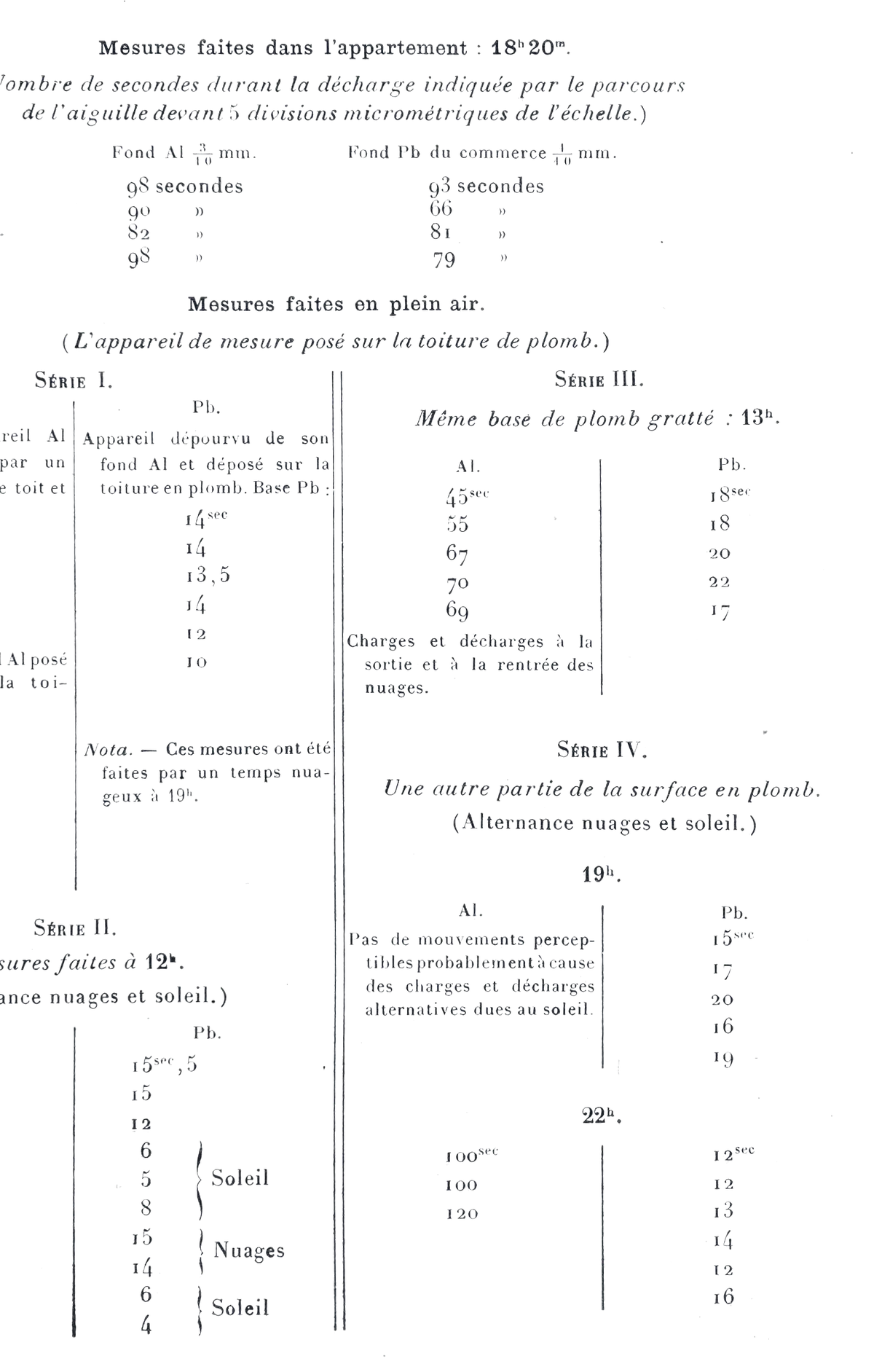
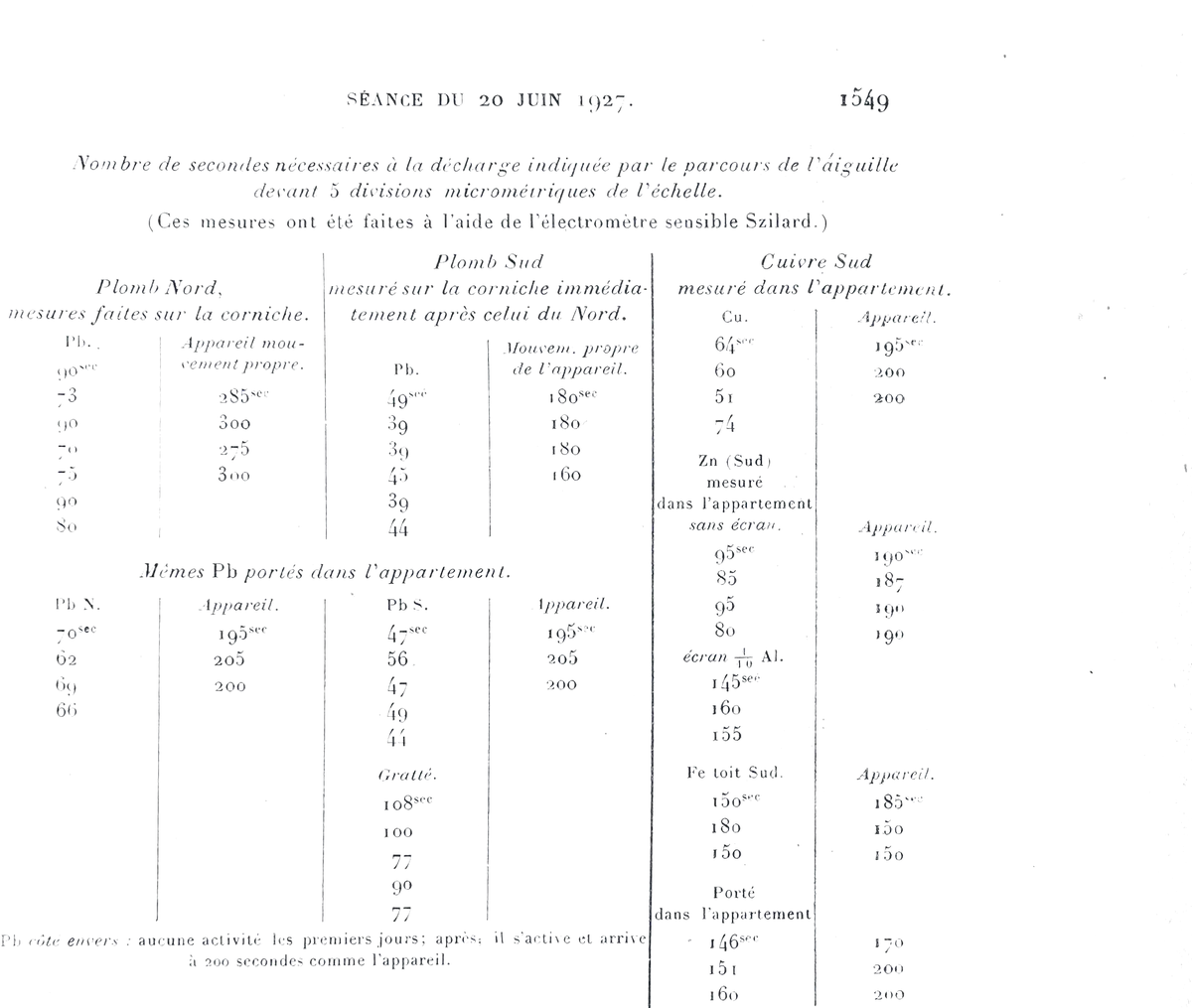
The Paris Observatory had an old, flat lead roof. On the advice of Le Bel and Deslandres, she climbed onto it with a Szilard electrometer whose ionisation chamber had a removable aluminium base about 15 centimetres in diameter. With the base fitted, the instrument measured its own discharge. Without it, the ionisation chamber took the roof’s radiation directly. She switched between the two in the morning, at noon and in the evening, in sun and cloud, counting the seconds the needle took to cross five divisions of the scale.
The roof discharged the instrument five to seven times faster, she wrote. The radiation was mainly alpha. In a room nearby, commercial lead gave almost the same readings as the aluminium base. “It is natural to attribute the effect to the Sun,” she concluded, while asking for other roofs to be checked.
In June she cut a plate out of the roof and took it to the laboratory. The underside showed no activity at all. The top gave the roof’s value on the first day, then less and less in the days after. The limestone next to the roof was not radioactive. Lead from the south cornice was more active than lead from the north cornice, and the zinc and copper roofs were active on their exposed faces too. The iron, she allowed, was at most very weakly active.
“People who have lead that has long been exposed to the sun, and who lack the apparatus to look for its radioactivity, are asked to send a sample to the Paris Observatory.”
H. Deslandres, Comptes rendus 184, p. 1325, 1927
She did think of radioactive deposits from the air, and dismissed them in a footnote: the activity was “too strong” to be put down entirely to atmospheric deposits.
What her own figures show
The noon sun and the lead after sunset
Her readings can be reread with one simple rule: for each series, the needle’s speed over the lead (five divisions divided by the seconds) minus its speed with the aluminium base fitted. The difference is what comes from the lead.
Read that way, the sample from the south cornice gives 2.1 times the signal of the north one measured in place, and 1.7 times in the laboratory. How much rain each side took was never measured. And in January 1928, two fresh discs cut from the same cornice, north and south, started out equally active, she noted.
Noon, when the lead seemed “twice as active”, is also when the instrument was least steady. With the aluminium base fitted, the needle crossed the five divisions in 30–67 seconds, and in another series, at 7 p.m., it showed no perceptible movement at all; she put that down to charges and discharges caused by the sun. An open electrometer in full sunshine was not a laboratory condition.
At 10 p.m., after sunset, on another part of the roof, the needle crossed over the lead in 12–16 seconds and with the aluminium base in 100–120. The underside of the cut plate had nothing. And scraping took most of the activity away: it sat in a thin surface layer.
1928–1930 · The replies
How did radioactive material get onto the roof?
In March 1928 she published the sequel: the discs cut in June 1927 stayed active for months and declined slowly, with a period comparable, she wrote, only with polonium’s. She rejected an atmospheric origin and went further: the Sun might rebuild lead as far as radium D. Radium D is lead-210, polonium’s parent. She had the right family of atoms. The source she proposed was the Sun.
In 1929, in a bulletin of the Romanian Academy, she announced gold, mercury and helium in the exposed lead, that is, transmuted lead. Charles Fabry, director of the Institute of Optics, and E. Dureuil, who had helped her take the spectra, replied on 13 January 1930: no trace of gold or mercury, no helium, no difference between the faces apart from a sooty crust with a little iron. She suggested that their roofs might have been too new, or that the Observatory lead had come from spots she had already scraped.
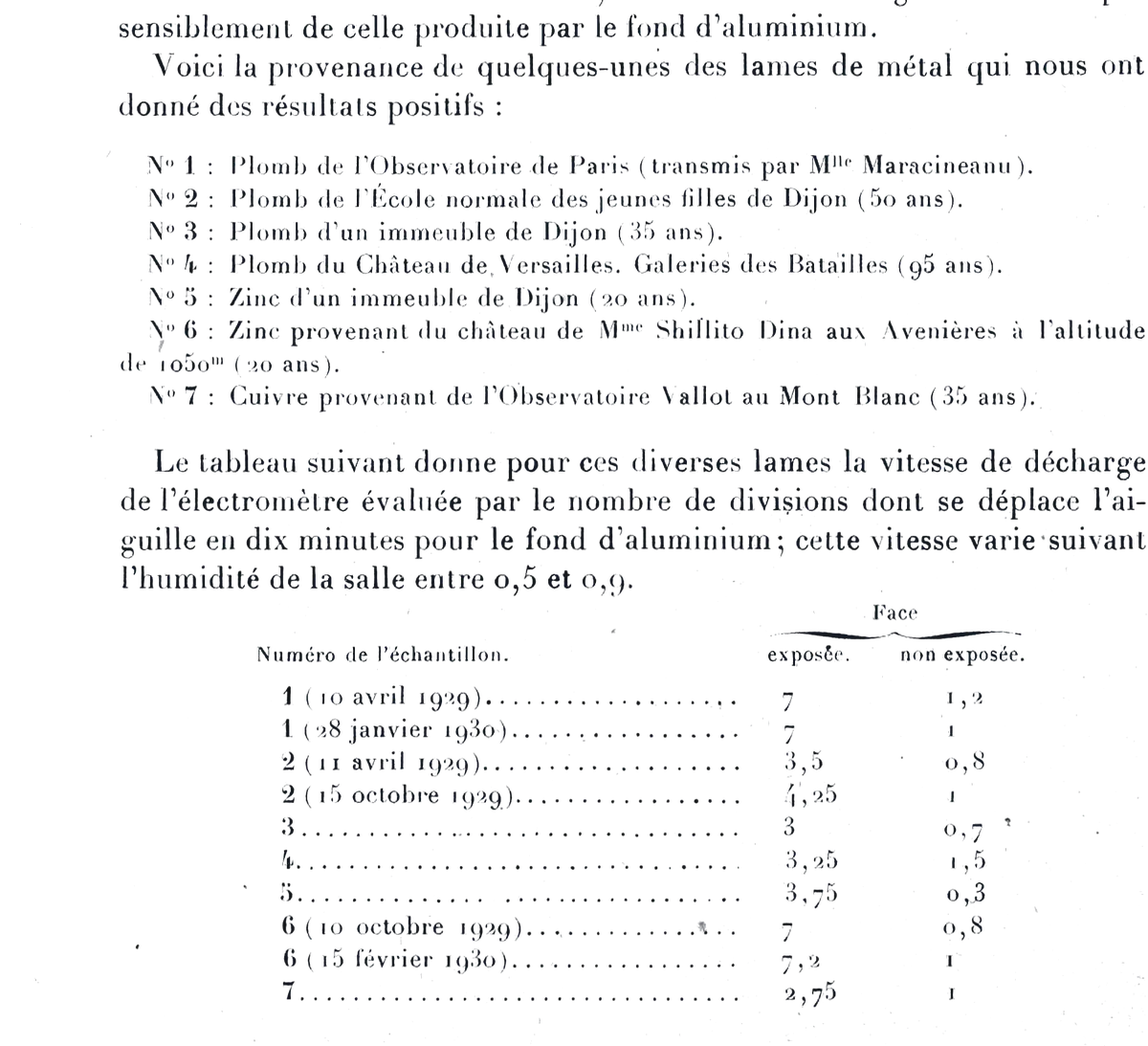
In February 1930 Augustin Boutaric and Madeleine Roy published laboratory readings for seven roofing samples, including her lead from the Observatory, 95-year-old lead from Versailles, zinc from Les Avenières at 1,050 metres and copper from the Vallot observatory on Mont Blanc. The exposed faces were active, the inner faces almost not at all, and a few hours in the sun changed nothing. After scraping, the radioactivity turned up in the material removed. The explanation they favoured: metals fix radioactive substances from the air and from rainwater. In March, Adolphe Lepape and Marcel Geslin found slate from the Collège de France roof about as active as lead, with most of the lead’s activity in a layer a tenth of a millimetre thick, and gave rain the main part.
In June 1930 Boutaric and Roy closed the case with a simple experiment on a roof in Dijon. The most active lead was from a gutter that collected rainwater, not from the sunniest ridge. The samples ranked by how much rain had touched them. And sand and charcoal that had filtered a roof’s water for 30 years, sealed in a cement wall in complete darkness, were radioactive too. The radioactivity of roofs, they wrote, can be explained solely by rainwater.
Her sample from the Observatory, no. 1 in the February table, read 7 divisions in 10 minutes on 10 April 1929 and 7 again on 28 January 1930, 293 days later. A single deposit of polonium-210, with nothing to replenish it, would have fallen to 23% in that time, with today’s half-life or with her own 139.5 days alike: about 2.2 divisions, the instrument’s background included. The authors give no uncertainty for their readings. The two equal values do fit polonium being continually replenished by a long-lived parent: lead-210, with a half-life of 22.2 years, brought out of the air by rain. That is an explanation, not a measurement. And her 1928 curves, falling over the first months, fit an excess of polonium dying away to the level that lead-210 holds up.
The size fits too. Bulk deposition measured in Paris in 1982–83 averaged 109 becquerels of lead-210 per square metre per year. A roof that kept all of it would hold about 2,758 becquerels of lead-210 per square metre after 50 years, approaching 3,491 over time, and the polonium it produces would reach the same activity. The current she measured on the roof would correspond, if it all came from polonium-210, to roughly 560–1,500 becquerels per square metre. It is an order of magnitude, with the assumptions set out below, but it needs no Sun.
How it was calculated
Roof readings (30 May 1927): for each reading, five divisions divided by the elapsed seconds; the median background rate for the series (aluminium base fitted) is subtracted from the median rate over the lead. Her calibration: one division per second = 0.0014 electrostatic units. The two evening series give net currents of 1.22 and 1.64·10⁻¹³ amperes, or 0.76–1.0 million ion pairs a second.
A polonium-210 alpha particle carries 5.3 MeV and makes about 154,000 ion pairs if it gives up all its energy in air. From a surface at most half the particles head upwards, and some lose energy in the oxide and dust layer. Each decay was assumed to leave, on average, between a quarter and a half of its energy as ionisation collected in the chamber, over the 15 cm diameter opening she gives. The result is a range of scenarios, not a measurement of how much the roof retained.
Deposition: 109 Bq/m² a year of lead-210, bulk (wet and dry) deposition in Paris in 1982–83 (Preiss et al., 1996, from the Zhang et al. 2021 dataset). With lead-210’s mean life of 32 years, complete retention gives 2,758 Bq/m² after 50 years and 3,491 Bq/m² at saturation. Deposition in the 1920s was not measured.
The 293-day test uses Boutaric and Roy’s two readings of the same sample (7 and 7), with an instrument background of 0.5–0.9 divisions (taken as 0.7): (7 − 0.7) × 2^(−293/138.376) + 0.7 = 2.2 divisions.
1930–1936 · Bucharest and the Sahara
Artificial rain and the quarrel with the Joliot-Curies
Rain, the thing that had brought the radioactivity down onto the roof, became her subject in the 1930s, with the arrow reversed: radioactive substances exposed to the sun would cause rain. She published the idea in a pamphlet in Bucharest in 1930 and ran trials in the city. At the Institute of the Sisters of Charity, she wrote, the sky clouded over within an hour and the director cried out: “You’ve put in too strong a dose! Take those diabolical powders away!” At the Faculty of Sciences, in 1931, witnesses signed reports.
On 11 March 1933 the Academy of Sciences in Paris declined to print her rain note: its permanent secretaries told her it would not appear in the Comptes rendus and would be kept in the archives. The journal’s cumulative index for 1926–1940 lists no note of hers after February 1930.
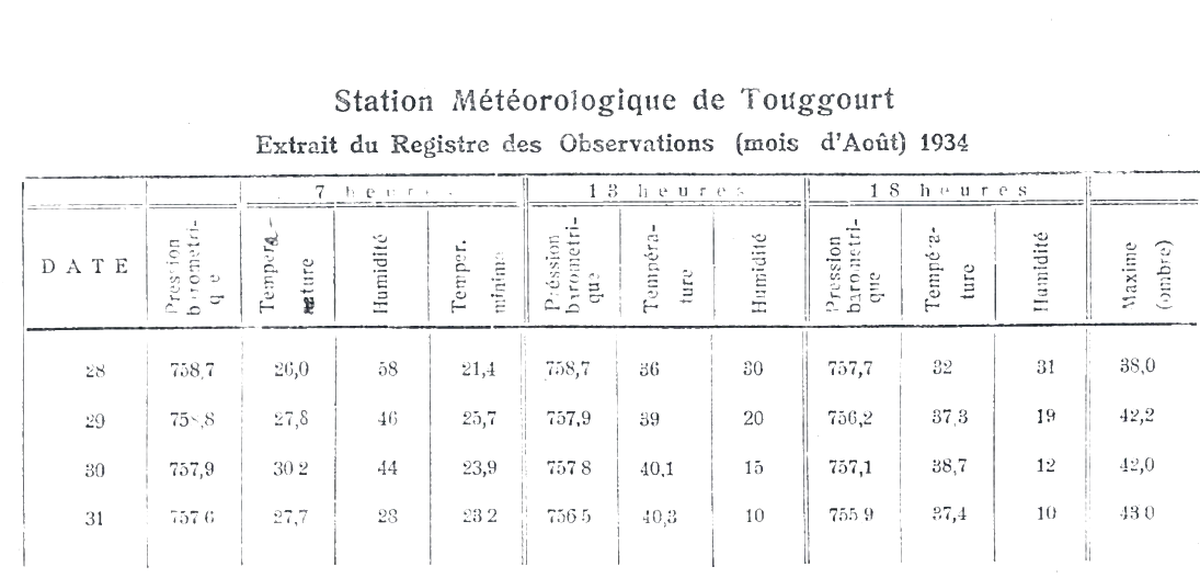
In August 1934 she went to Algeria at her own expense. On 20 August, after she had reached Algiers, the governor-general’s office authorised rain trials at Touggourt, a thousand kilometres south of Algiers, where, she wrote, it never rains in summer. The place and season, the order said, would reduce doubts about natural rainfall. Captain Pinon’s report, from 28 August to 1 September, records clouds forming and burning off in the heat. She wrote herself that at Touggourt there was “only cloud formation, without rain on the spot”. The Touggourt weather station’s register for 28–31 August, printed in her own pamphlet, has no column for precipitation: 6 p.m. humidity falls from 31% to 10%, and the shade maximum rises from 38 to 43 °C.
In the same 1934 pamphlet she claimed artificial radioactivity, announced by Irène and Frédéric Joliot-Curie in January 1934 and rewarded with the 1935 Nobel Prize in Chemistry “in recognition of their synthesis of new radioactive elements”. Her own research, she wrote, had begun “in 1924, at the Radium Institute”. In 1936 she wrote to Lise Meitner as well, complaining that Irène Joliot-Curie had used her work without citing it.
The effects she measured were not artificial radioactivity in the sense of the 1934 discovery, a stable element turned by alpha particles into a new, chemically identified radioactive isotope. Historians who have studied the case, from the Rayner-Canhams to Fontani and colleagues, find the claim unsupported by her measurements. In 1937 the Academy of Sciences of Romania elected her a corresponding member.
1882–1944
Who was Ștefania Mărăcineanu?
She was born in Bucharest on 17 June 1882, according to the Romanian National Archives; the birth was registered the next day. At ten she appeared as an orphan in the records of the Elena Doamna asylum, and she did not like to talk about her childhood. She took a degree in physical and chemical sciences in 1910 and taught at the Central School for Girls in Bucharest.
By March 1922 she was working at the Radium Institute, with backing from the Romanian ministry, and she defended her doctorate in 1924. Marie Curie wrote her a reference: “I have great esteem for the work she has done. In particular, she has acquired a perfect knowledge of precise electrometric measurements.” On 1 January 1925 the University of Bucharest appointed her a provisional assistant in its physics laboratory; after a spell of work in Romania, she returned to France and the observatories.
She returned to Romania in 1930. She worked at the university, wrote about the radioactivity of the Earth and about earthquakes, and stayed outside the network of letters that linked the women of the Curie laboratory. She died in Bucharest on 15 March 1944, after four months in hospital, according to the National Archives.
She left a good value and a good table. Her 139.5 days were closer to the truth than the figure officially adopted after her. And the tables from the Observatory roof, reread, fit what her colleagues put down to rain in 1930: radioactivity from the Paris air, gathered on the lead for decades.
- 1882Born in Bucharest, 17 June.
- 1910Degree in physical and chemical sciences; teacher at the Central School for Girls.
- 1922In Paris, at the Radium Institute, with Marie Curie.
- 1923Polonium: 139.5 days on glass; a signal beyond a lead foil.
- 1924Doctorate in Paris.
- 1925–1930Meudon and the Paris Observatory, with Henri Deslandres.
- 1927The electrometer on the roof of the Paris Observatory.
- 1928The roof discs decline slowly, like polonium; she thinks of radium D, rebuilt by the Sun.
- 1930Fabry and Dureuil reject the transmutation; Boutaric and Roy, Lepape and Geslin point to the rain. Returns to Romania.
- 1933The Paris Academy declines to print her rain note.
- 1934Touggourt, Algeria: clouds, no rain. Claims priority for artificial radioactivity.
- 1937Corresponding member of the Academy of Sciences of Romania.
- 1944Dies in Bucharest, 15 March.
Sources
The links open scans of the original papers, including the printed tables.
- S. Maracineanu, “Recherches sur la constante du polonium”, Comptes rendus 176 (25 June 1923), pp. 1879–1881. Internet Archive
- S. Maracineanu, “Recherches sur la pénétration des substances radioactives dans les métaux”, Comptes rendus 177 (3 December 1923), pp. 1215–1217. Internet Archive
- S. Maracineanu, “Actions spéciales du Soleil sur la radioactivité du polonium et du plomb”, Comptes rendus 183 (2 August 1926), pp. 345–347. Internet Archive
- M. A. da Silva, “Sur une nouvelle détermination de la période du polonium”, Comptes rendus 184 (24 January 1927), pp. 197–199. Internet Archive
- S. Maracineanu, “Recherches sur la radioactivité du plomb, qui a été soumis pendant longtemps au rayonnement solaire”, with H. Deslandres’s remark, Comptes rendus 184 (30 May 1927), pp. 1322–1325. Internet Archive
- S. Maracineanu, “Recherches sur la radioactivité de la matière exposée pendant longtemps au rayonnement solaire”, Comptes rendus 184 (20 June 1927), pp. 1547–1549. Internet Archive
- S. Maracineanu, “Sur les phénomènes, semblables à ceux des corps radioactifs, présentés par les métaux”, Comptes rendus 186 (19 March 1928), pp. 746–748. Internet Archive
- Ch. Fabry and E. Dureuil, “Sur une prétendue transformation du plomb par l’effet du rayonnement solaire”, Comptes rendus 190 (13 January 1930), p. 91. Internet Archive
- S. Maracineanu, “Remarques sur une Note de MM. Fabry et Dureuil”, Comptes rendus 190 (10 February 1930), pp. 373–374. Internet Archive
- A. Boutaric and M. Roy, “Sur la radioactivité de divers métaux provenant de toitures anciennes”, Comptes rendus 190 (24 February 1930), pp. 483–485. Internet Archive
- A. Smits and C. H. MacGillavry, “Remarques sur la Note de Mlle Maracineanu”, with H. Deslandres’s remark, Comptes rendus 190 (10 March 1930), pp. 635–639. Internet Archive
- A. Lepape and M. Geslin, “Sur la radioactivité acquise par les matériaux exposés à l’action des agents atmosphériques”, Comptes rendus 190 (17 March 1930), pp. 676–678. Internet Archive
- A. Boutaric and M. Roy, note of 16 June 1930 (the Dijon gutter, the sand and charcoal filter), Comptes rendus 190, pp. 1410–1412. Internet Archive
- S. Maracineanu, Radioactivité, soleil, pluie artificielle. Expériences et recherches, București, Cultura Românească, 1934. BCU Iași
- S. Maracineanu, Radioactivité artificielle. Pluie artificielle (La pluie au Sahara), Bucharest, Editura Analelor Române, 1934, with the order of 20 August 1934, the Touggourt report and the weather-station register. BCU Iași
- J. F. Eichelberger, Recommended value for the half life of polonium, Mound Laboratory MLM-698, 1952. OSTI
- LNHB/DDEP, Po-210 nuclide table (T½ = 138.3763 days). lnhb.fr
- F. Zhang, J. Wang, M. Baskaran et al., “A global dataset of atmospheric ⁷Be and ²¹⁰Pb measurements”, Earth System Science Data 13 (2021), 2963–2994; Paris row (109 Bq/m² a year, 1982–83). doi
- M. Popescu, M. F. Rayner-Canham, G. W. Rayner-Canham, “Stefania Maracineanu: Ignored Romanian Scientist”, in A Devotion to Their Science: Pioneer Women of Radioactivity, Chemical Heritage Foundation / McGill-Queen’s, 1997, pp. 87–91.
- M. Fontani, M. V. Orna, M. Costa, S. Vater, “Science is Not a Totally Transparent Structure: Ştefania Mărăcineanu and the Presumed Discovery of Artificial Radioactivity”, Substantia 1 (2017). doi
- “Ștefania Mărăcineanu, cercetătoarea care a provocat prima ploaie artificială din lume”, Historia, after the Romanian National Archives (birth, death). historia.ro
- University of Bucharest Museum, record “Mărăcineanu Ștefania” (posts at the Faculty of Sciences). muzeu.unibuc.ro
- Nobel Prize in Chemistry 1935, citation. nobelprize.org
Images
- Comptes rendus hebdomadaires de l’Académie des sciences, Internet Archive scan; text and figures in the public domain
- Central University Library, Iași, 1934 pamphlet; public domain
- Agence Rol, 21 July 1931, Bibliothèque nationale de France (Gallica) via Wikimedia Commons, public domain