mariuscomper.uk RO
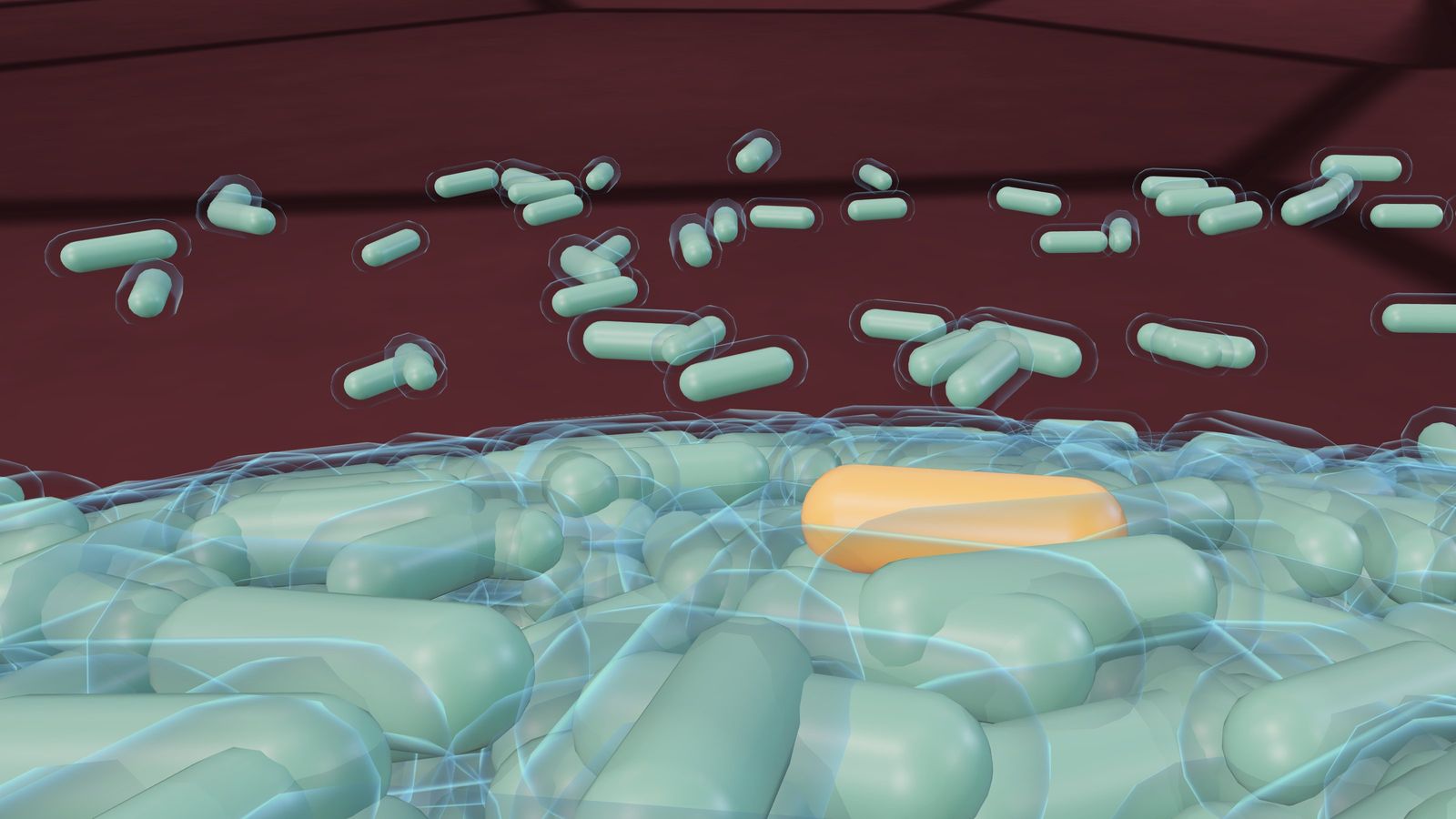
A colony of Klebsiella bacteria, pale green, with a few amber cells.

Antibiotic resistance, inside one infection

The bacterium that stays

A hospital urinary infection holds tens or hundreds of millions of bacteria. Some of them can break a last-line antibiotic. Watch what happens when treatment arrives.

colony · micrometres

One in thousands is different

Each rod is a Klebsiella pneumoniae bacterium, a few micrometres long, wrapped in a sugar capsule that helps it slip past immune cells.

The amber ones carry something extra: a gene for an enzyme, a carbapenemase. It cuts carbapenem antibiotics before they can strike. While there is no antibiotic around, these cells have no advantage at all.

hospital ward · bladder

A hospital infection

The colony lives in the bladder of a patient in hospital who has a urinary catheter. The catheter is one of the ways bacteria get from outside into the bladder.

Klebsiella pneumoniae usually lives in the gut and does no harm. It becomes dangerous where it does not belong: in urine, in the lungs, in the blood.

drip · meropenem

Meropenem arrives

The doctor chooses meropenem, a carbapenem: one of the last-line antibiotics, used for serious infections or for bacteria that no longer respond to others. It goes in through a drip, usually every eight hours.

The blood carries it through the whole body. The kidneys clear it fast: its level in the blood halves in about an hour, and most of each dose leaves unchanged in the urine.

colony · first hours

The susceptible cells burst

The antibiotic blocks the enzymes a bacterium uses to build its wall. The cell keeps growing, the wall gives way and the cell bursts.

Within hours most of the colony is gone. The amber cells are still standing.

one bacterium · cut open

Why one bursts

Meropenem gets through the capsule, then through the outer membrane by channels called porins. Beneath lies the wall: a mesh of sugar chains tied together by short bridges.

The mesh is woven by enzymes called PBPs. Meropenem sticks to them and stops them. Without them, the wall can no longer hold the pressure inside.

between the two membranes · nanometres

And why the other does not

In the resistant cell, between the two membranes, the carbapenemase is waiting. It breaks a ring in the meropenem molecule, and a broken molecule can stop nothing.

The gene for the enzyme usually sits on a plasmid, a small ring of DNA apart from the chromosome. In Europe the commonest carbapenemases have been KPC, OXA-48 and NDM, and NDM is now rising fastest. In Romania OXA-48 dominated for a decade; recent hospital studies increasingly find strains carrying both NDM and OXA-48.

colony · after selection

The colony grows back, from them

The antibiotic did not make the cells resistant. They were already there. It only took away their competition.

In a test-tube model that starts with 100 resistant cells in a million, meropenem at the levels it reaches in blood after 1 g every eight hours kills the susceptible cells in under two hours. By hour 12 the resistant ones are past 100 million per millilitre. That is selection.

your test tube · 48 hours

You choose what the colony gets

Choose how the colony starts and which antibiotic it gets. The model plays 48 hours in a few seconds, and the colony in the picture follows it.

Dose and duration are missing on purpose: a test tube with no immune system and no tissue, where everything happens within hours, cannot answer them. The dose and length of a treatment are a prescriber’s decision.

At the start, the colony holds

The antibiotic

susceptibleresistantdrug level

susceptible · resistant

A test-tube model, not a patient. It shows which cells survive, not how long a treatment should last: the drug, dose and length of a course are a prescriber’s decision.

About the model

A test-tube model with parameters from published studies (see Sources): the bacteria get meropenem at the levels it reaches in blood, 1 g every 8 hours. With no immune system and no tissue, everything happens far faster than in a patient. The model shows which cells survive, not how long a treatment should last. The drug, dose and length of a course are a prescriber’s decision.

the plasmid

The gene does not stay in one bacterium

A plasmid can pass from one bacterium to another by direct contact, even between different species. And bacteria pass from patient to patient on hands, equipment and surfaces.

That is why, in a hospital, an infection with resistant bacteria is not just one patient’s problem.

100 bloodstream infections · 2025

One in two, in Romania

Of every 100 Klebsiella pneumoniae infections found in blood (or spinal fluid) in Romania in 2025, 50 involved strains resistant to carbapenems: 604 of 1,216 tested. ECDC asks for caution: Romania’s data come from hospitals that are not representative, covering about 17% of the population.

The average across the European Union and European Economic Area: 12 in 100. Only Bulgaria (70) and Greece (62) were worse.

The UK no longer reports to this European network. England’s own figure comes next.

UKHSA · bloodstream infections

And in England

In England in 2025, 134 of 9,594 Klebsiella pneumoniae bloodstream infections tested were resistant to carbapenems: 1.4%, about one in a hundred, according to the UK Health Security Agency.

Resistant infections keep rising in number all the same: 21,129 antibiotic-resistant bloodstream infections were reported in England in 2025, about 406 a week. An estimated 2,318 people with a resistant Gram-negative bloodstream infection died within 30 days, from any cause.

the same colony · the right treatment

When the antibiotic is the right one

When the colony has no resistant cells, or when the antibiotic is chosen after a susceptibility test, which shows what the bacteria still respond to, the antibiotic can clear the infection. In the model, the colony is gone in under two hours.

How long a course lasts is the prescriber’s decision. NICE, which sets guidance for the NHS in England, asks health services to give patients advice so that they “take them as instructed by their healthcare professional”, including “the correct dose for the time specified”. The WHO’s guide for prescribers adds that, where clinically appropriate, shorter treatment is generally linked to less toxicity and a lower risk of selecting resistance, with equivalent outcomes.

What anyone can do: take antibiotics only when a healthcare professional prescribes them, exactly as prescribed, never save leftovers for later and never share them.
Pass it on

For someone who works in a hospital, has someone in one, or has ever bought antibiotics without a prescription.

Sources and method

The resistance percentages come from ECDC’s European EARS-Net network (Romania and the EU/EEA average: bacteria from blood or spinal fluid) and from UKHSA’s ESPAUR report (England: bacteria from blood). Neither counts urinary infections. Dataset provided by ECDC based on data provided by public health authorities, scientific institutes or health care providers in the relevant reporting countries and/or by WHO.

ECDC content is used under CC BY 4.0; percentages are rounded.

The model

The “Try it” panel and the “After” step use a test-tube model, not a patient model. Bacterial growth and killing follow the pharmacodynamic function of Regoes and colleagues (2004), with the shape they estimated in E. coli for ampicillin, an antibiotic of the same family as meropenem (growth of 0.75 and decline of up to 4 orders of magnitude per hour). The model uses blood levels, like the ECDC data; in urine meropenem reaches higher levels. The meropenem minimum inhibitory concentration is 0.06 mg/L for susceptible cells (Xiong et al., 2021: 0.047–0.064) and 64 mg/L for carbapenemase producers (Mahadevan et al., 2026: 64–256, the lowest value in that study; EUCAST notes that some carbapenemase producers have much lower values). The drug: 1 g as a 30-minute infusion every 8 hours, peaking at about 49 mg/L and halving in about an hour (prescribing information). Chosen for illustration, without a source: a million bacteria per millilitre at the start, 100 of them resistant, a ceiling of a billion per millilitre and the same growth rate for both kinds. “One both kinds are sensitive to” is a hypothetical drug with the susceptible cells’ parameters. The drawn colony shows the total on a log scale, and the resistant cells by their share, with at least a few visible while any remain.

  1. ECDC, Surveillance Atlas of Infectious Diseases: K. pneumoniae, carbapenem resistance by country, 2005–2025. atlas.ecdc.europa.eu
  2. ECDC, Antimicrobial resistance in the EU/EEA (EARS-Net), annual report for 2025 (November 2026). www.ecdc.europa.eu
  3. UKHSA, ESPAUR report 2025 to 2026, chapter 2 and data tables (Figure 2.8). www.gov.uk
  4. Regoes RR et al., Pharmacodynamic functions, Antimicrobial Agents and Chemotherapy, 2004. doi.org
  5. EUCAST guidelines for detection of resistance mechanisms, 2017. www.eucast.org
  6. Xiong Y et al., carbapenem heteroresistance in K. pneumoniae, Infection and Drug Resistance, 2021 (Table 1). doi.org
  7. Mahadevan R et al., carbapenem-resistant K. pneumoniae, Antimicrobial Agents and Chemotherapy, 2026. doi.org
  8. NICE NG63, recommendation 1.2.2. www.nice.org.uk
  9. WHO, The WHO AWaRe Antibiotic Book, 2022, p. 18. www.who.int
  10. ECDC, Carbapenem-resistant Enterobacterales, rapid risk assessment, fourth update (November 2026), and the 2019 CCRE survey. www.ecdc.europa.eu
  11. Cireșă et al., 2026, and Lixandru et al., 2015: carbapenemases in Klebsiella in Romanian hospitals. pmc.ncbi.nlm.nih.gov
  12. David S et al., PNAS 2020: spread of carbapenemase plasmids. pmc.ncbi.nlm.nih.gov
  13. EUCAST, Expected Resistant Phenotypes v1.2, Table 1 (Klebsiella pneumoniae: ampicillin/amoxicillin). www.eucast.org
  14. Paczosa MK, Mecsas J, Klebsiella pneumoniae: going on the offense with a strong defense, MMBR 2016. pmc.ncbi.nlm.nih.gov
  15. Meronem, harmonised summary of product characteristics (EMA), sections 4.2 and 5.2. www.ema.europa.eu
  16. Meropenem, US prescribing information (DailyMed), section 12.3: peak level, urinary excretion. dailymed.nlm.nih.gov