We export what we ban — then we eat what we export
The pesticides Europe banned come back on the plate
In 2025, the official monitoring programmes in Great Britain and Northern Ireland tested 3,550 food samples from the supply chain. Our preliminary extraction identifies 122 detections of the 12 selected substances; it is being reconciled with the official report. A detection is not the same as a sample or an established violation.
How it's legal
01How residues can legally appear in food
The EU and Great Britain do not approve agricultural use of the substances discussed here. Some may be manufactured for export, subject to applicable rules, including notification and consent procedures under the PIC Regulation.
Maximum residue limits (MRLs) are set for combinations of food and substance. Non-approval for agricultural use does not automatically ban imported food that complies with its applicable limit. An MRL exceedance is a separate issue; official assessment can account for measurement uncertainty. An exceedance alone does not establish an acute health risk.
Numbers of 2025
02What the laboratories found in 2025, food by food
PRiF samples the UK supply chain, including shops, depots and ports. The HSE annual report of 30 October 2026 provides the official totals. Our extraction from individual sheets is preliminary: sample identifiers and results still need reconciliation with that report.
Detections of the 12 banned molecules by food, 2025 (GB + NI). Spices (cumin, turmeric) concentrate 55 of 122 — 45%.
The most frequent banned molecules in 2025. Neonicotinoids (clothianidin, imidacloprid, thiamethoxam) account for 54 of 122.
By "country of origin" as coded by PRiF. Of the 52 detections coded "UK", 48 are in spices. The record code alone does not establish the origin of the ingredients.
The cumin case
03Spices: detections are not the same as samples
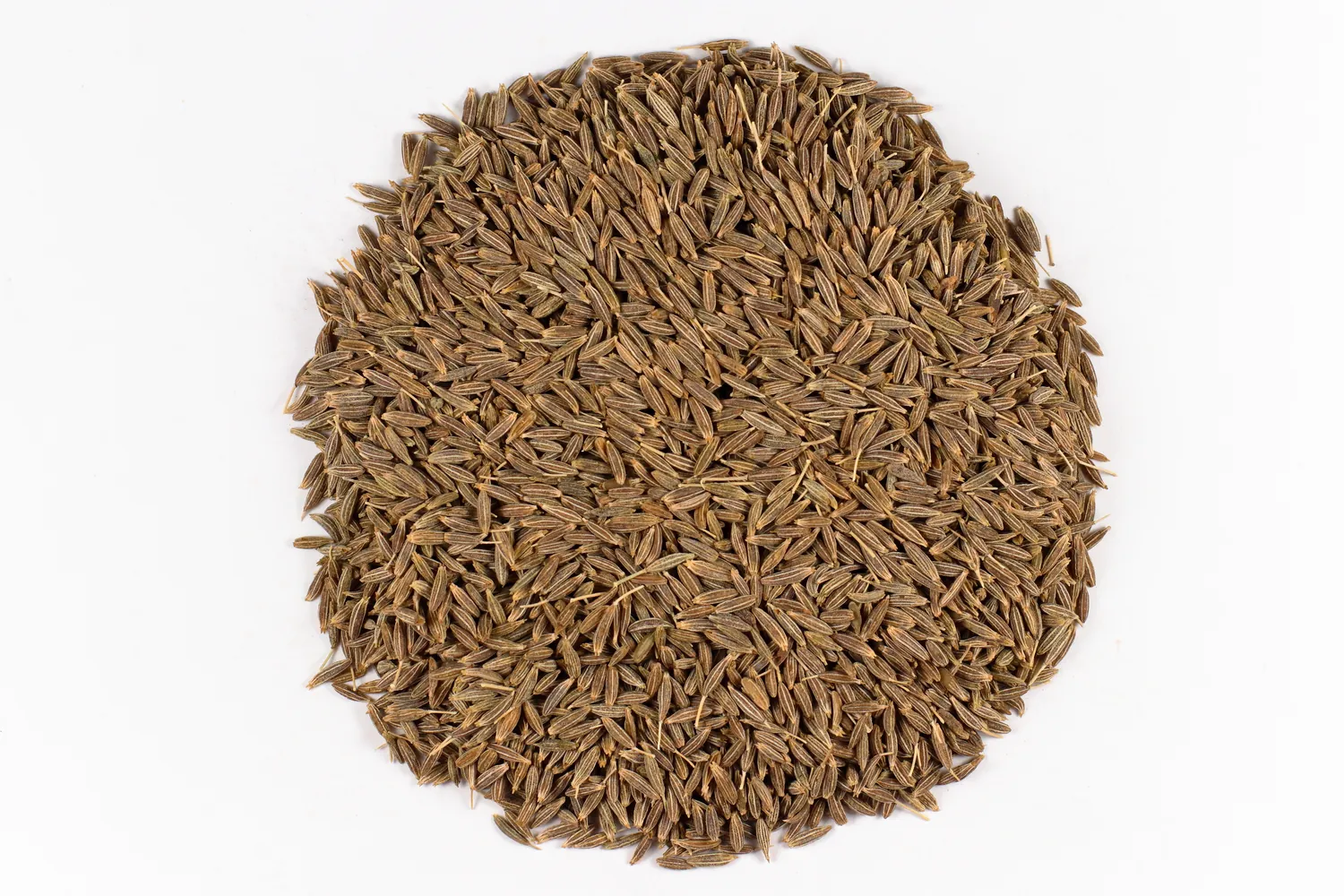
Among the 60 cumin and turmeric samples, our preliminary extraction identifies 55 detections of the 12 selected substances across 31 distinct sample identifiers. One sample can contain multiple residues. HSE reports 46 samples with residues at or below the MRL, three above the MRL and 11 with none of the residues sought. The extracted figures require reconciliation against the official data before they can be considered definitive.
| What was found | Value (mg/kg) | Tolerance | Where |
|---|---|---|---|
| Ground cumin, "UK origin" | profenofos 0.30 | MRL 5 | GB 2025 |
| Ground cumin, "UK origin" | imidacloprid 0.10 | MRL 0.05* | GB 2025 |
| Cumin, China | chlorpyrifos 0.10 | MRL 0.01* | GB 2025 |
| Ground cumin, "UK origin" | clothianidin 0.10 | MRL 1 | GB 2025 |
2025 spices with banned molecules, from the PRiF sheets: clothianidin 18, profenofos 18, thiamethoxam 6, chlorpyrifos 5, imidacloprid 5, carbendazim 3. Detections above the printed tolerance: 4 of 55 — all on 0.01*/0.05*-type lines.
Who pays the real price
04The European farmer is protected. The farmworker spraying in India is not
The real price of this trade is not paid at the shelf. It is paid in the greenhouses and fields of the countries where exports are legal. In 2024, EU companies notified ~122,000 tonnes of banned-pesticide exports in 2024 — 50% more than in 2018 (81,600 tonnes), in 75 molecules (versus 41), 58% of the weight to low- and middle-income countries, 71 countries — Brazil, Ukraine, Morocco, Malaysia and China among the top destinations.
A recent analysis of 2024 notifications (Unearthed / Public Eye, September 2025) shows the peaks: ~4,600 tonnes of neonicotinoids (main destinations: Ukraine, Russia, Brazil), 427 tonnes of chlorpyrifos, 8,500 tonnes of mancozeb (a reprotoxic fungicide, in 59 countries) — and BASF is the largest exporter, with 33,600 tonnes notified, three times its nearest competitor. Germany holds over 40% of the weight share.
France banned banned-pesticide exports in 2022, Belgium in 2026; an EU law that would stop manufacture-for-export was promised in 2020 but has never been proposed.
Your basket
05Pick what is in your basket — and see what the labs found
The figures below come from our preliminary extraction and require reconciliation with the HSE report. Pick a food:
· · of the 12 banned molecules:
Real examples from the report (2025):
What you can do
06What you can do without giving up vegetables
- Keep eating fruit, vegetables and spices. The health benefit of a plant-rich diet far outweighs the risk at these residue levels.
- Vary your shopping and your sources. The biggest problems are in spices (cumin, turmeric) and imported beans — alternate brands and types, wash well, remove the outer leaves of leafy vegetables.
- Organic where it matters to you. Of the 452 organic samples in 2025 (1,072 in 2023–2025), there was no detection of the banned molecules (in 2023 there was one, linuron, a single sample). Organic does not mean zero residues — it means zero for these molecules, in the British data.
- Ask for traceability. "UK origin" spices don't say where the seed came from. Ask at the till or write to the producer — or ask for labels with the raw material's country of origin.
- Support the export ban. France (2022) and Belgium (2026) are alone in this. A petition to the European Commission, a letter to your MEP, or pressure on labelling: all of them work — the EU promised the ban in 2020 and still hasn't proposed it.
- If you farm: the ban applies to you, not the exporter — you cannot win by banning molecules yourself; reporting and labelling are your only tools.
Method and sources
07Where the numbers come from — and what we don't know
What the page says: which foods and which molecules account for the 122 detections in 2025 of the 12 molecules banned on EU/GB farms; that the vast majority fall within import tolerances; that European exports of banned molecules are growing (~122,000 tonnes notified in 2024).
What it doesn't say: that these data establish individual risk, the origin of ingredients in samples coded UK, or a year-on-year trend. The individual extraction is still being reconciled with HSE's totals.
Sources
- Pesticide Residues in Food programme (PRiF), UK Health and Safety Executive / Defra — open data, public results under OGL v3.0; sample sheets (.ods): 2025 GB+NI annual (2023 GB; 2024 GB; rolling July/August 2026). Parser: the "BNA" sample-level sheets, rows with a Sample ID; residue columns; the "residues sought but not found" rows (in the SUM sheets) were excluded.
- The 12 molecules and their status: outdoor neonicotinoids banned in the EU since May 2018 — European Commission; chlorpyrifos — non-renewal confirmed in January 2020 — European Commission. The others (carbendazim, acephate, bifenthrin, profenofos, linuron, methomyl, dimethoate, omethoate) are not approved for agricultural use in the EU; Great Britain retained the EU rules (EU-derived retained law).
- Exports: Unearthed/Public Eye (Sep 2025), analysis of PIC notifications (ECHA) for 2024: ~122,000 tonnes, 75 molecules, 58% to low/middle-income countries, 71 countries; ~4,600 tonnes of neonicotinoids (Ukraine, Russia, Brazil); 427 tonnes of chlorpyrifos; >8,500 tonnes of mancozeb in 59 countries; BASF 33,600 tonnes; Germany >40% share. Notifications are company estimates, not confirmed exports.
- PIC Regulation (EU) 649/2012 — prior informed consent; Regulation (EC) 396/2005 — maximum residue limits, applied in the same form in Romania; Regulation (EC) 1107/2009 — authorisation of active substances.
- The case of Dina Ndleleni: Unearthed (Sep 2025) — South Africa, 2022; Dormex (cyanamide), banned in the EU since 2008.
Exact figures from the dataset (2025)
HSE reports 1,967 / 3,550 samples with residues (55.4%); our preliminary extraction found 1,924 and requires reconciliation. Detections in the preliminary extraction: 5,059 (GB: 4,052; NI: 1,007). Detections of the banned molecules: 122 — spices 55, beans 23, grapes 17, mango 10, rice 7, asparagus 3, barley 2, wine 2, plant chocolate 1, potatoes 1, tomatoes 1. Detections above the printed tolerance (including 0.01*): 13 — comparison with printed limits alone does not establish compliance after measurement uncertainty. Organic samples: 452 (0 with banned molecules). Total samples 2023–2025: 2,574 + 2,609 + 3,550 = 8,733; total detections 2023–2025: 3,644 + 3,027 + 5,059 = 11,730. In the July–August 2026 rolling reports (small sample): 93 samples, 14 detections of the banned molecules.