Newborn vision, rebuilt from measurements
The first face
To someone, you were once the first face. Turn on your camera and see yourself the way a newborn sees the person holding them, rebuilt from studies of what babies can see. Then scroll through their first three months and watch your face arrive.
The picture stays on this device. Nothing is recorded or sent.
The first days: about thirty centimetres
Days 1–3
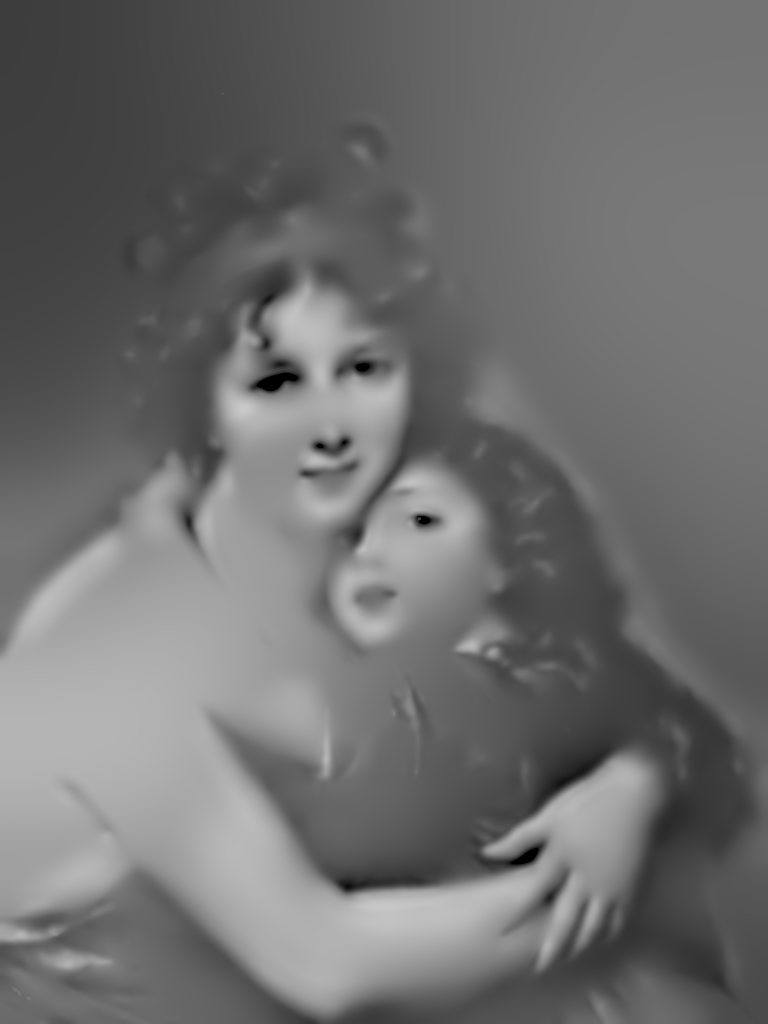
This is you, seen from the arms of someone a day or two old, about 30 cm away.
A newborn is not blind, and your face is there: a pale shape, dark eyes, the line of your hair. What is missing is contrast. In 2015 Angela Brown and colleagues in Ohio tested 119 babies under three days old with cards of grey stripes. On average, the light stripes had to be about three times as bright as the dark ones before the babies would fix on the card and follow it with their eyes.
At the size they see best, patches about 1 cm across, they did better: in a 2018 follow-up by the same group, the threshold fell to between 23% and 31%. Adults, measured with brain recordings, react to differences of about 0.3%.
Fine detail is gone altogether. At 30 cm, the smallest stripe a newborn picks out is about 2.7 mm wide. An eyebrow, yes. An eyelash, no.
Press and hold the picture to see it with your own eyes, then let go.
It is often said that newborns focus at exactly 20 to 30 cm. In 1965 Haynes, White and Held measured a median of 19 cm, and in 1980 Banks argued, from babies of one to three months, that vision this coarse loses almost nothing to blur from focus. A newborn is held back by the eye and brain behind the lens.
Not black and white
The popular picture
Books for new parents often say that babies see in black and white, and high-contrast black-and-white cards are sold on that promise. If it were true, this is what you would look like.
What the tests found
In 1994, Adams and colleagues showed 36 newborns a coloured patch on a grey background, changing its brightness so that only its colour could give it away. 74% of the babies could tell the red patch from the grey. For green it was 36%, for yellow 25%, for blue 14%.
Newborns are not colour-blind. They are colour-weak: in a later study of 180 newborns, a colour had to be 41% to 65% pure before they could tell it from white. Adults need less than 1%. So the world of the first days is nearly grey, with only strong colours, and red above all, breaking through. Large patches, that is: the mother's red headband in the painting is too narrow to make it.
Not everyone agrees on how early colour starts. A 1993 study recording brain responses found none to pure colour before 7 or 8 weeks; another, the same year, found them in babies as young as 2 weeks. The looking studies side with colour being there, faintly, from birth.
What the newborns needed
Look at what survives in the picture of the first days. The eyes and mouth fade; the outline stays. Dark hair against a pale face, the edge of the head against the light.
Within days, babies seem to know their mother. In 1995 Pascalis and colleagues in Marseille sat 34 newborns, on average 78 hours old, in front of two faces seen through windows in a screen: their mother and a woman they had never seen. A scent was sprayed in the room so that smell could not give her away. The babies looked at their mother about twice as long: 21.3 seconds against 10.7.
Then they covered the hair
In a second experiment, with 20 newborns, both women wore a pale scarf over their hair and the outline of their head. The preference vanished: 20.6 seconds for the mother, 19.4 for the stranger.
For these newborns, hiding the hairline and the outline of the head was enough to erase the preference for their mother's face. The first thing a baby learns of you may be the frame of your face.
The face arrives
One month
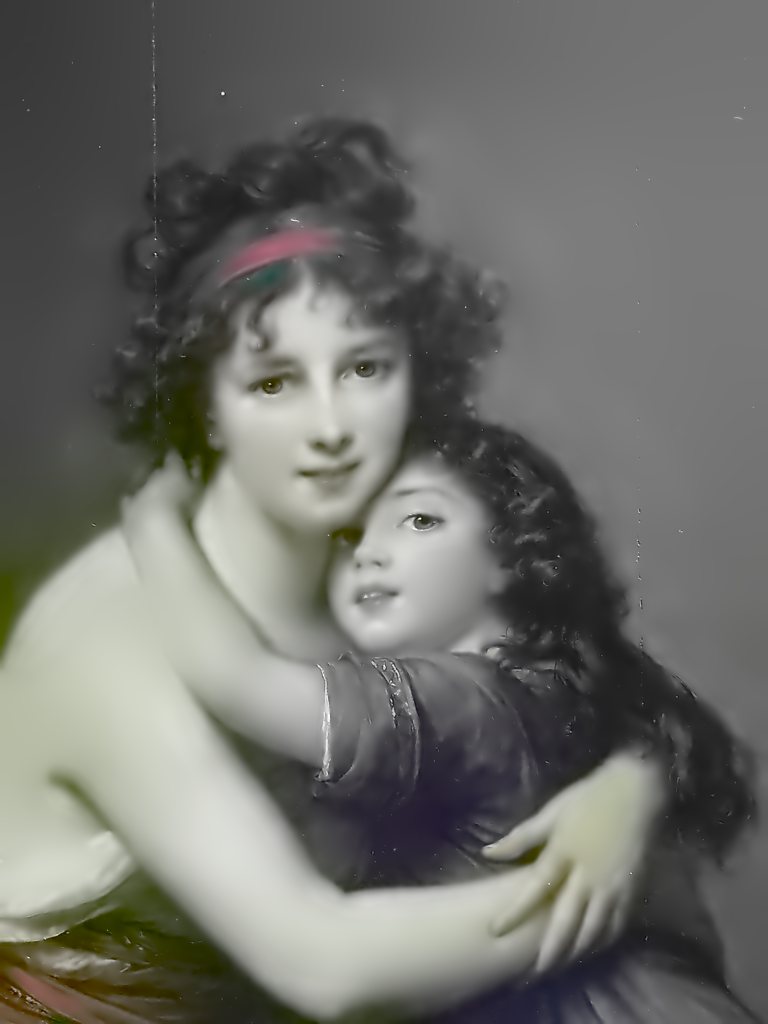
Banks and Salapatek measured curves at five sizes of stripe at one, two and three months, in 1978. At one month, the authors put the peak of the average curve at a contrast sensitivity of 9, more than twice the newborn value in Brown's tests, and the finest stripes they could see were 2.4 cycles per degree: at 30 cm, stripes about 1.1 mm wide. In this model, colour is still faint, and red still leads.
Babies of this age looking at a face still spend little time on it. In 1976 Maurer and Salapatek photographed the eyes of one-month-olds looking at faces, their mothers' among them: the babies fixed on small parts of the outline and looked away most of the time, from their mothers even more than from strangers.
Two months
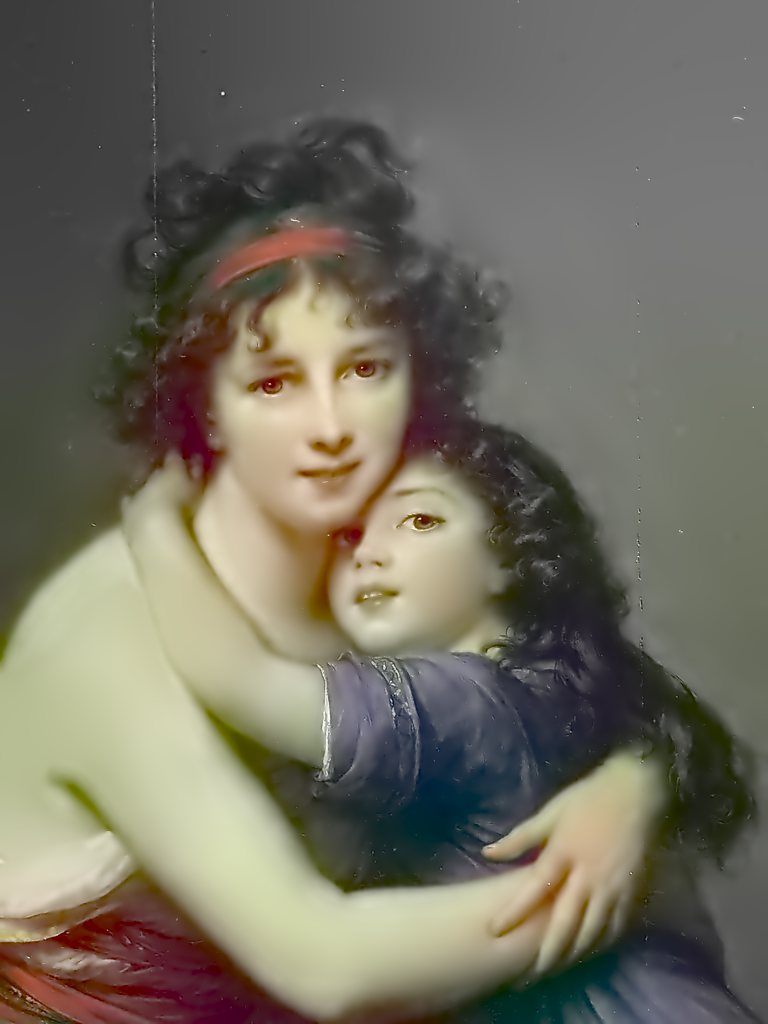
Something changes in the second month. The average curve now peaks at 12.5, and in Banks and Salapatek's tests babies now did worse with the very largest patterns than with middle-sized ones, as adults do.
The two-month-olds in Maurer and Salapatek's study looked at faces most of the time, and at the inner features more: above all, the eyes. A 1977 study found seven-week-olds looking at faces far more than babies a few weeks younger.
Blue against yellow arrives too. In 1985 Varner, Teller and colleagues found that most of the youngest one-month-olds failed a blue-yellow test that most two-month-olds passed.
Three months
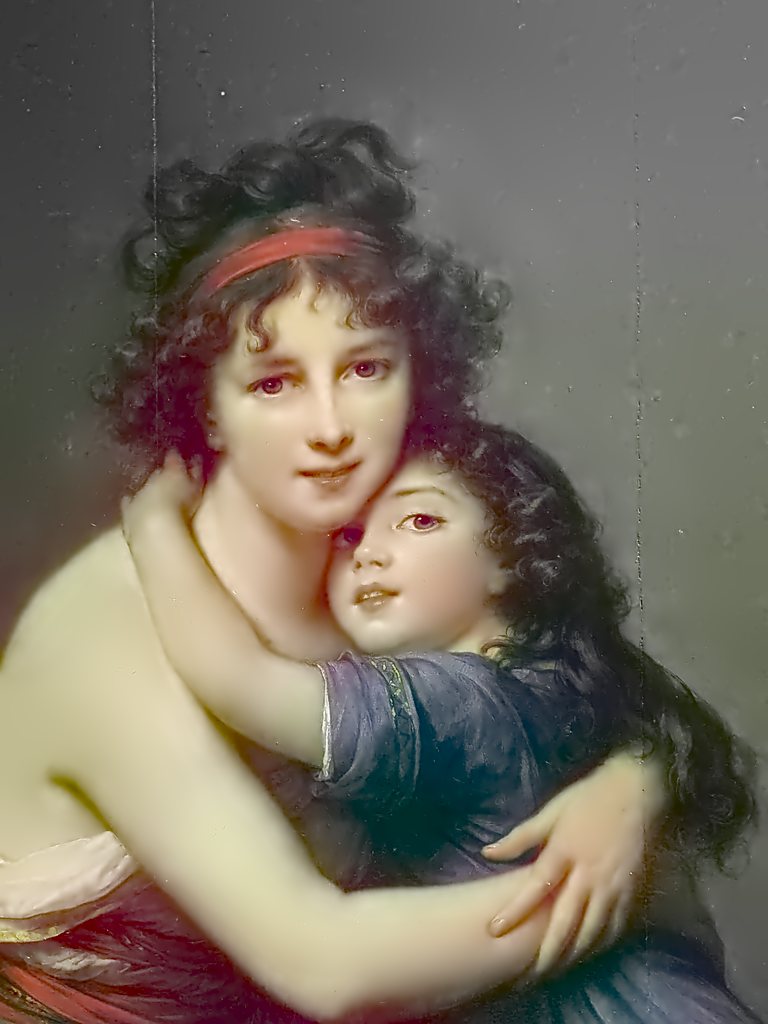
At three months, the average curve peaks at 15, about four times the newborn value in Brown's tests, and the limit is 4.0 cycles per degree: stripes of 0.65 mm at 30 cm, four times finer than at birth. Now more of the face resolves: eyes, mouth, the direction of your gaze.
Step back
Distance matters more than focus. Step away from the baby: your face shrinks in their view, but stays the same size here so you can compare.
When von Hofsten and colleagues filtered faces in a similar way in 2014, adults could still read the expressions at 30 cm. At 120 cm, across a small room, they did much worse. At newborn resolution, much more of a face survives up close than across a room.
The rest takes years
Your own eyes
This is the face as you see it. An adult resolves stripes of about 30 cycles per degree, some 30 times finer than a newborn.
The last part of the way is slow. At one year, studies of looking put acuity anywhere from 2.6 to 12 cycles per degree. Most studies find adult sharpness at around age six or seven, and contrast sensitivity keeps improving into the teens.
Someone held you this close
Everything on this page has been about the face you show a baby. But you were the baby once.
Someone held you about this close. You could not see their eyelashes or the colour of their eyes. You saw a pale shape, a dark line of hair, the edge of a head against the light, perhaps a red scarf. From that, within days, you may already have known them.
The picture stays on this device. Nothing is recorded or sent.
The first face you knew may have begun as an outline. You have been filling in the rest ever since.
How this is made
What the picture does. The image is split into bands of detail, from the coarsest shading to the finest lines, the way the visual system is thought to split it. In each band and at each point, the page measures the local contrast and compares it with the smallest contrast a baby of that age has been shown to detect at that size. What falls below the threshold is removed; what rises above it stays. Brightness and the two colour channels of the eye (red against green, blue against yellow) are handled separately. The method follows Peli's 1990 account of contrast in complex images; in 2014 von Hofsten and colleagues used a newborn version of this kind of filter to show adults what newborns might see.
What is measured. For the first days, Angela Brown and colleagues measured contrast sensitivity at selected sizes of stripe, and acuity, in newborns, then fitted candidate curve shapes; a band-pass curve fitted best, peaking at about 0.23 cycles per degree, where the babies needed about 23% to 31% contrast to notice a pattern. They stopped seeing stripes finer than 0.78 to 1.2 cycles per degree. The newborn curve on this page is built from those measured thresholds and that fitted shape. For 1, 2 and 3 months, Banks and Salapatek measured curves in 1978, at five sizes of stripe from 0.15 to 2 cycles per degree, with 200 to 300 trials per baby. They describe the average curves as peaking at sensitivities of 9, 12.5 and 15, with the finest stripes at 2.4, 2.8 and 4.0 cycles per degree. The curves on this page follow the plotted points of those average curves; our reading of the one-month points peaks nearer 8 than the 9 the authors give. The colour thresholds come from Adams and Courage's newborn tests with coloured lights.
What is assumed. The two studies are different experiments: Brown's babies were a few days old and looked at cards in bright light; Banks and Salapatek's were older and looked at a screen about a fifth as bright. The page joins them as they are, and between the measured ages it moves gradually from one curve to the next. Above 2 cycles per degree, the finest stripes they tested, each curve runs straight down to the limit the authors reported. Colour thresholds are assumed to improve at the same rate as sensitivity to light and dark (a 1993 study found the ratio between the two already adult-like at 2 to 8 weeks), with blue against yellow catching up with red against green by two months. The coloured lights in the newborn tests are approximated by screen colours.
What the baby is looking at. Every picture assumes a face about 14 cm wide, 30 cm away, filling about 26 degrees of view. For the camera and for your own photos, the scale holds when your face fills the oval, about half the width of the picture; the painting was measured. If you change the distance, the page recalculates the angle; it does not shrink the image, so you can compare.
Which kind of measurement. Infant vision is measured in two ways, by watching where babies look and by recording their brains through electrodes on the scalp. The brain recordings give newborn limits about four to five times finer. This page uses the looking studies throughout, because they measure what the baby acts on. By the brain measure, the pictures would be sharper.
What this shows, and what it does not. A filter that matches the measured points and the fitted and interpolated curves described above shows that the picture was built faithfully from them, within the two experiments' different conditions. It does not show that a baby's experience looks like this: no one can see through a baby's eyes, and the thresholds are averages from many babies, each one different.
The sister piece does the same for hearing: the first voice you ever heard, rebuilt from recordings made inside the womb.
Sources
- Brown, Lindsey, Cammenga, Giannone & Stenger (2015). The contrast sensitivity of the newborn human infant. Investigative Ophthalmology & Visual Science 56:625. pmc.ncbi.nlm.nih.gov/articles/PMC4309312/
- Brown, Opoku & Stenger (2018). Neonatal contrast sensitivity and visual acuity: basic psychophysics. Translational Vision Science & Technology 7(3):18. pmc.ncbi.nlm.nih.gov/articles/PMC6016435/
- Banks & Salapatek (1978). Acuity and contrast sensitivity in 1-, 2-, and 3-month-old human infants. Investigative Ophthalmology & Visual Science 17:361 (Fig. 1 read from the author-uploaded copy). researchgate.net/publication/22501090_Acuity_and_contrast_sensit
- Norcia, Tyler & Hamer (1990). Development of contrast sensitivity in the human infant. Vision Research 30:1475 (abstract). pubmed.ncbi.nlm.nih.gov/2247957/
- Leat, Yadav & Irving (2009). Development of visual acuity and contrast sensitivity in children. Journal of Optometry 2:19 (review). pmc.ncbi.nlm.nih.gov/articles/PMC3972638/
- Adams, Courage & Mercer (1994). Systematic measurement of human neonatal color vision. Vision Research 34:1691 (abstract). pubmed.ncbi.nlm.nih.gov/7941376/
- Adams & Courage (1998). Human newborn color vision: measurement with chromatic stimuli varying in excitation purity. Journal of Experimental Child Psychology 68:22 (abstract). pubmed.ncbi.nlm.nih.gov/9473313/
- Varner, Cook, Schneck, McDonald & Teller (1985). Tritan discriminations by 1- and 2-month-old human infants. Vision Research 25:821 (abstract). pubmed.ncbi.nlm.nih.gov/4024480/
- Allen, Banks & Norcia (1993). Does chromatic sensitivity develop more slowly than luminance sensitivity? Vision Research 33:2553 (abstract). pubmed.ncbi.nlm.nih.gov/8249334/
- Morrone, Burr & Fiorentini (1993). Development of infant contrast sensitivity to chromatic stimuli. Vision Research 33:2535 (abstract). pubmed.ncbi.nlm.nih.gov/8249333/
- Pascalis, de Schonen, Morton, Deruelle & Fabre-Grenet (1995). Mother's face recognition by neonates: a replication and an extension. Infant Behavior and Development 18:79. doi.org/10.1016/0163-6383(95)90009-8
- Bushnell, Sai & Mullin (1989). Neonatal recognition of the mother's face. British Journal of Developmental Psychology 7:3 (abstract). doi.org/10.1111/j.2044-835X.1989.tb00784.x
- Maurer & Salapatek (1976). Developmental changes in the scanning of faces by young infants. Child Development 47:523 (abstract). pubmed.ncbi.nlm.nih.gov/1269319/
- Haith, Bergman & Moore (1977). Eye contact and face scanning in early infancy. Science 198:853 (abstract). pubmed.ncbi.nlm.nih.gov/918670/
- Haynes, White & Held (1965). Visual accommodation in human infants. Science 148:528 (abstract). pubmed.ncbi.nlm.nih.gov/14263778/
- Banks (1980). The development of visual accommodation during early infancy. Child Development 51:646 (abstract). pubmed.ncbi.nlm.nih.gov/7418504/
- von Hofsten, von Hofsten, Sulutvedt, Laeng, Brennen & Magnussen (2014). Simulating newborn face perception. Journal of Vision 14(13):16 (abstract). pubmed.ncbi.nlm.nih.gov/25406161/
- Peli (1990). Contrast in complex images. Journal of the Optical Society of America A 7:2032. pelilab.partners.org/papers/Contrast%20in%20Complex%201990.pdf
- Viénot, Brettel & Mollon (1999). Digital video colourmaps for checking the legibility of displays by dichromats. Color Research & Application 24:243 (the RGB-to-cone conversion). doi.org/10.1002/(SICI)1520-6378(199908)24:4%3C243::AID-COL5%3E3.
- Élisabeth Vigée Le Brun, Madame Vigée-Le Brun et sa fille, Jeanne-Lucie-Louise, dite Julie (1786), Musée du Louvre INV 3068. Photograph: Shonagon, Wikimedia Commons, public domain. commons.wikimedia.org/wiki/File:Madame_Vig%C3%A9e-Le_Brun_et_sa_
