1,397 metres down, off California
Fifty-three months
In May 2007, at the bottom of a canyon off California, an octopus laid her eggs on a rock and wrapped herself around them. Scientists with a remote-controlled submarine kept coming back. On every visit for four and a half years, she was still there.
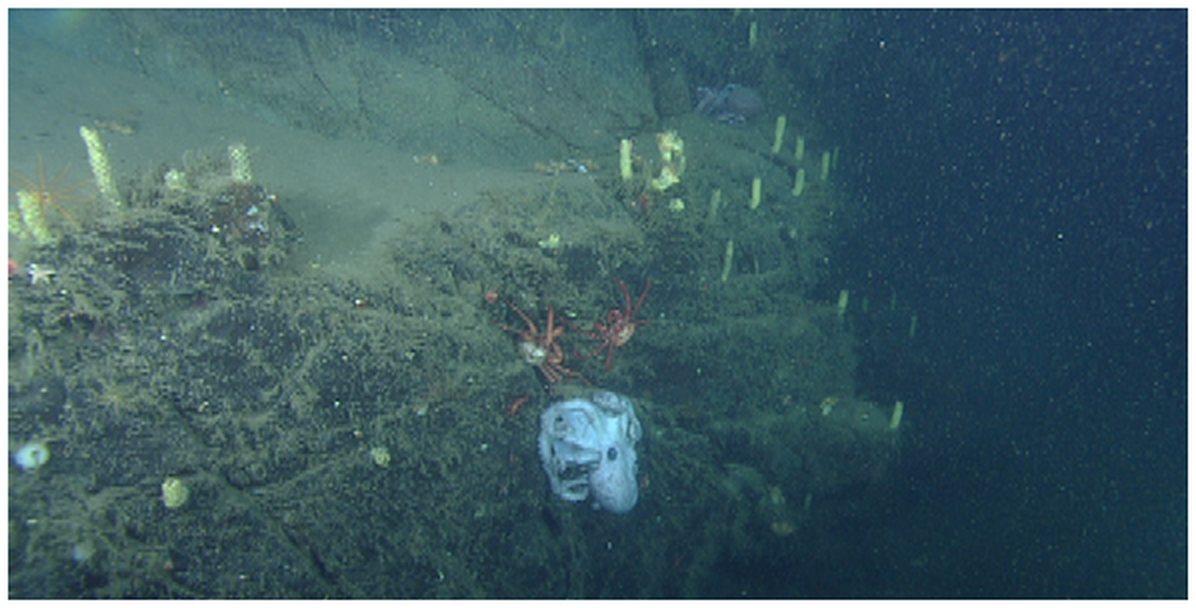
The rock
The rock is an isolated outcrop in Monterey Submarine Canyon, 1,397 metres below the surface. No sunlight reaches it, and the water stays between 2.8 and 3.4 °C all year.
In April 2007 a team from the Monterey Bay Aquarium Research Institute, diving with a robot submarine, filmed an octopus of the species Graneledone boreopacifica crossing the mud towards it. When they came back 38 days later, she was on the rock, covering a clutch of eggs.
Fifty-three months, month by month
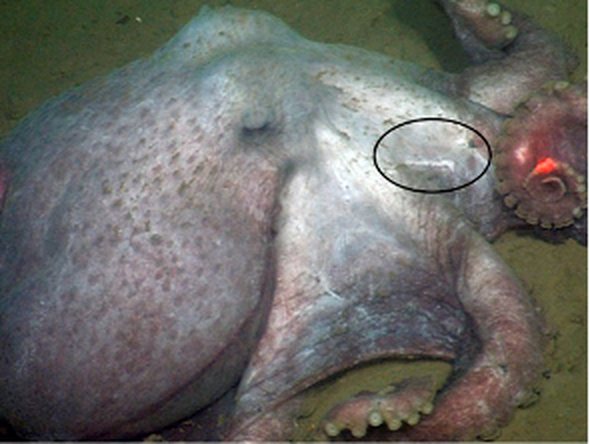
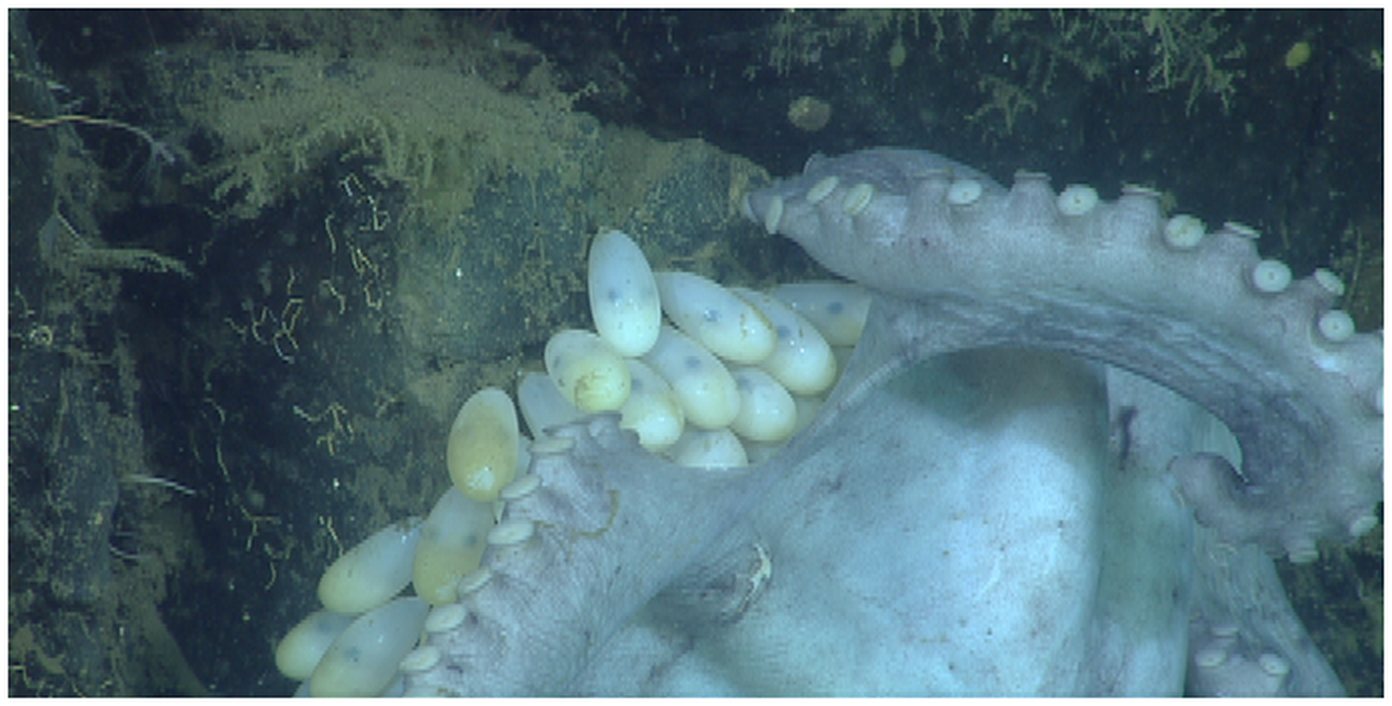
Drag along the calendar, or press play. The egg is drawn to scale from the five times the team measured it; the photograph is the latest taken by that month. Between visits nobody saw her: the line between measurements is a straight line, not a record. The circles and arrows on the photographs are the paper's own: they mark the scars by which she was recognised.
She did not leave
After finding her, the team returned to the site 18 times. They recognised her each time by scars on two of her arms and in the web between them. Each time she was in the same place, in the same position, guarding the eggs.
They never saw her eat. She pushed away crabs and shrimp that came close, and when the robot offered her a piece of crab, she ignored it. Over the years her skin went slack and pale, her body shrank and her eyes clouded over. The team saw her on only a small fraction of the days, so they can only say she was never seen to feed.
The longest known
Most shallow-water octopuses guard their eggs for one to three months. The longest the authors could find before was 14 months, in a deep-sea species kept in a laboratory at 7 °C. Nothing else known, octopus or any other animal, broods its eggs for anything like 53 months.
Cold slows the growth of an embryo, and this water is close to freezing. The young that come out are large and fully formed, small copies of the adult that can hunt straight away. But even a model built on temperature fell 307 days short of 53 months, so the cold does not explain all of it.
How long octopuses guard their eggs
October 2011
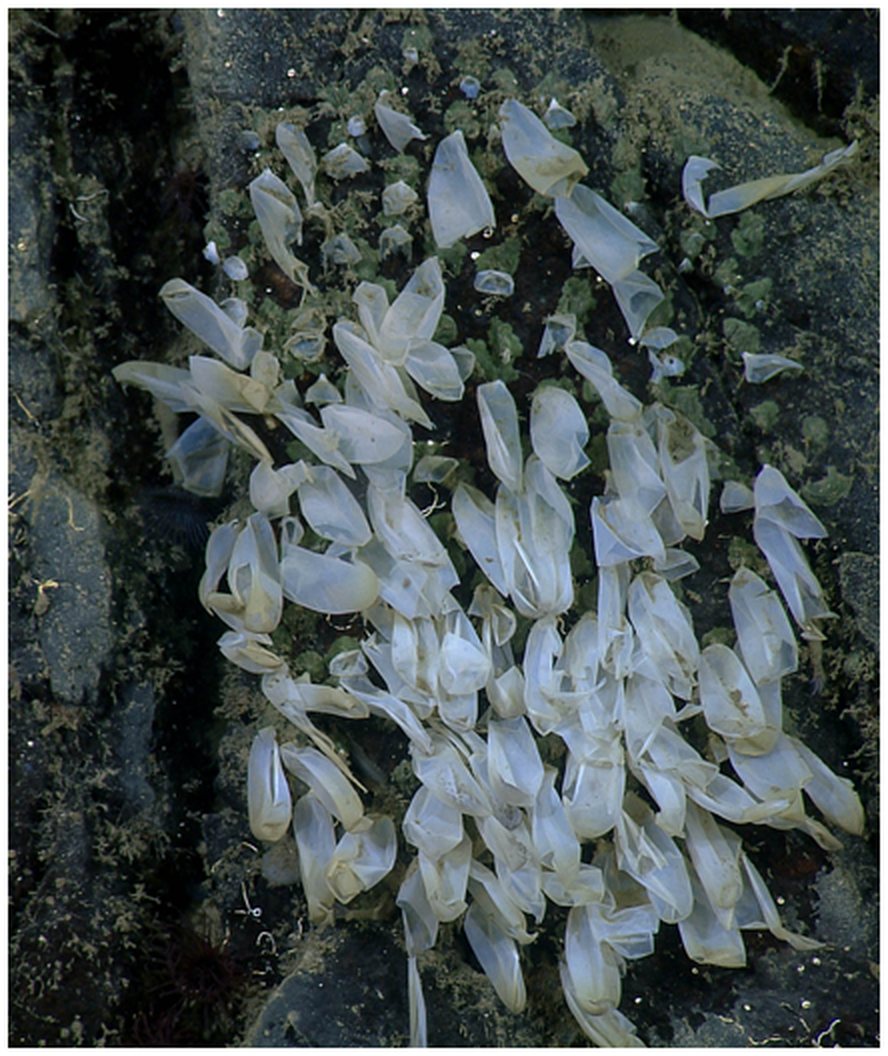
In September 2011 she was still there, and the eggs were about 3.3 centimetres long. When the team returned in October, she was gone. On the rock were the torn, empty capsules. Counting them and the marks where they had been glued, the team estimated the clutch at 155 to 165 eggs.
Octopuses like her breed once and die. Nobody saw the eggs hatch, or what happened to her.
In 2023, scientists described a different kind of nursery deep off California, where many octopuses of another species brood on rocks warmed by hydrothermal springs. In that warmer water, about 5 to 11 °C, brooding takes about 22 months.
Sources
Everything about this octopus comes from one paper by the team that watched her. The egg drawing is to scale but simplified.
- B. Robison, B. Seibel and J. Drazen, Deep-sea octopus (Graneledone boreopacifica) conducts the longest-known egg-brooding period of any animal, PLoS ONE 9(7): e103437 (2014). Every date, measurement and observation on this page; photographs from its figures 1, 2, 4 and 5, © 2014 Robison et al., CC BY 4.0, taken by the Monterey Bay Aquarium Research Institute (MBARI) with a remotely operated vehicle, cropped here.
- J. P. Barry et al., Abyssal hydrothermal springs: cryptic incubators for brooding octopus, Science Advances 9, eadg3247 (2023): Muusoctopus robustus at the Octopus Garden, about 1.8 years.