mariuscomper.uk RO

The Tisza · an evening in June

The Tisza blooms

On 3 to 5 evenings a year, Europe’s largest mayfly rises from this river, mates and dies before dark. Each one spent 3 years in the bank to get here.

Below the water line

A wall full of holes

Under the surface, the clay banks of the Tisza are pierced with small round holes. On the Danube, where the same insect used to live, the holes were 6 to 8 millimetres wide, and a biologist once counted 6,700 of them in a single square metre.

Inside

Two tubes and a bend

Each pair of holes is one home: two level tubes about 17 centimetres long, joined at the back by a bend. A larva lives inside. It draws the river through and sieves out its food, which is nine-tenths fine debris.

Three winters

Three years of this

It stays for 3 years. That figure comes from the sizes of the larvae found together in one bank, small, middling and large; nobody has followed a single one from egg to wing.

By an old estimate it sheds its skin some 20 times on the way. The largest larvae are about six centimetres long.

Spring

Waiting for low, warm water

The larva leaves only when the river has dropped and the water is warmer than 18 degrees. On the Tisza that comes in June or July.

About five in the afternoon

All at once

Then, on 3 to 5 evenings in the whole year, the bank empties. On the middle Tisza in 2005 the first males were in the air at about 17:00.

The hour changes from one stretch of river to the next and from year to year. Further upstream it has been close to sunset.

At the surface

One more skin

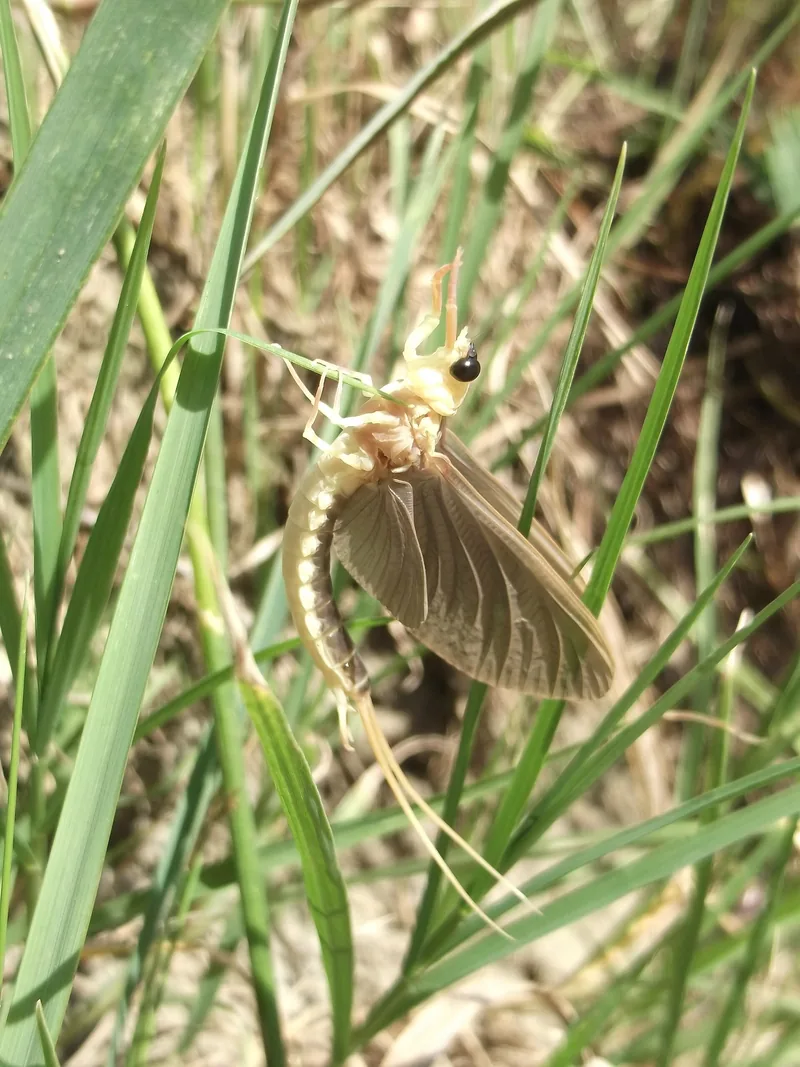
At the surface the larva’s skin splits, and a winged insect climbs out and flies. A male is not finished yet. He flies to the bank, settles there or on the plants and sheds one more skin, wings and all, in up to 5 minutes.

The females come up 20 to 40 minutes after the males and keep the skin they have.

About six

The river in flower

The males go back out and fly 5 to 50 centimetres above the water, their tails brushing it, after anything pale. When a female comes up, as many as 20 of them crowd onto her. Each knot of wings looks like a flower opening on the water, and that is its Hungarian name: tiszavirág, the Tisza flower.

Mating takes up to 10 seconds. In a dense flight on the Danube there were more than 120 insects in each cubic metre of air.

About half past six

Upstream, against the drift

A mated female does not lay where she is. More than 90 per cent of them turn upstream and fly as far as 4 kilometres, 5 to 15 metres above the middle of the river, together, with no males among them.

The eggs will be carried downstream as they sink. The flight makes up for it.

On the water

Eight thousand eggs

Then she drops onto the water and releases 8,000 to 9,000 eggs, each a disc about a third of a millimetre across. Where the bed is 7.5 metres down they take about 19 minutes to reach it, and the current carries them some 1,350 metres on the way.

By eight

Over before dark

None of them eats as an adult. A mayfly that has mated lives no more than about 2 hours. That evening in 2005, by about 20:00 there was not one left in the air.

The bodies and the cast skins go down the river.

39 days later

Back into the bank

On the bed the eggs take 39 days to hatch at 20 degrees. What comes out is 1.2 millimetres long, and it starts to dig.

The Tisza

Where it still happens

The Tisza runs 966 kilometres from the Ukrainian Carpathians, along the edge of Romania and through Hungary, to the Danube in Serbia. It is the river the insect is named for. Smaller populations are known from the Mureș in Romania, the Rába, the Prut, and the lower Danube and its delta.

In Hungary it is protected, and the law puts a value of 10,000 forints on each one.

Europe

Two per cent of where it was

It used to rise from the lowland rivers of western Europe too. A Dutch author wrote about it in 1634; it lived on the Rhine, the Meuse and their branches. It disappeared from western Europe between 1901 and 1927, and nobody saw it fly on the Bulgarian Danube after 1974. It survives on about 2 per cent of its former range.

There is a little movement the other way. It was found again on the Rába in 1999, and on the Hungarian Danube in June 2015.

North America

A hatch that shows on weather radar

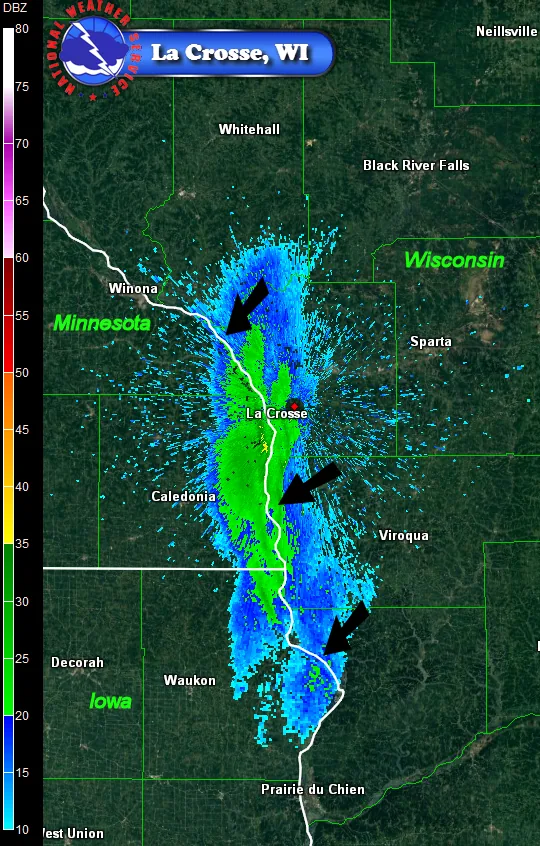
Its relatives across the Atlantic, burrowing mayflies of the genus Hexagenia, rise from the Mississippi and the Great Lakes thickly enough to show on weather radar like rain. From radar records, up to 87.9 billion have been estimated leaving Lake Erie in a single night.

The same records show them thinning: by 52 per cent on the Upper Mississippi between 2012 and 2019, and by 84 per cent on Lake Erie between 2015 and 2019.

Tonight

They are down there now

Whenever you read this, three years’ worth of larvae are in the banks of the Tisza, sieving the river in the dark. One of those years has its evening next summer.

Pass it on

If you know someone who has stood on the bank of the Tisza in June, send them the page.

The real thing

The scene above is drawn. These are photographs, and one radar image.

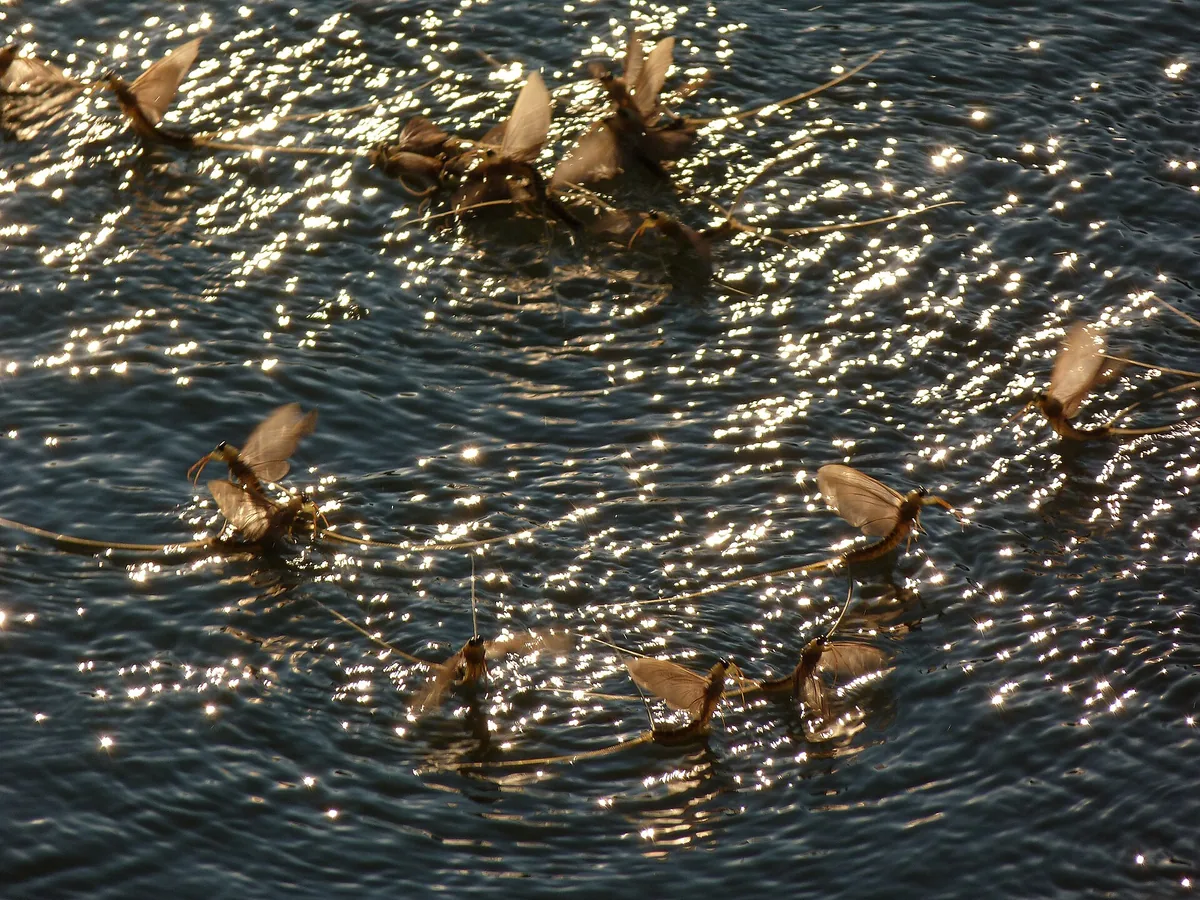
Brown-winged mayflies clustered on glittering water, long tails trailing behind them.
Mayflies on the Tisza at Tiszainoka, Hungary, 13 June 2011. Photo: Derzsi Elekes Andor, CC BY-SA 3.0, via Wikimedia Commons.
A pale yellow mayfly with grey-brown wings and two long tails, clinging to a blade of grass.
A male on the bank. Photo: Mirjana Rankov, CC BY 2.0, via Wikimedia Commons.
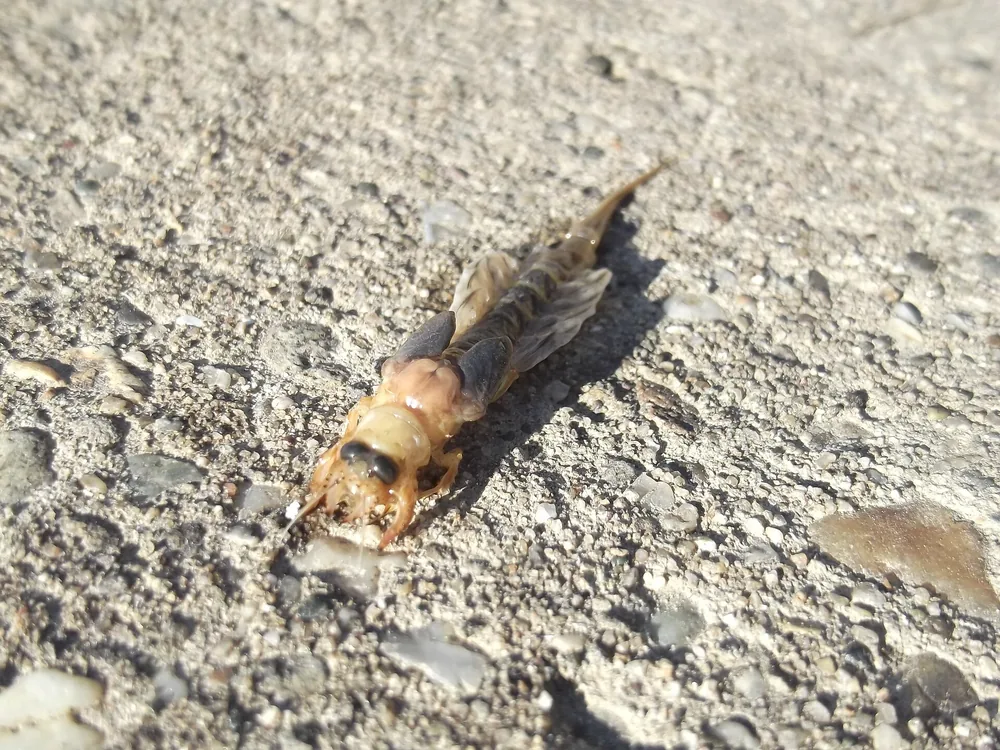
A yellowish larva with dark wing pads and feathery gills along its sides, lying on sand.
A full-grown larva out of its burrow. Photo: Mirjana Rankov, CC BY 2.0, via Wikimedia Commons.
A weather radar map centred on La Crosse, Wisconsin, with a long green and blue echo lying along the Mississippi River.
Mayflies rising from the Mississippi, as seen by the weather radar at La Crosse, Wisconsin, on a July evening in 2014. Image: US National Weather Service, public domain.

Sources and notes

What is measured and what is drawn. The river, the bank and the insects are drawings. The mayflies over the water are drawn about three times larger than they would look from that distance, so that they can be seen at all; their number on screen is not a count. The radar screen is a drawing too; the real one is below. On the maps, a river is gold if the sources name it as having the insect today, and that says nothing about which stretches.

Numbers from other rivers. The holes per square metre, their width and the density of a flight were measured on the Bulgarian Danube before the insect vanished there. The sinking of the eggs was worked out for a bed 7.5 metres deep. The hours are from one evening on the middle Tisza; other evenings and other stretches differ by an hour or two.

How firm it is. Three years in the bank is what every source says, and it rests on size classes of larvae, not on individuals followed through. The egg count is one author’s (8,000 to 9,000); an older estimate was 7,000. Adult life is given as no more than two hours after mating, and up to 13 hours for males that never mate. The Danube appears on both lists: the last flights on its Bulgarian stretch were seen by 1974, while larvae have been found in its lowest reaches since 2012 and adults in Hungary in 2015.

  1. Landolt, P., Sartori, M., Elpers, C. & Tomka, I. (1995). “Biological studies of Palingenia longicauda (Olivier) (Ephemeroptera: Palingeniidae) in one of its last European refuges: feeding habits, ethological observations and egg structure.” In Current Directions in Research on Ephemeroptera, 273–281. The burrow, feeding, the moult on the bank, the females’ delay, the “flower”, mating, water temperature.
  2. Landolt, P., Sartori, M. & Studemann, D. (1997). “Palingenia longicauda (Ephemeroptera, Palingeniidae): from mating to the larvulae stage.” In Ephemeroptera & Plecoptera: Biology–Ecology–Systematics, 15–20. The flight upstream, how the eggs sink, hatching, the first larva.
  3. Russev, B. K. (1987). “Ecology, life history and distribution of Palingenia longicauda (Olivier) (Ephemeroptera).” Tijdschrift voor Entomologie 130, 109–127. Holes per square metre and their width, larval sizes, eggs per female, adult life, density of a flight, the history of the range.
  4. Kriska, G., Bernáth, B. & Horváth, G. (2007). “Positive polarotaxis in a mayfly that never leaves the water surface.” Naturwissenschaften 94, 148–154. The hours of one evening on the middle Tisza in 2005.
  5. Málnás, K. et al. (2011). “Bridges as optical barriers and population disruptors for the mayfly Palingenia longicauda.” Journal of Insect Conservation 15, 823–832. Three years in the bank, three to five evenings, flight heights, adults do not feed.
  6. Bálint, M. et al. (2012). “Species history masks the effects of human-induced range loss – unexpected genetic diversity in the endangered giant mayfly Palingenia longicauda.” PLoS ONE 7, e31872. Two per cent of the former range.
  7. Dénes, A.-L. et al. (2021). Preprint on the present distribution and genetics of the species, bioRxiv. Body size; Mureș, Prut and Danube Delta populations. Pavel, A. B. et al. (2019), Geo-Eco-Marina 25: larvae in the lower Danube, 2012–2015. Málnás, K. et al. (2016), Folia Historico-Naturalia Musei Matraensis 40, 21–25: the Hungarian Danube, June 2015. Kovács, T. & Ambrus, A. (2001), Folia Historico-Naturalia Musei Matraensis 25, 145–162: the Rába.
  8. Stepanian, P. M. et al. (2020). “Declines in an abundant aquatic insect, the burrowing mayfly, across major North American waterways.” PNAS 117, 2987–2992. US National Weather Service, La Crosse: “Tracking Mayflies”.
  9. The Tisza’s length: International Commission for the Protection of the Danube River, Tisza Basin page (archived copy). The Hungarian protection value: decree 13/2001 (V. 9.) KöM. Rivers and coastlines on the maps: Natural Earth, public domain.