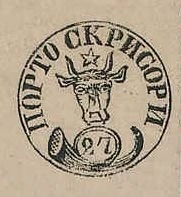
27 parale
Copies printed · 6,016
 Projects
Iași · 1858
An archival reproduction shows two 27-parale Bull’s Head stamps still joined. One head is upside down. The middle of the sheet explains how the pair came to be.
Open the sheet ↘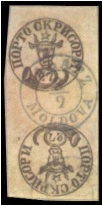
A piece of the sheet
Look at the two bull’s heads in the opening image. They are on the same piece of paper. The 27-parale pair is a clue to where two rows printed in opposite directions met.
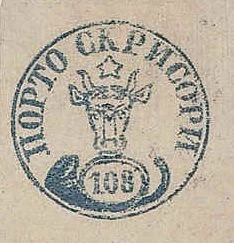
See the centre of the sheetMoldavia issued four Bull’s Head stamps in 1858. Each shows the head, star and post horn. The value appears inside the curve of the horn.
Copies printed · 6,016
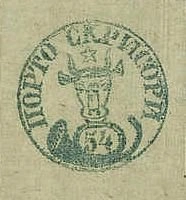
Copies printed · 10,016
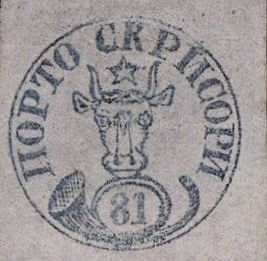
Copies printed · 2,016
Copies printed · 6,016
Iași, 1858
The bull’s head, star and post horn appear on all four 1858 denominations. Compare the stamps and look for the number inside the horn’s loop. Every stamp on a model sheet has the same value.
Load an 81-parale sheet81 parale
The Romanian Academy Library records 2,016 printed and 709 sold. Those numbers are part of the postal record. The pair in the opening image has a different value, 27 parale. Fritz Heimbüchler’s study records it as missing after 1950.
The Iași stamp workshop printed sheets of four rows of eight. At the centre, the two rows faced opposite ways. Collectors call these pairs tête-bêche.
Eight pairs
Choose a column near the middle. Bring the two halves together and the pair in that column meets head-to-head. The same arrangement repeats eight times across the sheet. The model reconstructs the row orientation and spacing.
Separate the rowsThe model sheet illustrates the eight pairs at the centre. The historical reproduction shows one 27-parale pair.
Separate a sheet in the model, then look again at the reproduction of the 27-parale pair. Two stamps still joined preserve a detail you would lose if each stamp were on its own.
Reproductions show the known 27-parale pair. Fritz Heimbüchler’s study records it as missing after 1950.