Ischaemic stroke · a teaching replay on real data
Time is brain: a real stroke on MRI, and the drive to thrombectomy in Romania
These are the scans of a person admitted with a blocked middle cerebral artery. Paint on the slices the area you think is already lost. Then decide, and see what the follow-up MRI showed once the injury had settled.
112Stroke signs right now? In Romania call 112; elsewhere, your emergency number. The signs and what to tell the dispatcher ↓
- 1Paint
- 2Decide
- 3What followed
Hold and drag over the area you think is already lost. Right-click or Shift-drag erases. Change the slice with the slider, the arrow keys or the strip under the image.
What do you do?
#Twelve brains, the same question
The cases come from a public research dataset: people treated at the university hospitals of Bern and Freiburg between 2005 and 2015, all with a blockage of the middle cerebral artery and all with an attempt to reopen it from inside the vessel (intra-arterial thrombolysis before 2010, mechanical thrombectomy from 2010 on). For 12 of them the dataset gives the admission scan, the final injury traced by a neuroradiologist, and how fully the artery reopened.
On the perfusion MRI, the area where blood arrives more than 6 seconds late (Tmax > 6 s) marks tissue in trouble. In the 10 people with a usable perfusion map and a fully reopened artery, the median ratio of final scar to that area was 9%. Taken separately, the scars had a median of 15 ml and the areas 216 ml. In 5 of them it stayed under 7%. In one it reached 54%.
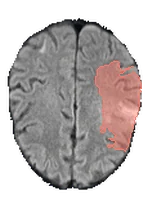 Case 188 ml · TICI 0
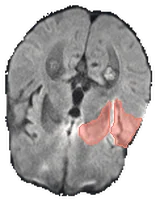 Case 232 ml · TICI 3
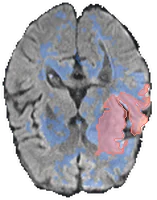 Case 364 / 312 ml
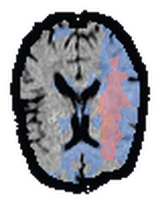 Case 427 / 248 ml
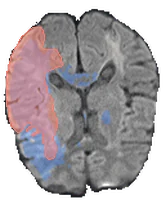 Case 5161 / 296 ml
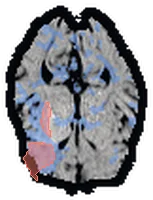 Case 620 / 300 ml
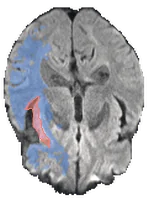 Case 76.2 / 212 ml
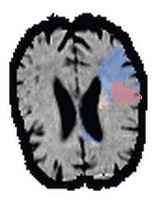 Case 810 / 60 ml
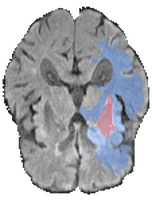 Case 94.7 / 204 ml
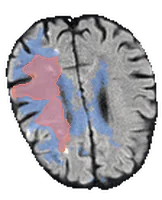 Case 1054 / 220 ml
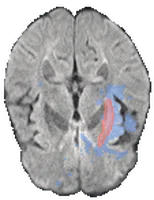 Case 116.4 / 107 ml
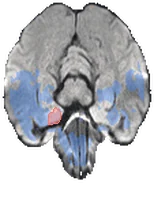 Case 121.2 / 193 ml
Each brain on the slice with the largest final injury. Blue: Tmax > 6 s on admission. Red outline: the final scar. Click a brain to open it above. Cases 4, 6 and 8 have no aligned diffusion image: they show the ADC map with tones inverted, where the fluid in the brain appears black.
The figure depends on how the perfusion map is cleaned: with a gentler clean-up the median is 7.4%. Ten people are not a study, and without an untreated group there is no way to say how much of the gap the procedure made. It does show why doctors look at both images: the area where blood arrives too late can be far larger than the scar left at the end.
Only one patient in the dataset kept a closed artery (TICI 0). Their scar reached 88 ml. Their perfusion map is not aligned with the injury image, so it is not used. It is an example of failed reperfusion, not of an untreated patient, and a single case proves nothing.
#How far thrombectomy is
Thrombectomy is done only in hospitals with an angiography suite, interventional neuroradiologists and a team. Romania's Health Ministry Order 450/2015 names 13 hospitals; the "Prof. Dr. Nicolae Oblu" hospital in Iași, in the north-east, also performs it under a different list. The map shows the drive by car, without traffic, from every inhabited area to the nearest of the 14.
42% of people live within an hour's drive, 79% within two. For half of Romanians the drive takes over 1 h 14 min. Galați, a Danube port city of more than 200,000 people, is over three hours from the nearest centre.
Type a locality or click the map.
Loading the map…
on the Order 450/2015 listIași (another list)round-the-clock cover announced in the pressfaded areas: uninhabited
Thrombectomy is usually done within 6 hours of onset, or of the last time the person was seen well; the DAWN (6–24 hours) and DEFUSE 3 (6–16 hours) trials showed benefit later too, in patients selected by imaging. The bars under the place name show only the drive; the call, the ambulance arriving, the CT scan and getting the room ready come out of the same hours. Who can be treated is for doctors to decide; where a person is taken, in Romania, is for the 112 dispatch centre.
#Who does thrombectomy at night
No official list says which hospitals perform thrombectomy at any hour. In Romania's national strategy against cardiovascular and cerebrovascular disease, approved in July 2025 (Government Decision 582/2025), the Health Ministry writes that "more than 50% of the centres in the AP AVC-ac programme do not carry out sustained endovascular activity" and calls for "the budgetary and legal framework" to organise on-call-from-home rotas for the doctors who perform thrombectomy.
In 2026 two hospitals announced round-the-clock stroke cover in the local press: Sibiu (May) and Suceava (September). If only they were open at night, 5.8% of Romanians would be within an hour's drive. For the other 12 hospitals, the night schedule is not published.
In 2024 Romania performed 1,191 thrombectomies, 2.95% of ischaemic stroke patients, according to the Health Ministry. In 2019 the rate was 0.27%, 37 of 42 in Europe, where the average was about 7%. The strategy's target is over 5%.
Before the drive comes the question of whether an artery is blocked. In the European RES-Q registry in 2022, 53% of Romanian acute stroke patients had no CT angiography, the scan that shows the blockage; in Czechia, 6.4%.
The 14 hospitals
| Hospital | City | On the legal list | At night |
|---|---|---|---|
| Spitalul Universitar de Urgență București | București | yes | not published |
| Spitalul Clinic Județean de Urgență Târgu Mureș | Târgu Mureș | yes | not published |
| Spitalul Clinic Județean de Urgență „Pius Brînzeu” Timișoara | Timișoara | yes | not published |
| Spitalul Universitar de Urgență Elias | București | yes | not published |
| Spitalul Județean de Urgență „Sfântul Ioan cel Nou” Suceava | Suceava | yes | announced in the press |
| Spitalul Universitar de Urgență Militar Central „Dr. Carol Davila” | București | yes | not published |
| Spitalul Clinic Județean de Urgență Sibiu | Sibiu | yes | announced in the press |
| Spitalul Clinic Județean de Urgență Bihor | Oradea | yes | not published |
| Institutul Național de Neurologie și Boli Neurovasculare | București | yes | not published |
| Spitalul Clinic Județean de Urgență Cluj-Napoca | Cluj-Napoca | yes | not published |
| Spitalul Clinic Județean de Urgență „Sf. Apostol Andrei” Constanța | Constanța | yes | not published |
| Spitalul Clinic Județean de Urgență Craiova | Craiova | yes | not published |
| Spitalul Județean de Urgență Miercurea Ciuc | Miercurea Ciuc | yes | not published |
| Spitalul Clinic de Urgență „Prof. Dr. Nicolae Oblu” Iași | Iași | no (art. 24 a) | not published |
#In the first hour: what to do if you see a stroke
Call the emergency number at once (112 in Romania and across the EU). Do not drive the person yourself and do not wait for it to pass.
112- BBalancesudden loss of balance, dizziness, unsteady walking
- EEyessudden loss of vision or double vision, in one eye or both
- FFaceone side of the face droops; the smile is lopsided
- AArman arm or a leg goes weak or numb
- SSpeechslurred words, can't find words, can't understand
- TTimecall 112 and give the time the person was last seen well
In Romanian the same checklist reads E-O-F-B-V-T: echilibru, ochi, față, braț, vorbire, timp.
Tell the dispatcher the exact address, what changed, and when the person was last seen well. A step-by-step guide for Romania, with a printable sheet and the legal list of hospitals: Stroke, the first hours.
#Method and limits
The images are diffusion (DWI, ADC) and perfusion (Tmax) MRI from the public ISLES 2017 dataset, with the final injury traced on the follow-up MRI (T2 or FLAIR, taken once the injury had settled; the reference paper says 90 days). Most hospitals in Romania start with a CT scan, not MRI; the way the images are read is the same.
The time shown for each patient is the dataset's: the minutes between this MRI and the start of reperfusion treatment. Onset time is missing for all 12 cases. The TICI grade says how fully the artery reopened: 0 not at all, 3 completely. The TICI 0 patient was treated too; the treatment failed.
Suffering tissue is Tmax > 6 s on the perfusion map, the threshold used in the DEFUSE 3 trial. The map was smoothed over 3×3 pixels, cerebrospinal fluid was removed (ADC above 1,500 × 10⁻⁶ mm²/s) and islands under 5 ml were dropped. The threshold was fixed before counting. In 2 of the 12 cases the perfusion map is not aligned with the injury image and is not used; a 13th case is left out because its final injury is on a different grid.
Your score is the overlap between what you painted and the final scar (the Dice coefficient: 0 no overlap, 1 identical). The final scar is not the admission "core": some tissue you painted may have survived and so falls outside the scar, and part of the scar can form after the scan. The overlap does not show what was already lost on admission.
Saver's figure, 1.9 million neurons a minute, is an average for a large untreated stroke of 54 ml evolving over about 10 hours. The page uses it as a rule of thumb for the minutes chosen, not as any one patient's loss.
Drive times are computed on the OpenStreetMap road network, with speeds per road type capped at 80% of the speed limit and calibrated on 8,670 OSRM routes (mean error about 3 minutes); on 20 long routes, from county towns to their centre, the median ratio to OSRM is 0.99. They are free-flow times for an ordinary car; ambulances, the SMURD helicopter service and transfers between hospitals are not modelled. Population is from Kontur, rescaled to the 2021 census in each administrative unit.
The hospital list is that of Order 450/2015 (art. 24 c), plus Iași. Coordinates are those of each hospital's main site. Each hospital's on-call schedule changes and is not published in one central place.
This is a teaching replay, not a clinical tool. It does not diagnose, decide eligibility for treatment, or say where anyone will be taken.
#Sources
- ISLES 2017, setul de test cu etichete (Zenodo 10.5281/zenodo.23760681), CC BY 4.0
- ISLES 2015–2018, seturile competiției (Zenodo 10.5281/zenodo.17736412), CC BY 4.0; date originale SICAS SMIR, ODbL 1.0
- Winzeck și colab., „ISLES 2016 and 2017: Benchmarking Ischemic Stroke Lesion Outcome Prediction”, Frontiers in Neurology, 2018
- Pagina ISLES 2016 (arhivată): definițiile timpilor și ale scorului TICI
- Saver JL, „Time Is Brain—Quantified”, Stroke, 2006
- Ordinul MS nr. 450/2015, art. 24 lit. c), forma consolidată la 8 decembrie 2025
- HG nr. 582/2025, Strategia națională pentru combaterea bolilor cardiovasculare și cerebrovasculare (Monitorul Oficial nr. 678 bis din 21 iulie 2025)
- Ministerul Sănătății, referatul pentru protocolul de tratament intervențional al AVC (februarie 2025): 1.191 de trombectomii în 2024
- Aguiar de Sousa și colab., ESO-ESMINT-EAN-SAFE: tratamentul AVC acut în 2019–2020 în Europa, European Stroke Journal, 2023
- Aguiar de Sousa și colab., accesul la tratamentul AVC acut în 44 de țări europene (date din 2016), European Stroke Journal, 2019
- Spitalul Clinic Județean de Urgență Sibiu, despre gărzile de trombectomie (Sibiu Independent, 28 mai 2026)
- Spitalul Județean de Urgență Suceava, linia de gardă pentru AVC (Ziarul de Pe Net, 22 septembrie 2026)
- Iași, trombectomii la Spitalul „Prof. Dr. Nicolae Oblu” în 2025 (medic24.ro, 9 decembrie 2025)
- Aroor și colab., „BE-FAST (Balance, Eyes, Face, Arm, Speech, Time)”, Stroke, 2017
- OpenStreetMap (ODbL), extras Geofabrik pentru România, octombrie 2026; Kontur Population (CC BY 4.0); recensământul 2021, INS
- SIRUTA, semestrul I 2026 (INS, data.gov.ro); GeoNames (CC BY 4.0)