Marius Comper RO
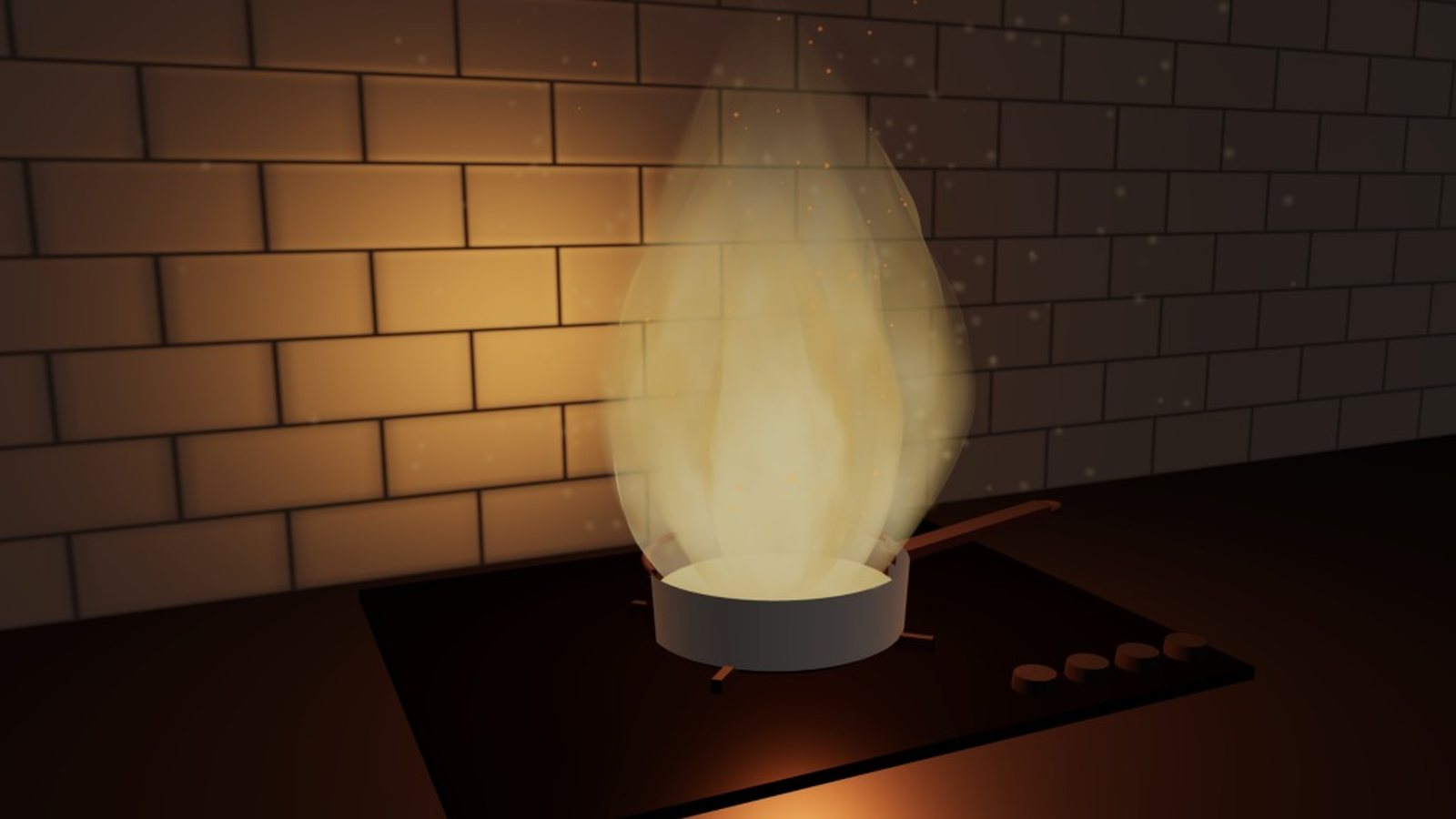
A pan of burning cooking oil on a hob with bright orange flames rising above the rim.

Kitchen physics · burning oil

Burning oil: why a glass of water turns a pan fire into a fireball

Around 60% of home fires attended by the London Fire Brigade start in the kitchen, and cooking remains the leading cause of accidental dwelling fires across England and the US. Cut through the pan wall to watch why reaching for water turns a small flame into a ceiling-high fireball.

From 180 °C to 350 °C

Smoke arrives long before flame

Normal frying sits around 175–190 °C. Left unattended on the hob, refined sunflower oil crosses its smoke point near 232 °C, releasing thick haze more than a hundred degrees before ignition.

At 315 °C it reaches its flash point, where vapours ignite from any spark. Around 350 °C at the pan base in NIST tests on corn oil — and roughly 340–370 °C for refined sunflower oil — the oil autoignites spontaneously with no pilot flame at all.

The wrong instinct

Water refuses to stay on top

Reaching for a glass of water from the sink is the first reflex when a pan catches fire. On wood or paper, water cools the fuel and suffocates the flame.

With superheated oil, density flips the order. Tap water at 20 °C sits at 998.2 kg/m³, whereas sunflower oil starts at 920 kg/m³ and expands sharply as it heats.

Through the cast-iron wall

Straight to the 350 °C pan floor

At 350 °C, burning oil drops to roughly 750 kg/m³. A 250 kg/m³ density gap and complete immiscibility drive cold water straight through the oil onto the glowing metal pan base.

Instead of blanketing the flame, water lands trapped beneath a lid of superheated oil sitting 250 degrees above its boiling point.

Water at base (998 kg/m³)Hot oil (750 kg/m³)Burning vapour

NIST IAPWS-95, 1 atm

One glass becomes a bathtub of steam

When liquid water flashes to steam at 100 °C and atmospheric pressure, its volume jumps 1,670-fold. Just 100 ml of tap water becomes 167 litres of saturated steam.

Superheated toward 350 °C inside the pan, that same water expands to 278.9 litres in the model (282.8 litres in exact NIST IAPWS-95 tables). A 200 ml glass yields 334 litres at 100 °C and 557.8 litres superheated.

From 452 cm² to 50 m²

Oil shredded into mist burns all at once

The expanding steam pocket at the base of the pan has only one exit: straight upward in a few tenths of a second. That blast launches 250 ml of burning oil into the air and shatters it into millions of fine droplets.

Inside a 24 cm pan, oil exposed just 452 cm² of surface to oxygen. Broken into 0.3 mm droplets, surface area jumps to 5 m² (111× larger); as a 30 µm mist it reaches 50 m², multiplying fuel-air contact 1,105-fold.

Hood at 0.75 m · ceiling at 2.4 m

Flame hits the ceiling and rolls outward

Every hot micro-droplet ignites almost simultaneously. In the default 100 ml water boilover over 250 ml of 350 °C oil, the fireball climbs to 2.76 m, engulfs the extractor hood at 0.75 m and slams into the 2.4 m ceiling, spreading sideways across wall cabinets.

In NIST tests inside a 2.4 m-ceiling kitchen, an unattended 26 cm pan already reaches 110 kW and 1.4 m flames without water. A boilover fireball radiates far above the 2.5 kW/m² NIST skin-burn threshold, where unprotected skin burns in under 20 seconds.

Cut oxygen, then cut heat

Why a lid works and why it stays shut

Sliding a flat metal lid sideways across the pan cuts oxygen immediately. Flames die out in around two seconds, allowing the hob to be switched off safely.

The dangerous mistake arrives a minute later: lifting the lid to peek. The oil stays above 340 °C long after the flame disappears, so fresh air reignites the vapours instantly. Keep the lid closed for at least 15–20 minutes, and avoid glass lids that can shatter from thermal shock.

Four reactions on the same hob

Set temperature, oil and reaction

Adjust oil temperature, pan volume and water poured, then compare all four reactions: pouring water, sliding a metal lid, carrying the pan, and throwing flour.

Watch the temperature threshold too: below 340 °C water triggers violent 280 °C oil splatter rather than a fireball. Throwing flour disperses a combustible organic dust cloud that flashes up to 1.79 m above the hob.

350 °C
250 ml
100 ml

Illustrative physical model for a 24 cm pan under an extractor hood at 0.75 m and a 2.4 m ceiling.

LFB · NFPA · IGSU

Slide a metal lid, cut the heat and leave it covered.

If a pan of oil catches fire: switch off the hob only if safe to reach without leaning through flame, slide a flat metal lid, baking tray or fire blanket sideways over the pan, and leave it covered until completely cool.

Never pour water, never throw flour, starch or sugar, and never try to carry a burning pan to the sink. Commercial kitchens use Class F (UK/EU) or Class K (US) wet-chemical extinguishers whose alkaline fine mist saponifies hot oil into a soapy blanket; at home, if fire reaches the extractor hood or cabinets, get out, close the door and call 999 or 112.

Pass it on

Almost everyone has left a pan on the hob a little too long. Share the clear physics of why a metal lid puts out burning oil while a glass of water sends flames into the ceiling.

Sources and method

Every thermodynamic constant, ignition threshold, laboratory measurement and fire-service guideline comes from the primary sources below.

Thermal thresholds of common cooking oils

Values from fire-safety literature and NIST cooktop experiments (Hamins et al. 2018; Hu et al. 2021)
Oil typeFryingSmoke pointFlash pointHob autoignition
Refined sunflower oil175–190 °C225–232 °C315–327 °C~340–370 °C
Refined rapeseed oil175–190 °C204–242 °C326–340 °C~350–370 °C
Extra virgin olive oil160–180 °C175–210 °C287–304 °C~350–370 °C
Corn oil (NIST benchmark)175–190 °C~230–236 °C254 °C350 °C (pan base)

Four reactions to a pan fire (350 °C, 250 ml oil, 100 ml water)

Model peak flame height alongside the physical mechanism observed in fire-service tests
ReactionPeak heightPhysical mechanism
Pour 100 ml water2.76 mWater sinks to the pan floor, flashes into 167 L of steam (100 °C) and blasts burning mist into the 2.4 m ceiling.
Slide metal lid0.45 m → 0 mCuts oxygen and extinguishes flames in ~2 s; oil stays above autoignition, so the lid must remain closed until cool.
Carry the pan1.23 mTilted 350 °C oil spills onto hands, hob and floor, spreading burning fuel across the kitchen.
Throw flour1.79 mAirborne carbohydrate dust ignites instantly above the flame (combustible dust flash fire).

The scene and simulator run an illustrative physical model for a 24 cm pan (452 cm² surface) beneath an extractor hood at 0.75 m and a 2.4 m ceiling. Steam expansion at 100 °C uses the NIST IAPWS-95 specific volume (1.673 m³/kg, 1,670× ratio), while 350 °C superheating uses ideal-gas scaling (278.9 L from 100 ml, within 1.4% of the exact NIST IAPWS-95 value of 282.8 L). Atomised droplet areas follow exact sphere geometry (6V/d). This model is explanatory and does not replace official fire-service guidance.

  1. NIST Chemistry WebBook, Thermophysical Properties of Fluid Systems (IAPWS-95 for H₂O at 1 atm): liquid water at 20 °C (998.21 kg/m³), saturated steam at 100 °C (v = 1.6733 m³/kg, 1,670× expansion, latent heat 2,256.4 kJ/kg) and superheated steam at 350 °C (v = 2.8333 m³/kg, 2,828×). webbook.nist.gov
  2. Hamins, A., Kim, S. C. and Madrzykowski, D. (2018), "Characterization of stovetop cooking oil fires", Journal of Fire Sciences 36(3):224–239 (NIST): pan-bottom autoignition near 350 °C, flames exceeding 10× pan diameter in a 2.4 m-ceiling kitchen, and 2.5 kW/m² human skin-burn threshold (< 20 s). pmc.ncbi.nlm.nih.gov
  3. Hu, Y. et al. (2021), The Character of Residential Cooktop Fires, NIST Technical Note 2133: an unattended 26 cm pan of corn oil reaches 110 kW peak heat release and 1.4 m flames even without water. www.nist.gov
  4. Nam, S. (2004), "Boilover upon suppression of cooking oil fire by water spray", Fire Safety Journal 39(5):429–432; and Liu, Z. et al. (2004), Fire Technology 40(4):309–333 (NRC Canada): explosive boilover from coarse water streams versus engineered high-pressure fine mist. doi.org
  5. Esteban, B. et al. (2012), Biomass and Bioenergy 42:164–171: temperature dependence of vegetable oil density (~920 kg/m³ at 20 °C, falling toward 730–780 kg/m³ at 300–350 °C). doi.org
  6. Sahasrabudhe, S. N. et al. (2017), Int. J. Food Properties 20(sup2):S1965–S1981: density, viscosity and surface tension of five vegetable oils at elevated temperatures. doi.org
  7. OSHA, Combustible Dust and UK HSE, DSEAR 2002: airborne wheat flour, cornstarch and sugar form combustible dust clouds capable of instant deflagration over an open flame. www.osha.gov
  8. London Fire Brigade, Cooking and fire safety and Pan fires: around 60% of home fires start in the kitchen; never throw water on burning oil, never move the pan; get out, stay out and call 999. www.london-fire.gov.uk
  9. UK Home Office, Fire and Rescue Incident Statistics (England): cooking appliances remain the leading cause of accidental dwelling fires (~42–49%). www.gov.uk
  10. NFPA, Cooking safety and Home Cooking Fires: cooking accounts for 44–49% of reported US home structure fires and 35–42% of injuries; slide a lid over the pan, turn off the hob and leave covered until completely cool. www.nfpa.org
  11. IGSU / DSU Romania, Fii Pregătit: official Romanian kitchen-fire guidance — never water, never move the pan, never flour; cut the heat if safe, smother with a tight metal lid or fire blanket, call 112. fiipregatit.ro