Sources and method
Legal limits are as in force on 23 November 2026.
How the sum works
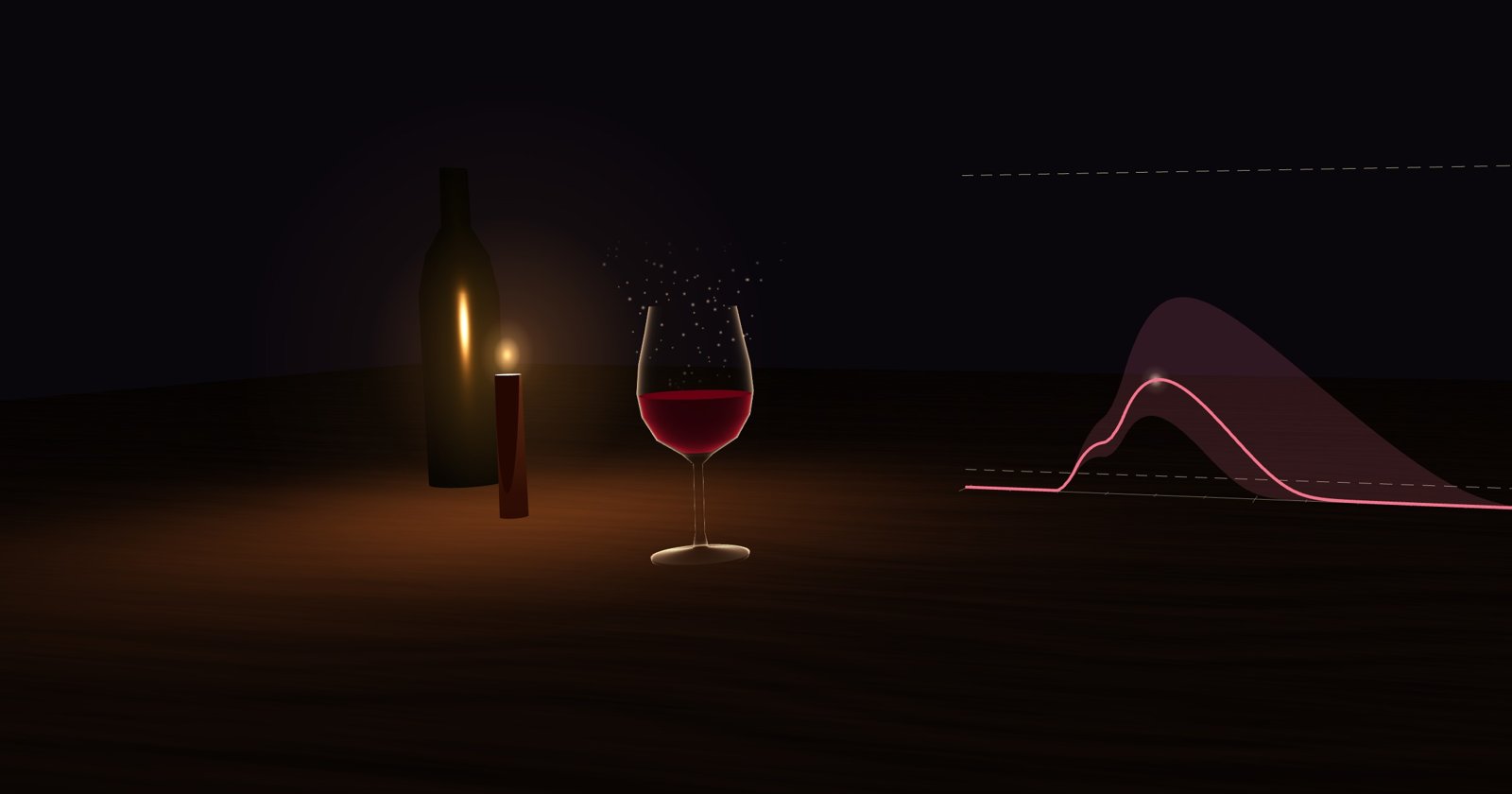
Alcohol from each drink passes from the stomach and intestine into the blood at a rate proportional to what is left (first-order absorption) and spreads through body water: 0.69 litres per kilogram in men and 0.60 in women (the Widmark model). The liver removes it at 0.13 g/l an hour on an empty stomach and 0.17 after a meal, almost constantly; the rate eases off gradually below about 0.15 g/l and sharply below 0.05 g/l, as for an enzyme running short of work (Michaelis–Menten constant 0.05 g/l, within the published range of 0.02–0.10).
The absorption speed is fitted to two controlled studies in men. For white wine on an empty stomach (0.5 g/kg) the model gives a peak of 0.58 g/l after 50 minutes, against 0.62 g/l after 54 minutes in the study. For 0.8 g/kg after breakfast it gives 0.67 g/l, as in the study, and on an empty stomach 1.00 g/l, against 1.04; after a meal the alcohol is gone about two hours sooner, as in the experiment. For women the model uses their average distribution volume, but it has not been checked against a study in women.
“Practically zero” here means under 0.05 g/l: below that, the curve depends more on the enzyme constant than on your evening. The band combines liver speed (0.10–0.20 g/l an hour) with ±12% body water: a plausible margin with no statistical meaning. Some people fall outside it.
- A. W. Jones, “Evidence-based survey of the elimination rates of ethanol from blood with applications in forensic casework”, Forensic Science International 200 (2010): 1–20 (elimination: 0.10–0.15 g/l per hour fasted, 0.15–0.20 fed; 0.15 as an average). pubmed.ncbi.nlm.nih.gov
- M. C. Mitchell, E. L. Teigen, V. A. Ramchandani, “Absorption and peak blood alcohol concentration after drinking beer, wine, or spirits”, Alcoholism: Clinical and Experimental Research 38 (2014): 1200–1204 (12.5% white wine, 0.5 g/kg, 15 men: 61.7 mg/dl after 54 minutes). pmc.ncbi.nlm.nih.gov
- A. W. Jones, L. Jönsson, “Food-induced lowering of blood-ethanol profiles and increased rate of elimination immediately after a meal”, Journal of Forensic Sciences 39 (1994): 1084–1093 (0.80 g/kg: peak 1.04 g/l fasted, 0.67 g/l after breakfast; a meal raises the elimination rate by 36–50%). pubmed.ncbi.nlm.nih.gov
- A. W. Jones, “Alcohol, its absorption, distribution, metabolism, and excretion in the body and pharmacokinetic calculations”, WIREs Forensic Science 1 (2019): e1340 (distribution volume 0.60 l/kg in women, 0.69 in men; ADH saturated above 15–20 mg/100 ml; share metabolised). doi.org
- A. I. Cederbaum, “Alcohol metabolism”, Clinics in Liver Disease 16 (2012): 667–685 (ADH Km about 1 mM: saturated at low concentrations; small effect of exercise). pmc.ncbi.nlm.nih.gov
- INSERM, Alcohol: Health Effects (2001), chapter on absorption (70–80% in the intestine). www.ncbi.nlm.nih.gov
- “Pharmacokinetic analysis of ethanol in a human study” (2023), introduction: absorption into the portal circulation and first pass through the liver. pmc.ncbi.nlm.nih.gov
- “Recent advances in alcohol metabolism” (2025): gastric emptying, brain concentration following arterial blood. pmc.ncbi.nlm.nih.gov
- “Physiologically based pharmacokinetic (PBPK) models for ethanol”: ethanol readily crosses the blood–brain barrier. pmc.ncbi.nlm.nih.gov
- Virginia Department of Forensic Science, on coffee, cold showers and exercise: “Only the passage of time” sobers someone up. dfs.virginia.gov
- M. Kanezashi et al., ACS Omega (2018): molecular size of ethanol, 0.43 nm. pmc.ncbi.nlm.nih.gov
- University of Galway, Open Histology: small-intestinal villi, 0.5–1 mm. openpress.universityofgalway.ie
- Romanian Government Emergency Ordinance 195/2002 on road traffic, consolidated text: art. 88(4), (5) and (5^1) as amended by GEO 84/2024; art. 102(3)(a). bpr.politiaromana.ro
- Romanian Law 172/2024, art. III(4): the new text of Criminal Code art. 336 (over 0.80 g/l of pure alcohol in blood, one to five years in prison and a ban on certain rights). www.senat.ro
- GOV.UK, “The drink drive limit” (limits in England, Wales, Northern Ireland and Scotland). www.gov.uk
- GOV.UK, consultation “Proposed changes to penalties for motoring offences” (7 January – 11 May 2026). www.gov.uk