Marius Comper RO
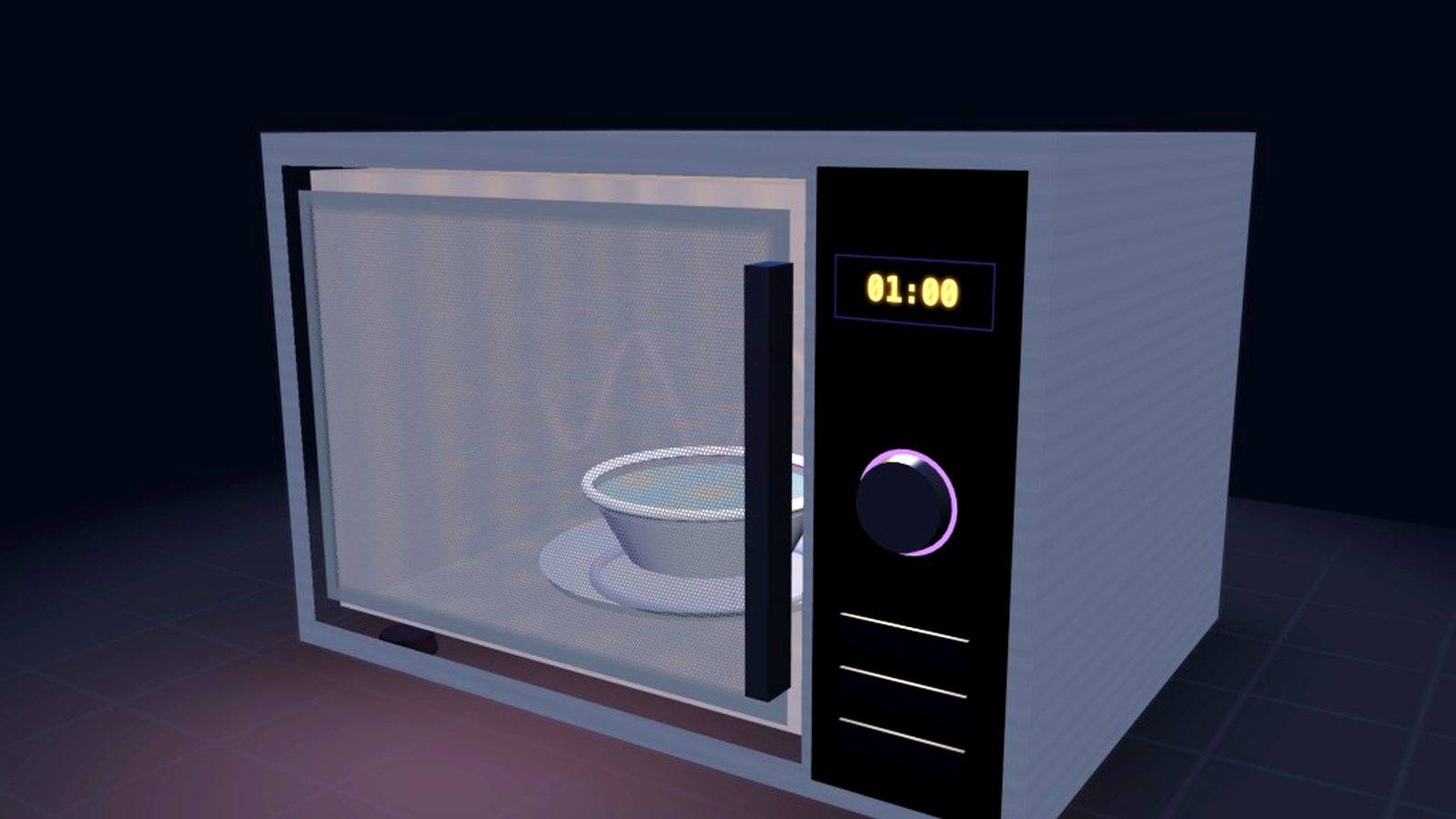
Brushed-steel microwave oven on a laboratory counter with warm interior light and a violet electromagnetic glow.

Kitchen electromagnetism · 2.45 GHz

The wave inside your microwave: cold spots, the 1 mm mesh, and why forks spark

Soup that scorches your lip yet stays lukewarm in the middle, a perforated window that traps radiation, and the crackle of a forgotten fork all come from the same 12.24-centimetre electromagnetic wave.

f = 2.45 GHz · λ = 12.24 cm

A trapped wave with fixed hot spots every six centimetres

The magnetron feeds electromagnetic waves at 2.45 GHz into the metal cavity. Dividing the speed of light (299,792,458 m/s) by that frequency gives a free-space wavelength of 12.24 cm.

Because the steel walls reflect microwaves back across the cavity, outgoing and reflected waves superpose into a standing wave. Every 6.12 cm (half a wavelength), electric-field antinodes deliver peak heating, separated by cold nodes where the field nearly cancels.

Hot antinode (every 6.12 cm)2.45 GHz electric fieldCold node (field minimum)

Stauffer (1997) · Vollmer (2004)

Measuring the speed of light with a bar of chocolate

Lift out the rotating turntable and lay a flat chocolate bar inside. After a short burst, distinct melted pools form — reaching 59.8 °C at the antinodes in the model while nodal strips stay solid at 31.4 °C.

The centre-to-centre gap between neighbouring melted pools measures half a wavelength directly: roughly 6.12 cm. Double it and multiply by 2.45 GHz, and out comes the speed of light (c ≈ 2.99 × 10⁸ m/s) within a few per cent.

5 rpm · 24 cm glass plate

Why the plate spins — and why dead centre stays cooler

With the turntable switched off, a bowl of soup heated at 800 W for 60 seconds hits 98.4 °C in the antinodes while nodal zones linger at 46.4 °C — a 52.0 °C spread.

Spinning the 24 cm glass plate at 5 rpm carries the bowl through successive hot and cold zones, shrinking the spread to just 5.0 °C (67.2–72.2 °C). One practical catch: the exact axis sweeps a circle of zero radius, so placing a mug slightly off-centre heats it more evenly.

ISM band · Debye relaxation

2.45 GHz is far below water’s resonance — and that is a feature

A stubborn popular-science myth claims 2.45 GHz was chosen as the resonant frequency of water. In reality, the ITU designates 2.4–2.5 GHz for industrial, scientific and medical applications (Footnote 5.150). Radio services operating in the band must accept harmful interference those applications may cause. Free water vapour’s lowest rotational resonance sits at 22.235 GHz, and liquid water’s broad Debye dielectric relaxation peak lies near 17–19 GHz.

Operating far below that peak is deliberate: polar H₂O dipoles still twist and dissipate heat in the oscillating field, yet the waves penetrate roughly 1.4–1.8 cm into water and food. At 18 GHz the radiation would be absorbed in the outer millimetre, scorching the crust while leaving the middle raw.

Water ε″ ≈ 10–12 · Ice ε″ ≈ 0.003

Why a frozen meal boils at the corner while the core stays icy

Inside solid ice, hydrogen bonds lock water molecules into a rigid hexagonal crystal lattice. Unable to reorient freely, ice has a dielectric loss factor of ε″ ≈ 0.003 (and even lower in pure ice) compared with ε″ ≈ 12 for liquid water — roughly 4,000 times lower.

That contrast drives thermal runaway: the instant one thin edge thaws into liquid water, that puddle hijacks almost all incoming power. In the simulation at 800 W for 60 seconds, the melted pocket climbs to 89.1 °C while the frozen core stays at -3.4 °C. Defrost mode cycles the magnetron on and off so conduction can spread heat from melted puddles into neighbouring ice.

1.5 mm holes · 5 mW/cm² limit

A perforated screen that lets light pass while stopping microwaves

The metal sheet bonded inside the door glass is punched with holes roughly 1.5 mm wide (typically 1–2 mm). Compared with 550 nm green light, each hole is 2,727 times wider than the wavelength, so visible light sails straight through.

To a 122.4 mm microwave, that same hole is 81.6 times narrower than the wave. Each perforation acts as a circular waveguide far below its ~117.1 GHz cutoff frequency, reflecting radiation back inside. Both FDA (21 CFR 1030.10) and IEC 60335-2-25 cap lifetime leakage at 5 mW/cm² at 5 cm (1 mW/cm² at manufacture), and 2.45 GHz photons (1.01 × 10⁻⁵ eV) are strictly non-ionising.

Air breakdown: 3 MV/m (3,000 V/mm)

Why fork tines throw sparks while a smooth spoon often stays quiet

The oven cavity itself is sheet steel, so bulk metal simply reflects microwaves. Trouble starts when oscillating surface currents pile charge onto sharp points and thin edges — the tines of a fork, creases in crumpled aluminium foil, or a metallic glaze.

By the lightning-rod tip-enhancement effect, the local electric field between fork tines spikes to 4.6 MV/m in the model, past the dielectric breakdown strength of dry air (3 MV/m = 3,000 V/mm). Air ionises into a crackling plasma arc. A thick, rounded spoon spreads charge gently below breakdown, though even a smooth spoon can arc if placed millimetres from the steel wall.

2.45 GHz cavity simulator

Pick an item, stop the turntable and watch the field

Test a soup bowl, a frozen meal, a chocolate bar and a metal fork. Switch the glass turntable on or off, set magnetron power (600–1,000 W) and duration (15–120 s), and compare the thermal maps.

Contrast spinning soup (ΔT = 5.0 °C) against stationary soup (ΔT = 52.0 °C), measure the 6.12 cm melted bands on chocolate, or trigger air breakdown across the fork tines.

Item on the turntable
Glass turntable (5 rpm)
800 W
60 s

Illustrative 2.45 GHz electromagnetic and thermal model (λ/2 = 6.12 cm, water/ice ε″ ratio 4,000×, dry air breakdown 3 MV/m).

From cavity physics to the counter

Once you see the wave, three small habits tame the oven.

Set bowls and mugs a few centimetres off-centre on the turntable so they sweep through both nodes and antinodes on every revolution, and stir dense dishes halfway through.

For frozen food, step down power or pause for a minute with the door closed so thermal conduction catches up with melted pockets before edges boil. Keep sharp metal points and crumpled foil on the counter.

Pass it on

Next time someone repeats the water-resonance myth or wonders why soup stays cold in the middle, send them the 3D cutaway.

Sources and method

Every electromagnetic constant, dielectric measurement, classroom experiment and safety standard comes from the primary sources below.

Wavelengths versus the door mesh (1.5 mm perforations)

Visible light and 2.45 GHz microwaves meeting the same perforated Faraday screen
Electromagnetic waveWavelengthRatio to 1.5 mm holeBehaviour at the door
Visible light (green)550 nmhole is 2,727× widerStreams through the perforations; you see the dish clearly.
Oven microwaves (2.45 GHz)122.4 mmwave is 81.6× widerCircular waveguide far below cutoff (~117.1 GHz); field decays exponentially and reflects back.

Dielectric loss at 2.45 GHz: liquid water, ice and cookware

Reference measurements from Ellison (2007), Mätzler & Wegmüller (1987) and Vollmer (2004)
Material (at 2.45 GHz)ε′Loss ε″Depth dpBehaviour in the cavity
Liquid water (20–25 °C)~789.5–121.4–1.8 cmMobile polar molecules lag the oscillating field and convert EM energy to heat efficiently.
Pure solid ice (−10 to −20 °C)3.15–3.200.0003–0.003> 10 mHydrogen-bonded crystal lattice locks dipoles in place; thousands of times lower loss than liquid water.
Borosilicate glass (Pyrex)4.6–5.10.018–0.0351.5–2.5 mLargely transparent to microwaves; warms mostly by conduction from hot food.
Dry glazed porcelain5.1–6.50.015–0.051.0–2.5 mLow loss when dry and free of metallic glazes; trapped moisture in porous mugs heats rapidly.

Simulator scenarios (reference: 800 W, 60 s; fork 15 s)

Illustrative model outputs across all four test items with the turntable on and off
ScenarioMinMaxΔTDominant physical effect
Soup bowl · turntable on67.2 °C72.2 °C5.0 °C5 rpm rotation averages nodes and antinodes into even heating.
Soup bowl · turntable off46.4 °C98.4 °C52.0 °CAntinodes climb near boiling while nodal pockets stay lukewarm.
Chocolate bar · turntable off31.4 °C59.8 °C28.5 °CDistinct melted pools spaced every 6.12 cm (λ/2).
Chocolate bar · turntable on37.6 °C44.4 °C6.8 °CRotation smooths the bar into gentle, even softening.
Frozen meal · turntable on-3.4 °C89.1 °C92.4 °CThermal runaway: the first melted pocket absorbs almost all power while the core stays frozen.
Frozen meal · turntable off-2.3 °C98.5 °C100.8 °CMelted puddle approaches boiling beside a sub-zero icy centre.
Metal fork (15 s)26.5 °C146.8 °C120.3 °CTip field reaches 4.6 MV/m (> 3 MV/m air breakdown): plasma arcs jump between tines.

The scene and simulator run an illustrative 2.45 GHz model (c = 299,792,458 m/s, λ₀ = 12.24 cm, λ₀/2 = 6.12 cm, 24 cm turntable at 5 rpm). Standing-wave intensity spans antinodes (1.00) to nodes (0.14), liquid-water versus ice dielectric loss uses a 4,000× ratio (ε″ = 12 vs 0.003), and arcing triggers once tip-enhanced fields exceed dry air breakdown (3 MV/m). Inside a real multimode cavity, 3D geometry and food permittivity shift exact hot-spot spacing slightly around the ideal 1D value (Vollmer 2004).

  1. NIST CODATA — Speed of light in vacuum (c = 299,792,458 m/s, exact): fundamental constant yielding free-space wavelength λ₀ = 12.236 cm at 2.45 GHz. physics.nist.gov
  2. ITU — Radio Regulations (Footnote 5.150): designates the 2,400–2,500 MHz band (centred at 2.45 GHz) for Industrial, Scientific and Medical applications; radio services in the band must accept harmful interference that these applications may cause. www.itu.int
  3. ITU-R Recommendation P.676 — Attenuation by atmospheric gases and related effects: documents the lowest rotational resonance line of free water vapour at 22.235 GHz, nearly nine times above 2.45 GHz. www.itu.int
  4. Vollmer, M. (2004), "Physics of the microwave oven", Physics Education 39(1):74–81: magnetrons, cavity standing waves, debunking the water-resonance myth, penetration depth and non-ionising photon energy. doi.org
  5. Vollmer, M., Möllmann, K.-P. and Karstädt, D. (2004), "More experiments with microwave ovens", Physics Education 39(4):346–351: standing-wave imaging in chocolate and thermal paper, superheating and door-screen shielding. doi.org
  6. Vollmer, M., Möllmann, K.-P. and Karstädt, D. (2004), "Microwave oven experiments with metals and light sources", Physics Education 39(6):500–508: induced currents, tip-enhanced arcing on sharp edges versus smooth spoons, and plasma discharges. doi.org
  7. Stauffer, R. H., Jr. (1997), "Finding the speed of light with marshmallows—A take-home lab", The Physics Teacher 35(4):231: measuring λ/2 hot-spot spacing to calculate the speed of light c = f · λ. doi.org
  8. Ellison, W. J. (2007), "Permittivity of Pure Water, at Standard Atmospheric Pressure, over the Frequency Range 0–25 THz and the Temperature Range 0–100 °C", J. Phys. Chem. Ref. Data 36(1):1–18: reference Debye relaxation model for liquid water (ε′ ≈ 78, ε″ ≈ 10–12 at 2.45 GHz; peak ~17–19 GHz). doi.org
  9. Mätzler, C. and Wegmüller, U. (1987), "Dielectric properties of fresh-water ice at microwave frequencies", J. Phys. D: Appl. Phys. 20(12):1623–1630: permittivity of fresh-water ice (ε′ ≈ 3.15–3.18, ε″ ≈ 0.0003–0.003), orders of magnitude below liquid water. doi.org
  10. 21 CFR § 1030.10 (eCFR) — Microwave ovens: US federal performance standard capping leakage at 1 mW/cm² at manufacture and 5 mW/cm² over lifetime at 5 cm from the cabinet, plus dual safety interlocks. www.ecfr.gov
  11. U.S. Food and Drug Administration (FDA) — Microwave Ovens: official guidance on non-ionising radiation, door-screen integrity and metal utensils. www.fda.gov
  12. IEC 60335-2-25:2020 — Household and similar electrical appliances — Particular requirements for microwave ovens: international and European leakage limit of 50 W/m² (5 mW/cm²) at 50 mm (5 cm) from the outer surface. webstore.iec.ch