What the front page of 29 November 1918 says
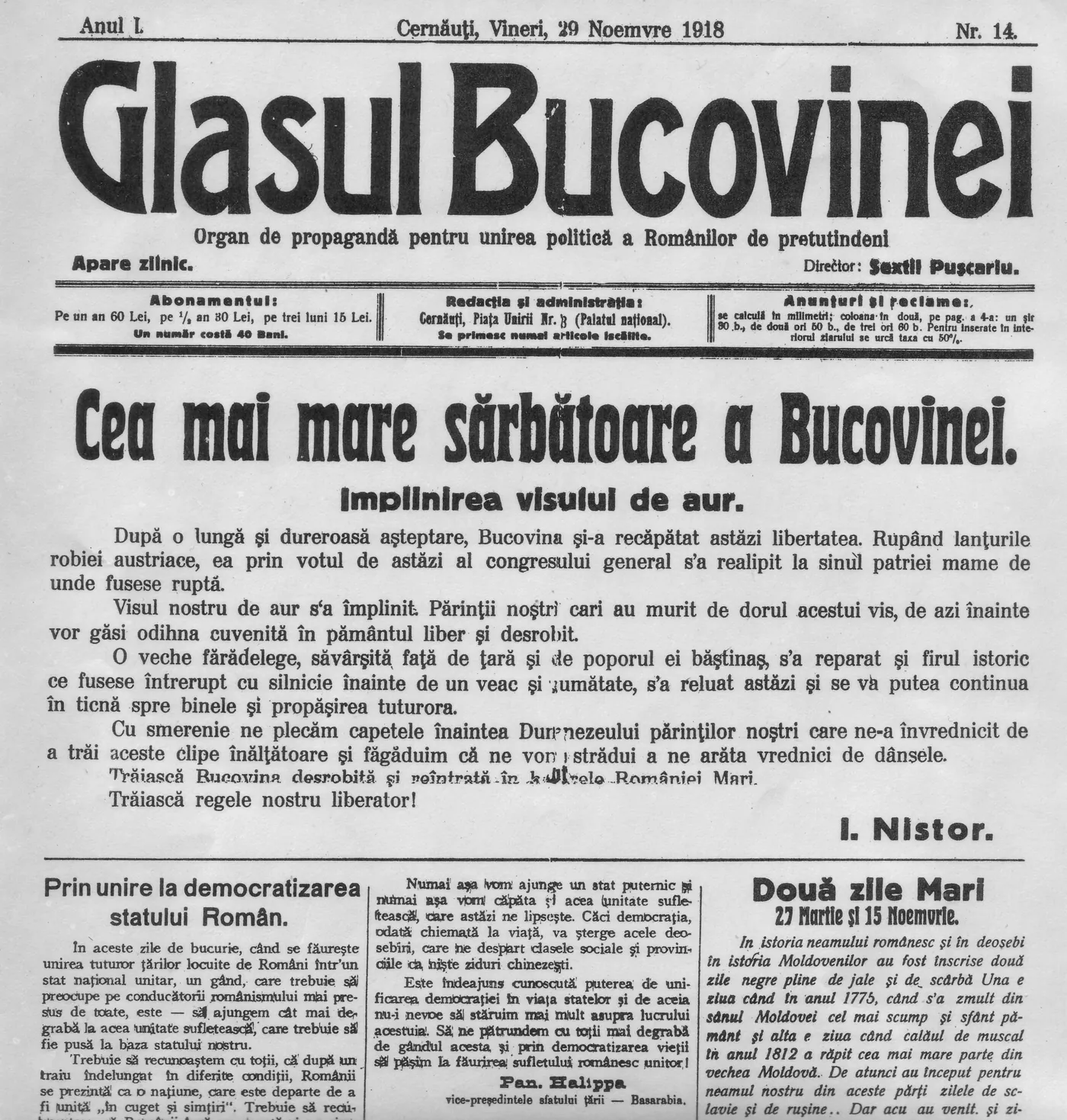
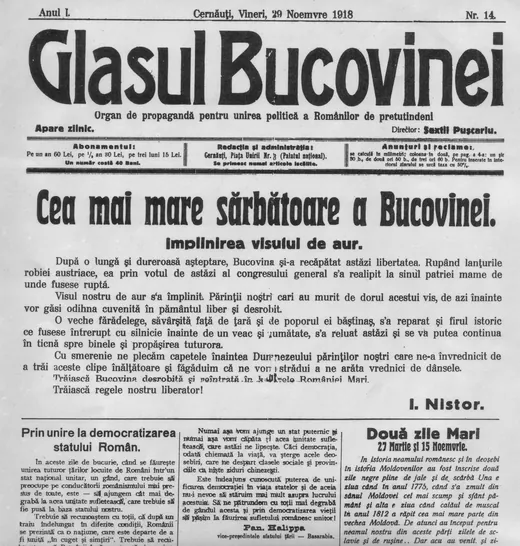
On Friday 29 November 1918, in Cernăuți (Czernowitz in German, today Chernivtsi in Ukraine), issue 14 of the Romanian daily «Glasul Bucovinei» («The Voice of Bukovina») ran a headline across the whole page: «Cea mai mare sărbătoare a Bucovinei», «Bukovina's greatest celebration». The page resurfaces on Romanian social media every year around 28 November.
Below it, a lead article by the historian Ion Nistor, a professor at the city's university, opens with «a long and painful wait» and sums up the paper's reaction in one sentence:
«Visul nostru de aur s’a împlinit.» (Our golden dream has come true.)Ion Nistor, Glasul Bucovinei, 29 November 1918
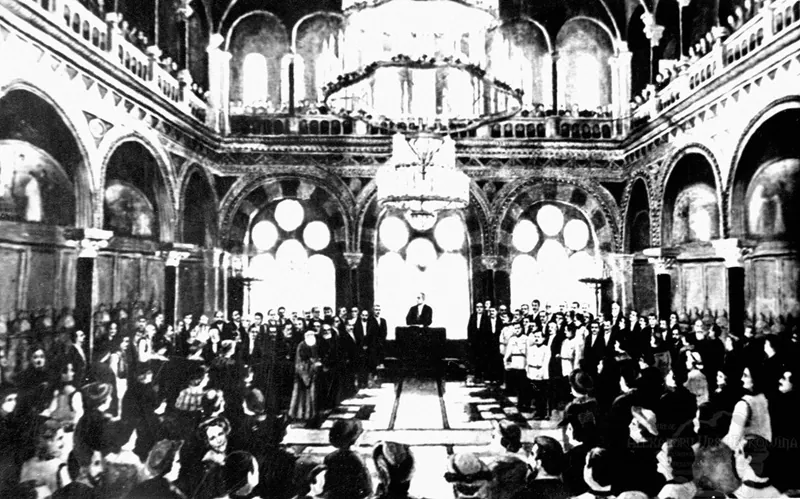
The day before, in the Synod Hall of the Metropolitan Residence in Cernăuți, the General Congress of Bukovina had voted to unite the province with the Kingdom of Romania. Bukovina had been under Habsburg rule since 1774.
The paper's subtitle, «organ of propaganda for the political union of Romanians everywhere», stated its purpose openly: its editors campaigned for union. Its director was the linguist Sextil Pușcariu, also a professor in Cernăuți.
The same article had appeared a day earlier
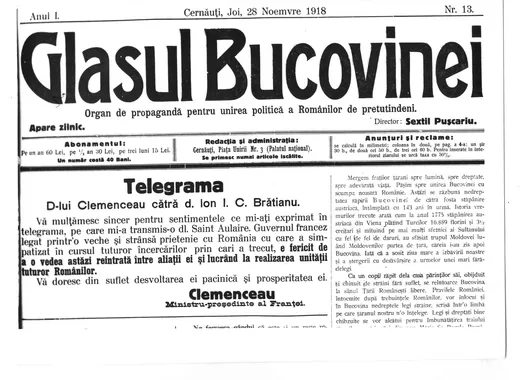
On 28 November, the day of the vote, Glasul Bucovinei printed two papers. The regular issue 13 led with a telegram from the French prime minister Georges Clemenceau to the Liberal leader Ion I. C. Brătianu, who would return as Romania's prime minister in December. Separately, a two-page «Ediție specială» (special edition) carried Nistor's article, the report of the session and the resolution into the city on the day of the congress itself.
Next day, issue 14 put the same article on its front page. That is why the text says Bukovina regained its freedom «today» on a page dated the 29th: it had been written for the 28th.
The cover of the special edition is openly available in the Libraria catalogue; high-resolution pages are available only to account holders.
A paper founded for union, five weeks earlier
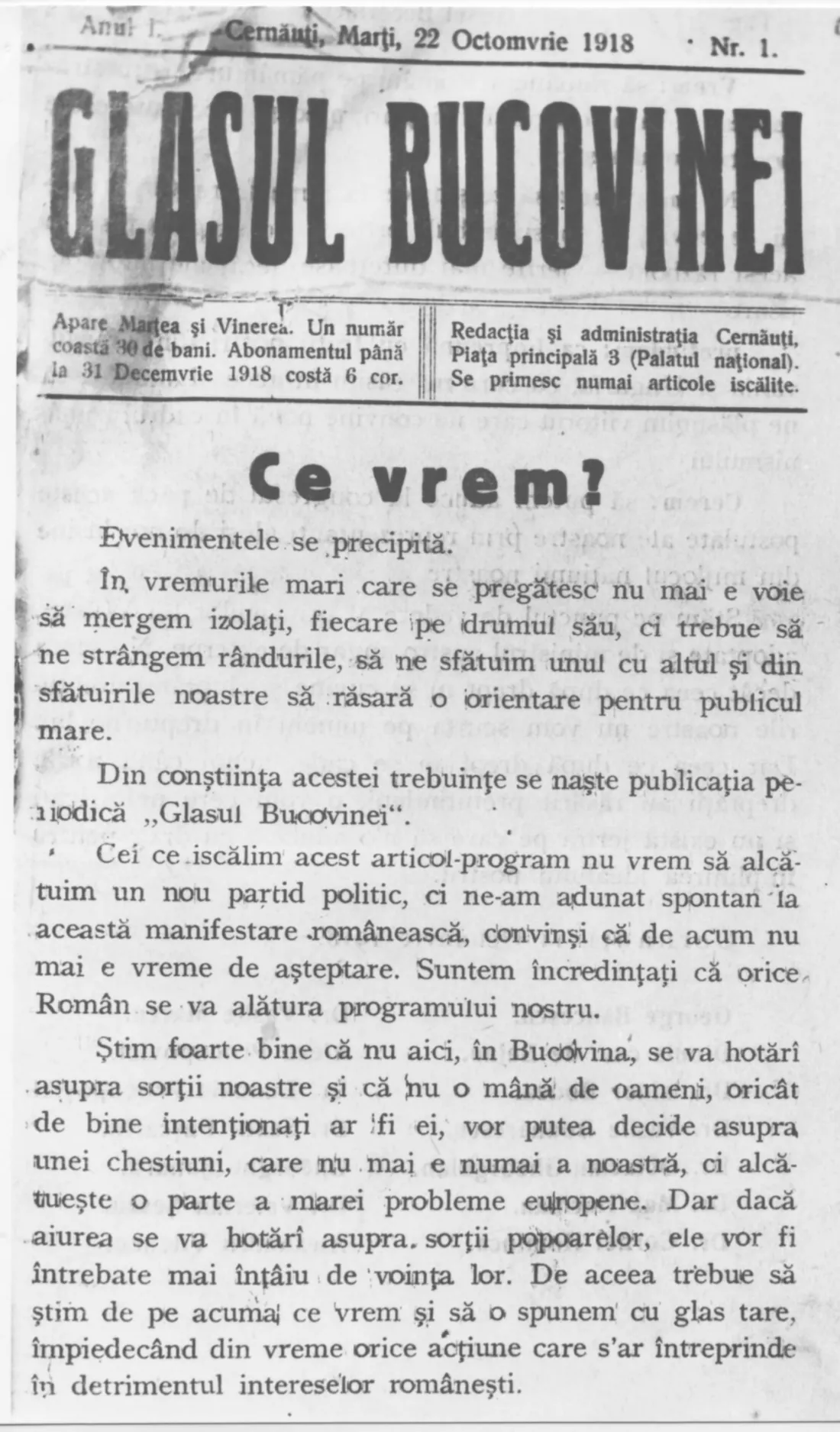
The first issue had come out on Tuesday 22 October 1918 with an editorial setting out the paper's aims, «Ce vrem?» («What do we want?»). Its first words, «Evenimentele se precipită» («Events are rushing ahead»), describe that month well: Austria-Hungary was losing the war and the empire's peoples were forming national councils.
The paper then appeared on Tuesdays and Fridays and cost 30 bani. A subscription to 31 December 1918 cost six crowns, the Austro-Hungarian currency. On 29 November the same paper charged 40 bani an issue and 60 lei a year. It now priced itself in Romanian money, though crowns stayed in circulation in Bukovina into 1919.
Twice a week, then almost daily
The calendar shows why the page of 29 November is only issue 14. Between 22 October and 19 November the paper came out at most nine times, on Tuesdays and Fridays. From issue 10, on Sunday 24 November, the masthead reads «Apare zilnic» («Appears daily»), though Mondays were usually skipped.
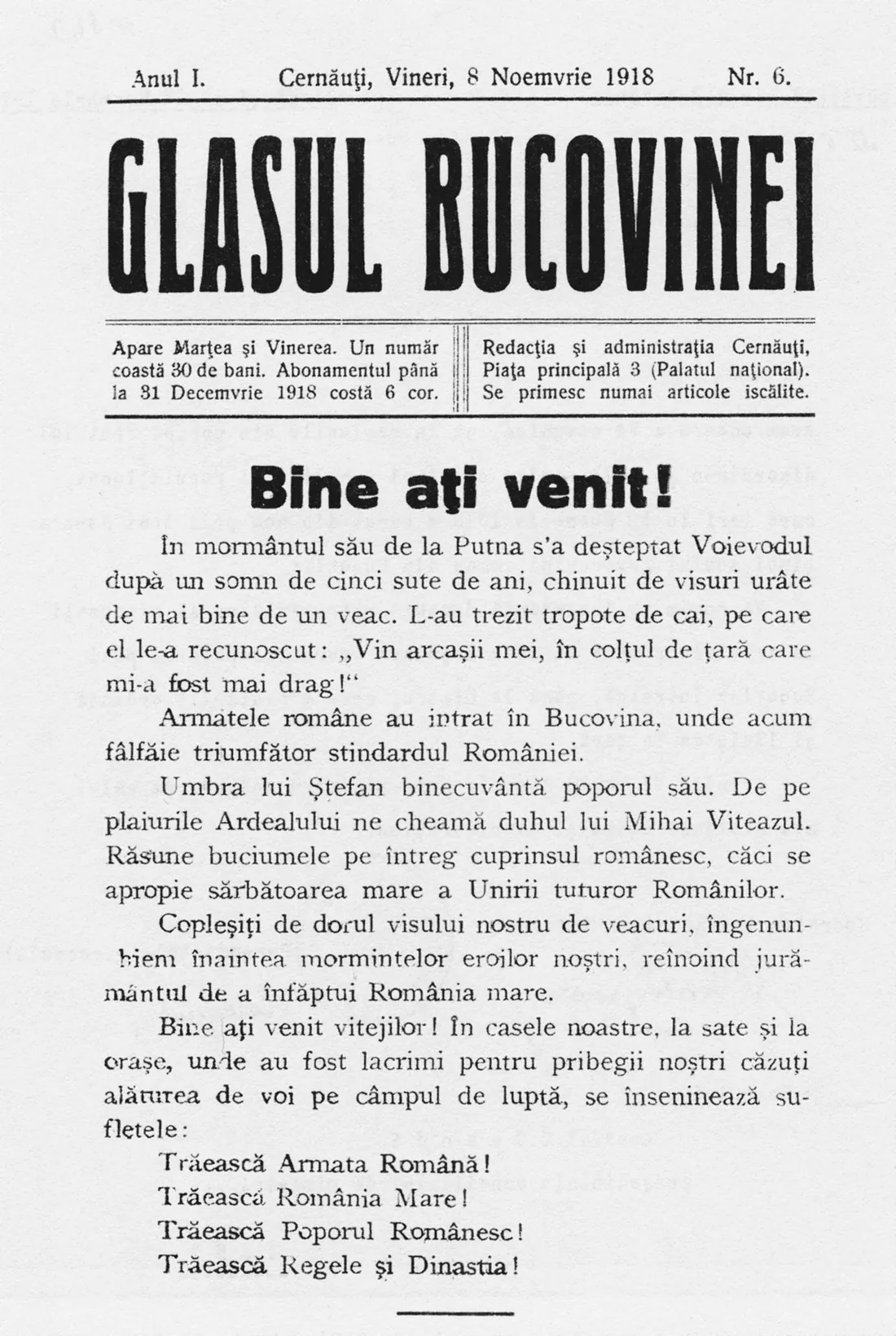
Between issues 6 and 13 the plain capitals of the masthead gave way to the heavy lettering on the page that circulates today.
Solid numbers are issues seen in scans or in the Libraria catalogue. Faded ones are dates inferred from the Tuesday-and-Friday schedule, not seen.
1774–1775: the north-western corner of Moldavia becomes Bukovina
Moldavia was a Romanian-speaking principality under Ottoman overlordship. In 1774, at the end of the Russo-Turkish war, Habsburg troops occupied part of its north. In 1775, by a convention signed in Constantinople, the Ottoman Empire ceded the land to the Habsburgs. The name Bukovina, «beech land», already used for the forests there, became the name of the province.
Suceava, Moldavia's old capital, ended up on the Habsburg side of the border, as did the monasteries of Putna, where Stephen the Great, Moldavia's most revered prince, is buried, Sucevița and Bogdana in Rădăuți. Moldavia's prince, Grigore III Ghica, opposed the cession; in 1777 an Ottoman envoy killed him in Iași, after a conflict between the prince, the Porte and part of the nobility.
The 1918 resolution reaches back to this moment: «in 1774, by trickery, Bukovina was torn from the body of Moldavia».
144 years under Austria
Until 1786 Bukovina was under military administration; it was then run as part of Galicia. The imperial constitution of 1849 recognised it as a separate duchy, and after a brief return to Galician rule its provincial diet first met in 1861. The capital was Czernowitz. The diet used German, Romanian and Ruthenian, the period name for Ukrainian, and the province published its laws in all three; German predominated in the administration.
The city grew around new buildings: a German-language university opened in 1875, and the Residence of the Orthodox metropolitans, built between 1864 and 1882 to designs by the Czech architect Josef Hlávka. UNESCO added the Residence to its World Heritage List in 2011.

Who lived in Bukovina in 1910
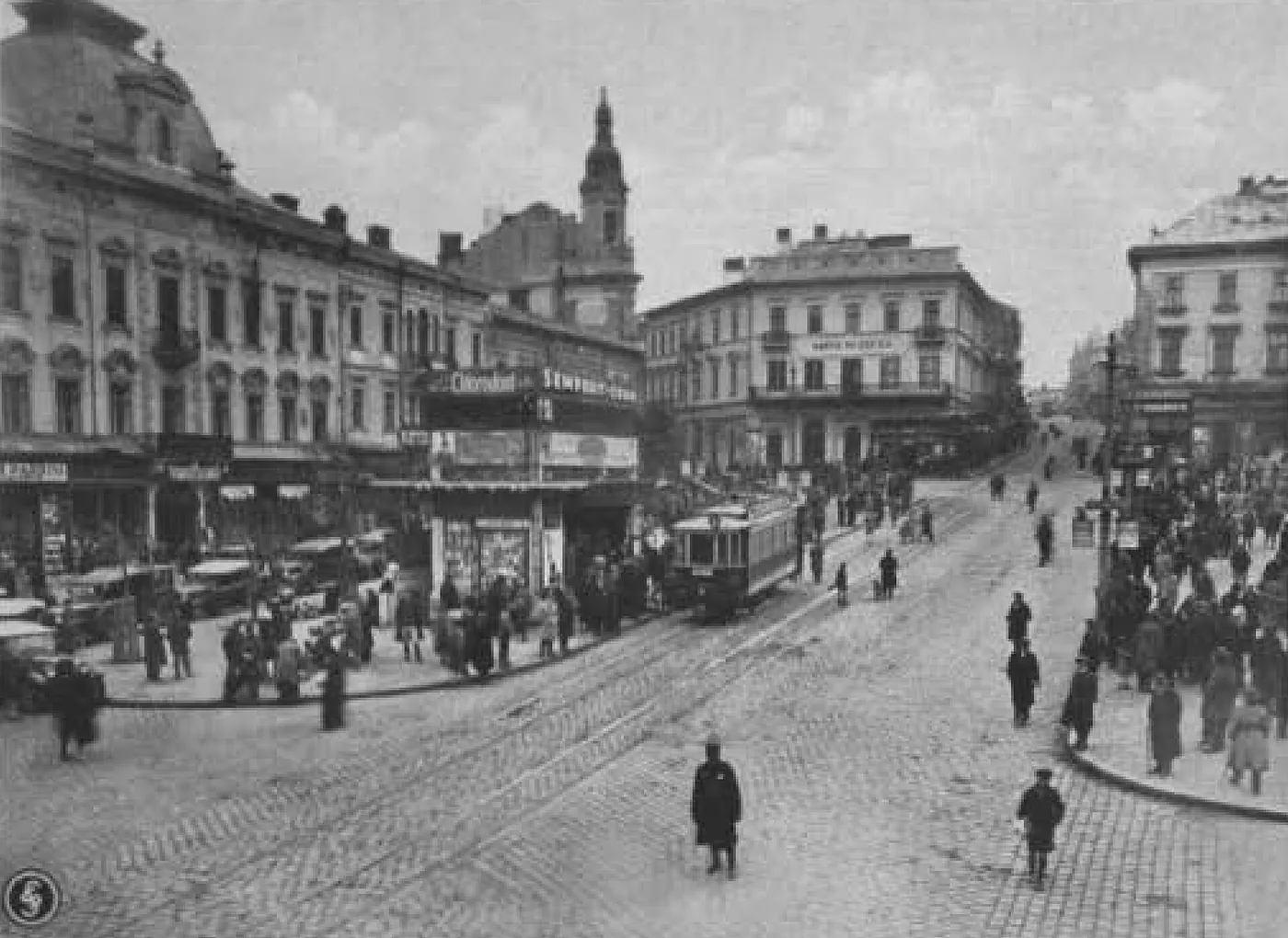
The last Austrian census recorded one language of everyday use for each of 794,929 Austrian citizens present in the province. Ruthenian was recorded most often (38.4%), followed by Romanian (34.4%), German (21.2%), Polish (4.6%) and Hungarian (1.3%). No language reached half.
The map shows where: Ruthenian dominated the north (92.7% in Zastawna district), Romanian the south (70.1% in Suczawa district), and German was recorded most often in the city of Czernowitz.
Each table hides someone. The census had no Yiddish category, so most Jews appear under German. The religion table counts 102,919 people of Jewish faith, 12.9% of the 800,098 people present. On the other hand, the Orthodox column lumps together speakers of Romanian and of Ruthenian.
Language of everyday use is not ethnicity. According to the historian Constantin Ungureanu, before the census Romanian leaders urged Romanian peasants in mixed villages, often bilingual, to register Romanian as their language. Data: the 1910 census, tables published by Ungureanu (2012); district boundaries: HistoGIS, Austrian Academy of Sciences.
16 October – 3 November 1918
Two assemblies, two plans for the same land
On 16 October Emperor Karl I proposed turning the Austrian half of the monarchy into a federation. In Cernăuți a Romanian constituent assembly, chaired on 27 October by Dionisie Bejan, called for all of Bukovina to unite with the other Romanian lands and elected a Romanian National Council whose executive committee was led by Iancu Flondor, a landowner from an old Bukovinian family.
On 3 November about 10,000 people attended the Ukrainian assembly in Czernowitz. It recognised the authority of the Ukrainian National Council in Lviv and called for union with Ukraine. It claimed the city of Czernowitz, all of the Zastawna, Kitsman, Vashkivtsi and Vyzhnytsia districts, the Czernowitz and Sereth districts without their Romanian-majority communes, and the Ukrainian-majority communes in the other districts. It also called for proportional representation of minorities, explicitly including Jews.

6 – 25 November 1918
The transfer of power and the Romanian army's arrival
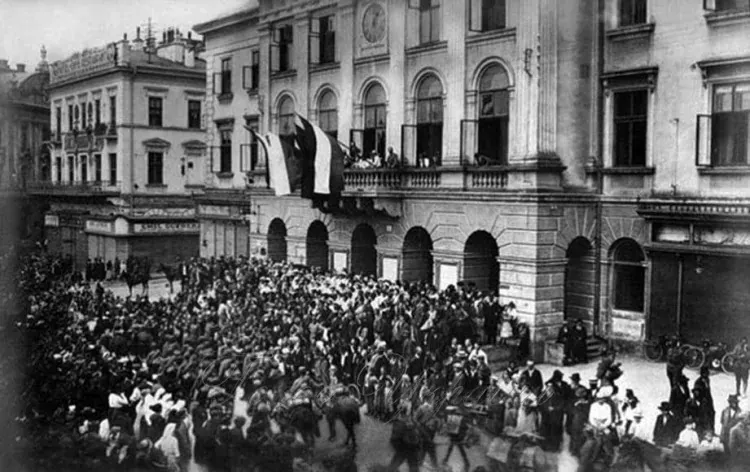
On 6 November, after Ukrainian troops had taken over the provincial government building, the Austrian governor Josef von Etzdorf handed power to Ukrainian representatives, including Omelian Popovych, and to the Romanian deputy Aurel Onciul. The agreement provided for separate administrations in the province and a provisional municipal administration in Czernowitz. Onciul had no mandate from the Romanian National Council, which rejected it and had already asked the Romanian government, then based in Iași, for military help.
Romanian border guards crossed overnight on 5–6 November, and General Iacob Zadik's 8th Division began its advance on 8 November. That day Glasul Bucovinei ran the headline «Bine ați venit!» («Welcome!»). The main body of Ukrainian troops left Czernowitz overnight into 10 November, and Zadik's soldiers entered the city around noon on 11 November. An illustrated history of the West Ukrainian state, published in Ukraine, calls this the «Romanian occupation».
On 12 November the National Council adopted a provisional basic law: it kept legislative power and elected a government under Flondor to exercise executive power. From 25 November Bukovina's clocks were put forward an hour, to Bucharest time.
11 a.m., in the Synod Hall
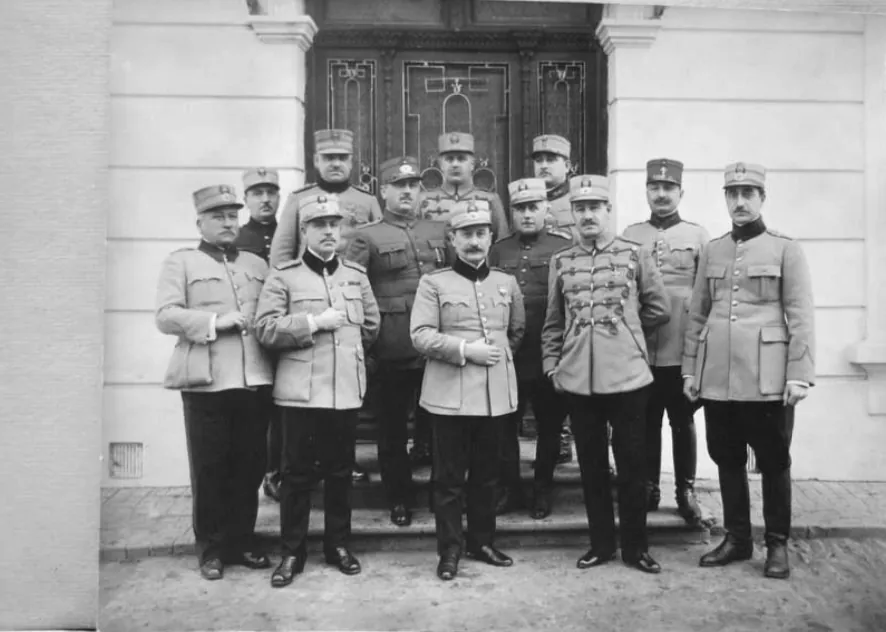
At 11 a.m. on Thursday 28 November 1918, Dionisie Bejan, the octogenarian president of the Romanian National Council, opened the session in the marble hall of the Metropolitan Residence. On his proposal the congress acclaimed Iancu Flondor as its president. Flondor read the resolution, and Ion Nistor spoke on the province's past.
Stanisław Kwiatkowski then backed union on behalf of the Polish National Council, citing assurances over Polish churches and schools. Professor Alois Lebouton backed it on behalf of the German National Council, citing the provisional government's promise to respect minorities' cultural needs. Flondor announced that the motion had carried unanimously. The minutes record no individual votes.
At the end, portraits of King Ferdinand and Queen Marie were unveiled, and Flondor read out telegrams to the king and to the governments of France, Britain, the United States and Italy.
Who sat in the hall and who stayed away
The minutes list 100 delegates: 74 from the Romanian National Council, 13 from Ruthenian communes near Czernowitz and in Putila, seven from the German National Council and six from the Polish National Council. Guests included General Zadik, four representatives of Bessarabia, among them Pantelimon Halippa, and three from Transylvania and Hungary.
The Ukrainian National Council sent no one. Its members considered themselves part of the Ukrainian state in Lviv, and its leadership had withdrawn to Kitsman.
The Jewish National Council answered Flondor's invitation with a letter in German dated 27 November and signed by Mayer Ebner, Jacob Pistiner and Berthold Friedmann. Invoking self-determination, it recognised the Romanians' right to unite their lands and stayed neutral in the territorial dispute. The letter recalled that Jews in Romania had not had equal rights, asked for guarantees of civil and political equality and of Jewish minority rights, and said the council would not attend.
The Jewish communities of Suceava, Câmpulung and Rădăuți separately declared their support for union.
The resolution: unconditional and for ever
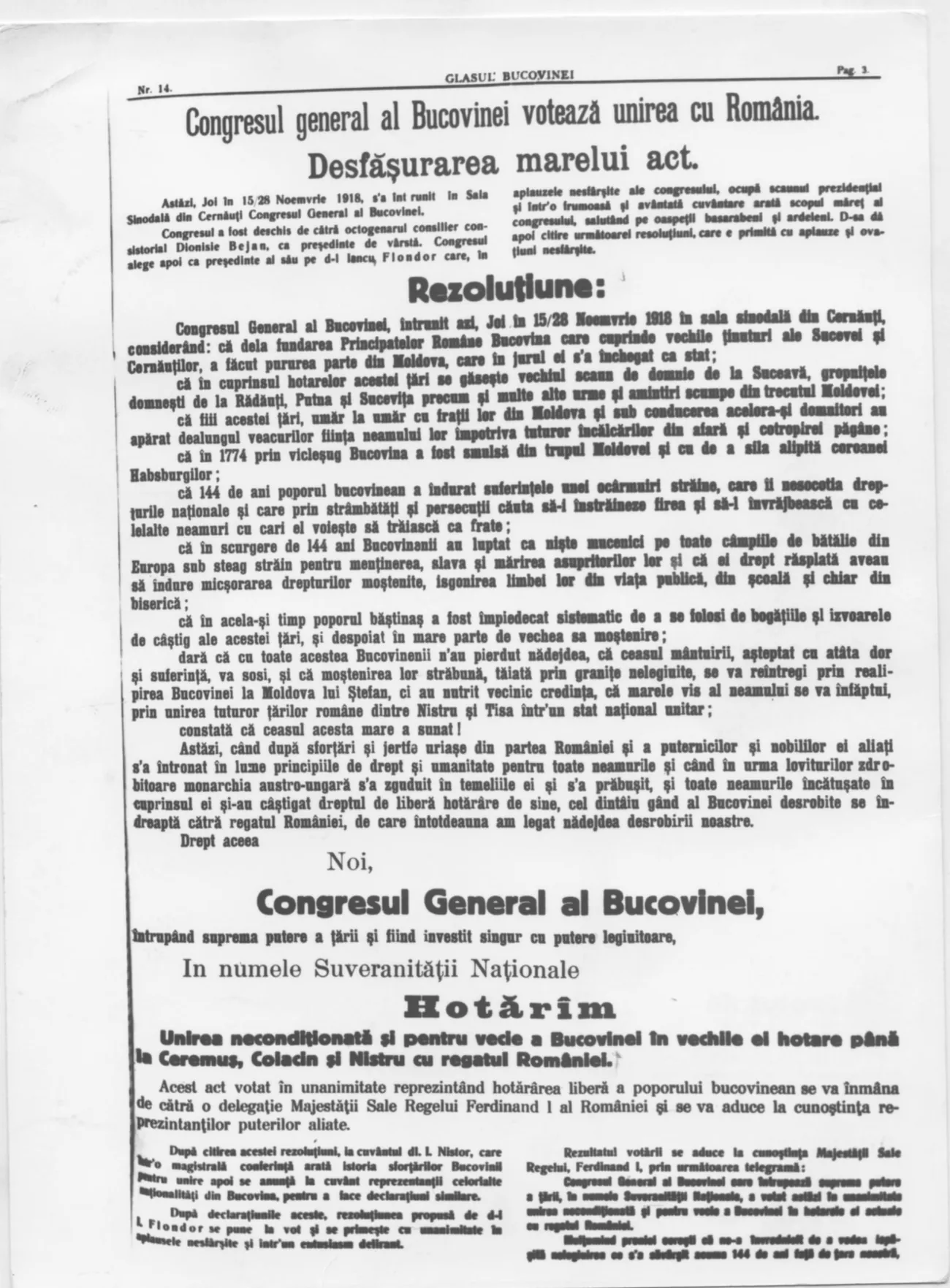
Page three of issue 14 prints the text that was voted. After eight paragraphs beginning «that…», the congress decides on «the unconditional union, for ever, of Bukovina within its old borders up to the Ceremuș, the Colacin and the Dniester with the Kingdom of Romania».
In Cernăuți the motion declared the union unconditional. Three days later, the assembly at Alba Iulia voted to unite Transylvania with Romania and provided, in separate articles, for temporary autonomy and for principles of the new state's organisation. On that day: How 1,228 delegates united a country in one day.
The resolution in full
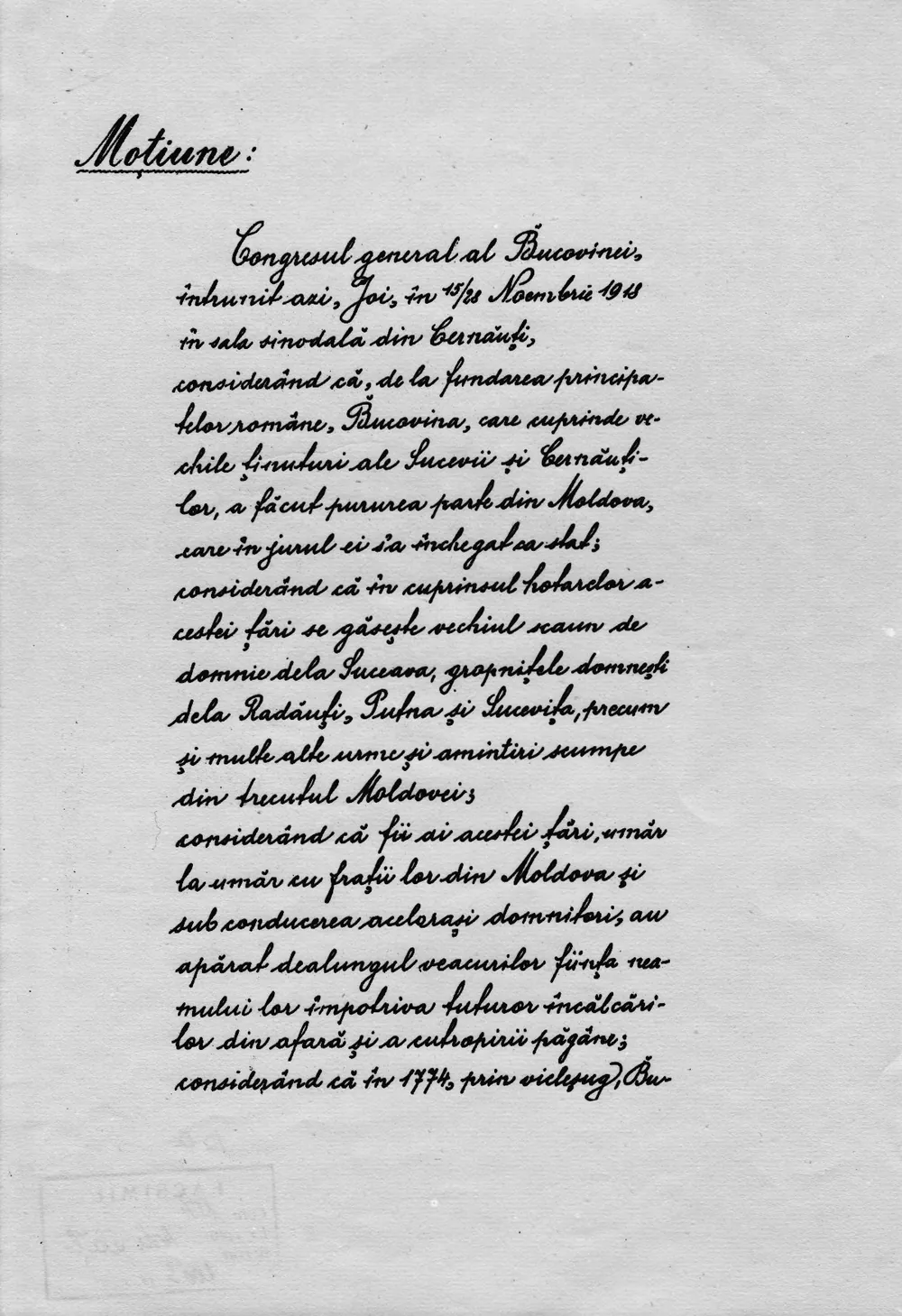
Translated from the text printed in Glasul Bucovinei no. 14, p. 3. The handwritten minutes call it a «Moțiune» (motion). The original Romanian is in the Romanian edition of this page.
The General Congress of Bukovina, meeting today, Thursday 15/28 November 1918, in the Synod Hall in Cernăuți,
considering: that since the founding of the Romanian Principalities, Bukovina, which comprises the old lands of Suceava and Cernăuți, was always part of Moldavia, around which that state took shape;
that within the borders of this land lie the old princely seat of Suceava and the princely burial churches of Rădăuți, Putna and Sucevița, as well as many other dear traces and memories of Moldavia's past;
that the sons of this land, shoulder to shoulder with their brothers in Moldavia and under the same princes, defended their nation through the centuries against every attack from outside and against pagan invasion;
that in 1774, by trickery, Bukovina was torn from the body of Moldavia and annexed by force to the crown of the Habsburgs;
that for 144 years the people of Bukovina endured the sufferings of a foreign administration that disregarded its national rights and sought, through injustice and persecution, to estrange it from its own nature and set it against the other peoples with whom it wishes to live as a brother;
that over 144 years the Bukovinians fought like martyrs on every battlefield of Europe under a foreign flag for the preservation, glory and greatness of their oppressors, and that their reward was to see their inherited rights reduced and their language driven out of public life, out of school and even out of church;
that at the same time the native people was systematically kept from using the wealth and sources of income of this land, and stripped of much of its old inheritance;
but that despite all this the Bukovinians never lost hope that the hour of deliverance, awaited with such longing and suffering, would come, and that their ancestral inheritance, cut by unlawful borders, would be made whole again by reattaching Bukovina to the Moldavia of Stephen; and they always kept the faith that the great dream of the nation would come true through the union of all the Romanian lands between the Dniester and the Tisza in one unitary national state;
declares that this great hour has struck!
Today, when after enormous efforts and sacrifices by Romania and her powerful and noble allies the principles of right and humanity for all peoples have been enthroned in the world, and when, after crushing blows, the Austro-Hungarian monarchy has been shaken to its foundations and has collapsed, and all the peoples chained within it have won the right to decide freely for themselves, the first thought of liberated Bukovina turns to the Kingdom of Romania, to which we have always tied our hope of liberation.
Therefore
We,
the General Congress of Bukovina,
embodying the supreme power of the land and alone invested with legislative power,
In the name of National Sovereignty
Decide
The unconditional union, for ever, of Bukovina within its old borders up to the Ceremuș, the Colacin and the Dniester with the Kingdom of Romania.
«Up to the Ceremuș, the Colacin and the Dniester»
The rivers named in the resolution are the province's old borders to the west, north and north-east. The congress claimed the entire former duchy. Its claim overlapped with the Ukrainian assembly's in the north and in Czernowitz, and also took in the south of the province.
The telegram sent to the king the same day spoke of Bukovina «within its present borders», meaning those of 1918. The final frontier was left to the peace conference in Paris.

A circle dance in the square and adverts on the last page
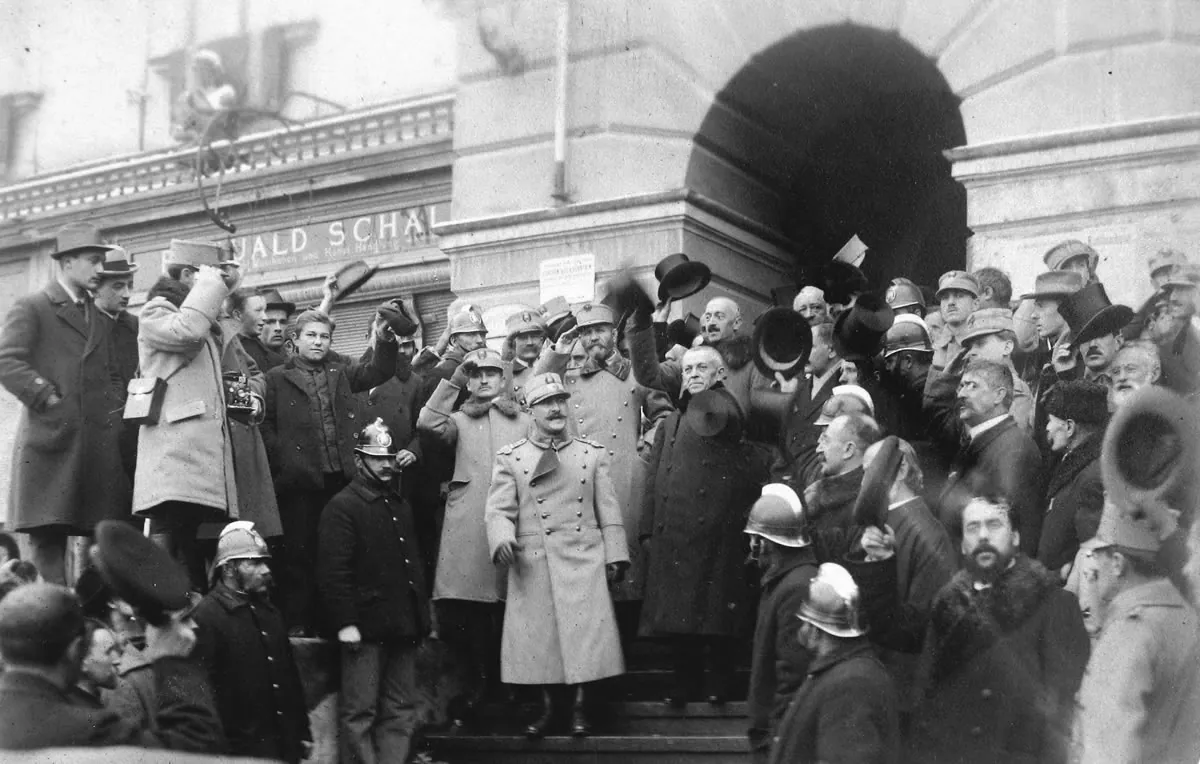
After the congress, Glasul Bucovinei reports, people danced the «hora unirii», a circle dance celebrating union, in the city's main square. On the front page of issue 14, next to Nistor's article, Pantelimon Halippa, a delegate from Bessarabia (a region that includes most of today's Moldova), wrote about «Two great days»: 27 March, the day Bessarabia voted to join Romania, and 15 November, the day of the Cernăuți vote, both old-calendar dates (9 April and 28 November in the new one).
The last page of the same issue shows the everyday city: a «Latest news» column, adverts for a dentist and a «Salon de tuns și ras» (barber's), and the «People's Calendar for 1919».
Two dates for one day: Austrian Bukovina used the Gregorian calendar, while Romania still used the Julian one until spring 1919. The paper printed both: «15/28 Noemvrie».

From vote to law
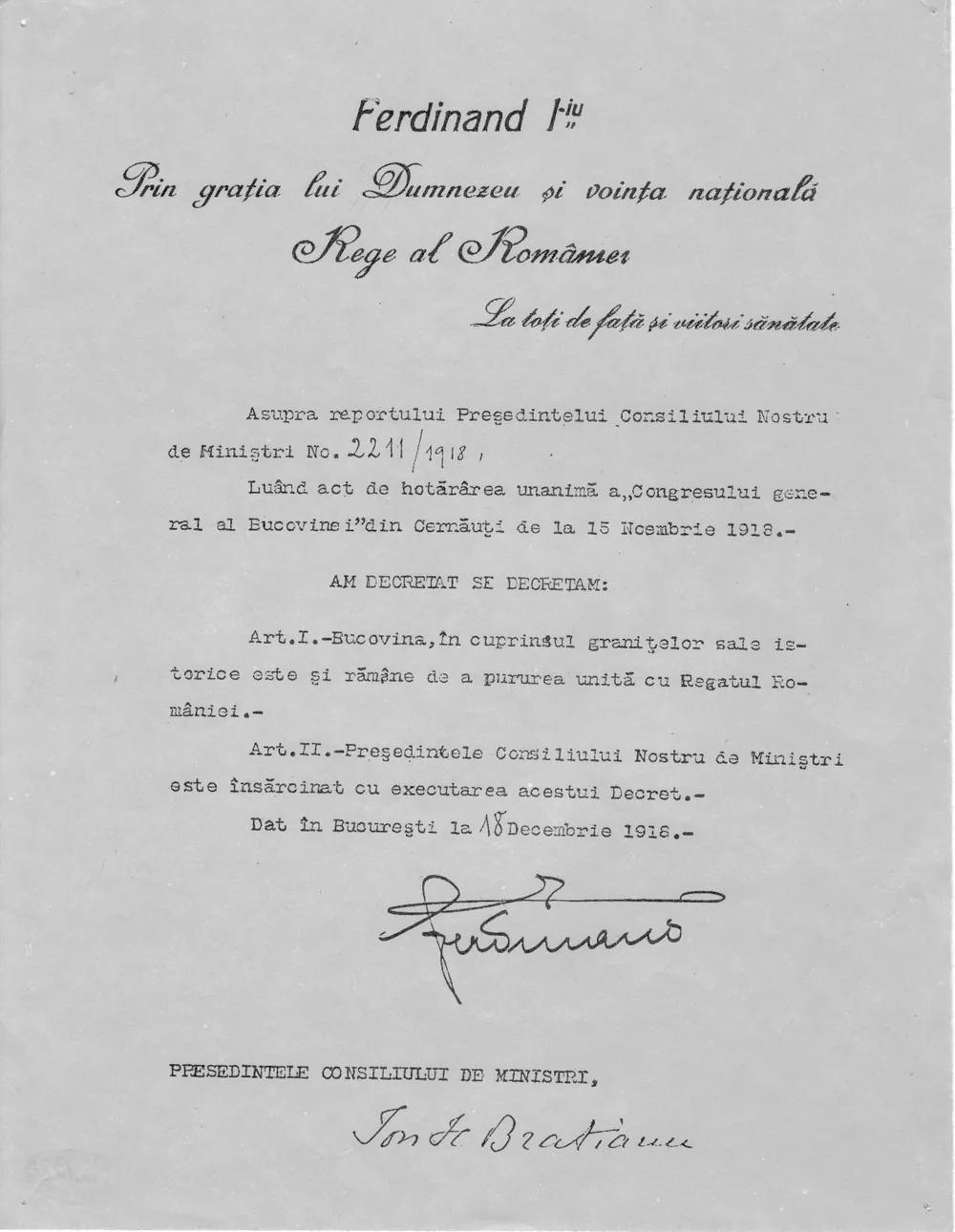
King Ferdinand signed decree-law no. 3744 in Bucharest on 18 December 1918 by the old calendar, 31 December by the new: «Bukovina, within its historic borders, is and remains for ever united with the Kingdom of Romania». Parliament ratified it by acclamation on 29 December 1919.
Under Article 59 of the Treaty of Saint-Germain-en-Laye of 10 September 1919, Austria renounced in Romania's favour its rights to the part of the former duchy within the frontiers fixed by the principal Allied powers. In the following years the university in Cernăuți became Romanian, and the state imposed Romanian in administration and schools, a policy its historians describe as Romanianisation.
June 1940: the northern half goes to the Soviet Union
After the Hitler–Stalin pact, the Soviet Union demanded Bessarabia and northern Bukovina from Romania in ultimatums of 26 and 27 June 1940. Romania's Crown Council decided to accept on the evening of 27 June, Romania communicated its acceptance on the morning of 28 June, and the Red Army crossed the frontier that day. On 29 June Soviet troops also entered the town of Hertsa, outside historical Bukovina and not named in the ultimatums.
The new line cut through the old Sereth and Radautz districts. Czernowitz, Storozynetz, Wiznitz and the whole north went to the Ukrainian SSR. In the Soviet Chernivtsi region, which also took in areas outside historical Bukovina, the authorities deported thousands of people in two waves, on 23 May and 13 June 1941.
In autumn 1940 Nazi Germany organised the resettlement of about 95,000 Bukovina Germans from both sides of the line, under separate agreements with the USSR and with Romania. Many were settled in Polish territory annexed by Germany.
1941–1944: the deportation of Bukovina's Jews
In July 1941 Romanian and German troops occupied northern Bukovina. In Cernăuți, German units and Romanian forces took part in massacres of Jews. Ion Antonescu's regime deported Jews from both northern and southern Bukovina to Transnistria, the territory between the Dniester and the Southern Bug then under Romanian administration.
Romanian authorities set up the Cernăuți ghetto on 11 October 1941. Yad Vashem records 28,391 Jews deported from the city by 15 November 1941; deportations resumed in 1942. The mayor, Traian Popovici, persuaded Antonescu to exempt up to 20,000 Jews from deportation, and the International Commission on the Holocaust in Romania (the Wiesel Commission) credits him with preventing the deportation of about 19,000. Some permit holders were deported in 1942.
The Red Army returned to Cernăuți on 29 March 1944. The 1947 Paris peace treaty confirmed the Romanian–Soviet border established in Bukovina in 1940.
How Bukovina's towns and villages changed hands, from 1774 to today
Search for a place in former Bukovina by its Romanian, Ukrainian or German name, or pick it on the map. The result shows who governed the region, the languages recorded in its district in the 1910 census, and which side of the 1940 border it lay on.
On the map, tap near the place you want.
Two cities, one border
Chernivtsi (Cernăuți in Romanian) is the administrative centre of Ukraine's Chernivtsi region; Ukraine has faced Russia's full-scale invasion since 2022. The Yuriy Fedkovych Chernivtsi National University uses the former Metropolitan Residence, where the congress voted. South of the border, Suceava is the seat of Suceava County in Romania. The present border is governed by a treaty Romania and Ukraine concluded in 2003.
In Romania, 28 November has been «Bukovina Day» under Law no. 250 of 2015. The border between Bukovina and the pre-1918 Kingdom of Romania is still faintly visible in today's data: The 1918 border in today's figures, commune by commune.
The front page of 29 November 1918 keeps the joy of a newspaper that campaigned for union. It does not show the Ukrainian assembly of 3 November, the Jewish Council's letter of 27 November or the line of June 1940. All of them belong to the same story.

