1 December 1918 · Alba Iulia
How 1,228 delegates united a country in one day
On 1 December 1918, 1,228 elected delegates met at Alba Iulia and decreed the union of Transylvania, Banat, Crișana and Maramureș with Romania, before over 100,000 people in the cold. This is who they were, what they promised, and who answered otherwise.
Every road led to Alba
In November 1918 the convocations travelled by newspaper and by word of mouth, and the delegations travelled by cart, by train and on foot. Six of their starting points are documented; the map below draws their representative roads to Alba Iulia.
The spine beside the map is the Resolution itself: nine articles voted on 1 December. Choose one to read its gloss further down the page.
Representative routes
The spine: nine articles
Each route on the map ends where the Resolution begins.
- IThe union
- IIProvisional autonomy
- IIIThe six principles
- IVThe peace congress
- VThe Bukovina salute
- VIThe freed peoples
- VIIThe fallen
- VIIIThe Allies
- IXThe Great Council
Choose an article to read its gloss in the reader below.
Schematic map: six verified delegation origins, representative dashed routes, no per-county figures. Anything more precise would be invented.
Chapter I
The call
12 October – 23 November 1918 · from Oradea to Blaj
- Chapter
- 1918
- Oradea
- 12 October 1918
- Budapest
- 18 October 1918
- Blaj
- 23 November 1918
On 12 October 1918 the Executive Committee of the Romanian National Party met at Oradea and adopted a declaration of self-determination, drafted by Vasile Goldiș's pen: Budapest would no longer speak for the Romanians at the coming peace conference. Six days later, on 18 October, Alexandru Vaida-Voevod read it aloud in the Hungarian parliament.
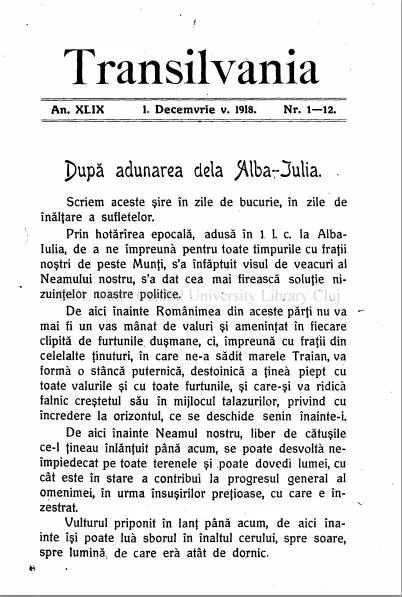

At Arad, on 30–31 October, the Central National Romanian Council took shape as the Romanians' provisional lead, and on 6 November it published its manifesto to the nation. A memorandum followed on 9 November, demanding Eastern Hungary's handover; the talks with Budapest's ministers at Arad, on 13–15 November, failed. The Council then convened the National Assembly for 18 November old style, 1 December new style.
On 23 November a Farman F.40 biplane landed at Blaj carrying letters about the union, including from Ion I. C. Brătianu, and flew the union decision back the next day. The call was out; the elections for the Assembly ran through November, district by district.
On the ground of the natural right of every nation to dispose of and decide its own fate alone and freely…
The Oradea declaration, 12 October 1918
Meanwhile: Meanwhile, on 25 November, the Saxon General Council at Sibiu chose neutrality, committing to neither the Hungarian nor the Romanian side.
Chapter II
The road
November 1918 · 600 elected, 628 appointed
- Chapter
- 1,228
- Elected
- 600, five per district
- Appointed
- 628, for organisations
- Counties
- 26
In a twelve-day interval in November 1918 the Romanians of Transylvania, Banat, Crișana and Maramureș elected their Assembly: 600 deputies, five from each electoral district drawn in 1910, and 628 more for the churches, the teachers' unions, the soldiers and the cultural associations. Together: 1,228 credentials.
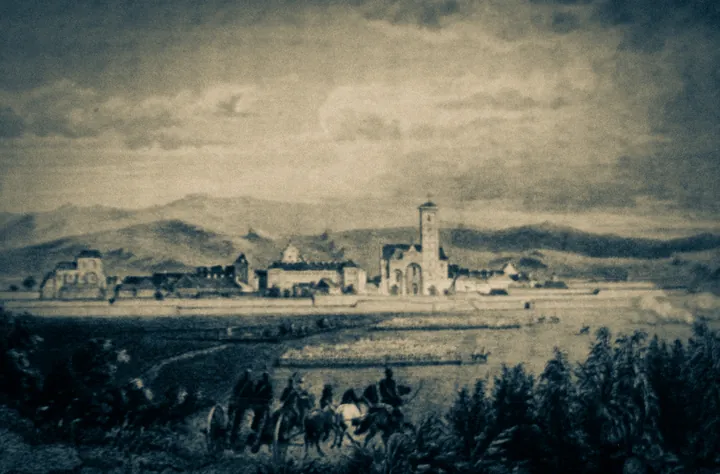

The convocation of 7/20 November, printed in Românul no. 10 at Arad and in Unirea at Blaj, called the Assembly to Alba Iulia and hoped the Romanian people itself would attend in numbers worthy of the cause. Delegations formed in Arad and Bistrița, in Brașov and Sibiu; one set out from București, across the Carpathians.
The road ran through snow: carts creaked toward Alba in the frozen ruts while a German army withdrew the same way, gun after gun. Samoilă Mârza, a peasant veteran from Galtiu, rode 11 km by bicycle with his camera to join his village delegation on the morning of 1 December.
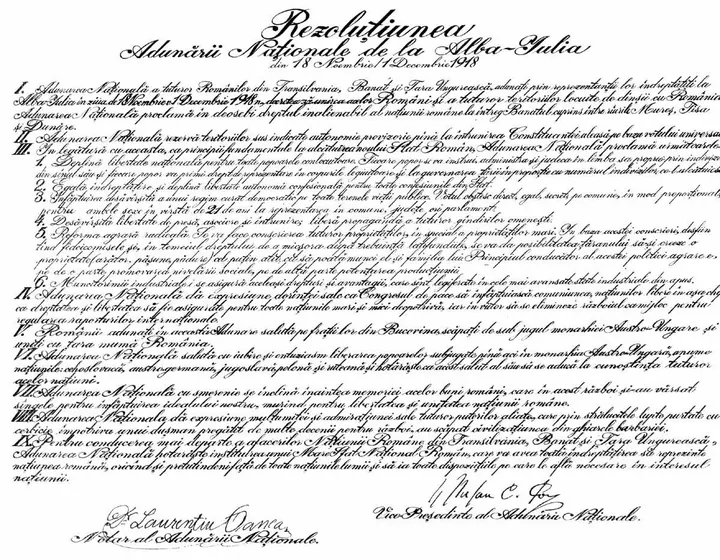
The National Assembly reserves for the above territories provisional autonomy until the meeting of the Constituent Assembly, elected on the basis of universal suffrage.
The Resolution, article II
Meanwhile: Meanwhile, on 28 November, Bukovina voted union at Cernăuți while at Târgu-Mureș the Székely assembly voted for Hungary's territorial integrity.
Chapter III
The day
1 December 1918 · 18 November old style
- Chapter
- 1 December 1918
- In the hall
- 1,228 delegates
- On the field
- Over 100,000
- The vote
- Unanimous
On the morning of 1 December 1918, 18 November by the old calendar the delegates still used, the credentials were counted at the military casino hall: 1,228, every one elected or appointed in November. Outside, on Câmpul lui Horea, over 100,000 people waited in the winter cold; one account puts them above 120,000.

In the hall Gheorghe Pop de Băsești presided while Vasile Goldiș presented the Resolution: nine articles, the union first, the democratic conditions with it. The vote was unanimous. Then Bishop Iuliu Hossu carried the text to the field and read it to the multitude.
The Assembly's writ ran over 26 counties of the old Kingdom of Hungary, and its last article instituted the Great National Romanian Council to speak for the nation before all the nations of the world. The union it decreed was conditional: autonomy first, a constituent assembly after, rights for all who lived in the new state.
All your life you will bear witness with pride: I too was at Alba Iulia!
Bishop Iuliu Hossu, to the crowd
Meanwhile: Meanwhile, that same day, King Ferdinand and Queen Marie rode back into Bucharest at the head of the army.
Chapter IV
The echo
2 December 1918 – August 1919 · councils and answers
- Chapter
- 1918 – 1919
- 2 December 1918
- The Directing Council
- 22 December 1918
- Cluj answers
- 8 January 1919
- Mediaș adheres
On 2 December the High National Romanian Council, 200 Assembly members plus 50 co-opted, formed a government for the united lands: the Directing Council under Iuliu Maniu. On 11 December King Ferdinand signed the Union Law: the lands named in the Alba Iulia resolution are and remain forever united with the Kingdom of Romania.
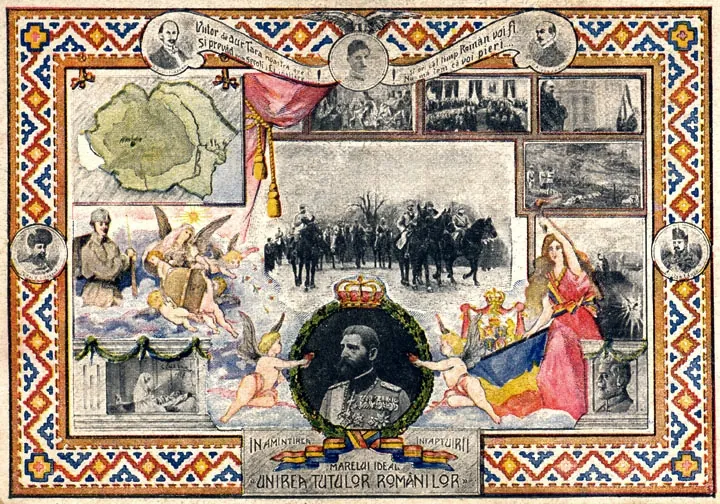

Not everyone had voted at Alba. On 22 December a Hungarian assembly at Cluj, organised around István Apáthy, reasserted the will to remain in Hungary; the Romanian army entered Cluj two days later, on 24 December. The Székely assembly of 28 November had already voted the same way at Târgu-Mureș.
The Saxons answered otherwise. After the neutrality of 25 November, their National Assembly met at Mediaș on 8 January 1919 and adhered to the union, trusting article III's first point: full national freedom for the co-inhabiting peoples. The Jews adhered in January 1919, the Swabians in August.
The lands named in the resolution of the Alba Iulia National Assembly of 18 November 1918 are and remain forever united with the Kingdom of Romania.
The Union Law, 11 December 1918
Meanwhile: Meanwhile, on 4 August 1919, the Romanian army entered Budapest.
Carry your village credential
Choose one of six documented delegations, then walk its four legs: the departure, the hall, the multitude and the echo. Every choice arrives; the questions check the journey against the sources. An illustrative game: only the origins and the Alba arrival are documented.
Choose your delegation:
-
1
The departure
The convocation of 7/20 November names the place and the day. Your cart is loaded; where do you go?
What happened
Românul no. 10 printed the convocation: the Assembly meets at Alba Iulia on 1 December, 18 November old style.
-
2
The hall
At the casino hall the doorkeepers count credentials. How many enter with a vote?
What happened
600 elected plus 628 for the organisations: 1,228 credentials cross the hall's threshold.
-
3
The multitude
On Câmpul lui Horea the crowd cannot fit into the hall. Someone must read the Resolution to them from the field.
What happened
Hossu read the Resolution to the multitude: all your life you will bear witness with pride.
-
4
The echo
In January 1919 one more national assembly meets, at Mediaș, and adheres to the union. Who gathers there?
What happened
On 8 January 1919 the Saxon National Assembly at Mediaș voted adhesion to the union.
Answer a card to set out.
The Resolution, article by article
Nine articles, voted as one text on 1 December 1918. Only the third carries subpoints: six of them. Open each for its gloss.
Article IThe union
The Assembly decrees the union of the Romanians of Transylvania, Banat and the Hungarian Land, and of all their territories, with Romania – and proclaims the inalienable right to the whole Banat between the Mureș, the Tisa and the Danube.
Article IIProvisional autonomy
The united territories keep provisional autonomy until the Constituent Assembly elected by universal suffrage meets.
Article IIIThe six principles
Six founding principles: national freedom for the co-inhabiting peoples; religious freedom; full democracy with universal, direct, equal and secret vote for both sexes from the age of 21; press and assembly freedoms; radical land reform; western-grade rights for industrial workers.
Article IVThe peace congress
The wish that the peace congress build a communion of free nations, with justice and liberty for great and small nations alike, and war abolished as a means of settling disputes.
Article VThe Bukovina salute
A salute to the brothers in Bukovina, freed from the Austro-Hungarian yoke and united with the motherland.
Article VIThe freed peoples
A loving salute to the liberated Czechoslovak, Austro-German, Yugoslav, Polish and Ruthenian nations.
Article VIIThe fallen
A bow before the memory of the Romanians who shed their blood in the war for liberty and national unity.
Article VIIIThe Allies
Thanks and admiration for the Allied powers, who saved civilisation from the claws of barbarism.
Article IXThe Great Council
A Great National Romanian Council is instituted to lead the nation's affairs, with full right to represent it before all the nations of the world. Recorded by Laurențiu Oanea, notary of the Assembly.
The glosses condense the 1918 text; the articles themselves are public domain and quoted in the chapters.
The day in numbers
Six figures, every one cited below and recomputed against this page at build time.
- 1,228
- credentials counted in the hall
- 600
- elected, five per district
- 628
- for churches, teachers and soldiers
- 100,000
- people on Câmpul lui Horea, at least
- 26
- counties in the declaration
- 9
- articles in the Resolution
Three myths, examined
Everyone agreed
Partly true, then false. The hall voted unanimously, and the Saxons adhered at Mediaș on 8 January 1919. But the Resolution itself promised the co-inhabiting peoples national freedom in their own language; the Székely assembly of 28 November 1918 voted for Hungary; and the Hungarian assembly at Cluj answered no on 22 December 1918. Consent was broad, not universal.
The union was unconditional
False: read articles II and III. The united lands kept provisional autonomy until a constituent assembly elected by universal suffrage, and the union carried six democratic conditions, from land reform to the vote for both sexes from the age of 21.
A hired professional photographed the day
False, and the reason this page shows no photographs of the crowd. The only pictures were taken by Samoilă Mârza, a peasant veteran from Galtiu who rode 11 km by bicycle with his own camera. He died in 1967, so his photographs are not public domain; the page uses the 1918 press, the Resolution and an 1883 engraving instead.
Sources and method
Every date and figure on this page is recomputed against the built HTML by scripts/check.py, and every factual claim above the sources section carries a citation below it. Short quotations come from 1918 public-domain texts, except one brief public utterance by Bishop Hossu, attributed and cited.
The map and the game are illustrative where labelled so. What the sources do not support – per-county delegate counts, the exact crowd figure, the union-law decree number – stays off the page as nedocumentat, the Romanian archival word for undocumented.
The call
- The Oradea declaration, 12 October 1918: text in Revista Arhivelor LXV, 1-2/2003
- 18 October 1918: Vaida-Voevod reads the declaration in Budapest; Emperor Charles's manifesto
- The CNRC at Arad, 30-31 October 1918; the 6 November 1918 manifesto
- The 9 November 1918 memorandum; the Arad talks, 13-15 November 1918
- The Blaj flight, 23 November 1918: the Farman F.40 with the union letters
The road
- The November 1918 elections: 1,228 members, 600 elected and 628 for organisations
- The 7/20 November 1918 convocation, in Românul no. 10 and in Blaj's Unirea
- The snow on the road to Alba, after Blaga's memoirs (Sebeș mayoral message)
- The Arad, Bistrița, Brașov, București and Sibiu delegations; Mârza with the Galtiu villagers
The day
- 1 December 1918: 1,228 delegates, unanimous vote, 26 counties
- Over 100,000 people on Câmpul lui Horea (Revista Arhivelor LXV, 1-2/2003)
- Gheorghe Pop de Băsești presides; Vasile Goldiș presents the Resolution
- Bishop Iuliu Hossu reads the Resolution to the crowd: 'Și eu am fost la Alba Iulia!'
- That same 1 December 1918: Ferdinand and Marie re-enter Bucharest triumphantly
The echo
- 2 December 1918: the Great Council (200 plus 50) and the Directing Council government, Iuliu Maniu
- 11 December 1918: King Ferdinand signs the Union Law
- 22 December 1918: the Hungarian assembly at Cluj; the Romanian army enters Cluj on 24 December
- 8 January 1919: the Saxon Assembly at Mediaș adheres to the union
- 28 November 1918: the Székely assembly at Târgu-Mureș; Bukovina's union the same day
The game
The reader
The pictures and their licences
- The 1918 Resolution, via CIMEC · Wikimedia Commons
- Transilvania, December 1918 · Wikimedia Commons
- Romanian postcard, about 1918–1919 · Wikimedia Commons
- Ludwig Rohbock, 1883 · Wikimedia Commons