An animal 0.05–2.1 millimetres long
The water bear survived open space. A 37-degree day kills it
Dried out, it spent ten days in the vacuum of space and woke after over 30 years frozen. Awake, it dies at the temperature of a torrid summer day. Measure yourself against it and see what kills it.
Measure yourself against itStand next to it
How small is it, really?
Set your height and slide the water bear along the ruler, from the smallest to the largest documented specimen.
A 135 cm child would be spanned, head to toe, by 2,700 water bears of 0.5 mm, laid head to tail.
The ruler runs from 0.05 to 2.1 mm: the whole documented range, from a 2017 review.
A schematic drawing: the animal and the ruler share one scale, but it is not life size on your screen.
All 1,549 known species fit between 0.05 and 2.1 millimetres, and the largest is 42 times longer than the smallest. They have eight legs, usually clawed, a complete digestive tract and a ring-shaped brain around the mouth, joined to a chain of ganglia along the belly.
Home is damp moss, lichen and soil. To feed and reproduce they need a thin film of water around the body; when the water dries, the tun trick begins.
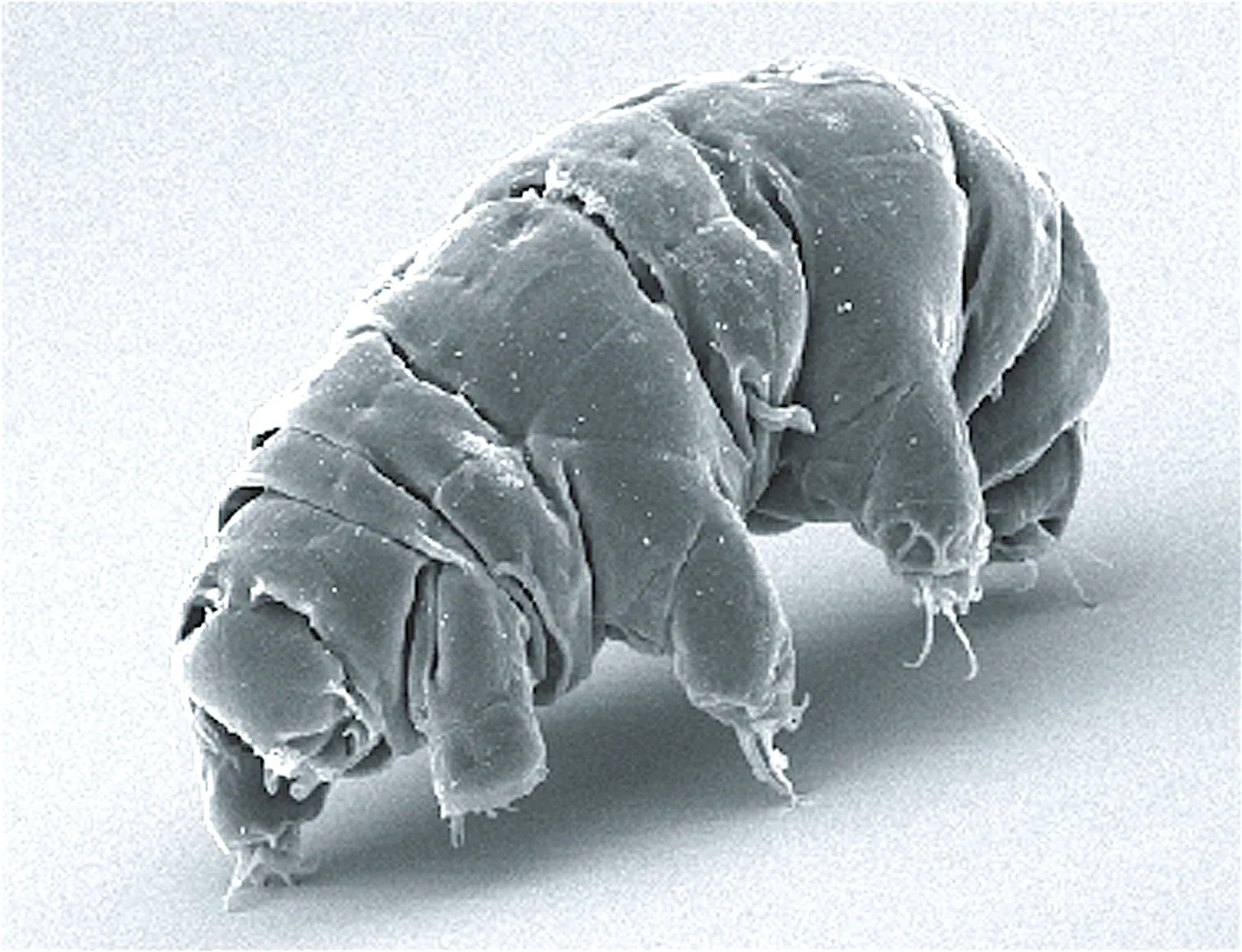
The secret
The tun that waits for years
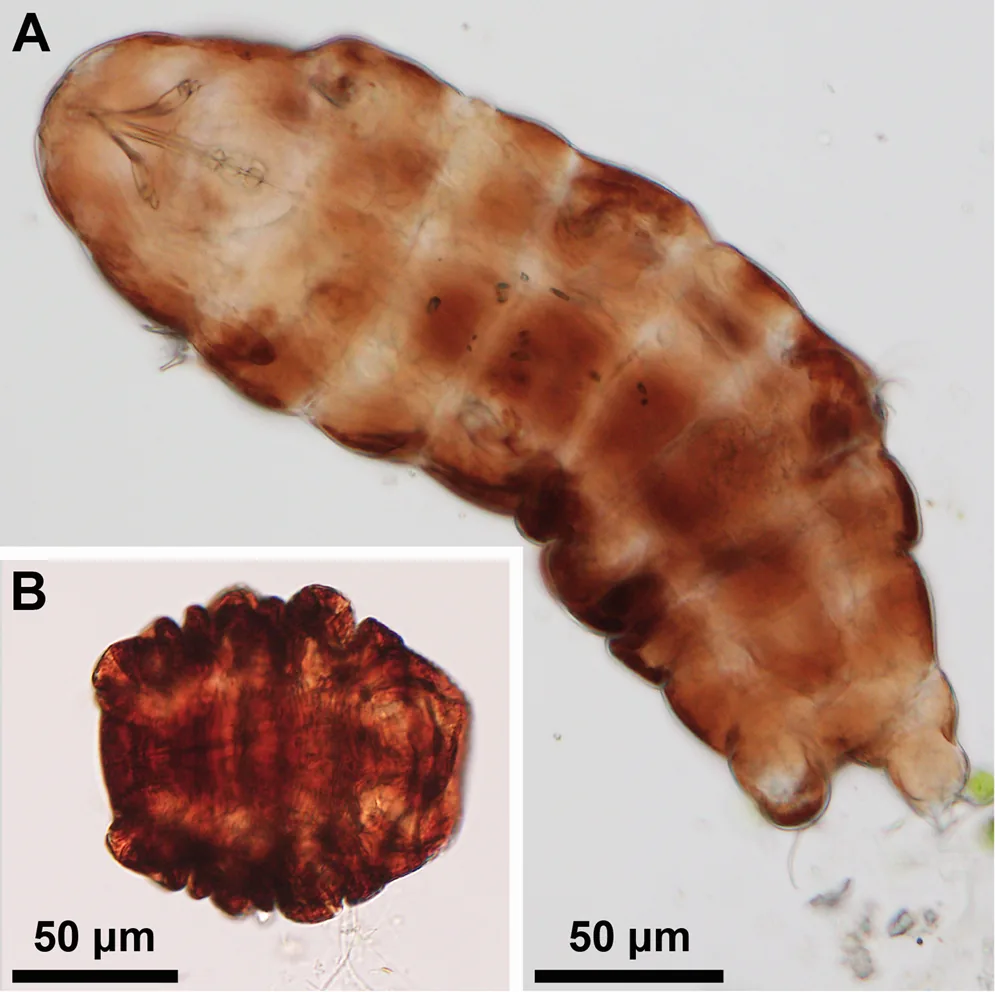
When the moss dries, the water bear curls up, pulls its legs into its body and waits. In this dried form, its life stops.
Which of them survives a whole year without a single drop of water?
The tun. As it dries, the body loses over 97% of its water and enters anhydrobiosis, the dry sleep in which metabolism stops.
That is how it lasts for years: between 9 and 20 years in natural conditions. The record belongs to Antarctic moss kept 30 and a half years at −20 °C, from which two animals and one egg woke up and went on to reproduce.
The hundred-year story is false, though. The only evidence ever offered is one tun from 120-year-old moss, which twitched once and never moved again. The two specialists who checked the case put the realistic limit at a decade.
The tun is more than a curl. The skin shrinks its surface, and water loss through the skin falls to about half, which buys time to make protective substances. The water still bound to molecules is replaced with trehalose and other molecules that guard proteins and DNA.
Not every species knows the trick equally well: drying tolerance differs between species and even between populations of one species.
2007 · ten days
Ten days in space, without a suit
Dried specimens of two species, Milnesium tardigradum and Richtersius coronifer, flew on the Foton-M3 capsule in low orbit, 258 to 281 kilometres up: in vacuum, in vacuum with partial ultraviolet, and in vacuum with the full ultraviolet spectrum.
What killed them in space?
The sunlight. The groups kept in vacuum survived as well as the controls on Earth, while the groups hit by ultraviolet survived worse.
Under partial ultraviolet, 68% of Milnesium tardigradum woke within 30 minutes, but many died afterwards, while a single Richtersius coronifer woke. Under the full ultraviolet spectrum three specimens survived, all Milnesium tardigradum: under 3% of the group.
They were the first animals to survive open space, and some of the survivors went on to reproduce.
The three groups on Foton-M3
The figures come from reviews citing the original study (Jönsson et al. 2008). Every exposed specimen was dried.
The limits
What kills it at home
The tun endures. The awake animal is fragile, though, and some limits are surprisingly low.
Heat fells it first. Kept awake for a whole day at 37.1 °C, half the Ramazzottius varieornatus specimens died, and brief warming beforehand moved the limit only to 37.6 °C. Depending on species, total death comes between 36 and 39 °C.
A swimming water bear would not survive boiling water: no awake specimen gets past 39 °C.
Dried, everything depends on species. After an hour at 100 °C, no Macrobiotidae or Echiniscidae survives, but over 90% of Milnesium tardigradum does. The 150 °C repeated everywhere comes from a 2017 review, for 15 minutes at most; the modern hour-long tests tell a more nuanced story.
The dose that kills half the hydrated adults is 5,000 Gy: 1,250 times the 4 Gy dose that kills half the people exposed without care. But past 1,000 Gy the animal no longer reproduces, and half the eggs fail to hatch at 48 Gy, nearly a hundred times less than adults of the same species withstand.
And between species the differences are huge. At 2.5 kJ/m² of ultraviolet, Hypsibius dujardini dies on the spot, while 81.1% of Ramazzottius varieornatus still move after five days.
What the sources read cannot say
- No study read boils the tun: about the dried animal in boiling water we know nothing.
- The −272.8 °C and 150 °C records come from a review citing old experiments; the original papers were not read here.
- This page says nothing about crushing pressures: the primary sources were not read.
- The limits above come from a few laboratory species; most of the 1,549 species were never tested in the studies read.
- The 2007 flight figures come from reviews citing the original study, because the article itself could not be opened.
The mechanism
The protein standing guard on DNA
A protein found only in tardigrades, Dsup, binds to DNA and protects it from breaks.
Researchers gave the Dsup gene to human cells in the laboratory, then irradiated them with 10 Gy of X-rays. Broken DNA was 16% in the Dsup cells against 33% in controls: less than half.
The same happened with hydrogen peroxide, which attacks DNA through oxidative stress: 18% against 71% in controls. And some of the irradiated cells kept on dividing.
Game
True or false?
Eight statements about the water bear. Some sound like fairy tales and are true.
The eight statements and their answers:
- True. A dried water bear spent ten days in the vacuum of space and survived. On the Foton-M3 capsule, the groups kept in vacuum survived as well as the controls left on Earth. The sunlight killed them. Jönsson et al. 2008, Current Biology
- False. Under direct sunlight in space, nearly all of them survived. Under the full ultraviolet spectrum three specimens survived, all Milnesium tardigradum: under 3% of the group. Jönsson et al. 2008 (Vasanthan et al. 2014)
- False. An awake water bear can stand boiling water. Kept awake for a day at 37.1 °C, half the animals died, and between 36 and 39 °C all of them die. Boiling water is far hotter. Neves et al. 2020, Scientific Reports
- True. Two water bears woke up after over 30 years in a freezer. From moss gathered in Antarctica in 1983 and kept at −20 °C for 30.5 years, two individuals and one egg revived, and went on to reproduce. Tsujimoto et al. 2016, Cryobiology
- False. A dried tun can wait a hundred years. The only evidence ever offered for a century is one tun from 120-year-old moss, which twitched once and never moved again. A decade is the realistic limit. Jönsson & Bertolani 2001, J. Zool.
- True. At 100 °C some species die out entirely while one escapes nearly untouched. After an hour of dry heat, no Macrobiotidae or Echiniscidae survived, but over 90% of Milnesium tardigradum did. Hengherr et al. 2009, Physiol. Biochem. Zool.
- False. If it survives radiation, the water bear escapes unharmed. Over 1,000 Gy sterilises it, and half the eggs fail to hatch at 48 Gy, nearly a hundred times less than the dose adults withstand. Horikawa et al. 2006, Int. J. Radiat. Biol.
- True. A tardigrade protein shields even human cells from radiation. Human cells given Dsup showed 16% broken DNA after X-rays against 33% in controls, and some kept on dividing. Hashimoto et al. 2016, Nature Communications
Sources
How we know all this
Every number on this page comes from a published study, read in full or as an abstract; the list says how far each reading went. The 2007 flight figures come from reviews citing the original study.
Five things often met elsewhere are missing or look different here: immortality (the awake animal dies at 37 degrees), the hundred-year dry sleep (a story with almost no evidence), the 150 °C without a duration (15 minutes at most, in a 2017 review), abyssal pressure (the primary sources were not read) and the boiled tun (no study read boils one).
The body and its size
- Erdmann W, Kaczmarek Ł (2017). Tardigrades in space research – past and future. Origins of Life and Evolution of Biospheres 47: 545–553. doi:10.1007/s11084-016-9522-1 — the 0.05–2.1 mm range, the years of dry sleep, the cold and heat records
- Degma P, Guidetti R (2026). Actual checklist of Tardigrada species, 45th edition. doi:10.5281/zenodo.20746849 — 1,549 species, 168 genera, 35 families
The tun and the long sleep
- Jönsson KI, Bertolani R (2001). Facts and fiction about long-term survival in tardigrades. Journal of Zoology 255(1): 121–123. doi:10.1017/S0952836901001169 — the hundred-year claim dismantled, the decade limit
- Tsujimoto M, Imura S, Kanda H (2016). Recovery and reproduction of an Antarctic tardigrade retrieved from a moss sample frozen for over 30 years. Cryobiology 72(1): 78–81. doi:10.1016/j.cryobiol.2015.12.003 — revival after 30.5 years at −20 °C (abstract read)
The 2007 flight
- Jönsson KI, Rabbow E, Schill RO, Harms-Ringdahl M, Rettberg P (2008). Tardigrades survive exposure to space in low Earth orbit. Current Biology 18(17): R729–R731. doi:10.1016/j.cub.2008.06.048 — the 2007 flight (read via the reviews below; the article itself could not be opened)
- Vasanthan T, Lubberdink A, Stone J (2014). Tardigrade exposure to outer space conditions – an experimental validation. Journal of Astrobiology & Outreach. walshmedicalmedia.com (PDF) — the TARDIS figures: the vacuum, the 68%, the three survivors
- Horikawa DD et al. (2013). Analysis of DNA repair and protection in the tardigrade Ramazzottius varieornatus and Hypsibius dujardini after exposure to UVC radiation. PLoS ONE 8(6): e64793. doi:10.1371/journal.pone.0064793 — under 3% in space with ultraviolet; H. dujardini dies at 2.5 kJ/m²
Heat and radiation
- Neves RC et al. (2020). Thermotolerance experiments on active and desiccated states of Ramazzottius varieornatus emphasize that tardigrades are sensitive to high temperatures. Scientific Reports 10: 94. doi:10.1038/s41598-019-56965-z — death at 37.1 °C, the active-animal and tun photographs
- Hengherr S, Worland MR, Reuner A, Brümmer F, Schill RO (2009). High-temperature tolerance in anhydrobiotic tardigrades is limited by glass transition. Physiological and Biochemical Zoology 82(6): 749–755. doi:10.1086/605954 — the 100 °C lottery (abstract read)
- Horikawa DD et al. (2006). Radiation tolerance in the tardigrade Milnesium tardigradum. International Journal of Radiation Biology 82(12): 843–848. doi:10.1080/09553000600972956 — the 5,000 Gy LD50, sterilisation above 1,000 Gy (abstract read)
- Jönsson KI et al. (2013). Tolerance to gamma-irradiation in eggs of the tardigrade Richtersius coronifer depends on stage of development. Journal of Limnology 72(s1): 73–79. doi:10.4081/jlimnol.2013.s1.e9 — half the eggs fail to hatch at 48 Gy
- Dainiak N (2011). Medical management of the acute radiation syndrome. Reports of Practical Oncology and Radiotherapy. PMC3863169 — the human lethal dose, about 4 Gy
The Dsup protein
- Hashimoto T et al. (2016). Extremotolerant tardigrade genome and improved radiotolerance of human cultured cells by tardigrade-unique protein. Nature Communications 7: 12808. doi:10.1038/ncomms12808 — the Dsup protein, 16% against 33%, 18% against 71%
The drawings
The ruler, the mission diagram and the pictograms are drawn for this page, from the studies' figures.