mariuscomper.uk Română

Ursus spelaeus, the last cave bear

The half-tonne giant that lived on plants alone

Males weighed 400–500 kilograms and stood 1.7 metres at the shoulder, and their bones say they ate only plants. Stand next to them, to scale, and see what researchers found in the caves of Romania.

Go down through time
  1. Today

    At Bears' Cave in Chișcău, guides tell the story of the 140 bears trapped inside 15,000 years ago. The digs say otherwise.

  2. 51 years ago

    In 1975 a blast at the marble quarry opens the cave. Traian Curta, a miner, climbs down the shaft first. Five years later the cave opens to visitors.

  3. About 100 years ago

    Between 1917 and 1921 Emil Bächler digs Drachenloch cave in Switzerland and thinks he sees a bear cult. In 1975 Jean-Pierre Jéquier shows that no evidence holds up.

  4. 24,000–26,000 years ago

    The last cave bears die. The youngest dated bone comes from Poland, and the extinction falls in the coldest phase of the glaciation.

  5. 28,000–48,000 years ago

    Six bears from the Măgura, Cioclovina and Răsuflătoarei caves, whose bones would settle the food question, live in the Carpathians.

Stand next to it

How big was it, really?

Pick the bear, set your height and look. Then bring in today's brown bear.

Ursus spelaeus

Ursus spelaeus means “the bear from the cave”. It lived in Ice Age Europe.

Snout to tail it was 2.7–3.5 metres: between two and three ten-year-olds lying head to toe.

  • Length2.7–3.5 m
  • At the shoulderup to 1.7 m
  • Weightmales 400–500 kg, females 225–250 kg
  • Foodplants
  • Gone24,000–26,000 years ago

Silhouettes are scaled to the published length, snout to tail tip. For the cave bear the brown bear silhouette stands in: at this scale the shape differences between them do not show.

Large males weighed 400–500 kilograms, females 225–250. At the shoulder they reached up to 1.7 metres. By the leg bones, the cave bear was about the size of the largest bears alive today, and the idea of one-tonne giants has no support.

Reared on two legs, a male reached about 2.5 metres. The number comes from an old paper, from 1987; new studies give no standing height, so pictures promising three and a half metres promise something nobody has measured.
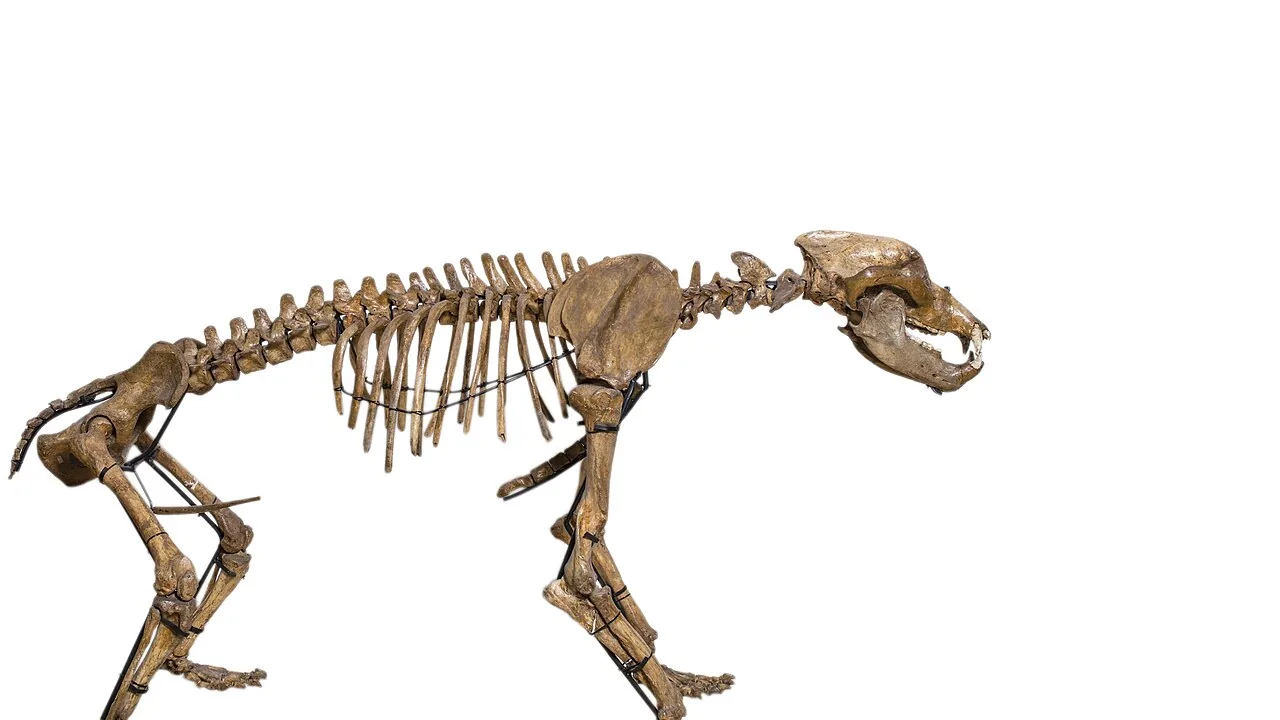
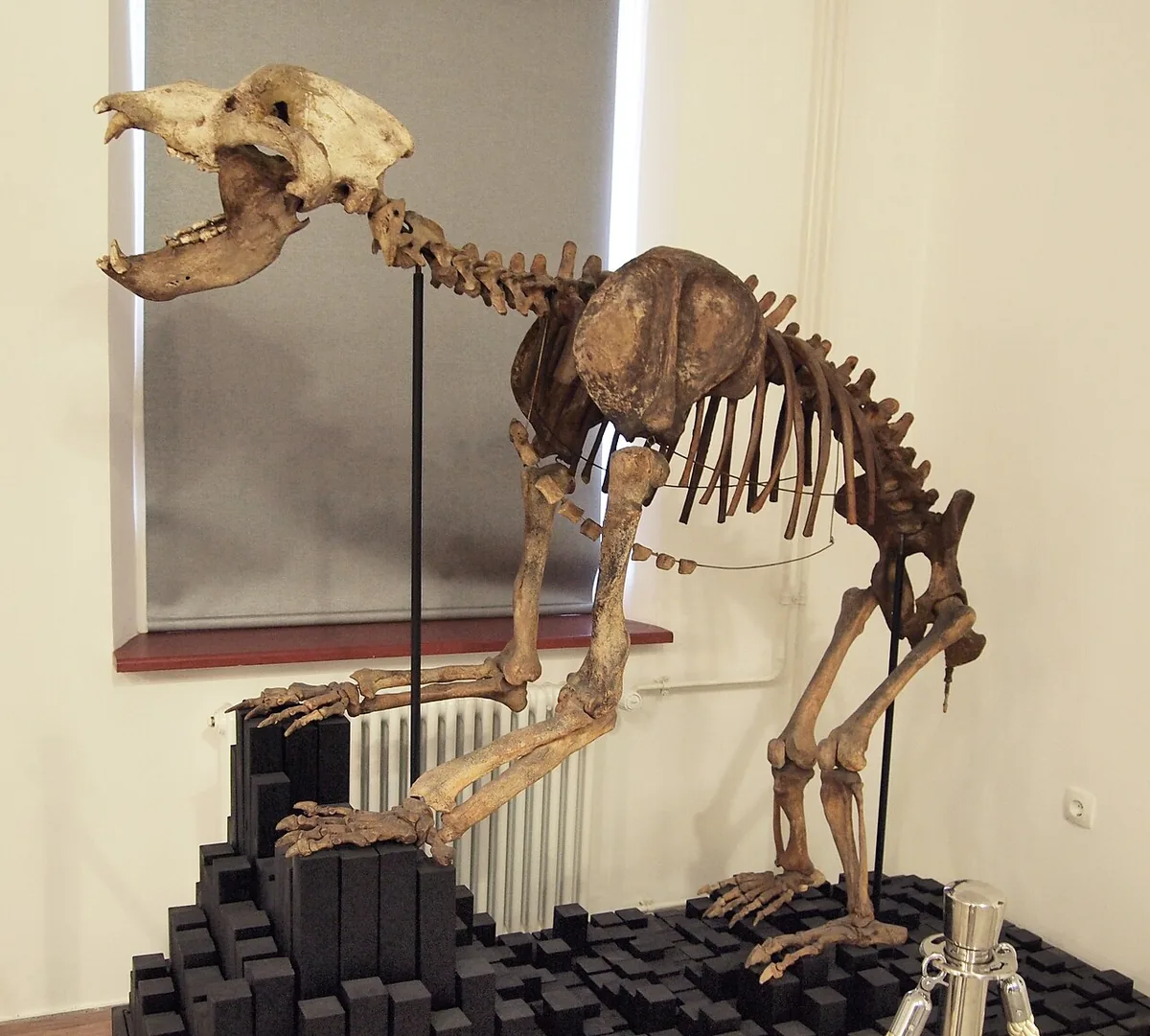
A mounted cave bear skeleton in a museum: a massive animal on all fours, with a large skull and a steep forehead.
A cave bear skeleton (MUSE Science Museum, Trento, Italy). The massive shoulders and the steep-foreheaded skull set it apart from the brown bear.Image: MUSE - Science Museum of Trento (photo: Niccolò Caranti), source, CC BY-SA 3.0

a male Ursus spelaeus

Ursus spelaeus

A half-tonne male, up to 1.7 metres at the shoulder, that ate only plants.

a male Ursus arctos, the living one

Ursus arctos

The bear of today's Carpathians, a close living relative of the cave bear.

Food

What did a half⁠-⁠tonne bear eat?

Bones of six bears from three Romanian caves settled an argument decades old. Guess first.

The giant from the cave was…?

All six bears tested, including the ones whose bones looked like meat-eaters', fed only on plants.

The old method measured the nitrogen in the whole bone, and in some Romanian bears the number came out high, like a lion's. The new method measures the nitrogen in two separate building blocks of bone, glutamate and phenylalanine, and shows it plainly: plants, in all six.

Bone nitrogen, in plain terms

The longer the bar, the higher up the food chain the animal looks. The horse sits low, the lion sits high, and the bears are all over, one even above the lion. By these bars, some bears would have eaten meat. The amino-acid analysis showed they did not.

0246810Horse4.2USR22 · Cioclovina5.2USR67 · Răsuflătoarei5.4USR10 · Măgura6.3USR11 · Măgura8.1Cave lion8.3USR25 · Cioclovina8.9USR65 · Răsuflătoarei9.8 δ15N (‰)
Nitrogen-15 (δ15N, per mille) in bone collagen, after Naito et al. (2020), Table 1. Rust bars are bears; gold bars are the comparison horse and lion.Naito și colab. (2020), Scientific Reports 10: 6612, tabelul 1, CC BY 4.0

The researchers compared the bears against two ends of the scale: a cave lion, which certainly ate meat, and a horse, which certainly ate plants. Three bears sat near the horse, two near the lion, and one, USR65 from Răsuflătoarei, above the lion.

That was where the argument started: by the old method, Romanian bears looked vegetarian at one moment and meat- or even fish-eaters the next. The new method sidesteps the problem, because the two building blocks in bone do not depend on the soil the plants grew in.

Two limits remain. Bones say the bears ate plants, but not which plants. And six bears are few, even from three caves. Beyond Romania, though, the hundreds of bones studied across Europe say the same: plants.

The cult story

Did people worship the bear? No.

For half a century textbooks said Neanderthals held a cult of the cave bear. The whole story started in one Swiss cave.

Walls, stone chests and aligned skulls

Between 1917 and 1921 Emil Bächler digs Drachenloch, “the Dragon's Hole”, in the Swiss Alps. He finds low stone walls, slab-built chests full of bear skulls, and one skull pierced by a femur. It seems plain to him: Neanderthals worshipped the bear.

The idea catches on. It enters novels, films and textbooks. Nobody checks the dig.

At Chauvet in France the floor is covered with 150 bear skeletons, and one skull sat on a slab, placed by a hand. What was it?

“There's no way to tell if it was just curiosity that made someone put a skull on the rock or if it had religious significance,” says Hervé Bocherens of the University of Tübingen.

The Chauvet skull was placed by a human hand, unlike the “evidence” from Drachenloch. But the hand does not say why.

Bears' Cave

What the guides say and what the bones say

The cave at Chișcău, in Bihor county, is among the most visited in Romania. The story you hear at the entrance sounds good. The bones say otherwise.

The guides' story

15,000 years ago the cave sheltered bears. At some point the entrance collapsed, and over 140 bears were trapped inside. Starving, they attacked each other until all were dead.
What the digs say

  • When? Not 15,000 years ago. The species had already been gone for some 9,000 years, and the Chișcău bears are from stage MIS 3, over 10,000 years older than the story.
  • How many? The 140 leaves no trail. The encyclopedia reference leads to a vanished student page. The old digs studied 1,660 bones, with 99 skulls and 107 femurs; the new one, 1,424 limb bones.
  • Cannibals? The marks belong to others. The bones carry tooth marks, but not from starving bears: at least two carnivores, the cave hyena among them, gnawed the bones. Elbows are the most gnawed, nearly 4 in 10.
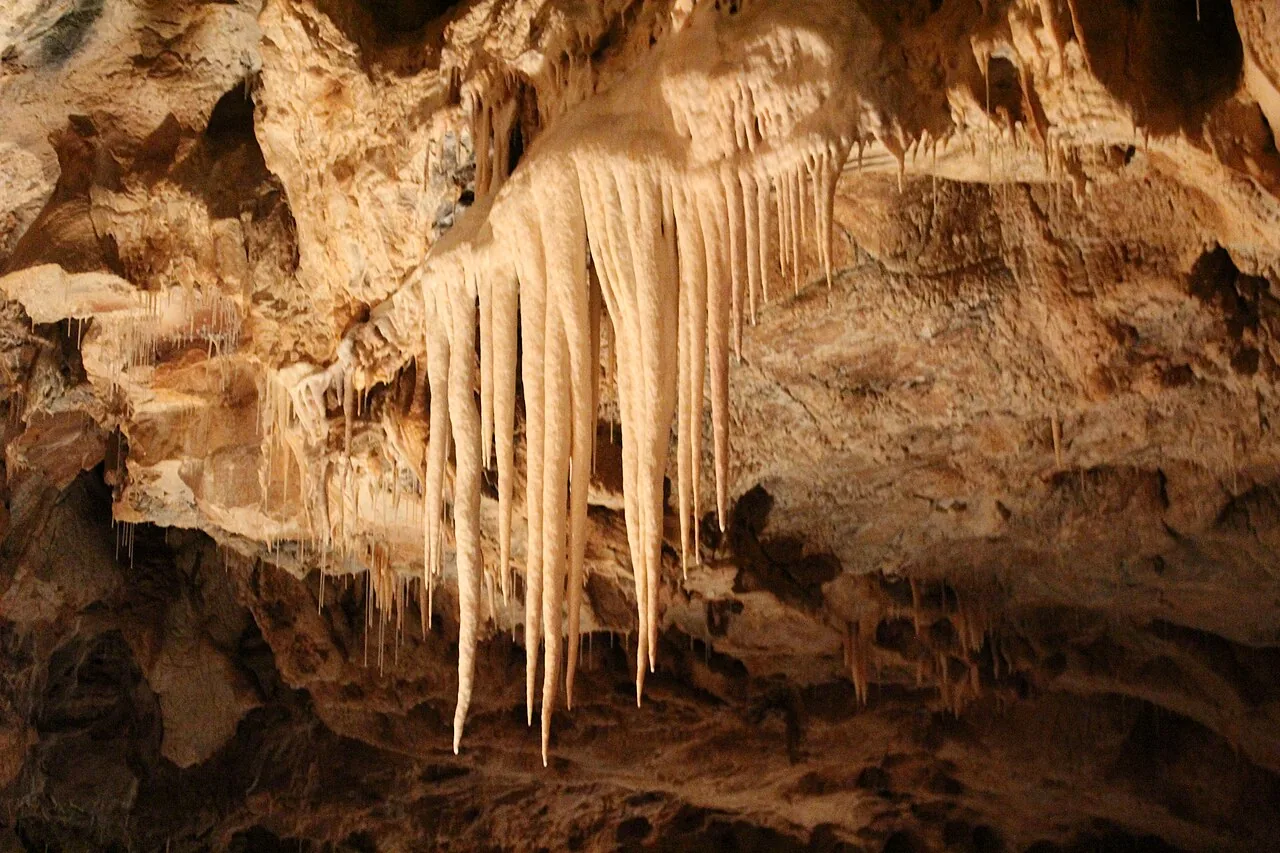
Long, thin stalactites hanging from the ceiling of Bears' Cave.
Stalactites in Bears' Cave, the Chișcău cave where the bones were found.Image: Fizped, source, CC BY 3.0

The sleeping hollows

Over 100 hollows show on the cave floor: pits up to 180 cm across and 60 deep, scraped by bears for sleep. Fourteen are deep pits, up to 2 metres, taken for birth hollows.

The cave opened on 17 September 1975, when a blast at the marble quarry broke the roof of a void. Traian Curta, a miner, climbed down first. Three days later the Speodava amateurs were exploring it, and on 14 July 1980 it opened to visitors.

Dig until you reach the skull

Under the layer of clay lies a cave bear skull. Rub the clay away until it shows.

A cave bear skull seen from the side, with long canines and rows of broad molars.

A cave bear skull with its full teeth. The canines tear, the broad molars grind plants.Image: Altaipanther, source, Public domain
A cave bear skeleton rearing on two legs, forepaws resting on a black support.
A cave bear skeleton rearing on two legs. This pose, about 2.5 metres, comes from an old estimate; new studies give no standing height.Image: Tiia Monto, source, CC BY-SA 3.0

The map

Where the evidence comes from

Four caves in Romania, each with its own story. Tap a point to see what was found there.

BucureștiCluj-NapocaTimișoaraIașiConstanțaOradeaBrașovDevaȘteiHațegHunedoaraOțelu RoșuReșițaPeștera UrșilorPeștera MăguraPeștera Cioclovina UscatăPeștera Răsuflătoarei
  1. All the evidence comes from the west

    4 caves, 6 bears tested

    The points are the caves the studied bones come from: one is the dig with thousands of bones, in three the food tests were done.

  2. Apuseni: Chișcău and Măgura

    2 caves

    Bears' Cave (Chișcău) is the big dig: 1,660 bones studied in the old digs, 1,424 limb bones in the new one, over 100 sleeping hollows. About 3 kilometres away, Măgura cave, 1,500 metres long, gave 2 of the 6 tested bears.

  3. Cioclovina: the oldest tested

    one cave

    Cioclovina Uscată cave, 2,002 metres long, in the Grădiștea Muncelului–Cioclovina park. The 2 bears here are 43,000–48,000 years old, the oldest of the six.

  4. Banat: Răsuflătoarei

    one cave

    The cave in the Banat Mountains, in the Semenic–Cheile Carașului park. This is where USR65 comes from, the bear whose nitrogen sat above the lion's, and which still proved vegetarian.

  5. What is not on the map

    Drachenloch (Switzerland), Chauvet (France) and the caves of the last bears (Poland) lie off the map. The map shows where Romania's evidence was found, not the whole range of the species.

The tested caves' coordinates come from the 2020 study; Bears' Cave's, from OpenStreetMap. The backdrop is Natural Earth.

Game

True or false?

Eight statements about the bear. Some sound like fairy tales and are true.

The eight statements and their answers:

  • True. The cave bear ate mostly plants. All six bears tested in Romania, from three caves, fed only on plants, by the nitrogen in their bone amino acids. Naito et al. 2020, Scientific Reports
  • False. Males reached a tonne. Large males weighed 400–500 kilograms, females 225–250. The idea of one-tonne bears has no support in the bones. Christiansen 1999, Annales Zoologici Fennici
  • False. 140 skeletons were found at Chișcău in 1983. The number 140 cannot be traced to any count. The digs studied 1,660 bones, with 99 skulls and 107 femurs. Viehmann 1987; Robu et al. 2016, Acta Carsologica
  • True. The last cave bears died 24,000–26,000 years ago. Over 200 dates place the extinction 26,100–24,300 years ago. The youngest bone comes from Poland. Baca et al. 2016, The Science of Nature
  • False. Neanderthals worshipped the cave bear. Since 1975 every piece of evidence for the “cult” has failed: either the description was already an interpretation, or nature explained it all. Chase 1987, after Jéquier 1975
  • True. At Chauvet, a skull had been set on a stone slab by a human hand. The floor is covered with 150 skeletons, and one skull sat on a slab, put there by someone. Why, nobody knows. Bocherens, in Smithsonian 2010
  • False. The bears at Chișcău lived 15,000 years ago. The bears there are from stage MIS 3, over 10,000 years older. 15,000 years ago the species was already gone. Robu et al. 2018; Baca et al. 2016
  • True. The bones at Chișcău carry carnivore tooth marks. At least two carnivores gnawed the bones, and a nearly complete hyena skeleton lay among them. Elbows are the most gnawed: 39.3%. Robu et al. 2016, Acta Carsologica

Go and see them

What you can see at Chișcău today

Bears' Cave is in Chișcău, Pietroasa commune, Bihor county, and is visited with a guide only.

  • The upper galleries Bears', Emil Racoviță and Candles: 847 metres of walkways, about 45 minutes.
  • The Bones Hall Bones and sleeping hollows kept in place, in the first gallery.
  • The scientific reserve The lower level, about 700 metres, is closed to the public: that is where they dig.

The cave holds 9 degrees all year. Hours and prices change; check them before you travel.
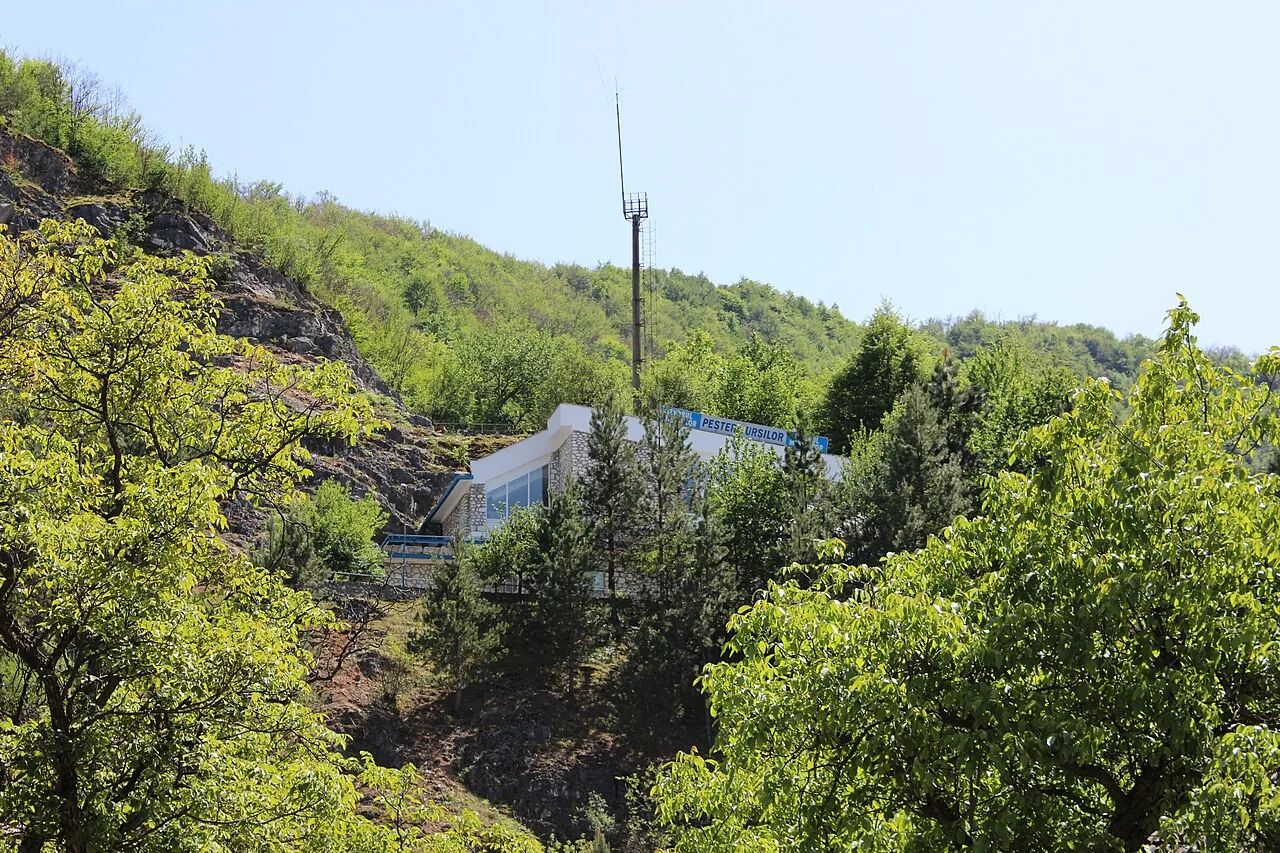
The white pavilion at the entrance to Bears' Cave, on the wooded hillside at Chișcău.
The pavilion at the entrance to Bears' Cave, Chișcău.Image: Fizped, source, CC BY 3.0

Sources

How we know all this

Measurements and dates come from published studies; where only the abstract could be read, or the article could not be opened, the list below says so. Where sources give different values, the range is printed.

Three things you will meet elsewhere are missing here or carry a question mark, because they have no primary source: the standing height (3–3.5 metres circulates; the only number read is 2.5, in a 1987 paper), the 140 bears of Chișcău, and the cause of the extinction. On the last, two serious studies say different things, and they are set face to face.

Size

  • Christiansen, P. (1999). What size were Arctodus simus and Ursus spelaeus (Carnivora: Ursidae)? Annales Zoologici Fennici 36(2): 93–102. OpenAlex — the masses: males 400–500 kg, females 225–250 kg; the tonne rejected (abstract read; the journal PDF could not be opened)
  • Viehmann, I. (1987). Traces of the cave bear's life. Travaux de l'Institut de Spéologie „Émile Racovitza” 26: 73–79. PDF — 2.5 metres standing; 1,660 bones from Chișcău, 99 skulls, 107 femurs; over 100 sleeping hollows
  • Bear Conservation (2014). Species factsheet 2: Brown bear (Ursus arctos). PDF — today's brown bear sizes, for comparison
  • Anderson, N. (2020). European cave bears had pure herbivorous diet. Sci-News, 26 mai 2020. sci.news — the 2.7–3.5 metre length and 1.7 metre shoulder (press summary; no primary source read gives them)

Food

  • Naito, Y.I., Meleg, I.N., Robu, M., Vlaicu, M., Drucker, D.G., Wißing, C., Hofreiter, M., Barlow, A., Bocherens, H. (2020). Heavy reliance on plants for Romanian cave bears evidenced by amino acid nitrogen isotope analysis. Scientific Reports 10: 6612. doi:10.1038/s41598-020-62990-0 — the 6 bears from 3 caves, the amino acids, the nitrogen chart, the cave coordinates
  • Curry, A. (2010). Fate of the cave bear. Smithsonian Magazine, December 2010. smithsonianmag.com — the hundreds of bones across Europe, plants again; Chauvet; the cut marks at Hohle Fels

The end

  • Baca, M. et al. (2016). Retreat and extinction of the Late Pleistocene cave bear. The Science of Nature 103: 92. doi:10.1007/s00114-016-1414-8 — extinction 26,100–24,300 years ago; the youngest bone, from Poland; climate as the explanation (abstract read)
  • Stiller, M. et al. (2010). Withering away — 25,000 years of genetic decline preceded cave bear extinction. Molecular Biology and Evolution 27(5). doi:10.1093/molbev/msq083 — the 25,000-year genetic decline; several causes, including competition with humans for caves (abstract read)
  • Marciszak, A. et al. (2024). Fate and preservation of the late Pleistocene cave bears from Niedźwiedzia Cave in Poland. Scientific Reports 14. doi:10.1038/s41598-024-60222-3 — deaths from scarce food in hibernation, juveniles above all (abstract read)

The cult

  • Chase, P.G. (1987). The cult of the cave bear: prehistoric rite or scientific myth? Expedition Magazine 29(2), Penn Museum. penn.museum — the cult taken apart after Jéquier 1975; Bächler at Drachenloch, 1917–1921

Bears' Cave

  • Robu, M. et al. (2016). Carnivore impact on cave bear bones… Case study: Urşilor Cave. Acta Carsologica 45(3). doi:10.3986/ac.v45i3.3329 — 1,424 limb bones, 69 tooth punctures, ulnae 39.3%, the hyena
  • Robu, M. et al. (2018). Palaeoichnology of an MIS 3 cave bear settlement – Urşilor Cave. Palaeogeography, Palaeoclimatology, Palaeoecology 493. doi:10.1016/j.palaeo.2018.01.009 — the Chișcău bears are MIS 3 (title and reference; the text could not be opened)
  • The Bears' Cave tourist leaflet (undated): the story of the 140 bears and the visiting details. PDF — the story told to visitors, which the page checks rather than follows

The map

  • The tested caves' coordinates, from Naito et al. (2020); the Bears' Cave one, from OpenStreetMap; the backdrop, Natural Earth. naturalearthdata.com — the map

The silhouettes

  • Brown bear (Ursus arctos), used for the cave bear and for today’s brown bear: Margot Michaud, PhyloPic, CC0 1.0
  • Brown bear (Ursus arctos), head raised, used in the scene: Margot Michaud, PhyloPic, CC0 1.0
  • Child: Jiro Wada, PhyloPic, CC0 1.0
  • Adult: Cagri CEVRIM, PhyloPic, CC0 1.0