Romania's named winds · 1974–2025
The crivăț still comes. Its frost doesn’t.
In a tale from the old county of Tutova, in eastern Romania, recorded by the folklorist Tudor Pamfile before 1916, an emperor had four sons, four winds. One of them, the Crivăț, the north-east wind, stripped roofs, felled trees and scattered the farmers’ work across the fields. His father scolded him, cursed him, and some say beat him, then let him out only in winter, “when there is nothing left in the fields”.
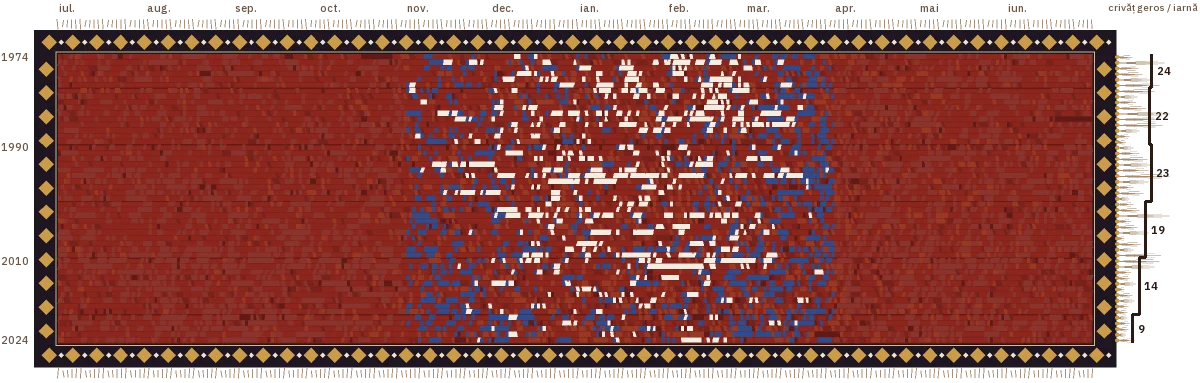
Does the crivăț still come out only in winter? Is it as cold as it was? Below, every day of wind measured from 1974 to 2025 is a thread in a scoarță, the woven rug of Romanian peasant houses: one row a year, July to June, with the winter in the middle.
Tudor Pamfile, “Văzduhul după credințele poporului român” (The Sky in the Beliefs of the Romanian People, 1916), pp. 54–55.
#When does the crivăț blow?
Mostly in winter, as the tale says, and most often in February and March. At 18 stations in the east and south of Romania, days of steady north-east wind (at least 5 metres a second for half the day) were between 1.3 and more than 7 times as common in December–February as in June–August, in 1974–1989.
A steady day: at least four of the day’s eight observations (every three hours) with wind from north round to east at 5 m/s or more. Only 1974–1989, before the anemometer changes.
The disobedient son still gets out in summer on the Black Sea coast and along the lower Danube. At Sulina, Buzău and Galați, summer has between two thirds and three quarters of winter’s crivăț days. In summer, though, the north-east wind crosses warm land and freezes nothing.
#Does the crivăț bring the cold?
Not as much as you might think. The rule set before the calculation required crivăț days to be at least 1.5 times as common among the ten coldest days of each winter as across the whole winter, at stations in crivăț country. On average they were only 1.2 times as common, so the test failed.
| Station | All winter days | The 10 coldest | Times as often |
|---|---|---|---|
| Sulina | 29% | 55% | 1.9× |
| Bacău | 18% | 30% | 1.6× |
| Constanța | 25% | 40% | 1.6× |
| Galați | 31% | 46% | 1.5× |
| Mihail Kogălniceanu (Constanța airport) | 22% | 33% | 1.5× |
| Călărași | 27% | 35% | 1.3× |
| Iași | 17% | 22% | 1.3× |
| Buzău | 29% | 34% | 1.2× |
| Botoșani | 5% | 5% | 1.1× |
| Craiova | 26% | 23% | 0.9× |
| Bucharest-Băneasa | 28% | 23% | 0.8× |
| Otopeni (Bucharest airport) | 29% | 23% | 0.8× |
| Roșiorii de Vede | 25% | 16% | 0.6× |
The stations differ widely, though. At Sulina the crivăț blows on 29% of winter days but on 55% of the ten coldest. At Constanța, Bacău and Galați, 1.5 to 1.6 times as often as across the whole winter. In Bucharest, at Otopeni, in Craiova and at Roșiorii de Vede, the coldest days of winter came with the crivăț less often than the others.
#Has the crivăț softened?
It comes almost as often. In the ERA5 reanalysis, which feeds all past observations into one model of the atmosphere, Galați had 20.5 crivăț days in an average winter in 1980–2002 and 19.4 in 2003–2025; Bucharest had 16.4 and 15.4. The differences are small next to how much one winter varies from the next. Here a crivăț day is a day whose mean wind blows from north round to east at 4 m/s or more; that rule is stricter than the rug’s, which is why the numbers are lower than at the stations.
Its frost, though, has gone. At the 13 stations in crivăț country with at least 40 complete winters, 41% of crivăț days were freezing in the winters of 1975–1990. In 2009–2025, 28%. About a third fewer.
How sure the fall is: for crivăț days, between 13% and 49% with 95% confidence, had the two periods drawn other winters of the same kind (resampling whole winters).
The other winter days lost as much, from 32% to 21%. The crivăț comes from the same side, almost as often. What has changed is the winter it blows in: it has fewer freezing days, crivăț or not.
#Every town's wind, day by day since 1974
Pick a station on the map or from the list. Each has its own rug: 51 rows, one a year, with the winter in the middle. Where the rug is white, the crivăț blew in a frost; where it is blue, it blew without one.
You can tap the map directly.
In Bucharest-Băneasa, the north-east wind, the crivăț, blew on 42 days of an average winter (November to March). In the winters of 1975–1990, 38% of its days were freezing; in 2009–2025, 25%. The strongest winds of the year come here most often from the east-north-east.
#Its brothers: the austru, the băltăreț, the coșava
The austru, “the empty bag”
Romanian dictionaries cannot agree where the austru blows from: south-west, says the standard DEX; south, says the Academy’s smaller dictionary; west or south depending on the region, says Scriban. Dictionaries of synonyms call it “sărăcilă” (the impoverisher) and “traistă-goală” (empty bag), the wind that dries the land; Pamfile records “traistă-goală” as a nickname of the crivăț too, in Argeș.
The measurements cannot pin it to one side either. At midday in Oltenia and western Wallachia, the driest winter wind comes from the west and north-west: air at 64% and 60% relative humidity, against 84–88% when it blows from the east. In summer the driest are the south-east and south winds (41% and 42%), though only by a few points. The drying wind changes side with the season.
The băltăreț, which “brings out the grain”
Pamfile describes it as “a wind from the marshes, from the south”, usually warm; in Argeș county it was said to hurry the grain in the ear. On the Bărăgan plain, from May to August, the south wind is indeed the warmest: at midday, 1.7 °C above the average for the hour. It is not more humid than the others, though: its dew point stays at the average.
The coșava, the wind of the Banat
The coșava (Serbian košava) pours down the Danube gorge at the Iron Gates and spreads over the Banat in the south-west, most often in the cold season. At the 8 stations in the Banat and at the Iron Gates, 56% of the mornings with above-usual wind between October and April had wind from the east, south-east or south. A study of the Serbian stations, where the coșava is strongest, found that it weakened between 1949 and 2010 (Romanić and colleagues, 2015).
The wind “from the Russians”
In Botoșani county, in the north-east, winds were named after the peoples they came from: the wind from the Russians or the Muscovites, from the Hungarians, from the Germans, from the Turks. Of the Cossack’s wind, Pamfile supposes it is the east wind.
At the Botoșani station in winter, the coldest wind is the north-easterly, 1.5 °C below the winter average, and the warmest the south-westerly, 4.5 °C above.
The names of the winds, after Pamfile (1916)
- Aburelul barely a breath
- Borilă from the south, brings rain
- Gorneagul the wind “from the hill”
- Coșava the wind “from the valley”
- Dunărințul from the south, off the Danube
- Băltăganul an east wind; in some places, “the mountaineer”
- Băltărețul from the marshes, from the south, warm
- Jelița cooling, and also cold
- Sieșul dry, cuts to the bone in winter
- Crivățul in winter, from the east and north
- Agostrul in Muscel, the south wind
- Vrănceanul probably the wind from Vrancea
#The wind the anemometers lost
At some stations the measured wind has halved. At Galați the yearly mean fell from 4.5 m/s in 1975 to 2.5 m/s in 2020, in steps; at Constanța from 4.1 m/s in 1985 to 2.3 m/s in 2020. At the same time, calm hours almost vanished from the records. At Sulina, on the open coast, the fall is small.
The ERA5 reanalysis sees nothing like it at Galați. The steps most likely come from new instruments, moved instruments, or trees and buildings grown up around them. That is why no comparison on this page uses the strength of the wind measured at stations across decades: the crivăț is defined by its direction, and each day’s strength is compared only with the other days of the same year.
#How the rug was made
The measurements come from NOAA’s ISD-Lite archive: the hourly observations Romanian weather stations send to the international network, from 1973 to August 2025. Only the eight synoptic hours are used (00, 03, 06 … 21 UTC), so that stations which moved from three-hourly to hourly reports do not look windier. Of 128 stations with long records, 32 have usable days in at least 60% of the period; they are on the map.
A day is a crivăț day when at least four of its eight observations show wind from north round to east (340°–100°), each at least as strong as the station’s usual wind that year. A day is freezing when the mean of its eight temperatures is below 0 °C. Crivăț country: stations below 400 m east and south of the Carpathian arc.
Each day’s thread is slanted by the day’s mean wind direction and is thicker the windier the day was compared with the station’s other days that year. A missing thread is a day without enough observations.
The rules of the tests were written before the results. Three hypotheses failed and are reported as such: the crivăț does not blow as often in summer as in winter; it does not come on the coldest days of winter at least 1.5 times as often as on the rest; and its frost has not held up better than the rest of winter’s. A fourth, that the number of crivăț days could be tracked directly from the speeds measured at stations, was withdrawn when the anemometers turned out to have changed their measure. The crivăț frequency in ERA5 comes from Open-Meteo’s daily data (dominant direction from north round to east, daily mean speed at least 4 m/s).
Sources
- NOAA NCEI, Integrated Surface Database (ISD-Lite), hourly observations at Romanian stations, 1973–2025
- ERA5 (Copernicus/ECMWF), via the Open-Meteo archive, daily values 1950–2025
- Tudor Pamfile, Văzduhul după credințele poporului român, Socec, Bucharest, 1916, pp. 53–55
- Dexonline: crivăț, austru, băltăreț, coșavă (DEX, MDA, Scriban, synonym dictionaries)
- Romanić D. et al., Long-term trends of the Koshava wind during the period 1949–2010, International Journal of Climatology 35, 2015, pp. 288–302
- geoBoundaries, outline of Romania (CC BY 4.0)