Four hundred grams of spruce and maple turn a horsehair stroke into sound that carries over a full orchestra. Rotate Antonio Stradivari’s 1715 Il Cremonese, slice it open with X-rays, and slide the six-millimetre soundpost to hear how the wood breathes.
Scroll to dissect the violin
CREMONA, 1715
Eighty-eight years around one wooden form
Antonio Stradivari built roughly 1,100 instruments in Cremona; around 650 survive today, more than 500 of them violins.
His 1715 Il Cremonese, preserved at the Museo del Violino, was built on the PG internal mould: a 357 mm back with 168, 112, and 207.5 mm bouts and 30 to 32.4 mm ribs.
SPRUCE AND MAPLE
A light belly paired with flamed maple
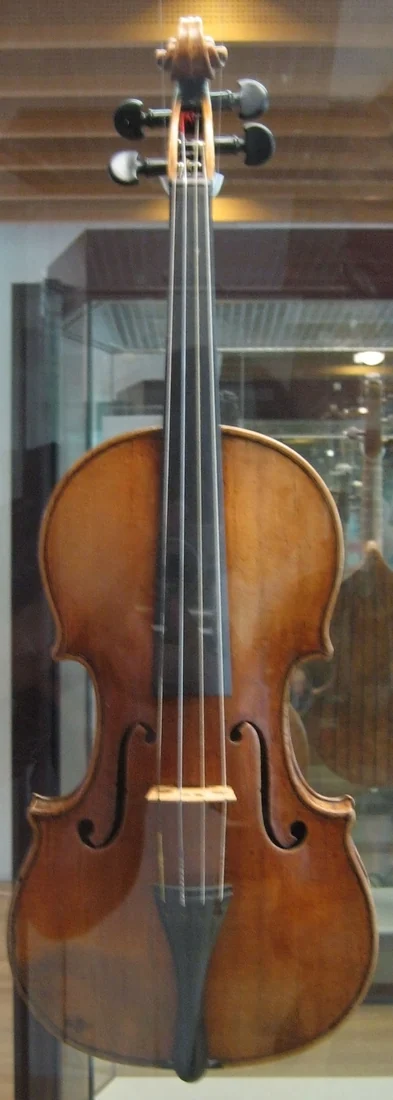
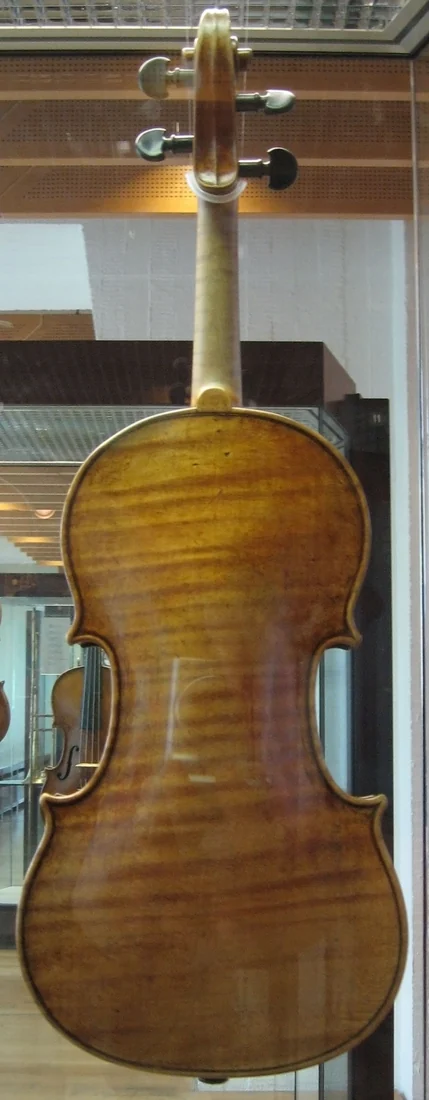
The top plate is carved from straight-grained Alpine spruce, stiff along the grain for its low mass. The back and ribs are bookmatched Bosnian maple whose wavy fibres shimmer as the angle of light shifts.
Medical CT scans by Berend Stoel and Terry Borman (2008) comparing five classical Cremonese violins with eight modern ones found similar median densities, but a significantly smaller earlywood-to-latewood density differential in the classical wood: 183 g/L versus 274 g/L in spruce tops (p = 0.028) and 115 g/L versus 128 g/L in maple backs.
Antonio Stradivari violin of 1703, front view (Musikinstrumenten-Museum, Berlin). Photo: Hay Kranen, Wikimedia Commons, CC BY 2.5.Bookmatched two-piece flamed maple back of the same 1703 violin. Photo: Hay Kranen, Wikimedia Commons, CC BY 2.5.
ARCHING GEOMETRY
Nine kilograms resting on two unglued feet
The four strings (G3, D4, A4, E5) pull with roughly 226 newtons in total. Breaking over the maple bridge at 158°, they press down onto the spruce belly with 86.2 newtons—nearly nine kilograms of force.
Nothing glues the bridge down, and the spruce plate is only 2.2 to 2.8 mm thick. It holds that load without collapsing thanks to a 15.2 mm curtate-cycloid arch ringed by a fluted edge channel.
CHEMISTRY & X-RAYS
Beneath the amber oil varnish
Chemical profiling by Hwan-Ching Tai and colleagues (2017) found mineral treatments—aluminium, calcium, copper, sodium, potassium, and zinc—in Stradivari’s maple that are absent from untreated modern tonewood.
Passing a virtual CT beam through the body exposes the six willow corner and end blocks, the 1715 parchment label, and the two interior pieces that govern the sound: the bass bar and the soundpost.
INTERNAL ANATOMY
A symmetric shell hiding an asymmetric engine
From the outside, the violin looks bilaterally symmetric. Inside, the luthier deliberately breaks symmetry on both sides of the bridge.
Glued beneath the bass bridge foot runs a 270 mm spruce bass bar. Wedged just behind the treble foot stands the soundpost: a six-millimetre spruce dowel, completely unglued, held solely by string pressure.
HELMHOLTZ MOTION
A sharp kink racing along the string
When rosined horsehair grips and releases a string hundreds of times per second, the string does not vibrate as a simple sine wave. It forms a sharp V-shaped corner that circulates up and down its length—Helmholtz slip-stick motion.
That motion drives the top of the bridge primarily sideways. Without an internal asymmetry to convert sideways rocking into volume change, the box would radiate poorly.
BREAKING SYMMETRY
Why one six-millimetre dowel makes the violin
The soundpost pins the treble foot of the bridge between the top and back plates, turning it into a pivot. As the bow rocks the bridge sideways, the bass foot—coupled to the bass bar—pumps the spruce plate up and down.
Lateral force becomes net air-volume pumping. Finite-element models (Colin Gough, 2015) show that removing the soundpost collapses this cross-coupling and starves the monopole breathing modes.
THE PERIMETER LAW
Why f-holes double the power of round holes
Air surges in and out through both f-holes at the A0 Helmholtz resonance near 278 Hz, reinforcing the lowest notes on the G string.
A 2015 MIT study in Proceedings of the Royal Society A showed that air-resonance conductance scales with cutout perimeter rather than open area. The two f-holes here have 10.47 cm² of open area and a combined perimeter of 39.0 cm—2.4 times the perimeter of two circular holes of identical area, roughly doubling air-resonance power efficiency.
ACOUSTIC HOLOGRAPHY
Vibration maps below 600 hertz
Below 600 Hz, every concert violin builds its voice from a handful of signature modes: A0 (~278 Hz), the centre-bout mode CBR (~405 Hz), and the two main body-bending modes B1⁻ (~465 Hz) and B1⁺ (~535 Hz).
George Bissinger’s 2008 modal measurements on 17 violins—including the Titian and Willemotte Stradivaris—showed that mode frequencies alone do not separate great violins from poor ones; higher A0 radiativity is what stands out.
PROJECTION AT 2.4 kHz
Cutting through a symphony orchestra
Between 2 and 3 kHz (peaking near 2.4 kHz), the bridge and the spruce island between the f-holes boost output in a broad spectral hump known as the Bridge Hill.
That peak lands right where human hearing is most sensitive and orchestral background energy dips—explaining how 400 grams of wood can be heard clearly at the back of a concert hall.
DOUBLE-BLIND TRIALS
What happens when the label is hidden
Between 2012 and 2017, Claudia Fritz, Joseph Curtin, and Jacques Poitevineau tested Stradivari and Guarneri del Gesù violins against fine contemporary instruments in strict double-blind trials.
In Indianapolis (2012, 21 violinists, six violins), a new violin ranked first and a Stradivarius last. In Paris (2014, 10 soloists wearing dark goggles, 12 violins), six of ten soloists chose a new violin for a tour. In 2017, 55 listeners in Paris and 82 in New York preferred the new violins behind a screen and guessed old versus new no better than chance.
ACOUSTIC WORKBENCH
Slide the soundpost and hear the spectrum shift
Use the workbench below to move or remove the soundpost, unhook the bass bar, or swap the f-holes for equal-area circular holes.
Press Sound to hear the bowed or plucked string through the live body formants while watching the holographic fringes and A0, B1⁺, and Bridge Hill readouts update together.
Excited stringExcitation
Soundpost position behind the treble bridge foot (drag or use arrow keys)
Sound holes
Holographic mode
A0278 Hz
B1⁺535 Hz
Bridge Hill2400 Hz
Coupling98%
FROM CREMONA TO REGHIN
The Elder-Voicu Stradivarius and Carpathian spruce
In 1956 Romania acquired the 1702 Elder-Voicu Stradivarius, played for four decades by violinist Ion Voicu and entrusted since 2007 to soloist Alexandru Tomescu (mandate renewed through 2028).
The wood itself links back to the Carpathians: slow-grown resonance spruce from the Gurghiu Mountains in central Romania supplies the lutherie workshops of Reghin, Romania’s violin-making town, and tonewood makers across Europe.
IN THE CREMONA VITRINE
A wooden machine three centuries undefeated
Modern concert violins carry a tilted neck and a longer bass bar than Stradivari fitted in 1715, adapted for larger halls and higher string tension.
Yet the external PG outline, the fluted edge channel, the perimeter-driven f-holes, and the unglued six-millimetre dowel inside have endured unchanged for more than three centuries.
Reference metrology — Il Cremonese (1715, PG form)
Every dimension and acoustic figure below comes from published Museo del Violino measurements and peer-reviewed acoustics papers.
Parameter
Value
Acoustic role or note
Back / belly length
357.0 mm / 355.0 mm
PG internal mould (MS21), Golden Period 1700–1720
Upper / C-bout / lower widths
168 / 112 / 207.5 mm
Classic PG outline with crisp corners
Rib height
30 – 32.4 mm
Tapers slightly from neck block to end block
Max arching (top / back)
15.2 mm / 14.5 mm
Curtate cycloid cross-arch with perimeter edge channel
Spruce top thickness
2.2 – 2.8 mm
Graduated toward the edges for compliance
Total string tension
226 N (23.0 kgf)
Sum of all four strings: G3, D4, A4, E5
Bridge downforce
86.2 N (8.8 kgf)
At a 158° string break angle over the bridge
Combined f-hole perimeter
39.0 cm (area 10.47 cm²)
2.4× larger perimeter than two equal-area round holes
Soundpost & bass bar
Ø 6 mm · 270 mm
Unglued spruce dowel; modern concert bass bar
Principal signature modes
A0 278 Hz · B1⁺ 535 Hz · BH 2400 Hz
Measured on concert Stradivari violins (Bissinger 2008)
Share this model
Send the interactive 3D violin, reference metrology, and live soundpost workbench.
Share
Sources and primary literature
The 3D geometry, wood densitometry, and real-time acoustic model are grounded exclusively in peer-reviewed studies and museum metrology.