New Mexico, USA · the last Ice Age
Ice-age footprints at White Sands: someone carried a small child across the mud and walked back
Between the walk out and the walk back, a mammoth and a giant ground sloth crossed the trail. Carry the child along it, and see what the prints show and what nobody knows.
You were carried, and you remember none of it
Someone carried you. For the first years of your life you were lifted onto a hip, shifted to the other one and set down when you wriggled. None of it is in your memory. When adults’ memories from age ten or younger were pooled across studies (more than 11,000 memories), about 1.1% were dated before age three.
Almost nothing records a particular walk. In White Sands National Park in New Mexico the mud kept one: a trail of footprints from the last Ice Age that shows someone carrying a small child.
What the mud kept
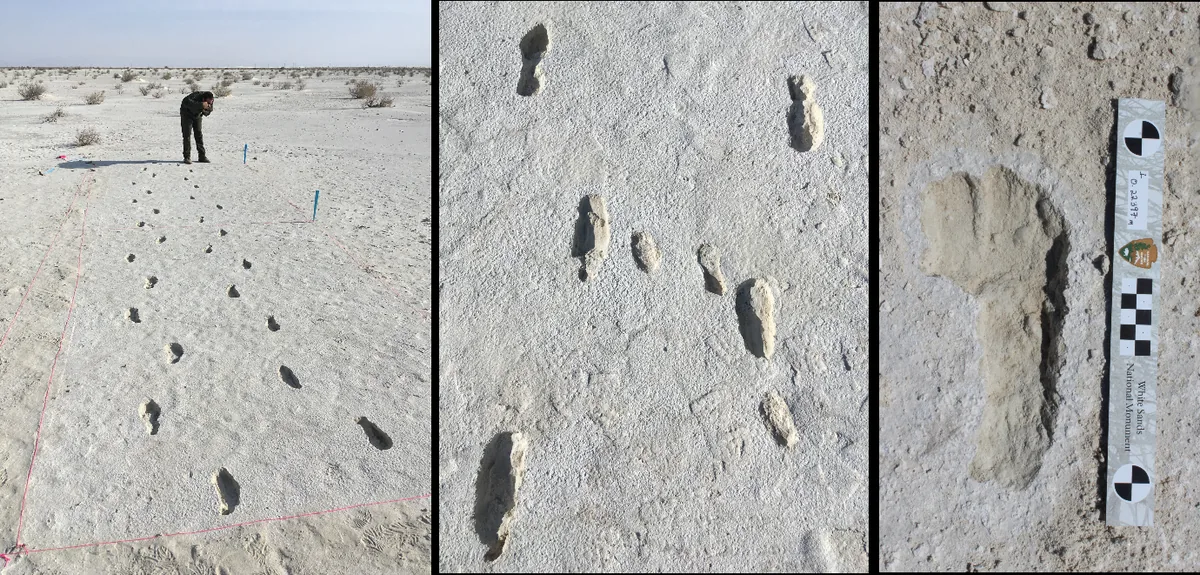
Two lines of footprints, at least 1.5 km long, run north-north-west across a flat of soft mud that was probably a patchwork of seasonal pools. One line goes out and one comes back. The scientists who mapped them identified 427 prints and excavated 140.
- The footprints average 23 to 25 cm. The authors read that as an adolescent or small adult, perhaps female; they put a question mark after it.
- In at least three places there are small prints, probably from a child under three; the clearest lie between the two lines. They do not form a line, which suggests the child was set down briefly.
- Along the surveyed 800 m the steps average about 0.69 m and change little. With a hip height estimated from foot size, a standard formula for footprints turns that into 1.7 m/s outward and 1.6 m/s back.
- A mammoth and a giant ground sloth crossed the outward line. The return line crosses their tracks.
- About 800 m of the trail is accessible and was surveyed. It runs at least another 600 m north into a military range. The authors put its length at more than 1.5 km.
The prints show only now and then, when moisture and salt make their fill stand out from the ground around it. Radar can find them underground. The exact location is withheld under US federal law.
Carry the child along the trail
You are the small person with the child on your hip. Lift the child, walk, switch hips when your arm tires and set the child down when they wriggle. The mud under your feet is blank, as it was that day. The walk skips between short stretches: the real trail is at least 1.5 km.
Step length, foot size and pace come from the 2020 paper. The light, the sky, the silhouette, the sound, the tiring and the distances between events are illustrative.
Your walk
The order of the prints shows what came first
Prints lie on top of each other. At one place on the real trail the outward prints beside a mammoth’s track are squeezed and partly closed, and two return prints cut across that same track. Put the three in the order they were made.
Tap the prints in the order they were made.
What the ground shows, and what nobody knows
The authors call the challenge “to find the line between ‘palaeo-poetry’ and evidenced fact”.
The ground shows
- One small person, with footprints averaging 23 to 25 cm, crossed a muddy flat along a line the authors trace for more than 1.5 km, and later walked back beside it. Two people of almost the same size cannot be ruled out.
- On at least one of the walks a small child, probably under three, was with them and was set down now and then. The authors think it was the outward walk.
- A steady pace of about 1.6 to 1.7 m/s, worked out from the length of the steps and not measured.
- A mammoth and a giant ground sloth crossed the trail between the two walks.
Nobody knows
- Why they went, where they were going and who the child was. The paper does not say parent.
- Whether the child came back with them. Less sideways slipping on the return might suggest the child was not carried, but the authors say there could be several causes.
- How long the walks were apart: likely a few hours, the authors estimate.
- How old the trail is. It has not been dated directly. Extinct animals cross it, so it is from the last Ice Age.
- Whether the left hip was the favoured side. The difference in the prints is not statistically significant.
How fast was that?
The prints give the step length: about 0.69 m along the surveyed section. With the walker’s modelled hip height of 83 to 87 cm, a standard formula for footprints gives 1.7 m/s outward and 1.6 m/s back, which works out to 148 and 139 steps a minute. These are modelled speeds, not measured ones.
Across 35 studies of 14,015 healthy adults walking outdoors, the usual pace was 1.31 m/s (117 steps a minute) and the fast pace 1.72 m/s (127 steps a minute). Young adults on a treadmill switch from walking to running at about 2.1 m/s; a shorter person switches somewhat sooner. The walker kept up a fast pace on slippery mud, on the way out probably while carrying a child.
Your own pace
Tap with the rhythm of your normal walking, eight times or more.
Where were we going?
Nobody can say where the walker was going, or why the walk was so fast. Someone carried you, too, and they may still remember the route.
Ask whoever carried you where you were going.
Sources and what is measured
From the paper: the number, spacing and size of the prints, the child prints, the mammoth and sloth crossings and their order. Modelled in the paper: the speed (from stride length and a hip height taken from adult data) and the age (from foot length). Calculated here from the paper’s table: the steps a minute. Illustrative here: the light, the sky, the mountains, the silhouette, the sound, the tiring, the child’s wriggling, the skips between stretches and the distances between events, because the survey map is not public.
- Bennett, M. R., Bustos, D., Odess, D., Urban, T. M., Lallensack, J. N., Budka, M., Santucci, V. L., Martinez, P., Wiseman, A. L. A., Reynolds, S. C. (2020). Walking in mud: remarkable Pleistocene human trackways from White Sands National Park (New Mexico). Quaternary Science Reviews 249, 106610. doi.org/10.1016/j.quascirev.2020.106610
- Urban, T. M. et al. (2019). 3-D radar imaging unlocks the untapped behavioral and biomechanical archive of Pleistocene ghost tracks. Scientific Reports 9, 16470. doi.org/10.1038/s41598-019-52996-8
- National Park Service (9 October 2020). News release on the White Sands trackway. nps.gov/whsa/learn/news/nr100920.htm
- Snyder, R. G., Schneider, L. W., Owings, C. L., et al. (1977). Anthropometry of infants, children, and youths to age 18 for product safety design. University of Michigan, UM-HSRI-77-17. deepblue.lib.umich.edu/handle/2027.42/64560
- Alexander, R. McN. (1984). Stride length and speed for adults, children, and fossil hominids. American Journal of Physical Anthropology 63, 23–27. doi.org/10.1002/ajpa.1330630105
- Murtagh, E. M. et al. (2021). Outdoor walking speeds of apparently healthy adults: a systematic review and meta-analysis. Sports Medicine 51, 125–141. doi.org/10.1007/s40279-020-01351-3
- Hreljac, A. (1993). Preferred and energetically optimal gait transition speeds in human locomotion. Medicine & Science in Sports & Exercise 25, 1158–1162. doi.org/10.1249/00005768-199310000-00012
- WHO Child Growth Standards: weight-for-age, 0–5 years. who.int/tools/child-growth-standards/standards/weight-for-age
- Rubin, D. C. (2000). The distribution of early childhood memories. Memory 8, 265–269. doi.org/10.1080/096582100406810