Țarcu Mountains, 13 June 2015
The bison comeback
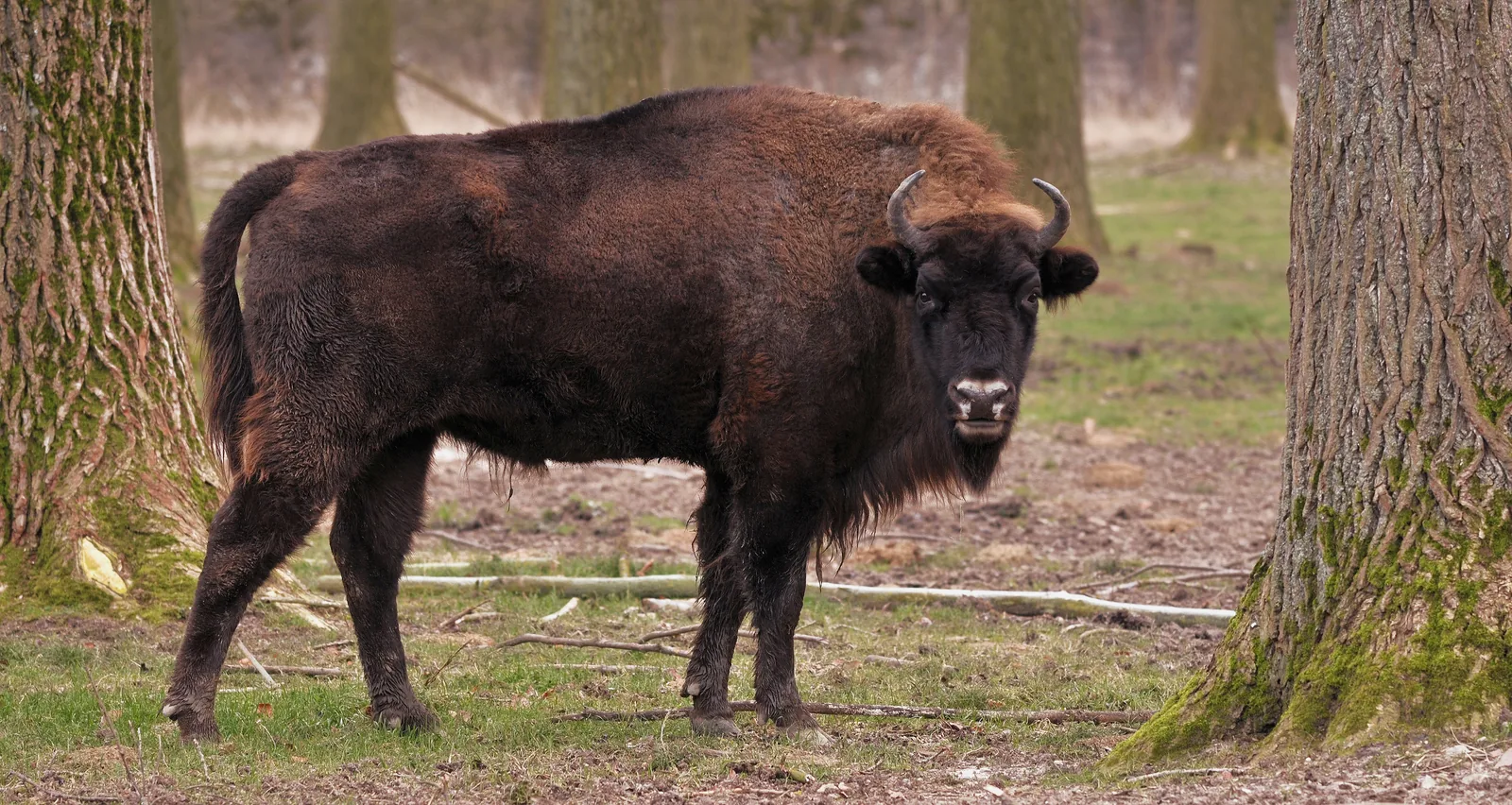
The last bison of Romania were killed in 1790, and the world's last wild bison in 1927. From 54 animals left in captivity the species recovered. In May 2026 more than 250 bison lived free in the Țarcu Mountains — nearly half of them born in the wild.
Open the crate
13 June 2015, Armeniș
The morning the crate opened
The day before, the lorries had arrived with 18 bison from six breeding centres in Switzerland, Germany, Belgium and France. On Saturday morning the team opened the acclimatisation pen and let out the herd brought a year earlier: 17 animals. They were the first bison to walk free through the Southern Carpathians in more than 200 years.
The place is called Armeniș, a commune in Caraș-Severin county at the foot of the Țarcu Mountains. Rewilding Europe and WWF Romania had chosen the area after a November 2011 assessment that found suitable habitat in the Țarcu Mountains Natura 2000 site, in the Domogled-Valea Cernei National Park and in the Mehedinți Plateau Geopark — and even village and hill names keeping the bison's memory.
The plan announced then, in June 2015, sounded bold: a truly wild population of at least 300 bison in the Southern Carpathians by 2024. It was an aim, not a result, and this page remembers it as one: no verified number since shows it reached.
The Țarcu release was the country's second. The first had taken place three years earlier at Vânători-Neamț, where the programme had begun back in 2003.
The brink
Fifty-four
That many animals were still alive when the world's last wild bison fell in 1927, in the Caucasus. All of them lived in captivity. Look at the three numbers to the end: the return starts from them.
54
animals alive in 1927, all in captivity
12
founders with descendants among today's bison
7,000
free in Europe in 2021 — up from 2,579 ten years earlier
In Romania the hunting had ended long before 1927. The last bison had been killed in Moldova in 1762 and in Transylvania in 1790. In Poland the last wild bison fell in 1919. From 1954 the first bison returned to the wild in the Białowieża forest, and the IUCN Red List has since moved the species from Vulnerable to Near Threatened.
Long before any of this, a person drew a bison on the wall of the Coliboaia cave in Bihor. The paintings are between 23,000 and 35,000 years old — the first rock art that old found in Central Europe. The cave lies about 200 kilometres from the Țarcu Mountains, where bison graze today.
In January 2021, when Rewilding Europe took stock, about 8,500 bison lived in the world, some 6,200 of them free. The rest of the story happens in our mountains.
Stand next to it
How big is a bull?
The bison is Europe's largest wild land mammal. Set your height and look: the bull drawn here carries the species account's measurements.
Bison bonasus · bull
A bull 1.95 m at the shoulder stands taller than most people, and snout to tail it measures as much as three ten-year-olds lying head to toe.
- Lengthabout 2.9 m
- Shoulder1.8–1.95 m
- Weight800–1,000 kg
- Herd10–12 animals, usually a single adult bull
- StatusNear Threatened (IUCN)
Silhouettes are scaled to the published measurements. The bull stands 1.95 m at the shoulder, the top of the species account's range.
The weight wants a comparison: a bull past 850 kg presses down like ten people. Small herds of 10–12 animals usually hold a single adult bull past the age of six; young bulls, though mature, take no part in breeding.
The map
Four herds in the wild
Each point is a place where free bison live, with the year of the first release. Touch a point to read its story. The numbers move month to month — each carries its date beside it.
East to west along the Carpathian arc
Romania is one of the 9 European countries with bison in wild areas, wrote the Conservation Carpathia foundation in 2020. The herds string along the arc: Neamț, Făgăraș, Poiana Ruscă, Țarcu.
Vânători-Neamț: where it all began
On 22 March 2012 five bison — two females and three males — were released in the Vânători-Neamț Nature Park, after a programme begun in 2003 with animals from Switzerland, Germany and Sweden. Five more followed in the spring of 2013. A study from June 2022 found over 50 bison in the wild here — the latest verified number for this site.
Legend says the medieval state of Moldova was founded during a bison hunt, in these lands then called the Bison Land. Since then the bison has been the symbol of Moldova.
Țarcu: the great herd
In 2014 the first 17 bison arrived near Armeniș, and on 12–13 June 2015 another 18 from six European centres. On 28 May 2026 Rewilding Europe counted more than 250 free bison in the Țarcu Mountains, nearly half born in the wild — the newest verified number in the country. The herd is cared for today by the LIFE with Bison coalition, whose members include the communes of Armeniș, Teregova and Cornereva.
Poiana Ruscă: the herd without a number
Free bison have lived in Poiana Ruscă since 2014 too, with a release point toward Densuș. How many live there today I found in no verified source, so the map shows the place with no number.
Făgăraș: the 8 from Pecineagu
In May 2020 the Conservation Carpathia foundation freed the first 8 bison near Pecineagu lake, then tracked by GPS collars. In the first five months they covered over 70 km through the forests of the north-eastern mountains and gathered into a compact herd led by an experienced female. The feasibility study asks for at least 100 genetically distinct individuals; the area's target is a stable population of 30.
And further?
The 2022 study did not stop at counting: it looked for ecological corridors between the free bison of Neamț and other populations, through new nuclei in Suceava and Maramureș counties. The link between the herds is the next chapter, still unwritten.
The years come from the Conservation Carpathia brochure (2020). Positions are approximate: the release communes. The hatched relief is the Carpathian chain, after Natural Earth.
Born free
One in two was born in the forest
Nearly half of the more than 250 bison of Țarcu did not arrive by lorry. They were born there, between May and July, after a gestation of about 264 days — one at a time; twins are rarely seen, on reserves.
25+
calves born in the wild in the Southern Carpathians
90
km² of range, by the GPS collars — a sign the area is being recolonised
Calving has a ritual of its own: the cow leaves the herd, calves alone and returns with the calf after a few days. The calf stands within an hour of birth. It is the sign that reintroduction works: the animals multiply in the forest, not merely survive.
Game
The watch post
A week at Armeniș, with binoculars and the tracking receiver. Each day one question about the herd on the slope. At the end, the verdict of the week.
The eight days and their answers:
- True. Monday. A grown bull can weigh as much as ten people. Bulls sometimes pass 850 kg. Ten people at 85 kg each come to the same. Rewilding Europe, fișa zimbrului
- True. Tuesday. The bison is Europe's largest living wild land mammal. That is what the rewilders call it: the largest wild land mammal living in Europe today. Rewilding Europe, fișa zimbrului
- True. Wednesday. Every bison alive today descends from 12 animals. Of the 54 left in 1927, only 12 have descendants among today's bison. That is why the species stays genetically vulnerable. Rewilding Europe, fișa zimbrului
- False. Thursday. The world's last wild bison was shot in Romania. The world's last one fell in the Caucasus, in 1927. In Romania the hunting had ended long before: 1762 in Moldova, 1790 in Transylvania. Rewilding Europe, 5 ianuarie 2021
- False. Friday. A bison cow usually gives birth to two calves at once. She gives birth to a single calf; twins are rare, and then on reserves. In the wild the cow leaves the herd to calve and returns with the calf a few days later. Animal Diversity Web, fișa Bison bonasus
- True. Saturday. Calves are usually born between May and July. So says the species account, after a gestation of about 264 days. The calf stands within an hour of birth. Animal Diversity Web, fișa Bison bonasus
- True. Sunday. A small herd usually holds a single adult bull. Small herds count 10–12 animals with, as a rule, one adult bull past the age of six. Animal Diversity Web, fișa Bison bonasus
- True. Verdict. In May 2026 more than 250 bison lived free in the Țarcu Mountains. The 28 May 2026 announcement says “more than 250”, with nearly half born in the wild. The numbers move month to month — this is the latest verified one. Rewilding Europe, 28 mai 2026
The week is imagined, the facts are checked: every answer points to its source.
Unknowns
What we do not know yet
Three numbers are missing from this story, because they were found in no verified source. They are written here so nobody fills them with guesses.
- How many bison live at Vânători-Neamț today?
The latest verified number is “over 50”, from a June 2022 study. Since then the herd may have changed either way.
- How many bison live in Făgăraș today?
Only the start is verified: 8 freed in May 2020, a target of 30. A recent census was not found.
- Was the 300-by-2024 target reached?
The aim announced in 2015 for the Southern Carpathians shows as reached in no verified source: in May 2026 Țarcu held over 250.
Sources
Where all this comes from
The numbers come from the Rewilding Europe and WWF Romania announcements, the Conservation Carpathia brochure, a 2022 study and the Animal Diversity Web species account. Each carries its date beside it, because herds change month to month.
Two things from the sources are missing here: a “last record of 1852”, from a 2012 article, contradicted by the precise 1762/1790 dates in a newer text from the same organisation, and the idea that the bison sits on Romania's flag — it sits on Moldova's arms.
The return to Romania
- Rewilding Europe, “First wild bison in Romania after 160 years” (25 aprilie 2012). rewildingeurope.com — the 22 March 2012 release, the programme begun in 2003, the Bison Land legend
- WWF, “Another five European bisons reintroduced in the Carpathians” (5 aprilie 2013). wwf.panda.org — the second release of five bison, spring 2013 (page read via the search snippet; the full page denies access)
- Rewilding Europe și WWF România, “Bison in the Wild — second bison release in the Southern Carpathians” (anunț de presă, iunie 2015). PDF — the 17 of 2014, the 18 of 12–13 June 2015, the 300-by-2024 aim
- Rewilding Europe, “Bison ambassadors to champion wildlife comeback in the Southern Carpathians” (28 mai 2026). rewildingeurope.com — over 250 free in Țarcu, nearly half wild-born, the LIFE with Bison coalition
- Fundația Conservation Carpathia, “Reintroducerea speciilor dispărute: temelia veștilor bune în munții Făgăraș” (broșură, septembrie 2020). PDF, carpathia.org — the four sites and their years, the first 8 in Făgăraș (May 2020), the GPS collars, the 70 km, the 100 and 30 targets
- Fedorca și colab., “The Reintroduction Analysis of European Bison in the North of Romania…” (Forests 13(6):920, 13 iunie 2022). doi:10.3390/f13060920 — over 50 wild at Vânători-Neamț, the corridors toward Suceava and Maramureș (abstract read)
The species
- Rewilding Europe, “Back from the brink: the European bison is a living legend” (5 ianuarie 2021). rewildingeurope.com — 1762/1790, 1919, 1927, the IUCN move to Near Threatened, the Coliboaia bison
- Rewilding Europe, “European bison” (poveste de impact, numere din 2021). rewildingeurope.com — the 54, the 12 founders, Białowieża 1954, 2,579 → 7,000, the 850 kg, the 25 calves, the 90 km²
- Animal Diversity Web (University of Michigan), the “Bison bonasus” account. animaldiversity.org — 2.9 m, 1.8–1.95 m, 800–1,000 kg, the herds of 10–12, calving