Marius Comper RO

Neuroscience, in plain words · part four

Acetylcholine and the frog heart of 1921

In 1921, in Graz, Otto Loewi stimulated the vagus nerve of a frog heart and collected the fluid inside it. Given back to the same heart, the fluid weakened its beats. The substance in it was later identified as acetylcholine. Here you turn a drawn drum and compare the 1921 paper with the story told later.

Before 1921

Electricity or a substance?

By the early 20th century it was known that the vagus nerve slows the heart. The mechanism was disputed. Most physiologists thought the electrical impulse passed straight from the nerve to the heart muscle.

A few suspected something else. In 1904 Thomas Elliott suggested that sympathetic nerves might act by releasing adrenaline; William Howell thought the vagus released potassium. Walter Dixon had reported an experiment supporting the chemical idea, which drew little attention.

Loewi, Nobel lecture, 1936 · Bechtel 2023

Loewi's story

The same dream, two nights running

Otto Loewi was professor of pharmacology in Graz. Many years later he said the idea for the experiment came to him in a dream. In his account, he woke, jotted down the idea and went back to sleep. He said that in the morning he could not decipher his notes.

The next night, he said, the same dream came back and he went straight to the laboratory.

Henry Dale remembered a different first version from Loewi: that he took better notes and went to the lab only the next day. Loewi himself later found two older papers from his own laboratory that described a similar method.

Bechtel 2023, note 22

What the 1921 paper says

One heart, its fluid and the vagus nerve

Loewi used isolated hearts on a cannula filled with Ringer's solution, with the left vagus nerve left attached. He worked in February and March, on 14 frogs and 4 toads.

With frogs, he first collected the fluid from the heart after a resting period, then the fluid from an equal period during which he stimulated the vagus. Once the heart had recovered, he gave it the two fluids in turn. The resting fluid had no effect. The fluid from the stimulation period weakened the beats every time, and sometimes slowed them too.

Loewi offered two explanations: either the nerve acts through a substance released into the fluid, or the substance is only a product of the way the heart beats. He did not yet name it.

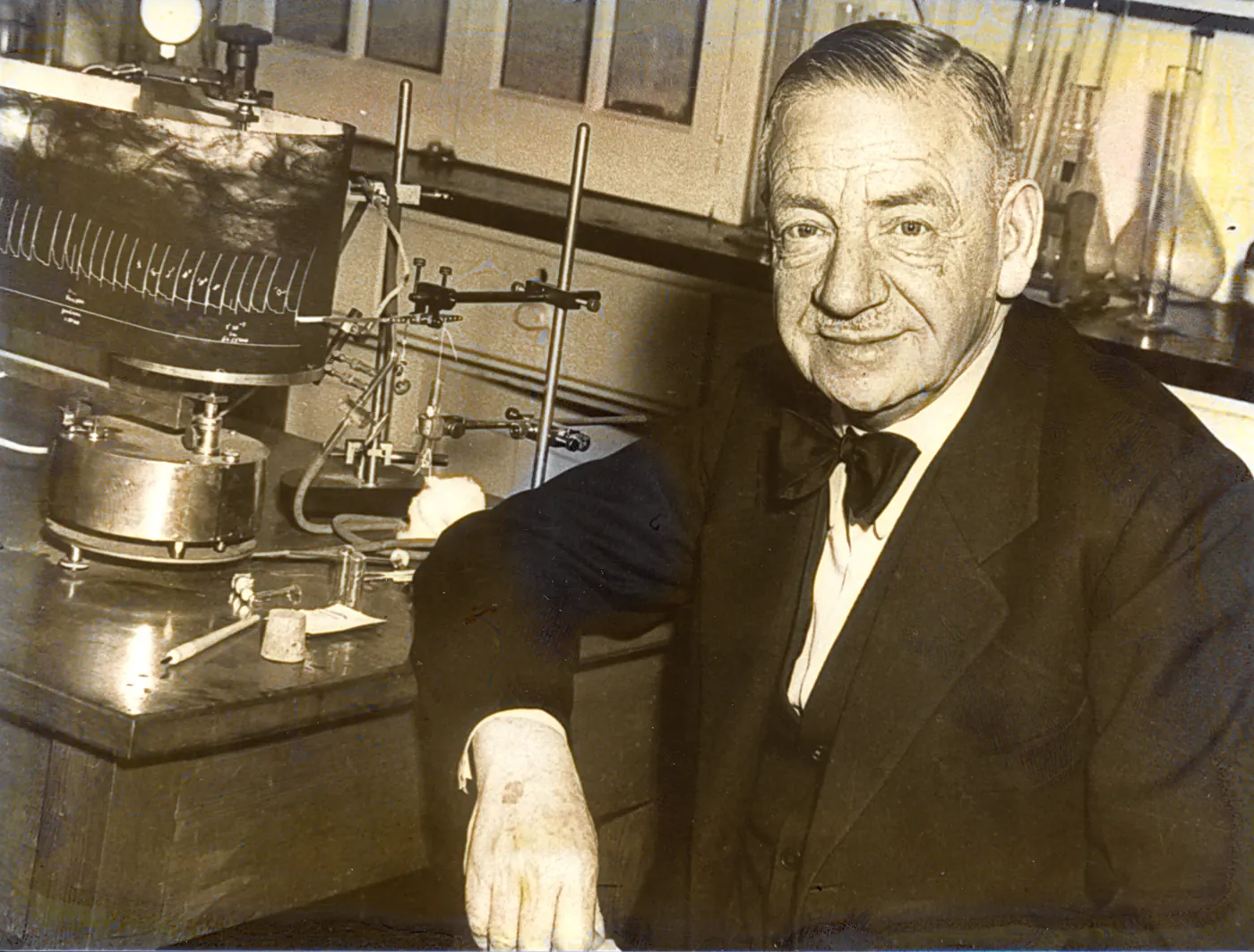
Otto Loewi sits at a laboratory bench; on the left is a soot-covered drum with traces of beats
Otto Loewi beside laboratory equipment in Graz, 1930s. On the left, a smoked drum. Photo: Institute of Pharmacology, Graz, CC BY-SA 3.0 de

Loewi 1921 · Nobel lecture

Turn the drum

What the drum recorded

On a kymograph, a stylus traced a line on smoked paper as the drum turned. In the drawing, each peak of the line marks one beat.

Turn the drum and choose the record: the frog heart from the paper, the two toad hearts from the same paper, or the two-frog-heart story told later.

Record

a drawn reconstruction; the rhythm is chosen for the drawing

The later story

Two frog hearts, in the later retellings

In the later retellings the experiment has two frog hearts: one with its vagus nerve, one without, and fluid from the first slows the second. In the 1921 paper, transfer to a fresh heart appears only with toads.

The experiment was hard to reproduce, and many attempts failed, sometimes even Loewi's. One reason was the season. In summer, stimulating a frog's vagus nerve can make the heart beat faster instead of slowing it. In the paper itself, Loewi notes that toads responded "at the present season" with larger, faster beats.

Record

Loewi 1921 · Bechtel 2023, note 24 (after Davenport 1991)

1926–1936

Soups against sparks

In 1926 Loewi's experiment was successfully repeated at the International Physiology Congress in Stockholm. The demonstration convinced many that the signal passes from nerve to heart through a substance. The dispute over transmission between neurons, between 'soups' and 'sparks', continued into the 1950s.

Loewi suspected the substance was acetylcholine. At the time its presence in animal tissue still had to be demonstrated.

Bechtel 2023

London, 1929

Dale and Dudley find acetylcholine in animal tissue

In London, the chemist Arthur Ewins had isolated acetylcholine from an ergot extract, and Henry Dale had studied its effects. In 1929 Dale and Harold Dudley identified acetylcholine in ox and horse spleens.

In 1935 Loewi identified 'Vagusstoff' as acetylcholine. Dale had also found, in animal experiments, that pituitary extract makes the womb contract, an effect later attributed to oxytocin.

Henry Dale and Otto Loewi, in suits, photographed together in 1936
Henry Dale (left) and Otto Loewi, 1936. Photographer unknown. Wellcome Collection, via Wikimedia Commons, CC BY 4.0

Dale, Nobel biography · Dale and Dudley 1929 · Bechtel 2023

1936–1961

The Nobel Prize, then exile

In 1936 Dale and Loewi shared the Nobel Prize in Physiology or Medicine "for their discoveries relating to chemical transmission of nerve impulses".

In 1938 Germany annexed Austria, and Loewi was forced to leave. Before he could go, he was made to instruct the Swedish bank in Stockholm to transfer his prize money to a Nazi-controlled bank. He worked in Brussels and Oxford, and from 1940 at New York University. He became an American citizen in 1946 and died in 1961.

Nobel Prize 1936 · Loewi, Nobel biography

Acetylcholine in the body

From nerve to muscle, to the heart and in the brain

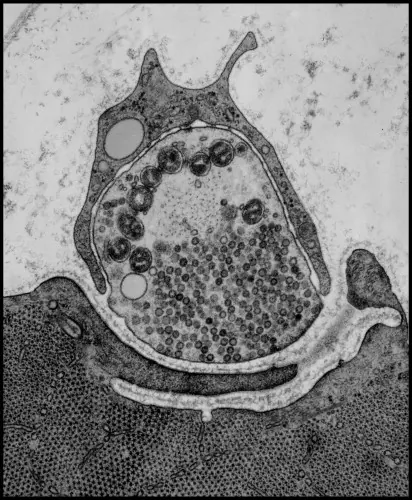
In 1936 Dale, Wilhelm Feldberg and Marthe Vogt showed in animal experiments that motor nerve endings release acetylcholine. At skeletal muscles, acetylcholine carries the signal from the nerve ending to the muscle fibre.

The nucleus basalis of Meynert lies in the basal forebrain. Some of its neurons use acetylcholine to signal to the cerebral cortex.

Black-and-white electron micrograph: a nerve ending full of small circles, pressed against a muscle fibre
Where a nerve meets a muscle fibre, under the electron microscope. The small circles in the nerve ending are vesicles. Photo: John Heuser, public domain

Dale, Feldberg and Vogt 1936 · Whitehouse et al. 1982

The signal from nerve to muscle

Myasthenia gravis and muscle weakness

In myasthenia gravis the immune system mistakenly disrupts the signal from nerves to muscles. Muscles weaken and tire easily. The condition often affects the muscles of the eyes, eyelids and face first: eyelids can droop and vision can double. Symptoms tend to worsen with tiredness, often towards the end of the day.

It is rare. A 2021 analysis of 63 studies estimated worldwide prevalence at 12.4 cases per 100,000 people. Treatment includes medicines that improve muscle strength and, sometimes, removing the thymus, a gland in the chest whose changes are linked to the condition.

NHS · Salari et al. 2021

The cholinergic hypothesis

Neuron loss in Alzheimer's disease

In a 1982 study of brains examined after death, researchers found a loss of more than 75% of the neurons in the nucleus basalis of Meynert, in people with Alzheimer's disease or what the authors called 'senile dementia of the Alzheimer's type'.

Also in 1982, Raymond Bartus and colleagues reviewed several lines of evidence suggesting that weaker acetylcholine signalling might contribute to memory problems. This became the 'cholinergic hypothesis'. Donepezil, rivastigmine and galantamine are among the drugs developed later for the disease's symptoms.

The cholinergic hypothesis concerns some of the cognitive symptoms; it does not explain the whole disease.

Whitehouse et al. 1982 · Bartus et al. 1982

How much they help

Donepezil's effect on cognitive scores

The 2018 Cochrane analysis pooled donepezil trials in people with dementia due to Alzheimer's disease. In the main comparison, at about six months, ADAS-Cog scores on donepezil were 2.67 points lower than on placebo, on a 0–70 scale where lower means fewer problems (5 trials, 1,130 participants). On the 0–30 MMSE scale, scores were 1.05 points higher.

The authors describe small benefits in cognition, daily activities and clinician-rated overall condition. In the same trials, 24% of participants on donepezil withdrew before the end, against 20% on placebo; in a separate analysis, 72% and 65% respectively had an adverse event. For rivastigmine, the Cochrane analysis found small benefits of uncertain clinical importance.

The UK's NICE guidance recommends donepezil, galantamine and rivastigmine as options for mild to moderate Alzheimer's disease, with treatment started on the advice of a clinician experienced in the disease. For each person, the decision is made together with a doctor.

Birks and Harvey 2018 (Cochrane) · NICE NG97
Your drum

A white line in the soot

Loewi's result supported chemical transmission from nerve to heart and left other researchers a question to test between neurons.

Save the drawing of the beats you turned.

Common questions

What is acetylcholine?
A substance that carries signals from motor nerves to skeletal muscles, from vagal nerve endings to the heart, and between some neurons in the brain.
What did Loewi's 1921 experiment show?
That fluid collected from a frog heart while its vagus nerve was stimulated could weaken the heart's beats, and sometimes slow them; fluid collected before had no effect. Loewi proposed that the nerve acts through a substance, which he later called 'Vagusstoff'. It was later shown to be acetylcholine.
Were there really two frog hearts?
That is how Loewi told it later. In the 1921 paper, for frogs, the fluid was given back to the same heart after it had recovered. Transfer to a second, fresh heart appears in the paper with toads, whose hearts beat faster and harder when the vagus was stimulated.
Did Loewi really dream the experiment?
That is how he told it, much later: the same dream two nights running. Henry Dale remembered a different first version from Loewi, and the historian William Bechtel treats the dream as uncertain.
How much does donepezil help in Alzheimer's?
In trials lasting about six months, the average benefit was small: on the 0–70 ADAS-Cog scale, scores were 2.67 points better than on placebo. The Cochrane review's authors describe small benefits. Treatment is decided together with a doctor.

Sources

The drum on the page is a drawn reconstruction based on the 1921 paper and on Loewi's later account; the rhythm of the beats is chosen for the drawing.

  1. Loewi O. Prelegerea Nobel / Nobel lecture, 1936. www.nobelprize.org
  2. Premiul Nobel pentru fiziologie sau medicină 1936 / Nobel Prize in Physiology or Medicine 1936. www.nobelprize.org
  3. Otto Loewi, biografie / biographical. NobelPrize.org. www.nobelprize.org
  4. Henry Dale, biografie / biographical. NobelPrize.org. www.nobelprize.org
  5. Loewi O. Über humorale Übertragbarkeit der Herznervenwirkung. Pflügers Arch 1921;189:239–242. doi.org
  6. Loewi 1921, volumul scanat / scan of the volume (Internet Archive). archive.org
  7. Ewins AJ. Acetylcholine, a new active principle of ergot. Biochem J 1914;8:44–49. pmc.ncbi.nlm.nih.gov
  8. Bechtel W. Minding the gap: discovering the phenomenon of chemical transmission in the nervous system. Hist Philos Life Sci 2023;45(4):37. pmc.ncbi.nlm.nih.gov
  9. Dale HH, Dudley HW. The presence of histamine and acetylcholine in the spleen of the ox and the horse. J Physiol 1929;68:97–123. doi.org
  10. Dale HH, Feldberg W, Vogt M. Release of acetylcholine at voluntary motor nerve endings. J Physiol 1936;86:353–380. doi.org
  11. NHS. Myasthenia gravis (2023). www.nhs.uk
  12. Salari N et al. Global prevalence of myasthenia gravis. J Transl Med 2021;19:516. doi.org
  13. Whitehouse PJ et al. Alzheimer's disease and senile dementia: loss of neurons in the basal forebrain. Science 1982;215:1237. doi.org
  14. Bartus RT et al. The cholinergic hypothesis of geriatric memory dysfunction. Science 1982;217:408. doi.org
  15. Birks JS, Harvey RJ. Donepezil for dementia due to Alzheimer's disease. Cochrane 2018. pmc.ncbi.nlm.nih.gov
  16. Birks JS et al. Rivastigmine for Alzheimer's disease. Cochrane 2015. doi.org
  17. NICE. Dementia: assessment, management and support (NG97). www.nice.org.uk