Pax Silica
A declaration and cooperation framework for secure supply chains: minerals, energy, factories, chips and AI. It began with seven signatories, and the declaration is non-binding.
PAX-01 ↗ PAX-02 ↗Current explainer · 16 August 2026
Models are the visible layer of the US-China competition. Underneath sit minerals, energy, factories, chips, data centres, rules and partners.
Editorial synthesis · based on documented policy, membership and industrial evidence
Pax Silica is a US initiative for supply chains and infrastructure. WAICO is an AI-cooperation organization launched in Shanghai, according to official sources. The guide below explains these names and their limits.
The layer that looks like software rests on a supply chain with physical chokepoints. Governance touches every band.
In plain terms
They are not names for two armies. They describe projects and labels for how AI power is being organized.
A declaration and cooperation framework for secure supply chains: minerals, energy, factories, chips and AI. It began with seven signatories, and the declaration is non-binding.
PAX-01 ↗ PAX-02 ↗An intergovernmental organization for AI cooperation and governance, agreed by 29 countries and headquartered in Shanghai, according to official accounts.
WAICO-01 ↗ WAICO-02 ↗A phrase for an order more centred on China. It is not the name of a current AI organization and does not describe one official plan.
Read the term's limit ↗"The Chinese AI war" is a working phrase used by this page, not the official name of a Chinese programme.
Washington is organizing trusted access to the material and industrial stack. Beijing is combining domestic capacity, open cooperation, infrastructure reach and a bid to shape governance. Neither side owns the whole system.
Export controls, supply-chain policy, infrastructure diplomacy and rival AI plans are now linked parts of state strategy.
The idea of two sealed blocs. Kazakhstan appears in both Pax Silica and WAICO. The overlap is a fact. Full strategic alignment is an inference.
The UN still convenes all states. Its AI process is a universal lane, even when it cannot settle the underlying rivalry.
A guided cutaway
Select a band. The object stays put while the question changes.
In 2024, China accounted for 91% of global rare-earth refining output in the IEA's summary. The number describes refining, not every mineral, mine or AI component.
Why it matters: a supply-chain coalition can diversify mines faster than it can duplicate chemical processing, magnet production and qualified customers.
Limit: concentration is leverage. It is not proof of automatic control over another state's choices. STACK-01 ↗
The IEA's base case puts global data-centre electricity demand at roughly 945 TWh in 2030, more than twice its 2024 level. AI-focused server power grows faster than the wider data-centre load.
Why it matters: grid connections, generation, cooling and permits can become as strategic as model quality.
Limit: this is a projection, not a guaranteed demand path. STACK-02 ↗
ASML describes itself as the only maker of EUV lithography systems. TSMC reported that 7nm-and-below processes were 74% of its 2025 wafer revenue, with 2nm entering high-volume manufacturing in the fourth quarter.
Why it matters: an AI strategy can be constrained by tools, foundries, packaging and memory before a model reaches a user.
Limit: leading-edge concentration does not describe every chip or every manufacturing node. STACK-03 ↗ STACK-04 ↗
US export controls target advanced computing chips, manufacturing equipment and high-bandwidth memory. January 2026 guidance also created case-by-case review for some approved exports to China.
Why it matters: Washington is trying to reduce strategic dependence while managing a market that still has selective flows.
Limit: "managed interdependence" is an editorial synthesis. It describes the pattern, not an official doctrine. US-02 ↗ US-03 ↗
Stanford's 2026 AI Index placed the leading US model only 2.7% ahead of the leading Chinese model in March 2026. The same report shows different advantages across private capital, data centres, publications, citations, patents and robots.
Why it matters: a single leaderboard cannot measure industrial capacity, diffusion or strategic resilience.
Limit: benchmark gaps are snapshots, and investment categories do not capture every public or state-directed resource. MODEL-01 ↗
Pax Silica's declaration links secure supply chains to economic and national security. China's Global AI Governance Action Plan links development, sovereignty, safety, open cooperation, infrastructure and UN channels. WAICO presents itself as a global cooperation organization.
Why it matters: standards and export rules decide who can build, buy, train, deploy and audit.
Limit: official purpose statements are evidence of what governments say they are building. They do not prove future implementation. PAX-02 ↗ CHINA-01 ↗ WAICO-02 ↗
Every layer remains available above without JavaScript. The controls change emphasis, not the evidence.
Different instruments
The comparison is institutional. It is not a ranking of technological power.
A US-led strategic initiative that connects critical minerals, energy, manufacturing, semiconductors, AI infrastructure, logistics and policy coordination.
Documented The initiative's form and initial declaration are official. Its future effectiveness remains unknown. PAX-01 ↗
The World Artificial Intelligence Cooperation Organization was agreed by 29 countries in July 2026 as an independent intergovernmental organization for AI cooperation and governance.
Documented The official Chinese description emphasizes global cooperation. Its wider geopolitical significance is an interpretation. WAICO-01 ↗ WAICO-02 ↗
China does not have one public programme called "the Chinese AI war". The evidence shows a family of connected domestic, diplomatic and infrastructure initiatives. The page keeps their official identities separate while examining their combined strategic effect.
Material constraints
A model can be copied, compressed or improved. A refinery, grid connection or lithography tool takes longer.
This is why the phrase "AI race" is too thin. The contested object includes chemical processing, power, equipment, packaging, memory, software, standards and the ability to move them across borders.
One country, two lanes
A membership can be real without becoming a complete strategic alignment.
Kazakhstan is documented in both institutional lanes.
The overlap supports a porous-alignment reading. It does not establish equivalence between Pax Silica and WAICO, or reveal Kazakhstan's full technology policy.
Whether either institution will change Kazakhstan's long-term procurement, infrastructure or standards choices.
The rivalry has two strong poles, several movable partners and one universal table.
Connected networks
An original illustration for atmosphere. It does not represent data, borders or membership.
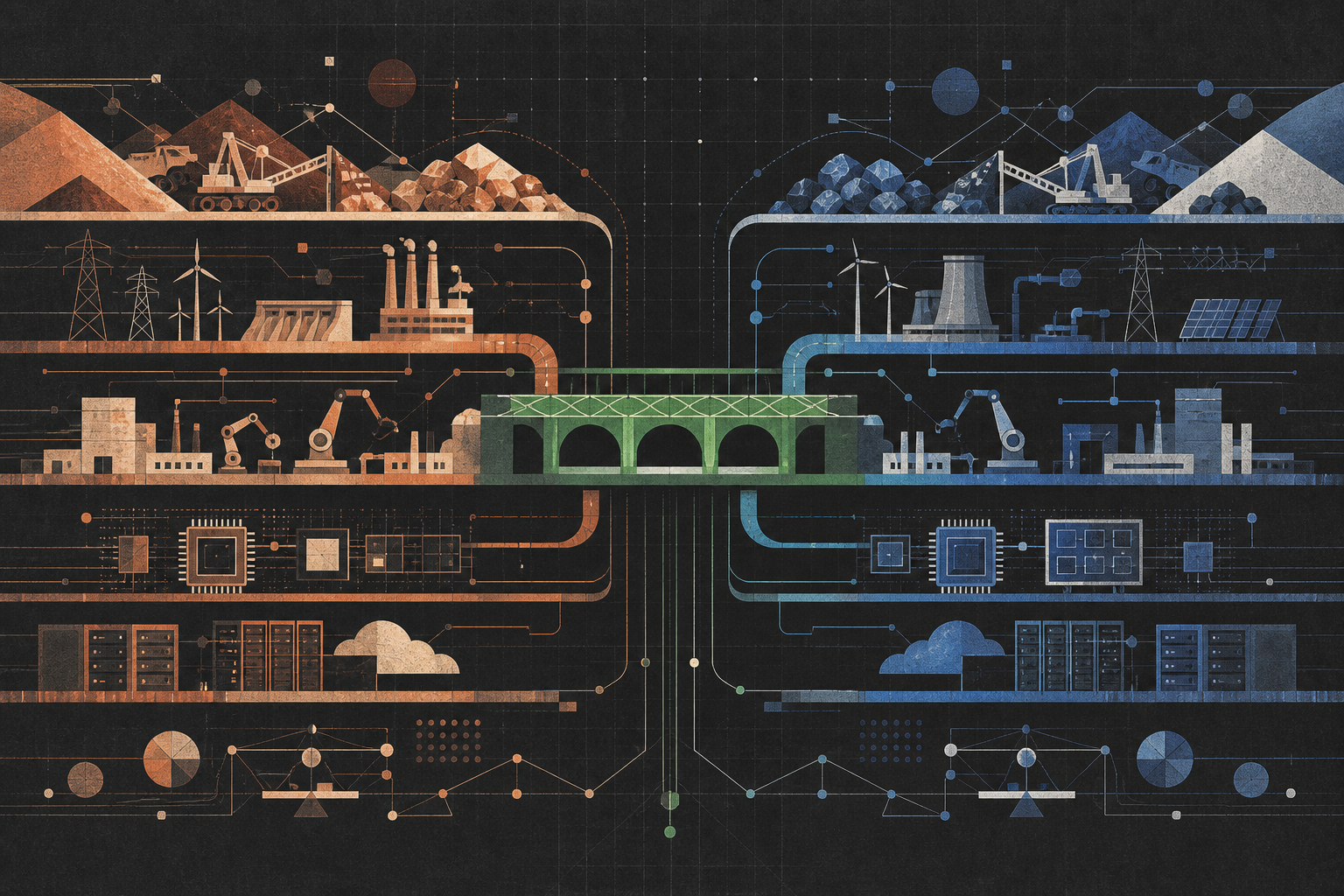
Controls and dependencies
Use the switch as a model. It is an explanatory scenario, not a forecast.
Controls and dependencies can coexist. That is the current condition.
US restrictions target advanced computing, manufacturing tools and HBM, with end-user compliance attached.
US-02 ↗ US-03 ↗Minerals, foundries, equipment, customers and knowledge still move through a globally connected system.
STACK-01 ↗ STACK-04 ↗This is the difference between decoupling as a slogan and interdependence as an operating condition. Policy can narrow a route without making the underlying system disappear.
What the model race misses
The figures measure different capacities. They should not be collapsed into one national score.
| Measure | US signal | China signal | Reading |
|---|---|---|---|
| Top model, March 2026 | Leads by 2.7% | Close behind | Frontier performance is near parity. |
| Private AI investment, 2025 | $285.9B | $12.4B | Private capital favours the US; state funding is not fully visible here. |
| Data-centre footprint | 5,427 centres | Second largest ecosystem | Compute infrastructure remains unevenly distributed. |
| Research and deployment | More top-tier models and higher-impact patents | More publications, citations, patents and robot installations | Leadership depends on the measure. |
Fact with scope These are Stanford's categories and definitions. They are a snapshot of capability, investment and output, not a forecast of geopolitical power. MODEL-01 ↗
Useful until it isn't
Use the historical analogy to ask better questions. Do not use it as a prediction.
Cold War language describes the strategic technology rivalry. It misleads when it predicts two sealed blocs with no room for overlap, trade or universal institutions.
The term "Pax Sinica" is treated here as a contested analytical label for a Chinese-centred order. It is not the name of a current Chinese AI organization. COLD-01 ↗
Universal forum
A universal process is not the same as a settled agreement.
The universal lane gives countries a place to negotiate across rival systems. It does not erase export controls, industrial policy or power asymmetry. It keeps the field from becoming a private contest between two capitals.
Documented institutional space · outcomes remain open.
What the evidence can carry
Documents record declarations, memberships, plans, controls, company disclosures and institutional processes.
The stack is a useful unit for reading the rivalry. "Managed interdependence" and "porous alignment" are syntheses.
Whether these institutions will deliver durable infrastructure, shared rules or lasting strategic alignment.
Primary documents first
Checked 16 August 2026.
Source IDs sit beside claims so the fact and the interpretation can be audited separately. The ledger below is selective in the interface and broader in the project source file.
Australian Department of Industry, 12 December 2025. Official overview of the non-binding declaration and the initial seven signatories.
Open source ↗Australian Department of Industry, 12 December 2025. Primary text on secure supply chains, economic security, AI, energy, minerals, manufacturing and infrastructure.
Open source ↗Government of Kazakhstan, 25 June 2026. Official announcement of Kazakhstan joining Pax Silica and the AI Opportunity Partnership.
Open source ↗State Council Information Office of China, 17 July 2026. Official account of the founding agreement, Shanghai headquarters and example members including Kazakhstan.
Open source ↗Ministry of Foreign Affairs of China, 17 July 2026. Official framing of WAICO as a global AI cooperation and governance organization.
Open source ↗Ministry of Foreign Affairs of China, 26 July 2025. Principles, infrastructure, standards, open-source cooperation, Global South capacity and UN channels.
Open source ↗Ministry of Industry and Information Technology, 26 August 2025. State Council goals for AI adoption across industry, services, healthcare, education and governance.
Open source ↗White House, July 2025. Executive order describing full-stack exports, end-user compliance and reduced dependence on adversary technology.
Open source ↗US Bureau of Industry and Security, December 2024. Controls on advanced semiconductor manufacturing equipment, HBM and Entity List additions.
Open source ↗US Bureau of Industry and Security, 13 January 2026. Revised license-review policy for selected advanced chips exported to China.
Open source ↗International Energy Agency, 2025. China's refining concentration and the global diversification problem.
Open source ↗International Energy Agency, 2025. Base-case data-centre electricity projection and the physical energy demand of AI.
Open source ↗ASML, 2026. Company disclosure describing ASML's position as the only EUV lithography-system maker.
Open source ↗TSMC, 2026. Advanced-node revenue mix and 2nm high-volume manufacturing disclosure.
Open source ↗Stanford HAI, 2026. Model performance, investment, data centres, research, patents and robot-installation comparisons.
Open source ↗United Nations, adopted 2024. Universal commitments on digital divides, data governance and AI cooperation.
Open source ↗United Nations, 2026. FAQ and process for the Global Dialogue on AI Governance, including the four themes used here.
Open source ↗Global Studies Quarterly, Oxford Academic, 2025. Scholarly analysis of how technology-war narratives carry and distort Cold War comparisons.
Open source ↗Checked 16 August 2026. Figures and institutional membership can change.