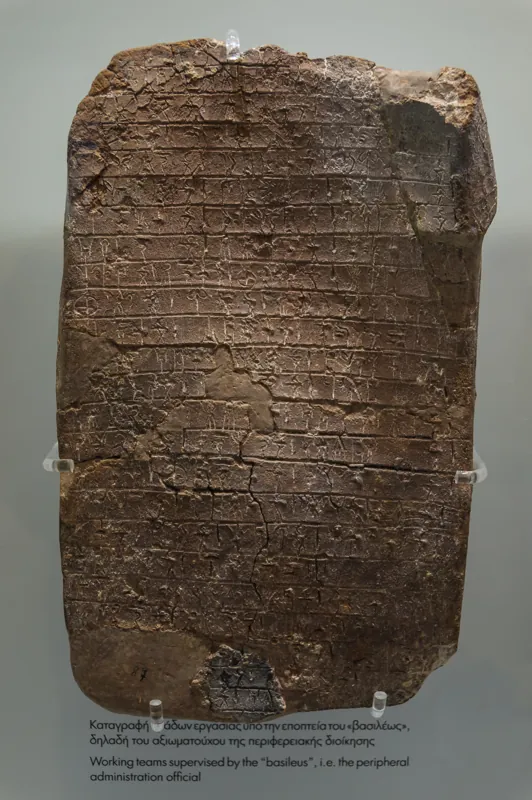
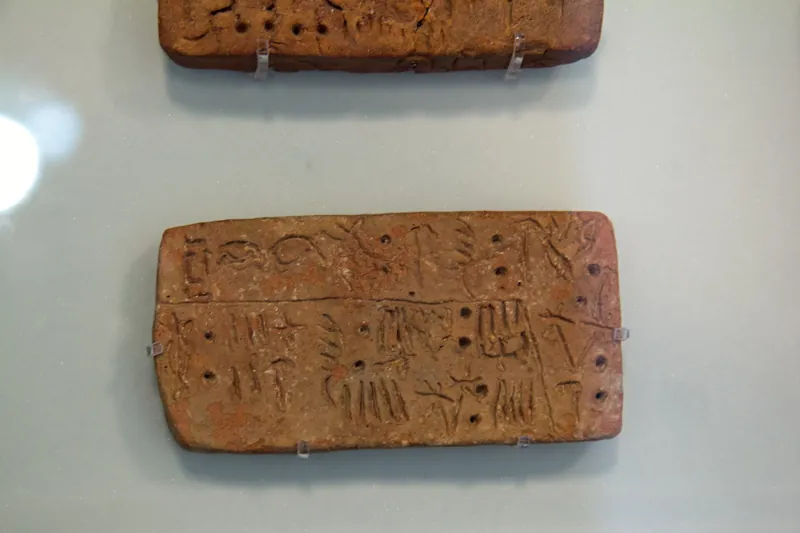
A line from a tablet at Pylos, 13th century BC
No one knew what language these signs hid. How do you read them anyway?
The clay tablets found at Knossos in 1900 held not one known word. In the 1940s Alice Kober, who taught classics at Brooklyn College, showed how some of their signs were related without knowing what they sounded like. In 1952 the architect Michael Ventris carried her method through to a grid of the signs, and out of the grid came Greek, though in 1940 he had called the Greek theory a fantasy.
This is a real tablet. Tap the marks you think are numbers.
There are three numbers: seven upright strokes, one level stroke (ten) and six strokes. The mark like a standing figure is a picture, not a syllable: woman. The rest are three words written in syllables. In chapter 6 you will read two of them yourself.
Tablet PY Aa 62 from Pylos, 13th century BC, set in printed signs.
1Knossos, Crete · 23 March – 5 April 1900
A thousand tablets nobody could read
1,000+tablets and fragments in the first season
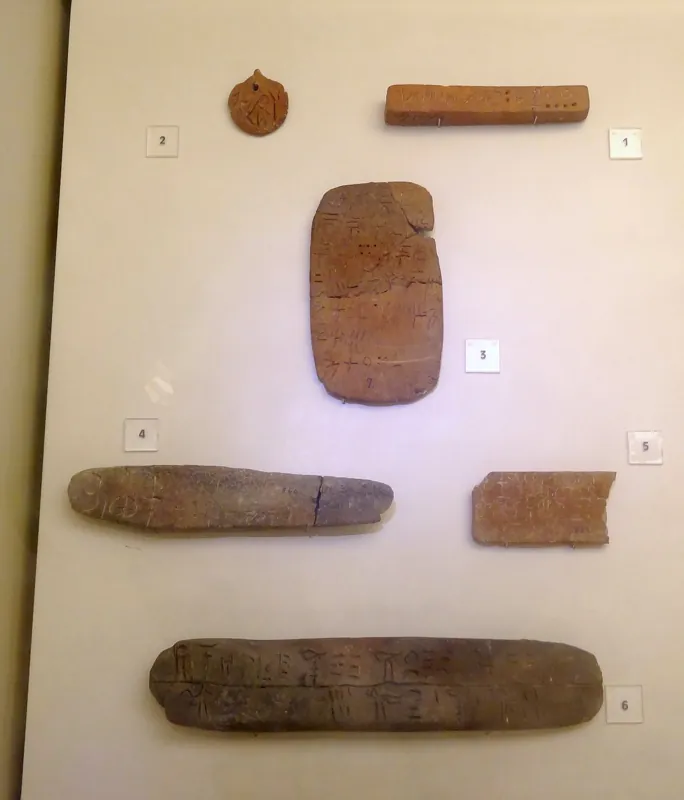
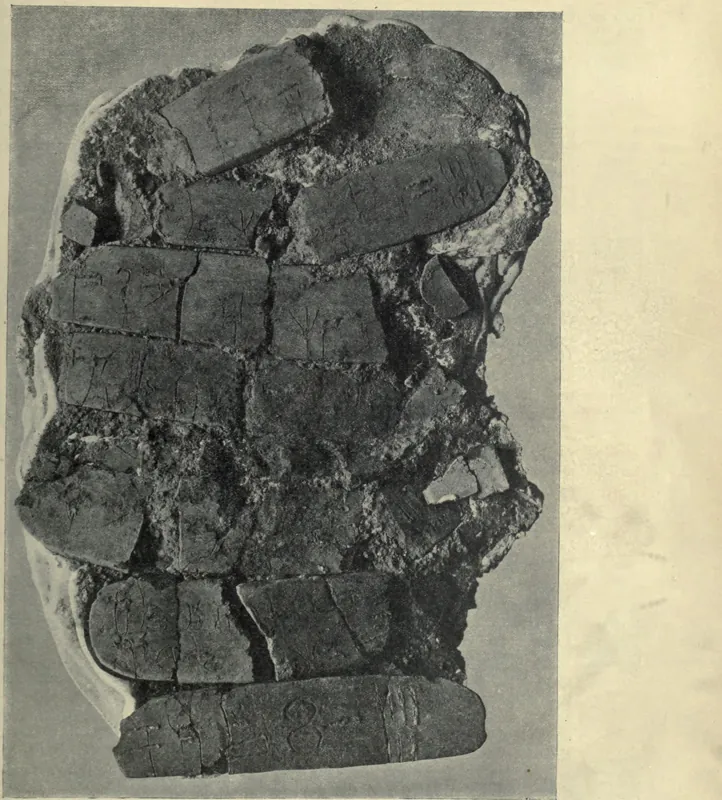
Arthur Evans began digging at Knossos on 23 March 1900. On 30 March the workmen turned up part of a long clay tablet, and on 5 April, Evans wrote, “an entire hoard of these clay documents, many of them perfect”. By the end of the first season he had counted over a thousand tablets and fragments.
They survived by accident. The scribes never fired their tablets: they wrote on soft clay, let it dry, and pulped it again when the record was no longer needed. The fire that destroyed the palace baked them hard. The ones the fire missed were, in Evans's words, mere sun-dried bits of clay; a storm one night during the dig turned a few of them into a “pulpy mass”.
On Crete Evans told apart three scripts: one of pictures, which he called hieroglyphic, and two linear ones, Class A and Class B. At Knossos almost everything was Class B. In his first report he counted about 70 signs in common use, guessed that each stood for a syllable, and noted that the lines always ran from left to right.
Then the tablets stayed with him. He published a selection in Scripta Minoa in 1909. Most of the Knossos texts appeared only in 1952, eleven years after his death.

How many Linear B documents are known today, from every site? Pick a number.
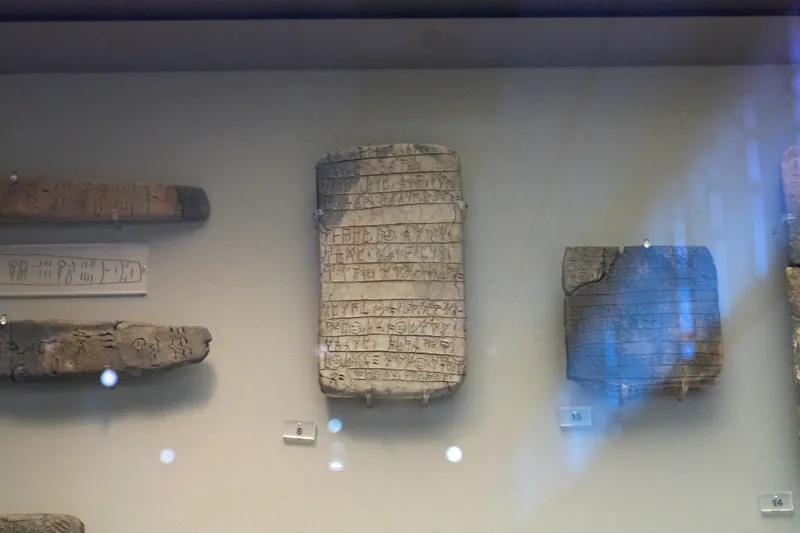
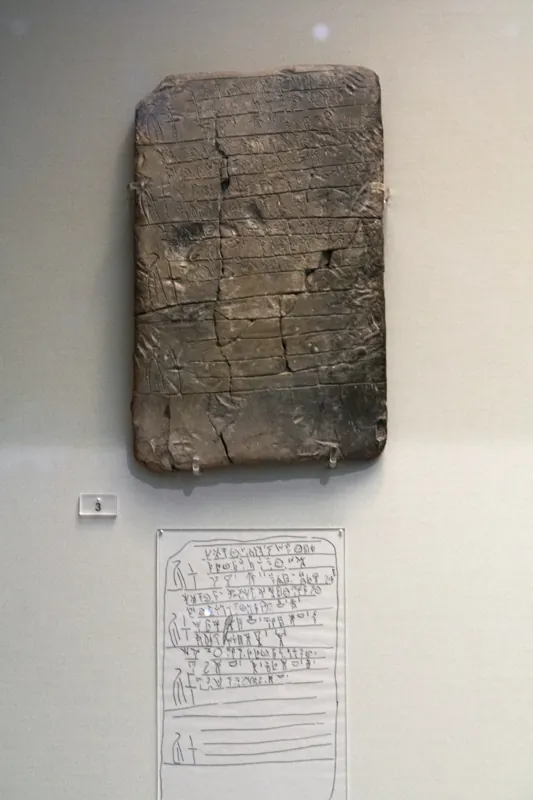
DAMOS, the University of Oslo's database, counts under six thousand Linear B documents. Many are narrow strips of clay holding a single entry.
2Oxford, New York, Pylos · 1930s–1940s
What could be known without reading a word
88signs for syllables in the 1953 list
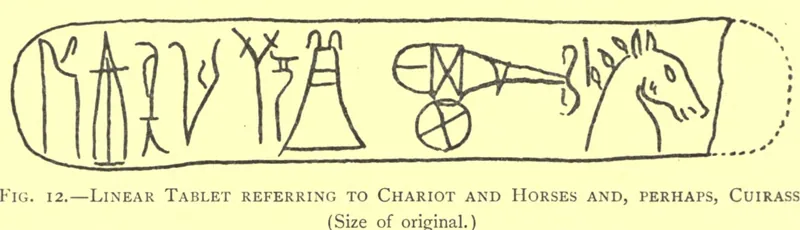
A fair amount. The numbers were the easy part: an upright stroke for each unit, a level one for each ten, a circle for a hundred. The pictures were plain too: a horse, a chariot, a man, a woman, a jar. A typical line held a word, a picture and a number, which is what an inventory looks like in any language.
The words were the problem. They were written with nearly ninety different signs; the list Ventris and Chadwick published in 1953, in Bennett's order, has about 88. There was no bilingual inscription, nothing like the Rosetta Stone that opened Egyptian hieroglyphs. No one even knew what language had been spoken at Knossos.
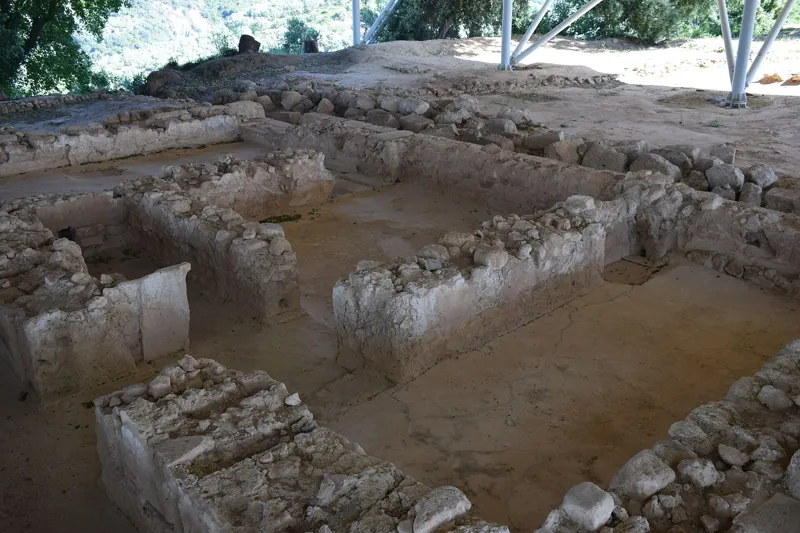
In spring 1939 Carl Blegen opened a hill at Ano Englianos, near Pylos on the Greek mainland, and found a room full of tablets: his provisional inventory ran to 618 numbers. They were in the same script as Knossos. Blegen dated them, at the earliest, to the end of the thirteenth century BC and wrote that “an early strain of Hellenic stock” had long ruled the mainland by then. As for the tablets' own language, he thought Minoan “almost certain”. The war came, and the Pylos tablets were published by Emmett Bennett only in 1951.
Nearly ninety signs. What kind of script can it be?
An alphabet has twenty to thirty letters; a script with a sign for every word has thousands. Ninety fits a syllabary, in which each sign writes a consonant together with a vowel, like the old script of Cyprus. Evans had guessed as much in 1900.

3Brooklyn College, New York · 1945–1948
Alice Kober sorts the signs without knowing their sounds
10signs in Kober's 1948 table
Alice Kober taught classics at Brooklyn College and had been working on the Knossos signs since 1931. In 1945 she set out her principle: if a language is inflected, she wrote, certain signs are bound to appear over and over in the same places in its words.
She did not try to guess sounds. She looked for words that appear in the same kind of list and differ only at the end. In 1946 she showed, for two types of noun, three forms each, which she called cases. One of them, written with the values found later, reads ko-no-si-ja, ko-no-si-jo, ko-no-so. She did not know that. She saw only the signs below.
Her point was about the signs, not the words. In a syllabary a changed ending replaces the whole sign. When a final sign turns into another, the two probably share a consonant and differ in the vowel. In 1948 she drew what follows: ten signs in five rows and two columns, labelled only “consonant 1–5” and “vowel 1–2”. She called it the “beginning of a tentative phonetic pattern”, and said in a footnote that for now it proved nothing.
She would go no further than the facts. “Let us face the facts,” she wrote in 1948. “An unknown language, written in an unknown script cannot be deciphered, bilingual or no bilingual.”

Three forms of one word, as Kober found them. In the third form, tap the sign that takes the place of the last two.
Type B
Type A
The sign 𐀯 (si) in the first two forms becomes 𐀰 (so) in the third: same consonant, different vowel. The same happens with 𐀴 (ti) and 𐀵 (to) in the other type of word. Kober put each pair on a row of her table.
4Brooklyn · 16 May 1950
What she left: over 186,000 slips of paper
186,747slips in her archive
Alice Kober died of cancer on 16 May 1950, at 43. She worked until a few days before.
What she left is in Austin, Texas, in the Program in Aegean Scripts and Prehistory: about 186,000 notes on slips of paper, some 117,000 of them cut to two inches by three and filed in cardboard cigarette boxes; forty notebooks; more than a hundred tabulations. Paper was scarce after the war, so she cut her slips from greeting cards, lecture announcements and envelopes.
She also did painstaking work for others. From 1946 she helped John Myres of Oxford prepare the Knossos texts Evans had left for the press; her classification of the tablets by what they count went into Scripta Minoa II. She was promoted to associate professor four months before she died, after nearly fifteen years as an assistant professor.
Early in 1950 Michael Ventris had sent a group of scholars a questionnaire on the language of the tablets. Ten answered. Kober did not: according to Chadwick, she wrote back that it was a waste of time. After her death a former teacher wrote to Myres that Alice stood out “not only for her clarity of mind but also for her fearlessness and honesty”.
How many slips do you think she wrote in nearly twenty years?
The archive's inventory counts 186,747 notes: an average of more than twenty-five a day from 1931 to 1950. Below, each rectangle stands for a thousand slips.
5London · 1936–1952
An architect sets the signs in a table, still without sounds
20Work Notes, January 1951 to June 1952
In 1936 a fourteen-year-old boy went with his school to an exhibition at Burlington House in London and heard Arthur Evans talk about Knossos. Michael Ventris was eighteen when the American Journal of Archaeology printed his first paper, “Introducing the Minoan Language”, in 1940.
He trained as an architect, flew as a navigator in the RAF during the war, and came back to the tablets. In 1950 he sent round the questionnaire. From January 1951 to June 1952 he wrote twenty Work Notes, 176 pages, and posted them to about two dozen colleagues.
His method was Kober's, applied to nearly every sign. Bennett's list, published in 1951 with the Pylos tablets, gave him a stable numbering. Ventris followed how each sign behaved in words that change and set them in a grid: signs that seemed to share a consonant on the same row, signs sharing a vowel in the same column. The rows and columns had numbers; the few sounds were only tentative. The team who later worked on the tablets called it simply “the grid”.

In 1940, which language did Ventris think the tablets' language was closest to?
Etruscan. His 1940 paper called the Greek theory “the fantasy with most followers” and put Etruscan forward as the nearest relative. The grid you see now uses today's positions; in his own, in February 1952, a few signs stood elsewhere, and the reading moved them.
6London · Work Note 20, 1 June 1952
From three town names, the grid gets its sounds
By June 1952 most of the Knossos texts were finally in print. Ventris took a group of words that were not personal names but headed very different lists, and that appeared at Knossos and not at Pylos. Kober's forms were among them. His guess, which Kober had not made, was that these were the names of towns, and the longer forms adjectives: “of Knossos”, as Athenian comes from Athens.
He added three small guesses: sign 08 is a, because it starts so many words; one row is n, because one sign looks like na in the script of Cyprus; one column is i, because sign 37 looks like the Cypriot ti. If 37 is ti, its row is the t row. Then he looked for Cretan towns whose names survived into classical times. Try it yourself, in the order Chadwick describes.
A word at Knossos that begins with a, has two signs in the i column and ends in an unknown sign. The harbour town near Knossos, named by Homer, would be spelled something like a-mi-ni-so.
08733012Amnisos. Since mi and ni sit in the same column, the i between m and n is an added vowel, as in the Cypriot script. Sign 12 becomes so, and its column o.
The other very common name: three signs, the last two of which now read no-so.
705212Knossos: ko-no-so. The first vowel is another added one, and the consonant must be k. The row of sign 70 is k.
The third name in -so: a rare sign not yet on the grid, then a sign from the i column, then so.
695312Tylissos, another important town in central Crete. Only the r row follows from it: sign 69, a rare one, had not been placed on the grid. Ventris wrote tu-li-so and called it less certain; today it is transcribed tu-ri-so, because one row of signs serves for both r and l.
Now you can read
- toso
τόσος so much, “total”
- tosa
τόσαι so many (feminine)
- konosijo
Κνώσιος of Knossos
- kowo
*κόρϝος → κοῦρος boy
- kowa
κόρϝα → κόρη girl
These words, read as far as the grid allows: what language do they look like?
Greek. to-so is tosos, “so much”; ko-no-si-jo is Knosios, “of Knossos”; ko-wo and ko-wa fit korwos and korwa, the old forms of “boy” and “girl”, with the s and r at the end of a syllable left unwritten. The woman from the tablet at the top of the page stands right beside them.
Beside the lists of women on the tablets stand two words: ko-wo and ko-wa. Ancient Greek has kouros, “boy”, and kore, “girl”; their older forms, korwos and korwa, reconstructed by linguists (korwa is attested in the Arcadian dialect), fit, if one allows that the script leaves some consonants out. The word before a total read to-so, Greek for “so much”. Ventris introduced his note as “a frivolous digression” and ended it warning that this line, if pursued, might “dissipate itself in absurdities”.
7BBC, 1 July 1952 · Greece, 16 May 1953
Greek, though no one expected it, and a test nobody arranged
On 1 July 1952 Ventris spoke on the BBC Third Programme. He said the Knossos and Pylos tablets “must, after all, be written in Greek”: “a difficult and archaic Greek, seeing that it is 500 years older than Homer”. John Chadwick, a Cambridge philologist who had broken codes in the war, was listening; he later wrote that the broadcast made no great impression, “but I for one was an eager listener”. On 13 July he wrote to Ventris offering help. Their joint paper appeared in the Journal of Hellenic Studies in 1953.
Colleagues were cautious. Bennett, in November 1952: “a tempting possibility: that is all I would say at this stage.”
Then came a test nobody had arranged. In 1952 Blegen had dug more tablets out at Pylos; cleaned over the winter, they could be read in spring 1953. On one of them Ventris's values gave ti-ri-po-de beside drawings of three-legged cauldrons, and words for four handles, three handles and none beside cups drawn with four, three and no handles. On 16 May 1953 Blegen wrote to Ventris: “All this seems too good to be true. Is coincidence excluded?”
Not everyone was convinced. In 1956 Arthur Beattie argued in the same journal that the match between words and pictures was due to chance.
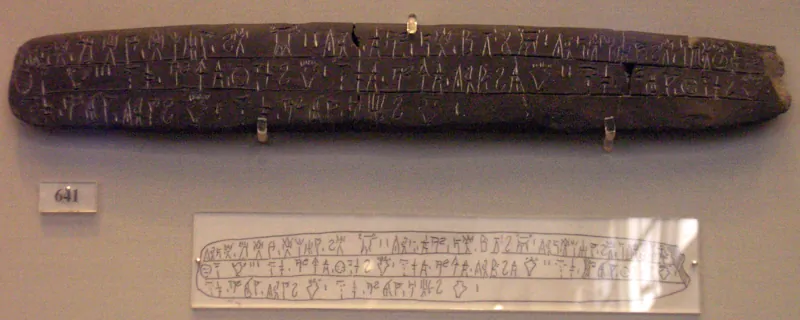

Read the tablet that convinced Blegen
The lines below are from PY Ta 641, in printed signs. Tap a word to see how it reads and what it means. First, though, take the test Ventris took without knowing it: which word stands beside the cup with no handles?
Three words stand beside cups drawn with four, three and no handles. Which one is beside the cup without handles?
a-no-we: an-, “without”, and ow-, “ear”, that is, handle. qe-to-ro-we has four, ti-ri-o-we-e three. The values of the signs had been fixed a year earlier, on other tablets.
- two tripods
- one tripod; the rest of the phrase is still disputed
- three vessels of another kind, called qe-to
- one larger cup, four-handled
- two larger cups, three-handled
- one smaller cup, without handles
Tap a word on the tablet
8Knossos and Pylos · Late Bronze Age
What the tablets say, what they do not, and who is owed the credit
14signs still listed without a value in the standard table
The tablets hold bookkeeping. Sheep and wool, oil for the gods, chariots and wheels, bronze handed to smiths, lists of the women who grind grain and of their children. No letter, no poem, no chronicle has been found: the tablets were the palace's current records, and the fire that kept them kept only what was on clay. Their Greek is some five hundred years older than Homer's.
Some of it is still unread. In the standard table of signs, fourteen are still listed without a value. Linear A, the older script of Crete, uses many of the same signs and remains undeciphered, because its language is unknown.
Ventris died on 6 September 1956, when his car hit a lorry on the Great North Road; he was 34. Documents in Mycenaean Greek, written with Chadwick, came out a few weeks later. It calls Kober's diagram “of fundamental importance”. Their 1953 paper had cited her at least five times and credited her with first noticing the forms ko-no-si-jo, ko-no-si-ja, ko-no-so. Chadwick wrote in 1958 that, of all the work before Ventris, hers was “the most valuable contribution”. Outside the field her name was little known until Margalit Fox's book in 2013.

What do you think has NEVER been found on a Linear B tablet?
A poem. Sheep are counted on many Knossos tablets, KN Da 1156 for one, and oil for the gods appears on KN Fp 1, beside the names of Zeus and the town of Amnisos.

Quiz: who did what
Eight facts, six people. Pick who did each one.
Found, on 5 April 1900, an entire hoard of tablets.
Found, in 1939, the first tablets on the Greek mainland.
Called the Greek theory, in 1940, “the fantasy with most followers”.
Showed, in 1946, that some words change their endings by rule.
Alice E. Kober, „Inflection in Linear Class B: 1 — Declension”, AJA 50 (1946), 268–276
Refused to answer the 1950 questionnaire.
John Chadwick, The Decipherment of Linear B (Cambridge, 1958)
Published, in 1951, the sign list and numbering still in use.
Wrote to Ventris on 13 July 1952, offering a philologist's help.
Cambridge Mycenaean Epigraphy Group, „The decipherment of Linear B”
Asked, in May 1953: “Is coincidence excluded?”
M. Ventris and J. Chadwick, Documents in Mycenaean Greek (Cambridge, 1956)
What is not known
- Which name Ventris read first. Chadwick, who worked with him, puts Amnisos first; Margalit Fox puts Knossos; Ventris himself, in 1956, says the five town names emerged together. The original Work Notes were not consulted directly.
- What Kober would have thought of Greek. She published no view on the language of the tablets beyond its being different from that of Linear A, and she died before the decipherment.
- How much Ventris took directly from her table. The 1953 paper does not credit the grid to her; the 1956 book says her diagram was fundamental throughout.
- When the Knossos tablets were written. The date of the palace's destruction has been disputed for a century; the proposals span nearly two hundred years.
- What language Linear A writes. Its signs can be sounded with Linear B values, but the words that result resemble no known language.
Sources
The tablet texts come from DAMOS, and the signs from the Unicode tables, checked one by one. Kober's and Ventris's letters could not be read directly; phrases from them come from the Austin archives' finding aids and from Chadwick's book, and are attributed as such. The date of the BBC talk comes from the Cambridge group's pages; according to the Ventris archive's finding aid, its text was printed in The Listener, 10 July 1952.
- Arthur J. Evans, „Knossos. Summary report of the excavations in 1900”, Annual of the British School at Athens 6 (1900). archive.org/details/annualathens06brituoft
- Arthur J. Evans, Scripta Minoa I (Oxford, 1909). archive.org/details/scriptaminoawrit01evanuoft
- C. W. Blegen and K. Kourouniotis, „Excavations at Pylos, 1939”, American Journal of Archaeology 43 (1939). archive.org/details/sim_american-journal-of-archaeology_octo
- M. G. F. Ventris, „Introducing the Minoan language”, American Journal of Archaeology 44 (1940), 494–520. archive.org/details/sim_american-journal-of-archaeology_octo
- Alice E. Kober, „Evidence of inflection in the «chariot» tablets from Knossos”, AJA 49 (1945), 143–151. archive.org/details/sim_american-journal-of-archaeology_1945
- Alice E. Kober, „Inflection in Linear Class B: 1 — Declension”, AJA 50 (1946), 268–276. archive.org/details/sim_american-journal-of-archaeology_1946
- Alice E. Kober, „The Minoan scripts: fact and theory”, AJA 52 (1948), 82–103. www.jstor.org/stable/500554
- M. Ventris and J. Chadwick, „Evidence for Greek dialect in the Mycenaean archives”, Journal of Hellenic Studies 73 (1953), 84–103. doi.org/10.2307/628239
- M. Ventris and J. Chadwick, Documents in Mycenaean Greek (Cambridge, 1956). archive.org/details/in.gov.ignca.17617
- A. J. Beattie, „Mr. Ventris’ decipherment of the Minoan Linear B script”, JHS 76 (1956), 1–17. doi.org/10.2307/629549
- John Chadwick, The Decipherment of Linear B (Cambridge, 1958). archive.org/details/bwb_S0-CCT-175
- Alice E. Kober Papers, finding aid, Program in Aegean Scripts and Prehistory, University of Texas at Austin. sites.utexas.edu/scripts/files/2016/11/Alice-E.-Kober-Papers
- Michael Ventris Papers, finding aid, PASP, University of Texas at Austin. sites.utexas.edu/scripts/files/2016/11/Michael-Ventris-Paper
- Cambridge Mycenaean Epigraphy Group, „The decipherment of Linear B”. www.classics.cam.ac.uk/research/projects/mycep/decipherment
- DAMOS, Database of Mycenaean at Oslo (tablet texts, CC BY-NC-SA 4.0). damos.hf.uio.no/
- Unicode 18.0, the Linear B Syllabary and Aegean Numbers blocks. www.unicode.org/charts/PDF/U10000.pdf
- W. W. Briggs, „Kober, Alice Elizabeth”, Database of Classical Scholars, Rutgers. dbcs.rutgers.edu/all-scholars/8851-kober-alice-elizabeth
Type: Newsreader, Noto Sans Linear B, GFS Didot, Atkinson Hyperlegible Next, IBM Plex Mono (SIL Open Font License).