mariuscomper.uk ROES中文

A Greek machine that predicted eclipses, more than 2,000 years ago

The Antikythera mechanism

In 1901 divers raised a lump of corroded bronze from a shipwreck off the Greek island of Antikythera. Inside were gear wheels with teeth a millimetre and a half long. Scroll to turn its handle: every pointer here moves because the gears drive it, from the tooth counts read in X-ray scans.

Easter 1900

A wreck off Antikythera

In spring 1900, sponge divers from the island of Symi found a shipwreck off Antikythera, a small island between Crete and the Peloponnese. The wreck is generally dated to around 60 BC.

Between November 1900 and September 1901, divers brought up bronze and marble statues and pottery. The mechanism, a lump of corroded bronze and wood, was probably raised in July 1901.

May 1902

A gear wheel in the lump

The lump went to the National Archaeological Museum in Athens with the rest of the finds. In May 1902 Spyridon Stais, a former education minister, noticed gear wheels on one of its pieces during a visit to the museum.

Gears were known in the ancient world, in water clocks and lifting machines. Nothing found from the period had gears this small or this many.

82 fragments

Eighty-two pieces

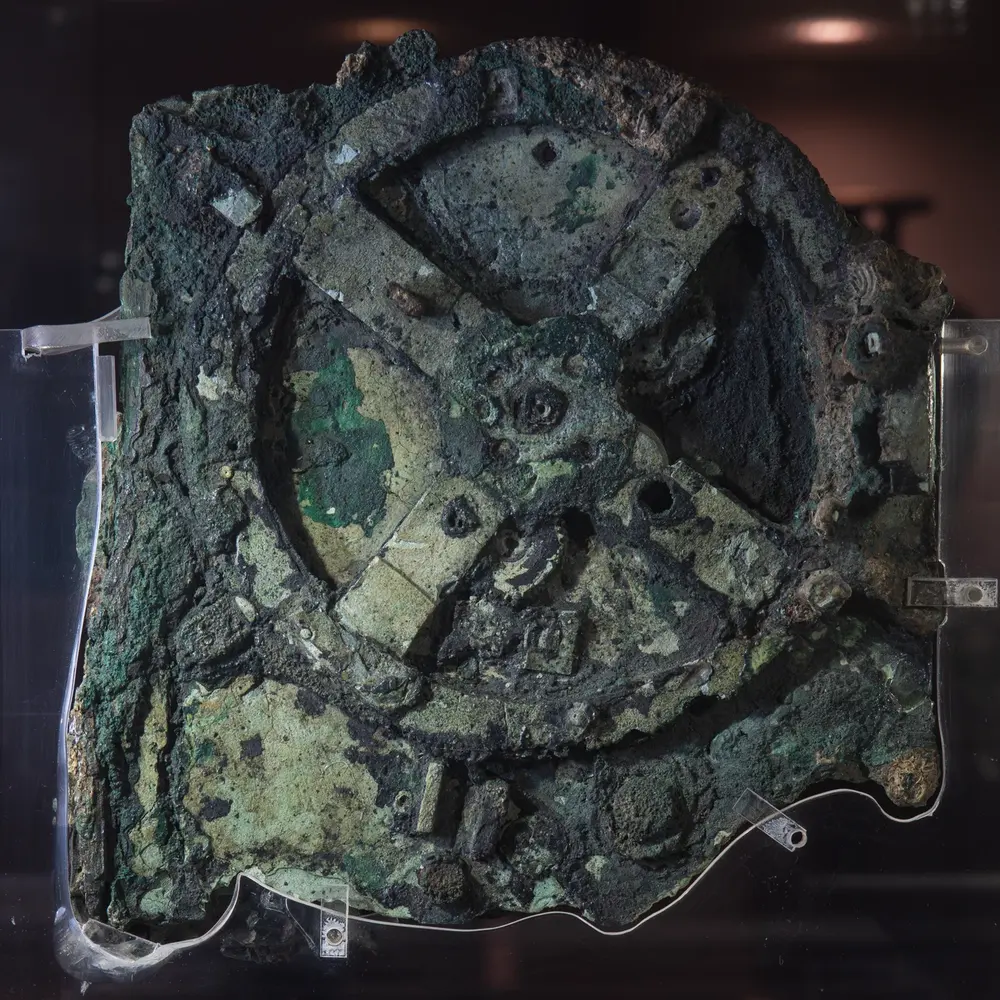
Today the mechanism is catalogued as 82 fragments: seven large ones, labelled A to G, and 75 small ones, some of which may belong to other objects. Only about a third of the machine survives.

Thirty bronze gears survive. Twenty-seven of them are in Fragment A, the largest piece, about 18 by 15 centimetres. One each is in Fragments B, C and D.

Fragment A of the Antikythera mechanism: a flat slab of corroded green and dark bronze with the outline of the large four-spoked wheel.
Fragment A today, in the National Archaeological Museum in Athens. Photo: Logg Tandy, Wikimedia Commons, CC BY 4.0.

1970s and 2005

Seeing inside the corrosion

Most of the gears are buried in the crust. In 1971–72 Charalambos Karakalos X-rayed the fragments. He, Emilia Karakalos and the historian of science Derek de Solla Price counted the teeth, and Price published a reconstruction in 1974.

In 2005 a team brought a large X-ray CT scanner from the firm X-Tek Systems to the museum, and a camera from HP that photographs the surface under light from many angles. The scans showed the gears in three dimensions, and with the surface images they doubled the number of inscriptions that could be read.

The team wrote that it was “technically more complex than any known device for at least a millennium afterwards”.

The 2006 reconstruction

The gears, put back together

This model follows the gear trains published from the scans in 2006 and 2008, with their tooth counts. The bronze gears survive. The three pale ones have not been found; they are inferred so that the trains shown can work.

The case was wooden, about 33 by 18 centimetres and perhaps 10 deep. The gears are bronze with only a few per cent of tin, and their triangular teeth are about 1.5 millimetres long. Here the gears are placed to fit their tooth counts; the layout is drawn, not measured from the fragments.

Surviving gearNot found; inferred

One turn, one year

One turn of the big wheel is one year

A handle on the side probably turned the largest wheel, the one with four spokes. One full turn of that wheel is one year: the Sun’s pointer on the front goes once round the zodiac.

From here on, scrolling turns the handle. Everything else on this page moves only because this wheel drives it, through the teeth. The readout shows the date the dials have reached.

Drag to turn the handle · right-drag to look around

254 ÷ 19

How bronze counts the Moon

Measured against the stars, the Moon goes round the sky about 254 times in 19 years. The gears use exactly that ratio: one gear turns 254 times while the big wheel turns 19.

Follow the bright gears: 64 teeth drive 38, then 48 drive 24, then 127 drive 32. Multiply it out: 64/38 × 48/24 × 127/32 = 254/19 The odd gear with 127 teeth is there because 254 is 2 × 127, and 127 is a prime number: no smaller wheels can make it.

Pin and slot

A Moon that speeds up and slows down

The Moon crosses the sky faster when it is near the Earth and slower when it is far. Two gears with 50 teeth each copy this. Their axles are about 1.1 millimetres apart, and a pin on one rides in a slot on the other, so the second gear runs a little ahead, then a little behind, by up to about 6.5 degrees.

Both ride on a larger gear that turns about once in nine years, as the long axis of the Moon’s orbit does. The 2006 team linked the design to the astronomer Hipparchus, who worked out a theory of the Moon in the second century BC.

The Moon ball

The phases, on a small ball

A small ball, half pale and half dark, probably showed the phase of the Moon: gears turned it so that it was dark at new Moon and bright at full. Here it rides on the Moon pointer.

Michael Wright identified a small surviving crown gear in Fragment C as part of its drive.

The front dial

The front: the year and the sky

Around the pointers on the front are two rings. The inner one is the zodiac, 360 divisions with the Greek names of the signs. The outer one carries the names of the Egyptian months and was long read as the Egyptian year of 365 days. It could be turned, using a ring of holes beneath it. In 2024 Graham Woan and Joseph Bayley of the University of Glasgow estimated from the surviving holes that there were 354 or 355 of them, the length of a lunar year. Here the ring is drawn with the 365 days of the older reading.

The 2021 reconstruction by Tony Freeth and colleagues adds the five planets known in antiquity, on rings across the front. Almost none of that gearing survives; in their model the 63-tooth gear of Fragment D drives Venus. Here those rings are drawn faint.

235 months

The back: a calendar of 19 years

Turn it round. The upper dial on the back is a spiral of five turns divided into 235 cells, one for each lunar month (new Moon to new Moon) of 19 years. A pin on the pointer rides in the groove, so the pointer moves outward as the years pass.

Nineteen years are almost exactly 235 lunar months. The inscription on the back cover describes a spiral with 235 divisions.

Every four years

The Games

Inside that spiral a small dial turns once every four years. It names the great Games, the Isthmian, Olympic, Nemean and Pythian, and two smaller festivals: the Naa of Dodona and, in Paul Iversen’s reading, the Halieia of Rhodes.

The Olympic Games fall at the end of the dial’s first year, after the Isthmian Games.

223 months

Eclipses, 18 years ahead

The lower spiral has four turns and 223 cells. After 223 lunar months, about 18 years, eclipses return in almost the same order. Glyphs in the cells mark the months when an eclipse was possible: Σ for the Moon, Η for the Sun. The 2008 study counted 18 surviving glyphs.

A Saros lasts about 6,585⅓ days, so each cycle ends a third of a day later. A small dial inside turns once every three cycles, 54 years, and tells the reader to add 0, 8 or 16 hours to the time inscribed. The glyphs on this reconstruction are computed from the Moon’s motion for the dial’s starting date.

205 BC

When the dials begin

Two studies published in 2014 dated the eclipse sequence on the spiral to 205–187 BC. Christián Carman and James Evans place the full Moon of its first month on 12 May 205 BC; Alexander Jones places the start of the calendar and Games cycles in late August of the same year. When the machine was made is less certain.

One reading of the letter forms points to the late second or early first century BC; other specialists allow a wider range. The ship carrying it sank around 60 BC.

Any day

Wind it to a day of your own

Type a date from AD 1 to 3000, a birthday for instance, and the handle winds from 205 BC to that day. The pale ring on the zodiac marks the real Moon’s average position that day.

The dials now show today.

About 10 days

Left running since 205 BC

The machine counts 235 months in 19 years. The true 235 months are about two hours longer. If its main wheel had turned once a year since 205 BC, its Moon would gain a day on the sky about every 220 years.

By today, after about 2,230 years, its Moon pointer would be about ten days ahead of the real Moon. Over one owner’s lifetime of 50 years, the error is about six hours.

Athens

The next machine as complex

A simpler geared calendar survives in a Byzantine sundial from around AD 500. The earliest known device of comparable complexity is the astronomical clock that Giovanni de Dondi built in the 14th century.

The fragments are in the National Archaeological Museum in Athens.

Share

Send the mechanism to someone. Once you have set a date, the link opens on that date.

Sources

Tooth counts, gear trains and survival of each gear follow the 2006 paper and its supplementary notes, with the 2008 revision of the four-year dial; the Games follow the 2008 paper and Iversen’s reading. The gear layout is drawn to fit the tooth counts and is not a survey of the fragments. The eclipse marks are computed from mean motions of the Moon. Moon phases for a chosen date are mean values, good to about a day.

  1. Antikythera Mechanism Research Project, history of the find and the research
  2. Antikythera Mechanism Research Project, frequently asked questions
  3. D. de Solla Price, Gears from the Greeks: The Antikythera Mechanism, a calendar computer from ca. 80 B.C., Transactions of the American Philosophical Society 64 (1974)
  4. T. Freeth et al., “Decoding the ancient Greek astronomical calculator known as the Antikythera Mechanism”, Nature 444 (2006), with its Supplementary Notes (tooth counts, gear trains)
  5. T. Freeth, A. Jones, J. M. Steele, Y. Bitsakis, “Calendars with Olympiad display and eclipse prediction on the Antikythera Mechanism”, Nature 454 (2008)
  6. T. Freeth et al., “A Model of the Cosmos in the ancient Greek Antikythera Mechanism”, Scientific Reports 11 (2021)
  7. C. C. Carman, J. Evans, “On the epoch of the Antikythera mechanism and its eclipse predictor”, Archive for History of Exact Sciences 68 (2014)
  8. A. Jones, “Epoch dates of the Antikythera Mechanism”, ISAW Papers 17 (2020)
  9. P. Iversen, “The Antikythera Mechanism, Rhodes, and Epeiros”, in Instruments – Observations – Theories: Studies in the History of Astronomy in Honor of James Evans (2020)
  10. G. Woan, J. Bayley, “An improved calendar ring hole-count for the Antikythera mechanism”, The Horological Journal (2024)
  11. Encyclopaedia Britannica, “Metonic cycle”