The Cerna Valley, for two thousand years
What does the water at Herculane taste like?
Warm, salty, and smelling of rotten eggs — that is how visitors drink and sense it today. The Romans called it sacred water and thanked it in stone; the Habsburgs built the resort around it; the laboratory counts its salt, sulphur, and calcium, milligram by milligram. The water is the same; the buildings rose and fell around it.
- 153the year of the first surviving tablet dedicated to the waters
- 38–60 °Cwhat the thermal springs described today measure
- 2,000 yearsfor which the Cerna water has been drunk
The Romans: the proof is in stone
The Romans never analysed the water. They healed in it and wrote that down in stone.
The ancient resort was called Ad Aquas Herculis Sacras Ad Mediam — “at the sacred waters of Hercules, near Mehadia”. A full bathing cult grew around the hot springs of the Cerna, under the protection of Hercules, Aesculapius, and Hygieia: temples, baths, altars, and statues. Aqueducts, baths, coins, and six statues of Hercules survive from the Roman period.
The resort is first documented in the year 153: a votive tablet raised by a delegation of Romans returned unharmed, dedicated to the gods and divinities of the waters. Other tablets praise the healing power of the springs; several are kept today at the Natural History Museum in Vienna. The local inscriptions are collected in the corpora as CIL III 1563–1565.
After the Roman administration withdrew under Aurelian, the baths declined, but the name survived — a sign the water was never abandoned. When the Austrians surveyed the ruins in 1774, the Roman thermae could still be read in the stone.
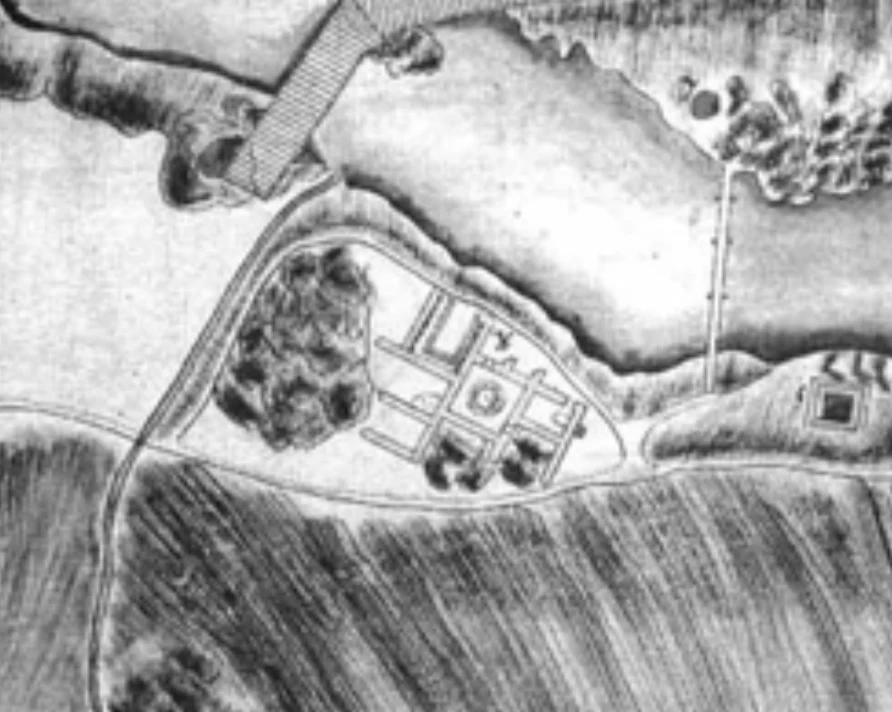

What did the water taste like to a Roman? No ancient recipe survives, and the only Roman “analysis” is gratitude: the votive tablets speak of healing, not milligrams. But the geology never changed the recipe — the springs rise from the same limestones, along the same faults — so today’s glass is the closest approximation of that glass.
- Where
- The Cerna Valley, between the Cerna and Mehedinți mountains; 168 m altitude
- Roman name
- Ad Aquas Herculis Sacras Ad Mediam
- First record
- The year 153, a tablet dedicated to the waters
- Guardian gods
- Hercules, Aesculapius, Hygieia
The Habsburgs: the resort grows around the water
After the Treaty of Passarowitz, the Austrians rebuild the baths. The water stays; the architecture changes.
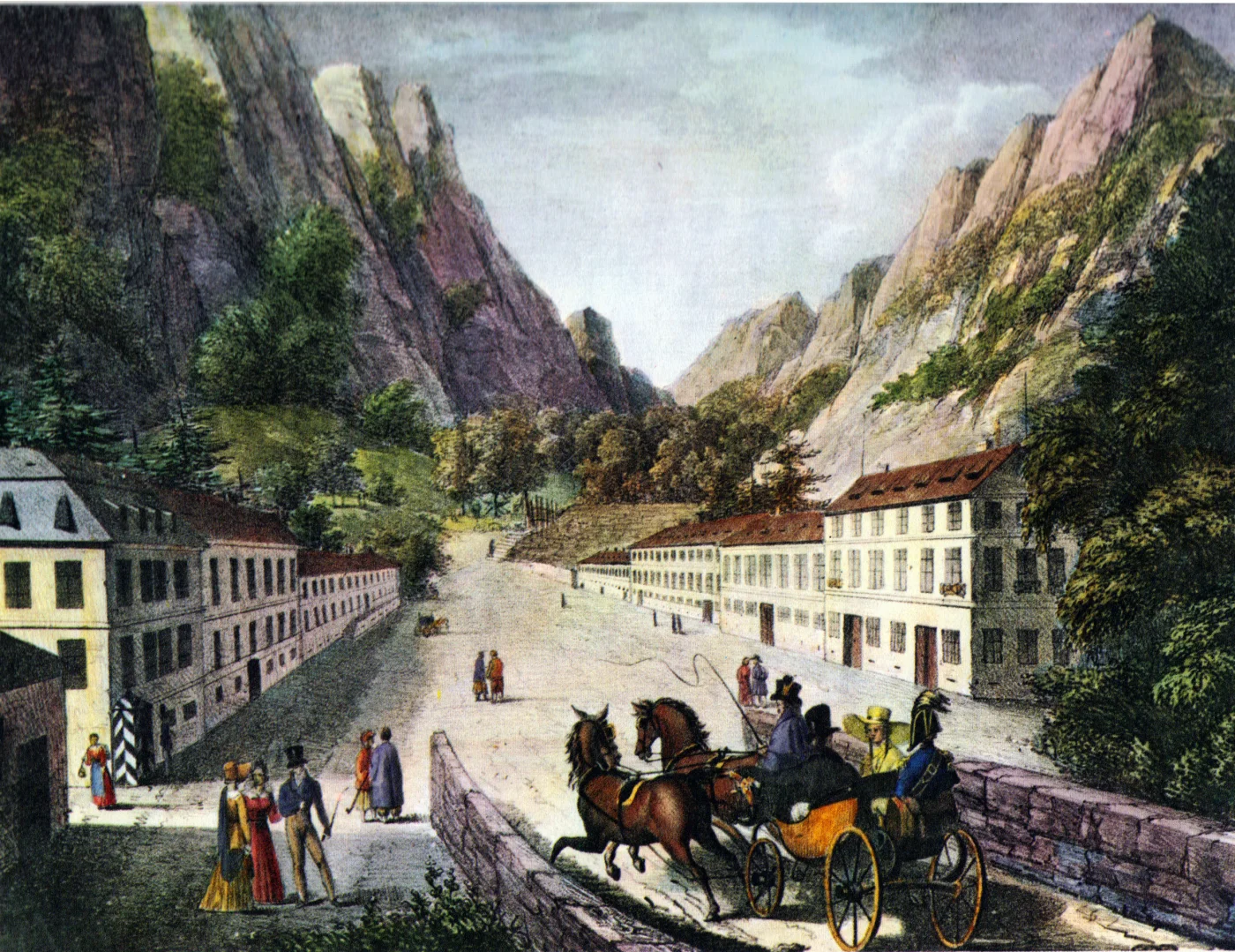
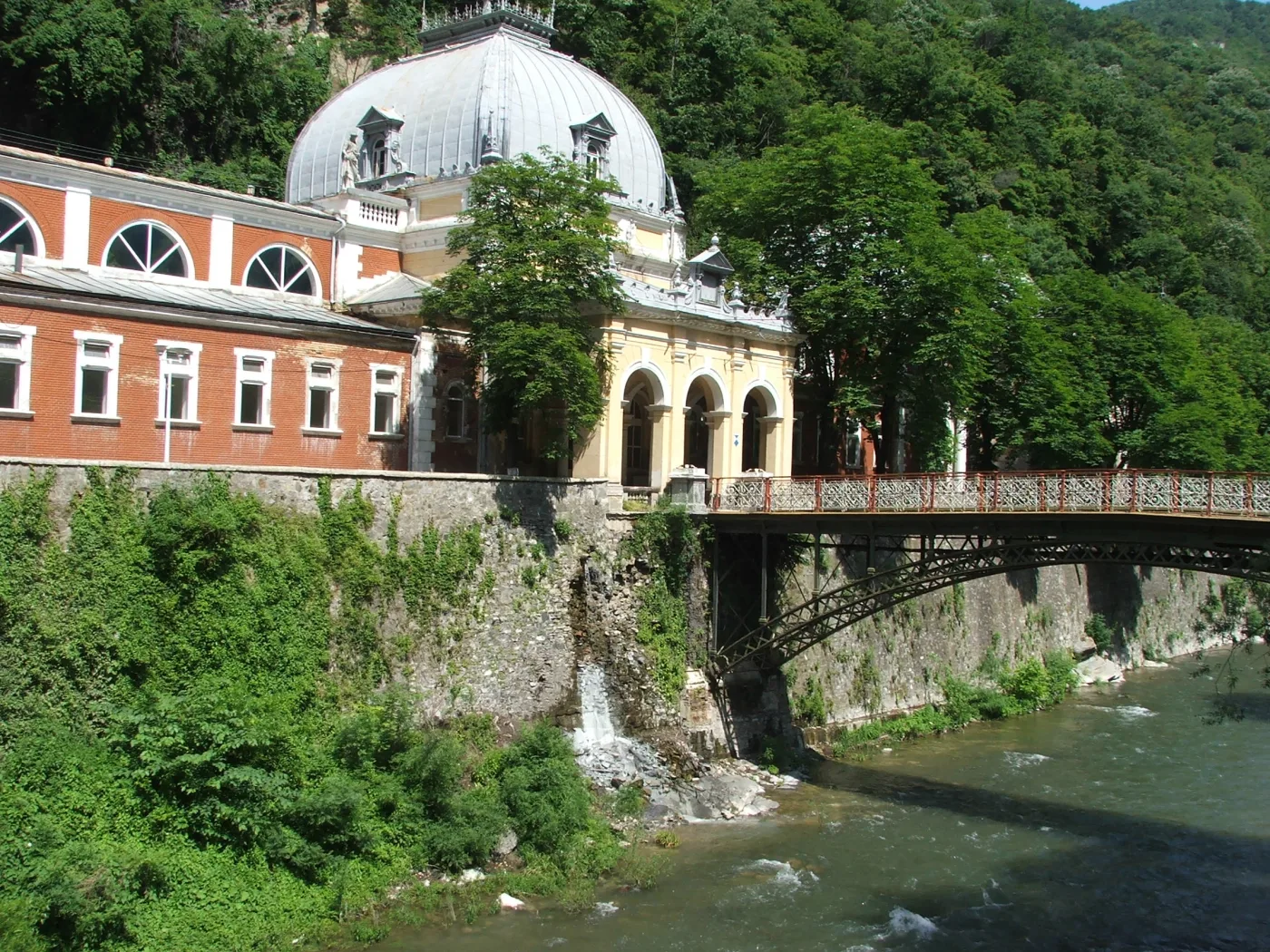
In 1718 the Banat entered the Austrian Empire, and from 1736 General Andreas Hamilton, the provincial governor, rebuilt the baths and recorded the thermae of Hercules, Hygieia, and Aesculapius. The Banat border guards then raised, one after another, the buildings that give the resort its face today: the Neptune and Diana baths, the casino ensemble, Hercules Square, the Traian and Decebal hotels, the stone and cast-iron bridges over the Cerna, the statues, the pavilions, and the station — an Austrian Baroque found nowhere else in Europe.

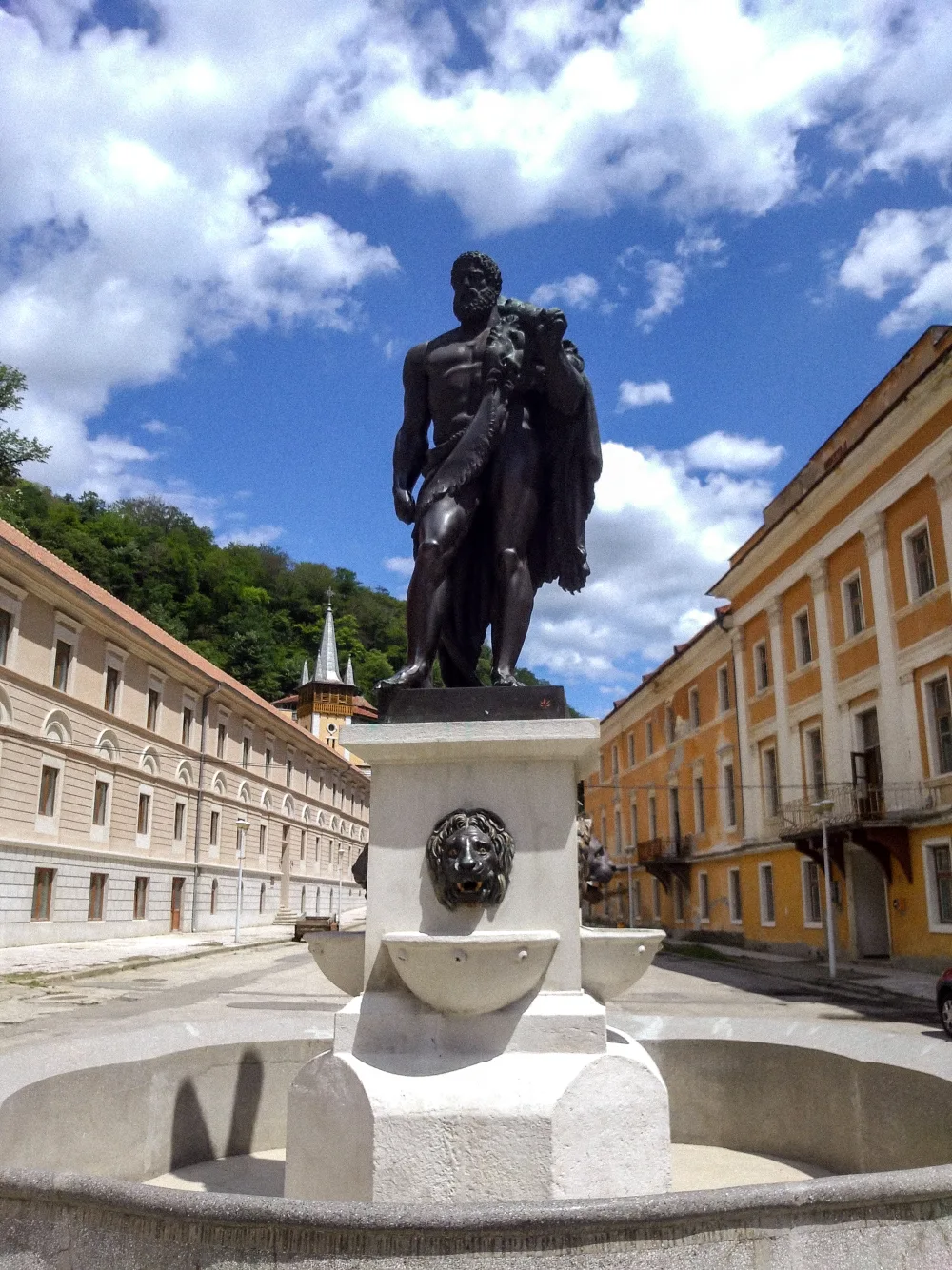
The Hercules statue in the central square was cast in bronze in 1847 by the Viennese founders Ramelmayer and Glantz. In 1852 Emperor Franz Joseph called Herculane “the most beautiful resort on the continent”, and Empress Elisabeth filled pages of her private journal with it.

Figures are missing from the imperial century, though: hydrochemical data on the springs had been published since the 17th century, but systematic records begin only in the early 20th. The 19th century left the buildings and a classification of the waters by the senses: warm, sulphurous, salty. Only the modern laboratory would put milligrams on each taste.
The laboratory: six springs, six tastes
Between 1984 and 1995, hydrogeologists tasted the water with instruments: 24 sources between the station and the Crucea Ghizelei well. Pick a spring and see what comes out of it.
Herculane water is of the sodium–chloride type: dissolved table salt, accompanied by sulphur and calcium. From north to south, temperature, mineralisation, and sulphur rise together — the southern springs are the hottest, saltiest, and most sulphurous. Geothermometers show the water sinks so deep it reaches 170–190 degrees before rising to the surface.
The most unsteady is the Hercules spring, with the highest flow: its temperature jumps between 17 and 53 degrees, depending on how much cold water mixes in along the way.
Traian
58.6 °C
Measured values from 52.9 to 59.5 °C · 27 samples
- Mineralisation
- Hydrogen sulphide
- Sodium
- Calcium
- Chlorides
Median values, 1984–1995, after Povară, Simion and Marin (2008). Each bar compares the spring against the highest of the six.
| Spring | Temp. °C | Mineral. g/l | H₂S mg/l | Na mg/l | Ca mg/l | Cl mg/l |
|---|---|---|---|---|---|---|
| Hercules | 32.6 | 1.6 | absent | 307.7 | 4.5 | 799.0 |
| Apollo II | 47.9 | 2.6 | 18.5 | 639.1 | 323.7 | 1,479.6 |
| Diana III | 54.4 | 3.7 | 35.5 | 977.9 | 387.9 | 2,141.3 |
| Neptun II | 47.4 | 6.2 | 54.3 | 1,465.0 | 828.9 | 3,682.9 |
| Traian | 58.6 | 7.5 | 49.4 | 1,691.8 | 1,025.4 | 4,427.4 |
| Decebal | 36.2 | 7.6 | 51.4 | 1,778.4 | 1,019.2 | 4,522.5 |
The threshold at which a water counts as sulphurous is one milligram of hydrogen sulphide per litre. Neptun II holds, at the median, 54 times more — hence the rotten-egg smell that greets the visitor. And Decebal, though lukewarm, is the saltiest: over four and a half grams of chlorides per litre.
Today: the water flows, the buildings wait
The springs never ran dry. Not everything built around them had the same luck.
The Neptune baths, the imperial pearl of the resort, stand abandoned today: after 1989, privatisations, lawsuits, and tangled property deeds blocked any publicly funded rescue. A collective of young architects, HerculaneProject, documented the building and prepared emergency works to make it safe.

Above the historic centre rise the concrete hotels of the communist era — eight- to twelve-storey blocks built for the mass tourism of employees and pensioners on state treatment vouchers. They still dominate the resort skyline.
Signs of life are not missing: the baths at the Roman Hotel, built over the ancient thermae, reopened in 1999, and recent years have brought private hotels, guesthouses, and villas. Herculane belongs to the European network of Roman thermal spas — the only member in Romania. The water, meanwhile, leaves the ground as it did two thousand years ago.
- 153The first surviving votive tablet: Roman delegates thank the waters.
- 1718The Treaty of Passarowitz: the Banat enters the Austrian Empire.
- 1736General Hamilton rebuilds the baths; the modern resort begins.
- 1774The Austrians survey the ruins of the Roman thermae.
- 1847The bronze statue of Hercules is cast in Vienna.
- 1852Franz Joseph calls Herculane the most beautiful resort on the continent.
- 1920The Treaty of Trianon: Herculane joins Romania.
- 1984–1995Hydrogeologists measure the springs systematically: temperature, salt, sulphur, calcium.
- 1999The Roman Hotel baths reopen over the ancient thermae.
Sources
The laboratory figures are medians over 1984–1995; the history comes from chronicles, archives, and museums.
- Povară, Simion and Marin: “Thermo-mineral waters from the Cerna Valley Basin”, Studia UBB Geologia, 2008 — the analyses of all 24 sources, the north–south gradient, the 170–190 °C geothermometers. digitalcommons.usf.edu
- Studia Antiqua et Archaeologica 23.1 (2017): the Roman population at Herculane, citing CIL III 1563–1565. saa.uaic.ro
- Wikipedia: “Băile Herculane” (ro, en) and the Hercules statue article (ro) — the 153–1999 chronology, the 1847 casting. en.wikipedia.org/wiki/Băile_Herculane
- Roman Thermal Spas of Europe: “Ad Aquas Herculi Sacras”, first documented in 153. roman-thermal-spas.eu
- HerculaneProject: urgent safety works for the Neptune Baths (2022). herculaneproject.ro
- Haus der Bayerischen Geschichte: Herkulesbad — the imperial ensemble, the 1847 statue, the casino. hdo.bayern.de
- INRMFB, via Czellecz et al. (2017): the sulphurous-water threshold, one milligram of hydrogen sulphide per litre. aerapa.conference.ubbcluj.ro