Rhythmic applause
A whole audience claps in time, though nobody is leading
To clap together, people clap about half as fast as in the first roar. Then, the physicists suggest, they want more noise, speed up, and lose the beat.
Tap the hall to clap along with it
Hold to ask the hall for more noise.
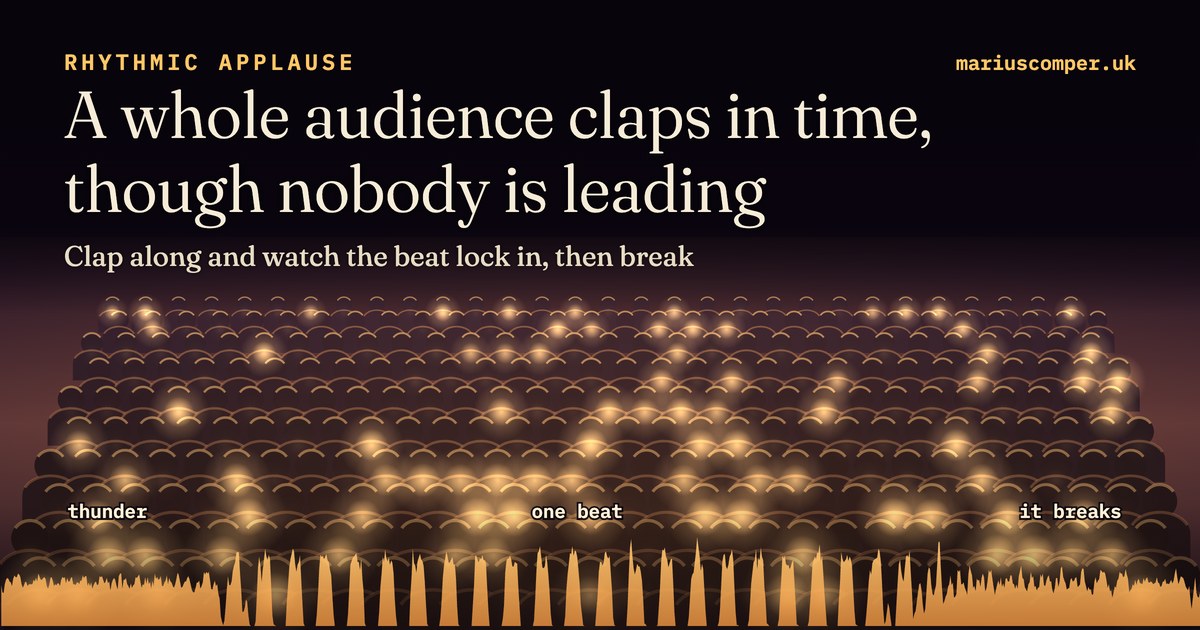
Applause starts as a thunder in which everyone claps however they like. After a few seconds the hall locks into a single beat that nobody gave. Then the beat breaks and the thunder comes back. Physicists at Babeș-Bolyai University in Cluj, Romania, with colleagues in Hungary, France and the United States, recorded this in theatres and opera houses in Romania and Hungary and found what happens between the two states.
The hall above has 300 spectators simulated by a model the authors published, with a rule I added that makes the beat break. The picture and the sound come from the simulation. The real measurements are below.
Your seat is the one marked “you”. Clap along with the hall (tap the hall or press Space), or just watch.
What an applauding hall sounds like to a microphone
In February 2000, Zoltán Néda and Erzsébet Ravasz of Babeș-Bolyai University in Cluj, with Yves Brechet, Tamás Vicsek and Albert-László Barabási, published in the journal Nature what a microphone hung from the ceiling of theatres and opera houses in Romania and Hungary had recorded. They found four things:
After a few seconds of random clapping a periodic signal appears: the hall claps in unison. The change comes fairly suddenly.
The unison can vanish and return several times within one ovation.
While the hall claps in unison, each clap is stronger, but the average noise in the hall drops.
A hidden microphone next to a group of spectators showed that the time between claps doubles at the start of the unison and then shrinks gradually as the unison is lost.
The Nature note counts 50 similar sequences, recorded across several performances.
One way of clapping cannot give both the loudest noise and the shared beat.
The authors’ conclusion in Physical Review E.
The authors add two opinions they did not measure. First: unison would be an everyday event in the smaller, more homogeneous communities of Eastern Europe and only occasional among audiences in Western Europe and North America, perhaps because spectators have to know that the beat comes from clapping more slowly. Second, in the long paper in Physical Review E: at speeches by the communist leader the unison was almost never lost, and they put this down to nobody wanting more noise than the hall was making.
Why the beat locks only if people clap more slowly
Each spectator is like a clock with its own tick. Two neighbours do not clap exactly alike, and the hall has no conductor. The physics of coupled oscillators (Winfree, 1967; Kuramoto and Nishikawa, 1987) says clocks that can hear each other lock into a shared beat only if the differences between their ticks are small enough compared with how much they influence one another.
In the fast clapping at the start of an ovation, the differences between people are too large. If everyone doubles their period, that is, skips one clap in two, the differences shrink and the hall can lock.
The authors checked this with 73 high-school students, each alone in a room. Each clapped first as they would after a good performance (mode I), then as they would when the whole hall claps in time (mode II). The average period doubled from one mode to the other. The frequencies in mode II were less spread out: their spread, measured in claps per second, was about 2.5 times smaller. One student, measured a hundred times over a week, showed the same pattern.
Try the students’ test
Two rounds of seven seconds each, taps only. You can skip it.
How do you clap?
In the 73 students, the ratio between the two rhythms clustered around two.
Round 1
Tap the button as fast as you usually clap after a great performance.
Round 2
Now tap the way you clap when the whole hall claps in unison.
Why the unison falls apart
Clapping more slowly, the hall makes less noise on average, although each clap sounds stronger. The authors write that enthusiastic spectators are not satisfied with this and try to raise the average noise. In their view a single clap cannot get any stronger, so they can do it mainly by clapping faster. Faster clapping brings the differences between people back, and the unison breaks. That, they say, is why the beat appears and disappears several times.
Another team measured groups of two to a few hundred people clapping in unison (Thomson, Murphy and Lukeman, 2018). Every group sped up, and larger groups sped up faster. The authors rule out each person rushing alone as the explanation. Their explanation: people correct more strongly to claps from neighbours that come before their own clap than to those that come after, and small timing errors add up to a speed-up.
Two papers, two explanations for a beat that speeds up: a wish for more noise (the Cluj team, in theatres) and small timing errors that add up (Thomson and colleagues, in groups asked to clap in unison). The hall above uses the first explanation.
How the hall above is made
Each of the 300 simulated spectators goes through three phases: wait a random time, wait a fixed time that sets the rhythm, then clap. When the first wait ends, they choose: if the hall is making less noise than it wants, they clap fast; if it is making enough, they clap slowly, and the fixed part of the wait is twice as long. The rule is from Nikitin, Néda and Vicsek (2001), a general model of oscillators that switch between two speeds, which the authors applied to rhythmic applause.
In their paper, how much noise the hall wants is a psychological state: high when the audience is enthusiastic, lower after people tire or rest, and then the unison appears. I added the rule for the way back: while the average noise stays under the wished level, the wish rises again, until the beat breaks. The “Louder!” button raises that wish directly. Your seat is one of the 300 spectators: if you stop, the hall claps just the same.
In my simulations (eight halls, two minutes each), the average noise drops by about 25% while the beat is locked, and the hall claps in unison about 31% of the time. These are numbers from the model, not measurements from real halls.
Fireflies: the same unison, seen in 1690 and measured in the 1960s
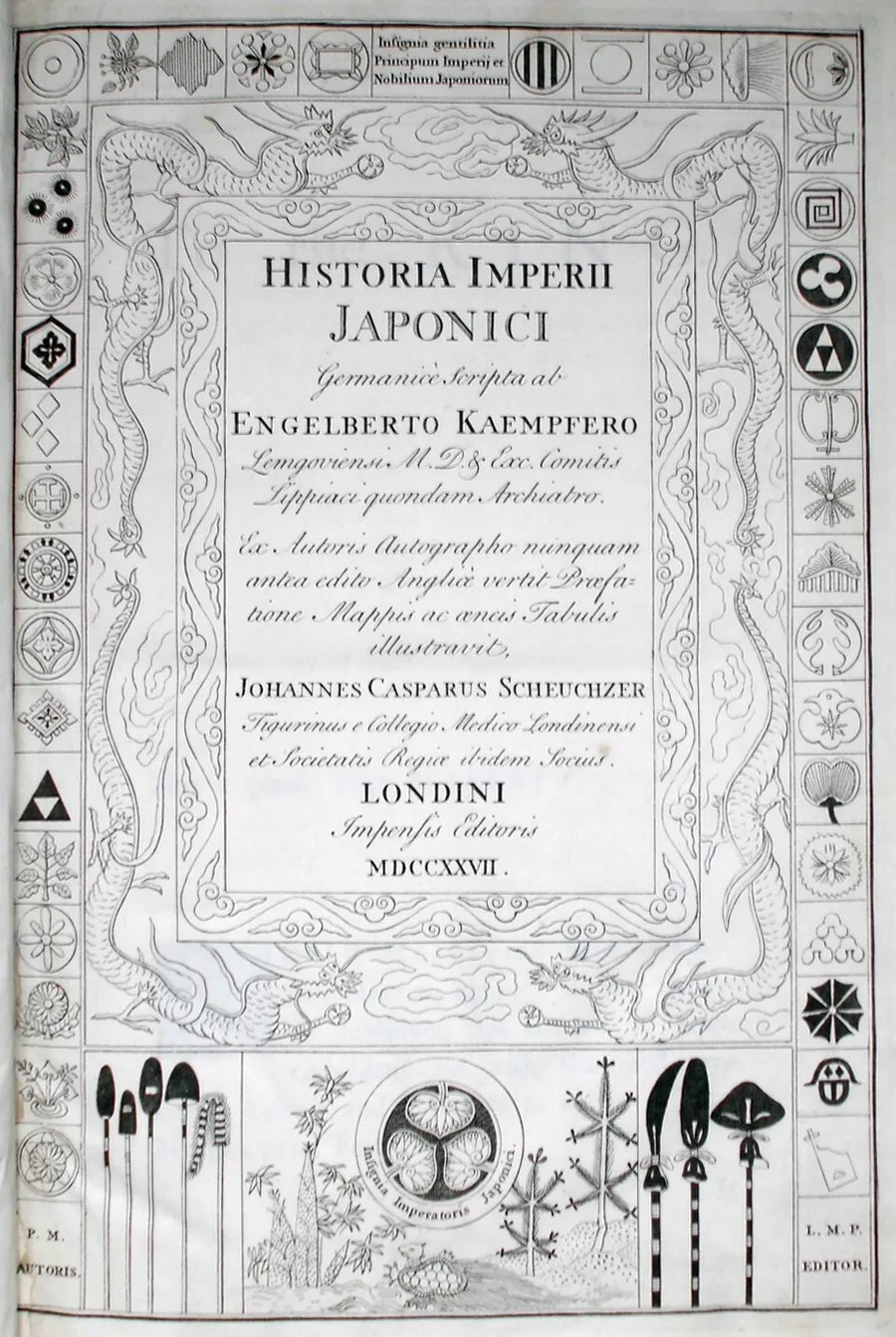
In the summer of 1690, Engelbert Kaempfer, a German physician, sailed up and down the Meinam river (today the Chao Phraya) in Siam. On the banks he saw trees where swarms of fireflies settled. This is what he wrote about them, in the English translation of 1727:
“a whole swarm of these Insects, having taken possession of one Tree, and spread themselves over its branches, sometimes hide their Light all at once, and a moment after make it appear again with the utmost regularity and exactness, as if they were in a perpetual Systole and Diastole.”
Engelbert Kaempfer, The History of Japan, 1727, translated by J. G. Scheuchzer
Similar reports followed from Siam, Burma and the Malay Peninsula, but they were treated with suspicion. In 1865, in the journal of the Entomological Society of London, an author named Bates suggested that the unison is an illusion. Craig (1916) and Ruckmick (1920) defended the idea on psychological grounds: the human mind would see rhythm in random flickers. Ruckmick showed people electric lamps flashing with no rhythm at all, and they grouped the lights into “rhythms” on their own, unprompted. He judged that witnesses were looking in a state close to romantic, and so were unreliable.
In 1938 the biologist John Buck collected 36 reports and argued that the illusion theory cannot explain all of them: it is statistically implausible that a whole swarm would flash together by accident, and Ruckmick’s lamps did not flash rhythmically, as fireflies do. Measurements with instruments followed in the 1960s: in 1966 and 1968, John and Elisabeth Buck studied in Thailand how the fireflies Pteroptyx malaccae flash and how they synchronise.
A 2010 experiment tested whether synchrony helps fireflies recognise one another. Female Photinus carolinus from the Great Smoky Mountains (USA) responded to LEDs imitating males more than 80 percent of the time when they flashed in unison, and 10 percent of the time or less when they were out of step (Moiseff and Copeland, 2010). The authors say the unison makes the species’ flash pattern easier to recognise.
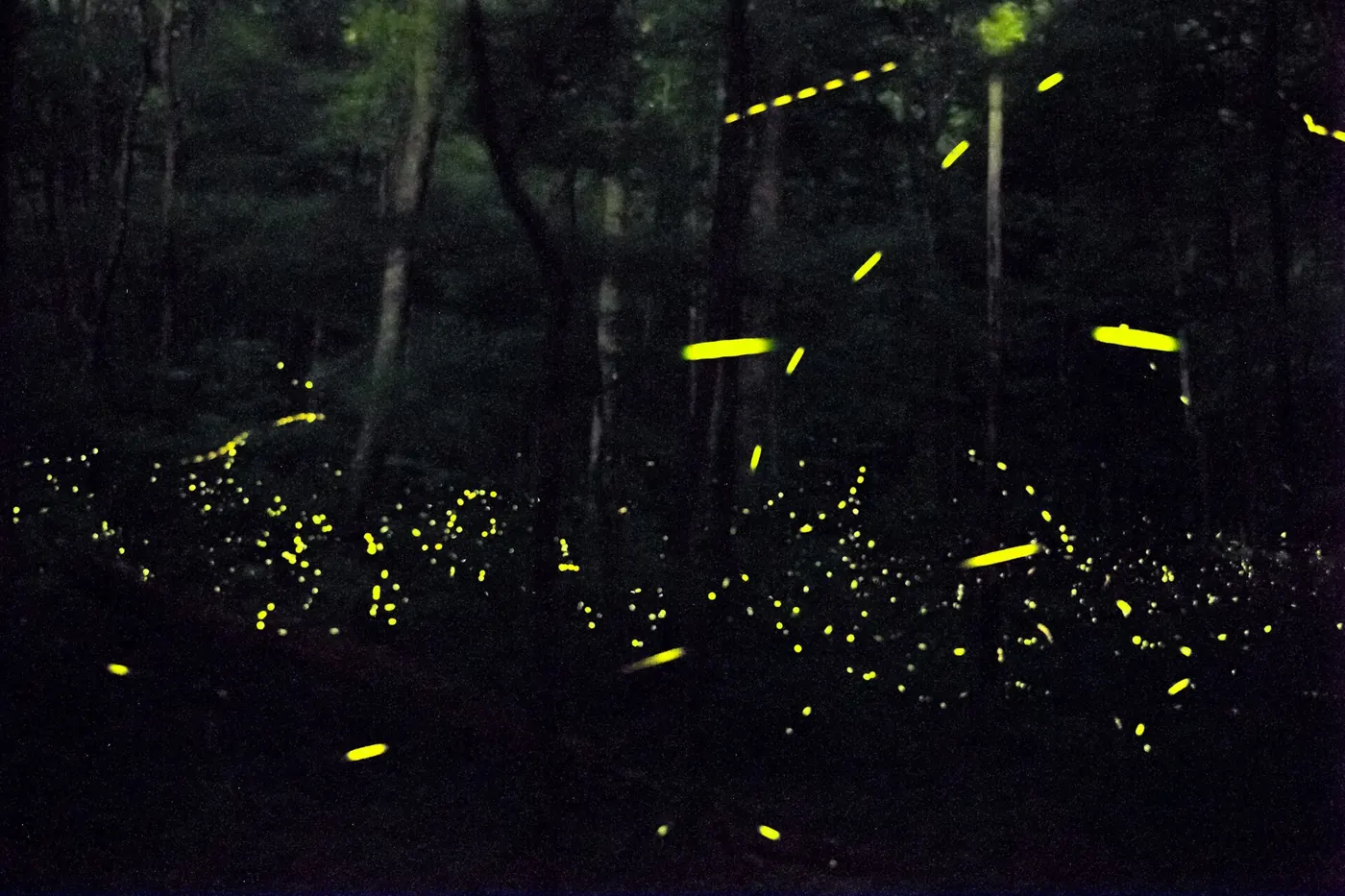
The physics differs from applause. The authors of the applause note write that period doubling is a route to synchronisation not yet observed in physical or biological systems. What they share: nobody leads, and the unison comes from each one adjusting to what it hears, or sees, of the others.
What is measured and what is imagined
| What you see or hear | Where it comes from |
|---|---|
| Applause that locks into a beat and falls apart; the period doubles in unison | Measured in theatres and opera houses in Romania and Hungary (Néda et al., 2000). The papers do not name the halls. |
| The 73 students and the student measured a hundred times | Measured in a room, not in a performance hall (Néda et al., 2000). |
| The 300 spectators and their clapping rules | A published model (Nikitin, Néda, Vicsek, 2001). The number of spectators, the time scales and the parameters are my choice. |
| How much noise the hall wants: high at the start, lower after tiring, then rising again; the “Louder!” button | High at the start and lower after tiring: the suggestion of the model’s authors (2001). Rising again: the explanation of the Nature authors. The exact rule that raises it, and the button, are mine and are not in a published paper. |
| Tempo: 2.8 claps per second in the fast mode and 1.7 in the slow one | Illustrative. Only the ratio of about two comes from measurements; in the simulation, because of the random wait, the slow period is 1.67 times the fast one. |
| The sound of the clapping and the acoustics of the hall | Synthetic: palms generated from filtered noise, and an artificial room. It is not a recording. |
| The silhouettes, the rows and your seat | Drawing. Your seat is one spectator out of 300. |
| Whether the model fits the real recordings | Not checked. The model’s authors say it reproduces what they observed; I did not fit it to the recordings. |
The applause recording on the authors’ page has no licence for redistribution, so it is not used here. You can listen to it in the archive copy of their page.
Sources
- Z. Néda, E. Ravasz, Y. Brechet, T. Vicsek, A.-L. Barabási, “The sound of many hands clapping”, Nature 403, 849–850 (24 February 2000). doi.org/10.1038/35002660
- Z. Néda, E. Ravasz, T. Vicsek, Y. Brechet, A.-L. Barabási, “Physics of the rhythmic applause”, Physical Review E 61, 6987–6992 (2000). doi.org/10.1103/PhysRevE.61.6987
- A. Nikitin, Z. Néda, T. Vicsek, “Collective dynamics of two-mode stochastic oscillators”, Physical Review Letters 87, 024101 (2001). doi.org/10.1103/PhysRevLett.87.024101
- M. Thomson, K. Murphy, R. Lukeman, “Groups clapping in unison undergo size-dependent error-induced frequency increase”, Scientific Reports 8, 808 (2018). doi.org/10.1038/s41598-017-18539-9
- E. Kaempfer, The History of Japan, together with a Description of the Kingdom of Siam, 1690–92, English translation by J. G. Scheuchzer (London, 1727); vol. I, pp. 78–79 of the 1906 Glasgow reprint (James MacLehose and Sons); the 1727 text read as well. archive.org/details/historyofjapanto01kaem
- J. B. Buck, “Synchronous rhythmic flashing of fireflies”, The Quarterly Review of Biology 13(3), 301–314 (1938). doi.org/10.1086/394562
- J. Buck, E. Buck, “Biology of synchronous flashing of fireflies”, Nature 211, 562–564 (6 August 1966). doi.org/10.1038/211562a0
- J. Buck, E. Buck, “Mechanism of rhythmic synchronous flashing of fireflies”, Science 159, 1319–1327 (1968). doi.org/10.1126/science.159.3821.1319
- A. Moiseff, J. Copeland, “Firefly synchrony: a behavioral strategy to minimize visual clutter”, Science 329, 181 (2010); response rates as reported in the press summary on ScienceDaily (8 July 2010). www.sciencedaily.com/releases/2010/07/100708141539.htm
- The authors’ own page for the Nature note, with a recording of rhythmic applause (Internet Archive copy, December 2001). web.archive.org/web/20011228130707/http://www.nd.edu/~networks/clap/