Around 1760, London played tunes on drinking glasses: each glass, tuned with a little water, sang when a wet finger went round its rim. The first Franklin saw and heard were those of Edward Delaval, a Fellow of the Royal Society, and he wanted all of them within one player’s reach.
He had bowls blown as near as possible to half a sphere, with a hole in the middle, and threaded them one inside another on a horizontal iron rod. The largest is 23 centimetres (nine inches) across, the smallest 7.6. There are 37 of them: three octaves, with all the semitones. The case is about 91 centimetres long. The rod is turned by the foot, like a spinning wheel, and a 46-centimetre mahogany wheel, with some 11 kilograms of lead hidden near its rim, keeps it turning evenly.
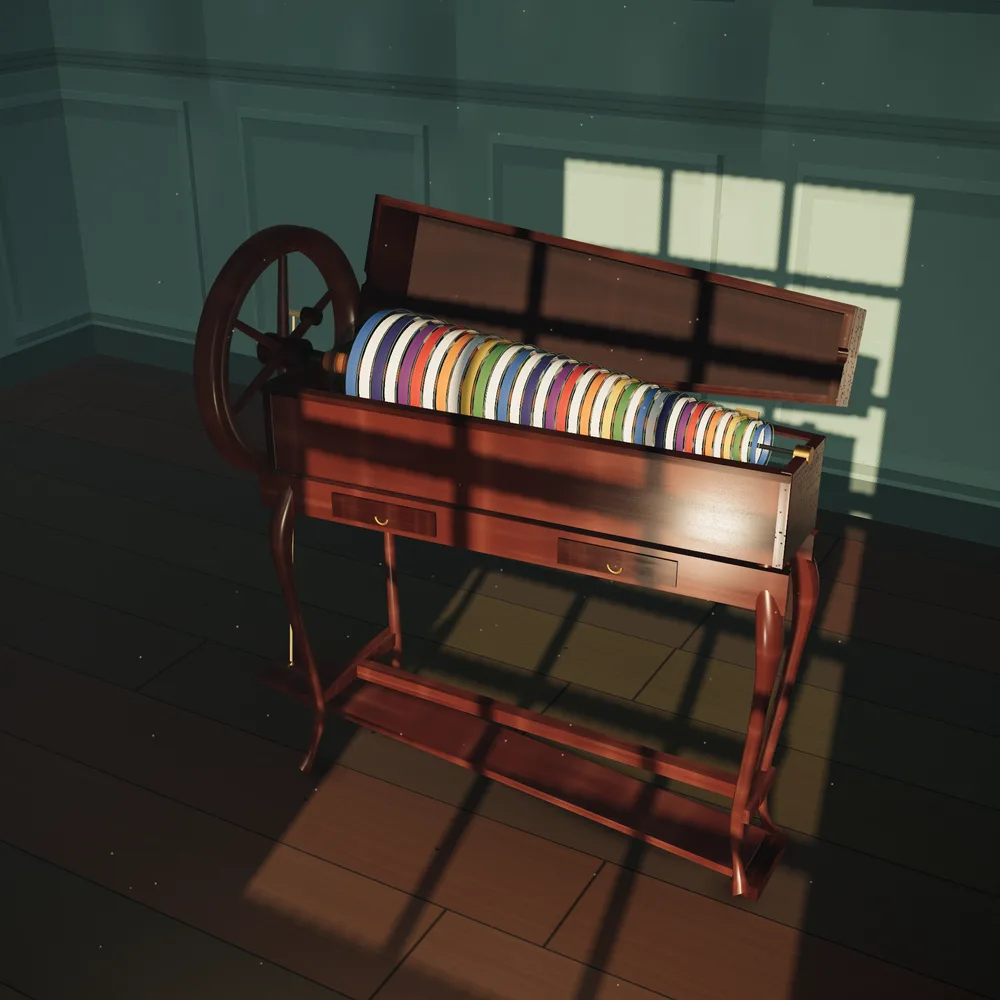
To find his notes quickly, Franklin painted the inside of the visible brim of each bowl in the seven colours of the rainbow: C red, D orange, E yellow, F green, G blue, A indigo, B purple. The semitones are white. Bowls of the same colour, the white ones apart, are always octaves of each other.
The largest bowl is a G “a little below the reach of a common voice”, and the smallest another G, three octaves higher.
CDEFGAB
Touch a rim and keep your finger on it; slide across several bowls. On a keyboard: the Z–/ and Q–] rows, with Shift an octave up.
A wet finger does not glide smoothly over glass: it grips and slips, hundreds of times a second. At each jerk the brim of the bowl squeezes into an oval and back, with four points that stay still. It is the same kind of vibration as a church bell’s, and the finger keeps it going the way a bow keeps a string going.
A larger bowl, or one with a thinner wall, sounds lower. Franklin tuned his bowls by grinding them thinner, trying each one beside a well-tuned harpsichord. He also noticed that wet glass sounds a little flatter than dry.
In 1791, in Vienna, Mozart heard Marianne Kirchgessner, a young blind woman who played the armonica. He wrote for her an Adagio for armonica alone, K.356, and an Adagio and Rondo for armonica, flute, oboe, viola and cello, K.617.
He had known the instrument for a long time. In 1773 his father wrote that Mesmer, the doctor of “animal magnetism”, played the armonica unusually well, and that Wolfgang too has played upon it.
Here the Adagio is played on this instrument, with both repeats. The notes are those of the Mozarteum Foundation’s digital edition in Salzburg; the page plays them itself; this is not a recording.
For a few decades the armonica was the fashion from London to Vienna. Then word went round that it did harm. People believed that the vibration of the glass passed through the fingers and damaged the player’s nerves, and that its too-melancholy sound laid its listeners low. A writer claimed in 1803 that not even the most robust man could listen to it for an hour without feeling unwell.
The editors of Franklin’s papers note that Marianne Davies, the first to play his armonica in public, was confined to her room, ill, for more than a year. Yet Franklin and Mesmer played it for years and, the same editors note, never had a nervous breakdown. Beyond the rumour, the instrument was expensive, hard to play well and fragile: a bowl could crack from its own vibration. After about 1825–1830 it was rarely heard in concerts.
The letter to the physicist Giambatista Beccaria, of 13 July 1762, gives almost everything needed to build the instrument: the shape, thickness and sizes of the bowls, how they fit into one another, the rod, the case, the wheel, the string, the colours. Everything that comes from it has polished wood and finished glass here.
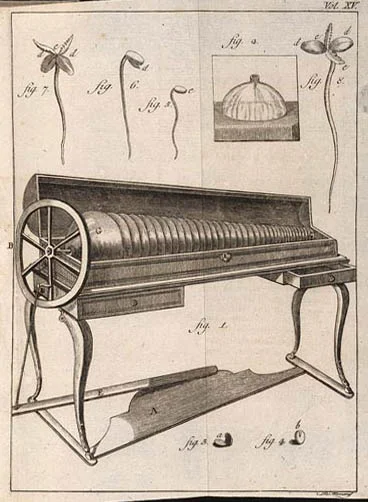
What it does not describe looks different. The letter mentions four legs, a movable step for the foot and hinges at the back, without giving their form; their form, like the drawers, follows the engraving printed with the letter and a replica of an instrument made by Charles James, who built Franklin’s armonicas. They show as raw timber with layout lines. The room, the candlestick and the chair are imagined: matt plaster.
From the letterpolished mahogany, glass, iron, brass
Inferredfrom the engraving and the James replica: raw timber with layout lines
Assumedthe room and everything in it: matt plaster
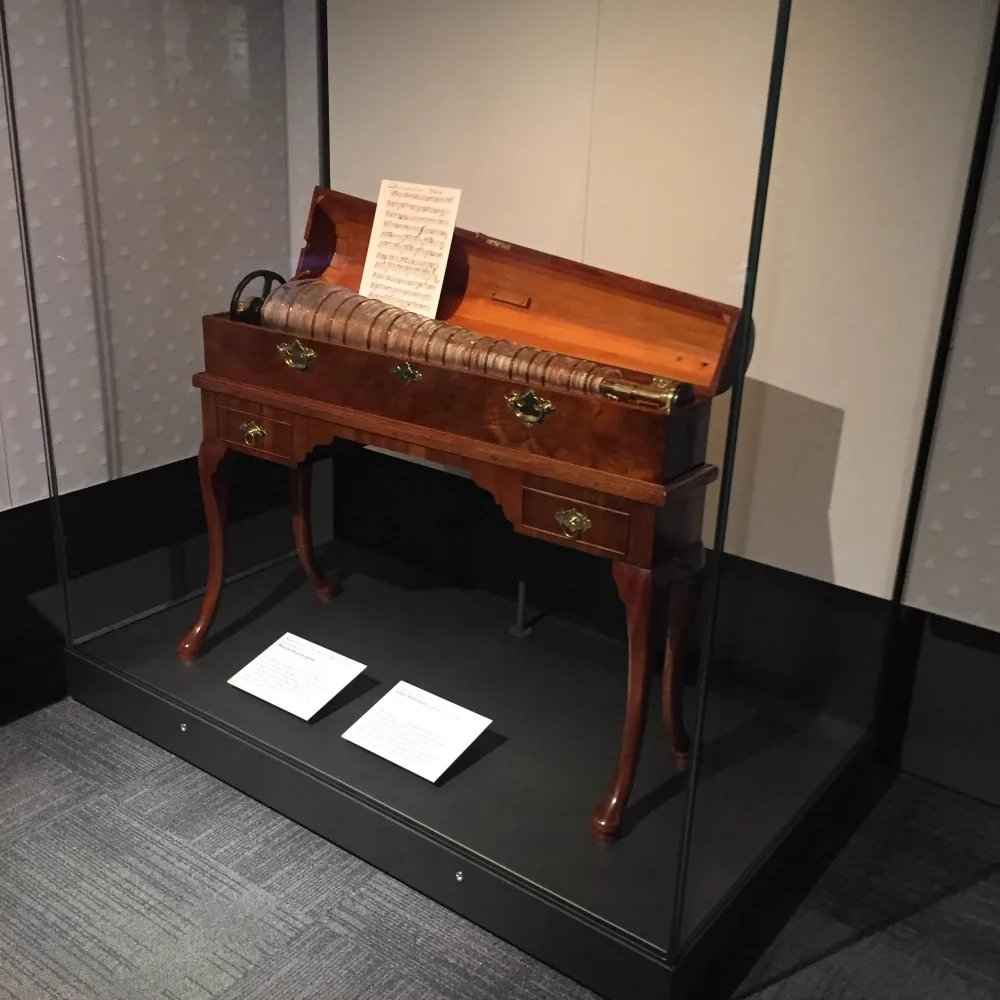
Replica of an instrument made by Charles James in 1761–1762, at the Benjamin Franklin Museum in Philadelphia. Photo: David Hilowitz, CC BY 2.0, Wikimedia Commons.The reconstruction, from a similar angle. The case here also tapers in height, as Franklin writes.
The engraving from an Italian printing of the letter. Library of Congress, public domain.
How exact the reconstruction is
The main measurements come from Franklin’s letter, converted from inches to centimetres; the thickness of the case walls and of the wheel is chosen here. The bowls step down from nine inches to three by quarters of an inch: 25 sizes for 37 bowls, so some sizes repeat, as Franklin says. Each bowl shows an inch beyond the one holding it in the bass and half an inch in the treble; the brim is a tenth of an inch thick.
Franklin does not say which octave the lowest G is in. The G of 196 hertz, below middle C, is taken here. Mozart’s Adagio, from the C of 262 hertz to the E of 1,319 hertz, fits on the instrument entirely.
The case tapers “every way”, from 11 inches to 5, and the rod lies exactly in the middle. The legs, drawers, treadle and hinges are not described; their form follows the Italian engraving and the Philadelphia replica.
The names of the colours are Franklin’s; the shades of paint are chosen here.
The sound is a model, not a recording. A wet finger mainly starts the bowl’s lowest vibration and its harmonics. In the model each bowl sounds on two very close frequencies, to give the slow waver of a rubbed glass. The attack is slow, and after the finger lifts the bowl rings on for a few seconds. The echo of the room is invented.
The score is the Mozarteum Foundation’s MEI edition (CC BY-NC-SA 4.0). The page plays both repeats, at a tempo chosen here (the crotchet at 66 a minute); the upper voice is a little louder than the accompaniment, and the last chord holds its fermata.
The morning light, the candles and the room are chosen for the picture.